AI Replacing Jobs: What You Need to Know Today
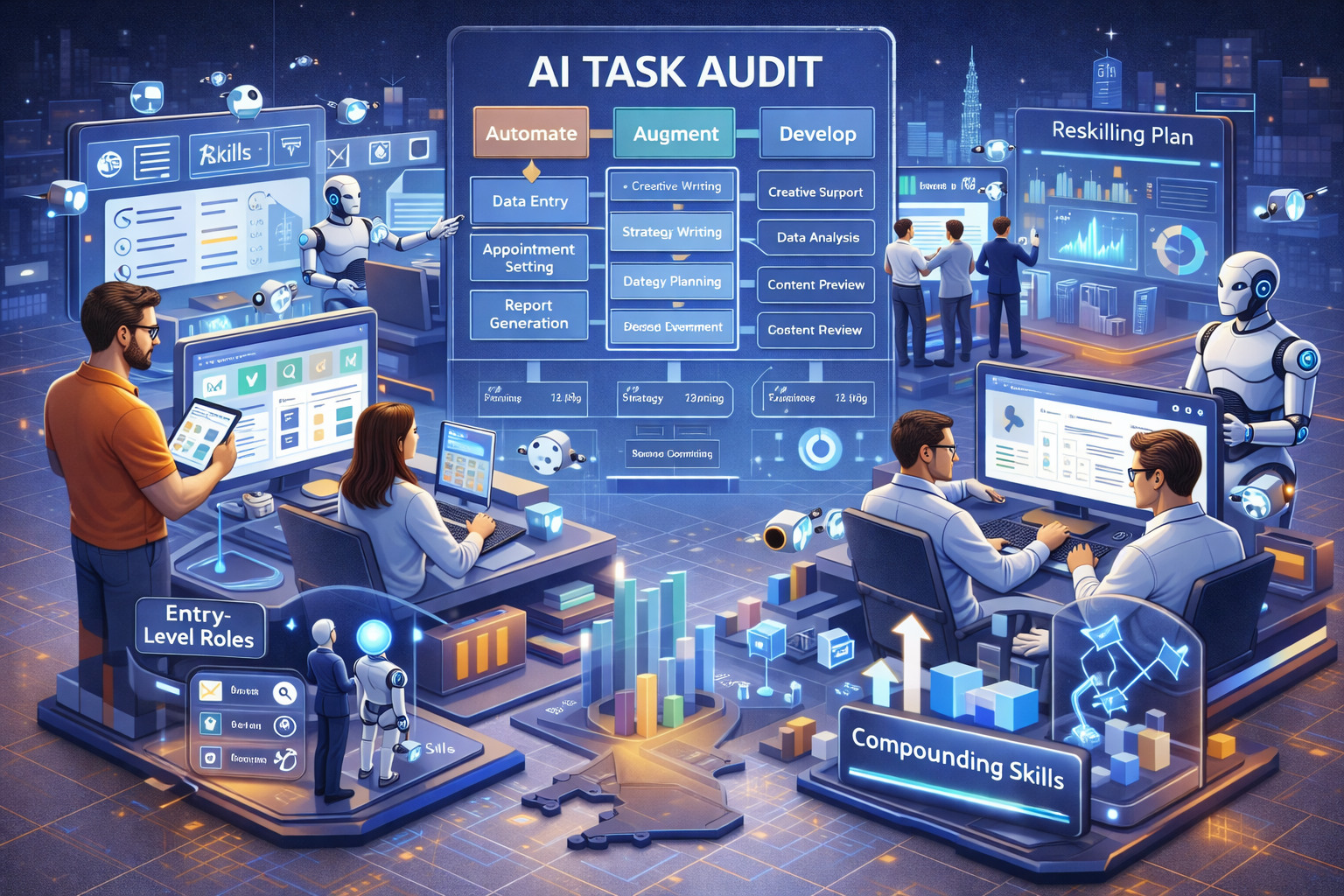
AI is replacing tasks, not whole professions, so entry-level roles are disrupted first because routine junior work is codifiable. UK signals show job posting growth in AI-exposed roles is 4x slower, and freelance writing/coding demand dropped 21% after ChatGPT launched. Long-term projections suggest churn: 92M jobs displaced vs 170M created by 2030.
Key Highlights
Artificial intelligence is not replacing entire jobs but automating specific task bundles within them.
The job market shows entry-level roles are disproportionately affected first by AI automation.
Evidence suggests employment declines are concentrated where AI substitutes tasks rather than augmenting human work.
The risk is a broken talent pipeline, as cutting junior roles for short-term savings harms long-term capability.
Strategic workforce planning must focus on task redesign and reskilling to adapt to technological change.
Skills in AI-assisted workflows, domain judgment, and quality assurance are becoming critical for new hires.
Introduction
People are talking more about artificial intelligence and what it means for the future of jobs. It looks like AI will not take away whole jobs all at once. Instead, it is breaking down and taking over certain parts of jobs that are already there. You can see this happening most in the entry-level job market. This lets us know bigger changes could be on the way. The best thing to do now is not to stop hiring people. Instead, companies should look at all the work and think about what to automate and what to make better for people.
AI is replacing tasks, not whole professions, so entry-level roles are disrupted first because routine junior work is codifiable. UK signals show job posting growth in AI-exposed roles is 4x slower, and freelance writing/coding demand dropped 21% after ChatGPT launched. Long-term projections suggest churn: 92M jobs displaced vs 170M created by 2030.
The Changing Landscape of Work: From Job Titles to Task Bundles
To see how AI really affects us, we need to look past job titles. The main thing is the groups of tasks that make up a role. These bundles of tasks are where the big changes from automation tools are taking place. A person might keep the same job title, but what they do day to day will change.
For example, someone with the title "Junior Analyst" has a mix of tasks. These include research, reporting, and data collection. AI often takes over the easiest and most organized tasks first, like when it makes summaries of data. This can really change what the job looks like. So, to see the true effect of AI on different job roles, people should focus less on the title and more on mapping what tasks can change quickly. That way, you understand the real impact from technology and from automation tools.
What Does “AI Replacing Human Jobs” Really Mean in 2026?
People used to talk about if artificial intelligence would take away jobs. Now it's clear that it is already happening. By 2026, the question is not if there will be job losses, but how the future of jobs will change in the global workforce. The World Economic Forum says that even though millions of jobs could go away, new jobs will also show up. There will be a net increase because more jobs will come out of these changes.
But this change is not easy for everyone. The split of work between people and machines will look much different. Many jobs that have a lot of typing, data entry, or even software development work are now being done by generative AI. You can see this in the number of people in the online gig economy and the news about company layoffs.
All of this shows that “job replacement” is not the full story. Some things people used to do are no longer needed, but there is more need for new skills. There is now a bigger need for skills in big data and knowledge about artificial intelligence. So, the world of work is changing fast and asking people to learn new things and get ready for new jobs.
Task Bundles Explained: Why Entry-Level Roles Are Vulnerable
Entry-level jobs act like an early warning for the job market. They often have tasks that are clear and follow a set process, which makes them easy for AI to take over. These junior jobs depend on written steps and simple rules. AI is very good at this kind of work. That puts these jobs at the most risk of AI replacing them.
People in starter jobs usually do work that repeats over and over. These tasks help people learn and get ready for harder work later. AI job loss happens mostly here because machines can do these jobs fast and well. For example:
Drafting reports from templates Summarizing research documents Performing templated data analysis Since AI can take over these basic tasks, entry-level jobs are the first to go and lose the most. This shows that the way we find new talent and train workers will have to change a lot in the coming years. Importantly, this issue is not limited to the tech sector—industries such as finance, healthcare, marketing, and even education also rely on similar task bundles for entry-level roles, making them vulnerable to AI-driven changes in the coming years.
Summarizing research documents
Performing templated data analysis
Since AI can take over these basic tasks, entry-level jobs are the first to go and lose the most. This shows that the way we find new talent and train workers will have to change a lot in the coming years.
job market, coming years, risk of ai, ai job loss
Recent Trends: How AI Is Shaping Entry-Level Employment in the UK
Recent trends show the future of AI is already changing entry-level jobs in the UK job market. There have not been any sharp, widespread job losses so far. But job postings for roles most at risk from AI are growing four times slower than the roles that are not at risk. This shows that there is a big shift happening quietly in who gets hired.
Big companies are putting a lot of money into the future of AI. They say economy problems are the reason for job cuts, but the truth is that technological advancements are at the heart of it. Because of this, it is now tough for freelancers and people starting out in different industries. They often feel the first hit when there is less need for their work.
Early Evidence: Sectors and Roles Seeing the Biggest Shifts
Early signs make it clear that some areas are seeing jobs get replaced faster because of the use of AI. This is hitting hardest in jobs where the work is the same each day and focused on data. Machine learning can now do many tasks that people used to do. Because of this, there are big changes in jobs.
The main areas seeing fast change are customer service, content creation, and administrative support. For example, buy-now-pay-later firm Klarna said its chatbot is now doing the work of 700 staff. The largest job changes are showing up in roles like:
Content writing and translation
Customer service assistance
Coding and software development
The need for freelance jobs in writing and coding went down by 21% just a few months after ChatGPT came out. This points to how generative ai is quickly changing these kinds of jobs. These job losses are not just ideas for the future. They are real and now.
Key 2025–2026 Statistics on AI Replacing Human Jobs
The latest AI job statistics paint a complex picture of disruption and opportunity. According to the World Economic Forum's Future of Jobs Report, the labor market is undergoing a massive transformation driven by technology. While job losses are a real concern, the creation of new roles is also a significant part of the story.
Data from 2025-2026 shows that AI is a factor in a growing number of layoffs, particularly in the tech sector. Simultaneously, wage growth is three times higher in industries more exposed to AI, rewarding employees who possess the requisite skills. This highlights the dual nature of AI's impact on employment.
Here are some key projections from the World Economic Forum and other sources :
| Statistic Description | Projected Figure | Timeframe |
|---|---|---|
| Potential Jobs Displaced by AI | 92 million | By 2030 |
| Potential New Jobs Created by AI | 170 million | By 2030 |
| Employers Expecting to Reduce Headcount due to AI | 17% | In 2026 |
| Workers Who May Need to Change Careers due to AI | 14% | By 2030 |
Industries Most and Least Affected by AI Task Automation
The risk of automation is not the same in every industry. The sectors that use a lot of data work, information review, and routine talks have the highest adoption rates of AI. Because of this, there will be big changes in AI jobs in these places. On the other hand, work that needs physical effort, or where people often talk and make tricky choices, is still less touched by automation.
It is important for people and businesses to know about this difference for workforce planning. The tech and finance areas move fast to add automation. But fields like construction and personal care hold out better. This split will shape jobs for many years.
Industries With Fastest AI Adoption and Job Replacement Rates
Yes, in some industries, people are using automation tools much faster, so jobs are being replaced sooner. The tech sector is leading this change. Big companies like Microsoft and Amazon use AI to do more work, which means they are letting some workers go. The finance industry, including Wall Street, is also moving quickly. Banks think they will switch many jobs to AI in the next few years.
The big reason for this is that AI can do jobs that are important in these fields. This includes coding, looking at data, and making financial models. Because of this, the global workforce is changing as more companies put money into AI. Here are some industries where the use of AI is growing the most:
Information Technology and Digital Services
Financial Services and Banking (FinTech)
Media and Entertainment
Some jobs, like data specialists and fintech engineers, are on the rise. But overall, the number of workers doing old jobs is going down as automation tools take over. This shows the future of work in these industries is happening right now.
Sectors Where Entry-Level Jobs Are Still in Demand
Even though there is more automation now, a lot of sectors still need people for entry-level jobs. Jobs that use unique human skills are not going away soon. The jobs that are most safe from AI are jobs where you need to use your hands well, show creative thinking, or have strong emotional intelligence. Machines are not able to do these things like people can.
Many administrative roles are at risk because of new technology. Still, the job market is creating new roles where you need both technical knowledge and to work well with people. The jobs that are growing need you to build relationships, plan things in a smart way, and do work that needs you to be hands-on. There are some areas that are still hiring for entry-level jobs, like:
Healthcare and personal care (for example, nursing assistants)
Skilled trades (for example, painters and roofers)
Education and training
These fields are safer because they need people to use human skills like deep understanding, caring, and being present. AI is not able to show these traits yet, so these jobs are still in demand for human workers.
Entry-Level Roles: Why They’re Hit First by AI Disruption
Entry-level jobs are often the first to feel the risk of AI because these roles have tasks that are simple, with steps that do not change much. These tasks are easy for machines to do. This brings a high risk of AI taking over, so job losses happen mostly with people who are just starting out in the job market. It is a big challenge for all new people trying to get their first job.
Because of this, companies now need to look at what skills matter in these roles. Routine work is now done by automation, so workers must have new skills, such as good critical thinking and the ability to adapt. This changes what the first day in a new job looks like, and how people enter many types of jobs.
Typical Task Bundles AI Can Automate in Junior Jobs
The jobs most at risk in the next ten years are the ones that have sets of tasks AI can do faster and with more accuracy. In junior roles, there are a lot of duties that focus on administration and data. These types of tasks used to be the main work for people at the start of their careers. Now, AI is really good at taking care of simple data collection and basic data processing.
Job categories like data entry clerks and customer service are good examples. Much of the work in these jobs is about clear rules and steps, so it is easy to hand that over to automation. For example, AI can respond to the first set of questions from customers or check the quality of data sets.
Some jobs that AI often does instead of junior workers include:
Data entry and taking care of information
Setting up meetings and keeping calendars updated
Answering common questions in customer service
These are the core jobs that are important in many kinds of work, but now more of them are being given to AI systems.
How Automated Tasks Change Skill Requirements for New Hires
As AI takes over many simple tasks in low-skilled jobs, the job market is now looking for people with new skills. Employers want entry-level workers to do more than just follow steps. They look for people who can work with AI, review what it does, and use it in smart ways. This means new workers need to have more creative thinking and good digital skills.
Because of this, there is now a bigger need for people who never stop learning and can quickly adapt. In higher-level jobs, AI helps people get more done. But in lower-level jobs, AI changes what workers must bring to the table. Entry-level workers are now expected to have a new set of skills, including:
Proficiency with AI tools and platforms
Strong problem-solving and analytical skills
The ability to provide human oversight and use good judgment
People who show these digital skills, especially in SEO and AI Search, have a better chance of doing well in work today. Those who cannot keep up with these changes may find it harder to get hired. The job market is truly different now, so learning new skills and always improving is what helps people get ahead.
Automation vs. Augmentation: Two Ways AI Changes Jobs
AI's effect on jobs can be seen in two ways: automation and augmentation. When there is ai automation, machines do work instead of people. This means you do not need as many workers. In augmentation, AI helps out with the job. This can make someone’s work better and often faster.
It is important to know the difference between these two. Most job cuts happen in places that use a lot of ai automation. But with augmentation, roles often go up as people work with new tools. Many times, it also opens new doors. This kind of technological innovation does not just replace workers. It can help upgrade their work, too.
Which Entry-Level Tasks Are Being Fully Automated?
The first jobs to go will be the ones where people do the same thing again and again. These are jobs that the computer can do without help from people. AI is getting really good at doing this kind of simple, step-by-step work. These tasks make up a lot of entry-level jobs, so the risk of AI is real here and we can see it happening now.
AI job statistics show that jobs like data processing, easy office work, and basic customer service are highest on the list to go. When businesses use computers for these areas, they get large efficiency gains. This means that most companies will switch soon. Roles like data entry clerks, bank tellers, and postal clerks will probably become less common because AI does their work faster and better.
In the end, any task that has clear steps and does not need special judgment can be done by a computer. This is why these jobs go away first.
How AI-Assisted Workflows Are Elevating Junior Job Functions
Yes, AI is now being used to help people at their jobs. It does not take away junior roles but makes them better. When AI takes care of simple things, entry-level workers are free to work on good and important projects. For example, ai chatbots can take care of first questions from customers. This lets a junior support worker look at tougher cases that need people to use their empathy and skills in solving problems.
With this kind of new tech, a junior job looks different now. Employees no longer have to do all the boring, repeat tasks. They now can help with bigger ideas. This is helping with job growth, especially for big data jobs. There, big data specialists use AI to check lots of data but still have to make the final call.
So, junior workers get more involved and learn to do more. They use AI to get better at what they do. This new way of working lets them grow and learn big skills sooner in their career. Overall, it makes a strong place for new talent.
The “AI Agent Skills” Revolution: What Entry-Level Workers Need
The future of jobs for entry-level workers will depend on learning “AI agent skills.” This means more than just knowing how to use AI tools. You need to know how to set up tasks for AI, check the AI’s work, and use it with other steps to get good results. These new skills are a big sign in the job market now.
Having these digital skills is important if you want to show your value. They help link human work and what machines can do best. This lets new employees use AI as a helpful tool instead of losing their jobs to it.
Essential Skills That AI Can't Easily Replace
If you want to have your place in the future of jobs, you need to grow the human skills that are hard for AI to copy. AI is good at using data and following steps, but it still cannot really get emotion, the bigger picture, or come up with new thoughts like people do. These human skills are now even more important.
Skills such as emotional intelligence, complex problem-solving, and real creative thinking help people stand out in a world where much gets automated. Being able to work well in a team, talk things out with others, and lead with understanding come from true human strengths.
To stay needed in the future, work on these skills:
Emotional Intelligence: Know your own feelings and the feelings of people around you. Learn to manage them well.
Creative and Strategic Thinking: Think of new ideas and make smart, long-term plans.
Complex Problem-Solving: Handle tough situations when there is no clear answer.
These human skills will help you work with AI rather than try to be better than it.
Proving “Human Value” in an AI-Dominated Job Market
In the 2026 job market, a regular resume will not be enough. If you want to work in AI jobs, you need to show real proof of what you can do. The best way to do this is by building a portfolio. This means you must show work that AI cannot copy. Show projects where your choices, ideas, and results matter most. You need to prove you can do human work that adds value.
Your portfolio should do more than just list skills. It should tell the story of how you solve problems. Some people now say that AI-created writing feels "hollow" and "soulless." Because of this, clients go back to people for better results. Your portfolio should show that you are someone who brings that human touch. For example, being good at AI Marketing and AEO (Answer Engine Optimization) with smart GEO-targeting are skills that need your mind, not just a machine.
The best portfolio proof in 2026 includes:
Case studies that show how you made smart choices and solved problems.
Projects that need you to use deep domain judgment and handle client relationships well.
Samples of your work that prove you have people skills like persuasion and teamwork.
Impacts Beyond Hiring: Risks to the Future Workforce Pipeline
The way new technology changes things goes beyond just hiring freezes or cutting jobs. The biggest risk for the group is that there will slowly be fewer new people ready to join in the future. Companies cut costs by letting machines do simple work and having fewer new workers. But, this means there may not be enough new leaders and people who are experts later on.
This focus on saving money now leads to a problem with what the team can do later. When there are not many beginners learning from others, special knowledge is lost. The group loses some of its skills to grow and come up with new ideas. Over time, this makes it hard to keep up with others in the job market because there are fewer trained people in the company.
The Organizational Consequences of Reducing Junior Roles
The biggest risk of AI adoption in companies is not people losing jobs. It is what some call "organizational amnesia." When companies cut junior roles to save money, they block the main way knowledge is shared in the company. Chief executives and global employers that do this set themselves up to face a lack of future leaders.
Without entry-level jobs, young staff do not have enough chances to learn from older or more skilled workers. This breaks the way people pick up the know-how that cannot be written down in a guide or passed to a machine. Over the years, the company starts to lose its memory and cannot deal with small or tricky problems well.
This kind of change brings a weak and top-heavy team. Companies, in the future of work, may have senior people but no one to take their place when they go. The quick win in saving money comes at the cost of long-term strength and weakens their spot in the worldwide job market.
Why Strategic Workforce Planning Matters Now More Than Ever
To keep the junior pipeline strong while you use AI, companies need to start with better workforce planning. Instead of just cutting jobs, the goal is now to change the roles. You do this by first looking at all the tasks closely. Then, you decide what to give to automation, what to use with help from AI, and what should stay as high-value human work.
This way looks at bringing in AI like it is a change program. There are clear marks to know if it is working. Even while the adoption rates of automation get higher in the global workforce, the human work stays out in front for company growth. The aim is not only to cut costs but to help people build new skills.
To keep the pipeline for junior workers going, a company should:
Redesign entry-level jobs so they are more about watching over AI and making good calls.
Put money into programs to teach new hires how to use AI tools.
Check if AI works well by looking at things like results, better quality, and less risk—not just cutting staff numbers.
Conclusion
To sum up, the way we work is changing because of AI. This is especially true for entry-level job roles. It helps if companies look at what people do on the job instead of just their job titles. This makes it easier to see which tasks AI might take over, and plan for what comes next. We are not just talking about automation. The real change is in how AI works with people. AI might take some tasks, but it also lets people in junior roles do more and use their skills in new ways.
For companies to find and keep good people, they need to plan ahead. It's important to help workers build the kind of skills that AI can't copy. If you want advice on how to handle these shifts, talk to our experts today.
Frequently Asked Questions
Is AI Actually Eliminating Entry-Level Roles, or Mostly Changing Them?
AI is mostly changing how people work in entry-level jobs. It does this by using machines to do certain tasks instead of people. Because of this, there might be some AI job loss. At the same time, companies need to think again about what these jobs look like. This can make job growth possible in areas where people are needed and for work that asks for new skills.
How Can Companies Balance AI Adoption With Building Junior Talent?
Companies can find a good balance between ai automation and growing their team. This happens through careful planning for workers. They can change junior roles so people spend more time on human work. This human work could be tasks like checking the quality of things and helping with ideas. It would be good to spend more on training so employees get new skills for the future.
What Should Students and Early-Career Professionals Focus On to Stay Relevant?
To keep up in the future of jobs, it is important for students and people starting their careers to work on new skills that AI cannot do. This means learning creative thinking, emotional intelligence, and handling tough problems. You need to always keep learning and get good at digital skills.
Is AI replacing jobs right now?
Yes, mainly by automating routine tasks inside roles, with measurable hiring slowdowns in AI-exposed roles. Right now AI is predominantly replacing routine tasks within roles, not wholesale job categories. That shift already shows up in measurable hiring slowdowns and changing role definitions for occupations that are highly exposed to automation.
Key points
Task-level automation, not mass replacement: AI is automating repetitive, predictable tasks — data entry, first-draft writing, simple analysis, routine customer queries, basic image editing. That reduces the time people spend on low-value work and changes the day-to-day responsibilities of many roles.
Hiring slowdowns in AI-exposed roles: Companies are pausing or slowing hiring for roles where a significant portion of tasks can be automated with current AI tools. Recruitment data and employer surveys indicate fewer openings and smaller headcount plans in those areas, especially for entry-level and junior positions.
Role transformation and upskilling: Where tasks are automated, remaining work emphasises judgement, creativity, relationship-building and systems thinking. Employers increasingly demand skills in AI tooling, prompt engineering, oversight, and domain expertise. Many roles evolve rather than vanish.
Productivity and redeployment: Some organisations use AI to boost productivity and redeploy staff into higher-impact work. In the best cases this raises output and creates new roles in supervision, model management, data governance, and productised AI services.
Sector variation: Exposure is uneven. High-exposure sectors include copy-heavy marketing, certain types of legal work, basic accounting and bookkeeping, routine customer support, and some data-heavy analyst tasks. Low-exposure roles remain those requiring complex manual skills, deep human judgement, empathy, or unpredictable physical interaction.
Short-term labour market effects: Expect more competition for higher-skilled roles, fewer entry-level openings in automated areas, wage pressure on routine-task jobs, and new demand for AI-related skills. These effects can show up quickly as firms adopt off-the-shelf AI tools.
What leaders should do
Audit tasks, not job titles: Map which tasks are automatable and which require uniquely human skills.
Reskill and redeploy: Invest in training for tool use, model oversight, problem framing and domain expertise.
Redesign roles: Shift performance metrics to outcomes and impact, not output volume of routine work.
Manage transition: Offer clear career pathways for impacted employees and phased AI adoption to avoid abrupt displacement.
Focus on ethical deployment: Ensure fairness, transparency and accountability in AI decisions that affect hiring and work allocation.
Bottom line: AI is already replacing parts of jobs and reshaping hiring patterns, especially for routine-task-heavy roles. The bigger story is transformation — the net effect on employment will depend on how organisations deploy AI, invest in people, and create new work that leverages human strengths alongside automation.
Why are entry-level roles hit first?
Because junior work often follows repeatable steps (admin, data handling, first-line support), which AI systems can automate reliably.
Entry-level roles are typically structured around predictable, rule-based tasks that scale horizontally. Employers hire juniors to execute high-volume, standardised processes: data entry, simple content moderation, first-line customer support, basic reporting, and routine admin. Those tasks map cleanly to current AI capabilities for three reasons:
Predictability and repeatability: AI excels where inputs, workflows and expected outputs are consistent. Templates, checklists and scripted interactions are easy to encode and automate.
Low requirement for deep domain judgement: Tasks that need pattern recognition, matching or retrieval – not nuanced professional judgement – are straightforward for models or RPA (robotic process automation) combined with LLMs.
Clear success metrics: Time saved, errors reduced and throughput increased are measurable, making automation an attractive, low-risk investment for management.
Cost-efficiency: Replacing many low-paid, high-volume tasks with software reduces variable labour costs and scales marginally at low incremental cost.
Data-centric work is exploitable: Much junior work involves cleaning, normalising and tagging data – exactly the kind of input modern AI pipelines are trained to handle and improve with human-in-the-loop feedback.
First line of contact is scriptable: Support agents following decision trees and canned responses can be partly or wholly replaced by chatbots and voice assistants that handle common queries and escalate only complex cases.
This pattern doesn’t mean junior roles will disappear overnight. Instead, expect three likely outcomes:
Displacement of purely transactional tasks. Roles focused exclusively on repeatable processes will decline as companies automate routine work to gain efficiency.
Job reshaping and upskilling. Many entry-level positions will evolve to emphasise tasks that require human skills AI struggles with: complex problem-solving, empathy, critical thinking, creative judgement, and cross-functional collaboration. Employers will value candidates who combine domain basics with digital literacy, prompt engineering, and data-handling oversight.
New junior opportunities. Automation creates demand for different entry-level functions: AI supervision, data annotation with quality control, prompt tuning, model monitoring, workflow orchestration and customer experience design. These are still accessible to newcomers but require new training.
For employers and early-career professionals the practical implications are clear:
Hire and train for adaptability. Prioritise learning agility and foundational digital skills over narrow task mastery.
Redesign junior roles to include oversight and exception management. Use AI to handle routine throughput while humans focus on edge cases and continuous improvement.
Invest in reskilling pathways. Offer structured programmes to transition impacted staff into augmented roles that pair human strengths with AI tools.
Measure value differently. Track metrics that capture quality, escalation rates, customer satisfaction and speed-to-resolution — not just headcount or task throughput.
In short, entry-level roles are hit first because they’re the low-hanging fruit for automation: predictable, scalable and measurable work that AI can perform reliably. The constructive response is not to accept inevitable job loss, but to redesign how organisations recruit, train and deploy early-career talent so humans and AI create more valuable, resilient teams.
What’s the outlook to 2030?
The shift is structural: large displacement alongside large creation, plus meaningful career-switching pressure.
Outlook summary
Structural transformation: By 2030 the labour market will be reshaped by automation, generative AI and platform-driven workflows. This isn’t a short-term cycle but a durable change in how work is organised and valued.
Dual effects: Expect significant displacement in routine, repeatable tasks across white‑ and blue‑collar roles, and simultaneous creation of new roles, industries and value chains — many centred on AI, data, human‑machine teaming, and digitally enabled services.
Career switching pressure: Workers face sustained pressure to reskill or pivot. The pace of required skill change accelerates; mid‑career transitions and portfolio careers become more common.
Key dynamics to watch
Task-level substitution and augmentation
High-risk: routine cognitive and manual tasks (data entry, basic coding, routine legal/research drafting, repetitive manufacturing steps).
Augmentation winners: roles combining domain expertise with creativity, judgement, interpersonal skills, and the ability to orchestrate AI (prompt engineering, model oversight, strategy).
Result: job counts may decline in some functions while productivity per worker rises; companies will reallocate human effort to higher‑value activities.
New job creation and scaling of adjacent industries
Emerging roles: AI system designers, safety and compliance specialists, data curators, human-AI interaction designers, AI-enabled service operators, and creative technologists.
Growth in ecosystems: cloud infrastructure, AI auditing, content verification, specialised marketplaces and localised AI solutions (GEO/AEO opportunities).
Net effect: gross job creation may offset some displacement but will demand different skills and geographic distribution.
Skills and learning economy
Continuous reskilling: microcredentials, modular upskilling and employer-led retraining become standard. Lifelong learning marketplaces expand.
Credentialing shifts: competency-based validation, project portfolios and performance metrics supplant time-based credentials.
Inequality risk: access to training, digital infrastructure and networks will determine who benefits; policy and corporate programs will matter.
Labour market structure and mobility
Increased mobility: more frequent career switches, gig and hybrid employment models, and cross-sector movement.
Wage polarization within occupations: higher pay for AI-fluent roles; downward pressure on commoditised tasks.
Geographic effects: remote work and AI tooling decentralise some work, but core hubs for AI talent and infrastructure will persist.
Business and market implications
Productivity & margins: firms that embed AI effectively will see disproportionate gains in efficiency and margins.
Customer experience: AI-driven personalization and answer-engine optimisation (AEO/GEO) change discovery funnels — brands must optimise for AI answers and marketplaces, not just search.
Competitive dynamics: incumbent advantage for firms with data, distribution and capital; niche players can scale quickly through platform and API ecosystems.
Risks and challenges
Transition lag: mismatch between displaced workers and new job requirements can produce structural unemployment pockets without active policy and corporate intervention.
Regulatory and ethical constraints: safety, privacy and labour protections will shape adoption speed and job design.
Concentration and power: winner-take-most dynamics risk market concentration and reduced bargaining power for workers.
Misinformation and trust: reliance on AI answers increases the need for verification, provenance and brand credibility.
Practical actions for organisations (to 2030)
Workforce strategy: map roles by task-level automation risk, invest in reskilling for augmenting skills, and redesign jobs around human-AI collaboration.
Talent architecture: adopt competency-based hiring, recognise transferable skills, and build internal mobility pathways to ease career switching.
Product & marketing: optimise for AI-first discovery — answer-engine optimisation (AEO), geographic intent (GEO), marketplace positioning and performance creative.
Data & safety: invest in clean data pipelines, explainability and compliance to sustain trust and operational continuity.
Partnerships: collaborate with training providers, local governments and platforms to scale reskilling and capture new talent pools.
Practical actions for workers (to 2030)
Prioritise AI-fluent literacies: learn to prompt, evaluate and steer AI outputs; understand data ethics and domain‑specific AI applications.
Build complementary skills: strategic thinking, complex communication, empathy, cross-disciplinary problem solving and project delivery.
Embrace modular learning: short courses, portfolio projects and microcredentials that demonstrate capability quickly.
Network and mobility: cultivate cross-sector contacts and a demonstrable track record of outcomes, not just credentials.
Bottom line Through 2030 the labour market will not simply shrink or grow — it will reconfigure. Organisations and workers who treat AI as a capability to be integrated, who invest
Work with Modi Elnadi
Modi is the founder of Integrated.Social, a London-based AI Search and performance marketing consultancy. He helps B2B and ecommerce teams scale pipeline by blending AI-driven performance marketing (predictive lead scoring, intent-led personalisation, conversational qualification, and automation) with AEO/GEO/LLMO; so brands earn visibility inside AI answers while still converting those visits into measurable revenue.
Modi’s work focuses on making AI growth operational and provable: improving data readiness and structured content, building always-on experimentation across SEO and paid media, and tightening measurement from MQL volume to SQL quality, using multi-touch attribution and revenue forecasting. He has led growth programmes across the UK, EMEA, and global teams; turning fast-moving AI platform shifts into practical playbooks, governance, and repeatable outcomes.
Get a Free AI Growth Audit: https://integrated.social/free-ai-growth-audit
AI SEO + AEO + GEO (AI Answers visibility): https://integrated.social/ai-seo-aeo-geo-aio-agency-london
PPC + Performance Max strategy and execution with AI models: https://integrated.social/ppc-performance-max-agency-london
AI Marketing Strategy + GenAI Content Ops: https://integrated.social/ai-marketing-strategy-genai-content-ops-london
UK AI Marketing Playbook 2026: cluster around “AI funding UK”, “enterprise GenAI”, “AI-native video”, “agentic automation”.