ChatGPT AI Ads Are Coming
What OpenAI’s “AI Ad Principles” Mean for Marketers in 2026
Quick Summary
OpenAI says ads are not live yet, but it will test ads in the U.S. “in the coming weeks” for logged-in adults on ChatGPT Free and ChatGPT Go. The first formats are planned at the bottom of answers, clearly labelled, and separated from the organic response. If you're looking for more information about the policies for ads in ChatGPT, you can visit the official OpenAI website or check the ChatGPT Help Center, where details and policy updates are regularly published.
The first formats are planned at the bottom of answers, clearly labelled, and separated from the organic response.
OpenAI's framework centres on five principles: mission alignment, answer independence, conversation privacy, choice/control, and long-term value.
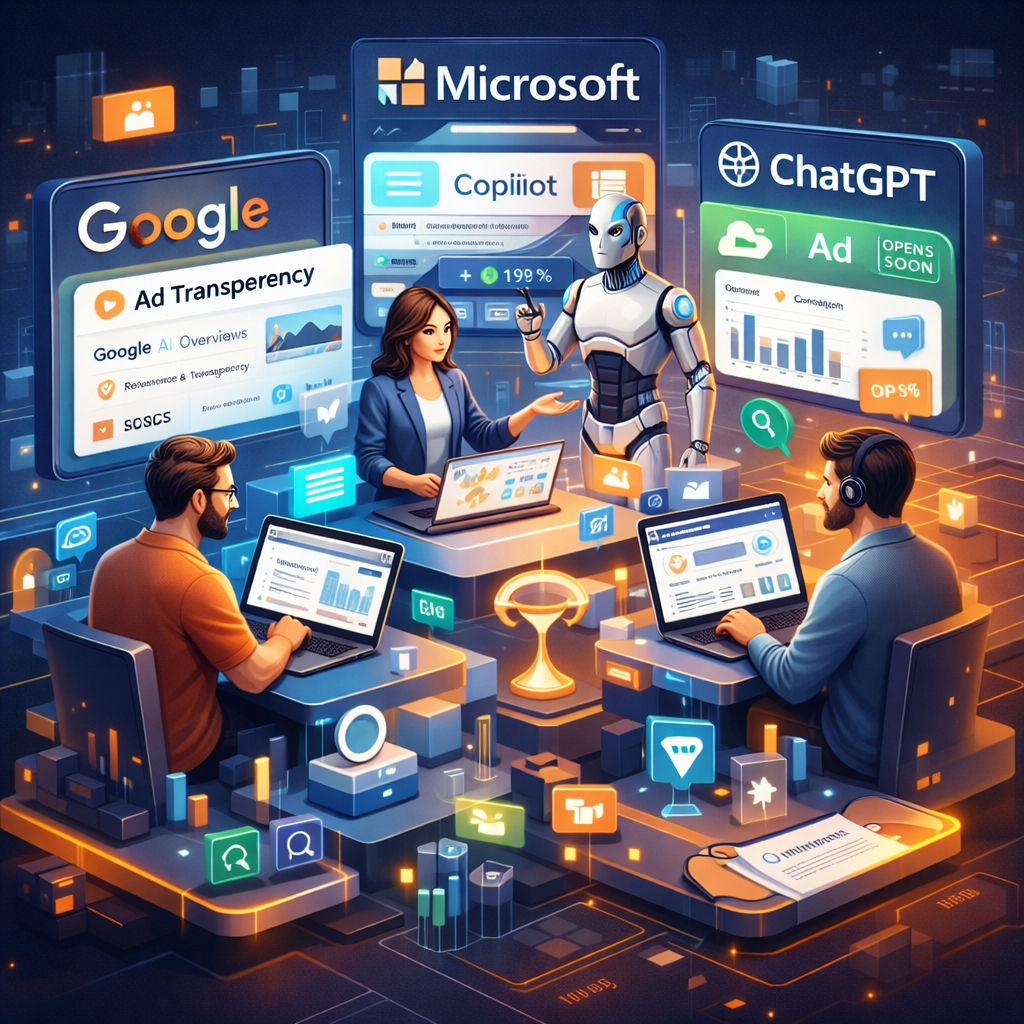
For agencies, the early advantage is not “secret media buying”, it is AEO/GEO-ready content + offer governance + incrementality measurement + social media posts across AI surfaces (ChatGPT, Google AI Overviews, Microsoft Copilot).
ChatGPT scale is material: OpenAI has stated ChatGPT serves 800M+ users weekly, and Altman has also cited 800M weekly active users.
TL;DR
ChatGPT ads are not live externally today, per OpenAI's Help Centre.
Testing is planned in the coming weeks in the U.S., for Free + Go, for logged-in adults only.
Ads are planned to appear at the bottom of answers, labelled, separate, dismissible, with “why am I seeing this” transparency.
Under-18 accounts (declared or predicted) are excluded, and ads will not appear near health, mental health, politics.
The opportunity is real, but the moat will be trust-safe creative, structured answer-first content, and measurement discipline, not hype.
Quick Answer
OpenAI plans to test ads in ChatGPT in the U.S. for Free and ChatGPT Go users “in the coming weeks”, with ads clearly labelled, separated from answers, and placed at the bottom of responses in the context of digital marketing when a relevant sponsored product or service matches the conversation. Ads are not live externally yet, and Plus/Pro/Business/Enterprise/Edu remain ad-free.
OpenAI has confirmed it will begin testing impression-based ads within ChatGPT in early 2026 as it looks to diversify its revenue beyond subscriptions. This initial pilot involves a select group of dozens of brands, with participating advertisers reportedly committing under $1 million each for the trial.
The key features and principles of ChatGPT AI advertising model include:
Placement and Design: Ads will appear at the bottom of a conversation, clearly separated and labeled as "sponsored" to maintain answer independence.
Impression-Based Pricing: Unlike traditional pay-per-click models, OpenAI is charging based on a cost-per-thousand-impressions (CPM) model, with asking prices reportedly reaching $60 CPMs.
Target Audience: The test is limited to logged-in adult users in the U.S. who are on the Free tier or the newly introduced ChatGPT Go plan ($8/month).
Exclusions: Ads will not be shown to users under 18, and they will be restricted from appearing alongside sensitive topics such as health, mental health, or politics.
Ad-Free Tiers: Premium tiers including Plus, Pro, Business, and Enterprise will remain entirely ad-free.
What are ChatGPT ads?
ChatGPT ads, as OpenAI describes them, are sponsored placements that will be tested at the bottom of answers, shown only when there is a relevant sponsored product or service based on the current conversation. Unlike traditional ads, OpenAI states ads will be clearly labelled and separated from organic answers, and that ads do not influence responses.
OpenAI has also clarified the current state plainly: “There are currently no ads in ChatGPT.”
Who will see ads, and where?
OpenAI plans to test ads for logged-in adult users in the U.S. on Free and Go tiers, while Plus, Pro, Business, Enterprise, and Edu remain ad-free. OpenAI also states it will not show ads to users who declare, or are predicted to be, under 18, but will provide insights into ad performance metrics.
Why this matters right now
This matters now because OpenAI is attempting to add advertising without breaking trust, and because the AI answer layer is becoming a mainstream distribution channel, not a novelty interface. With ChatGPT at 800M+ weekly users, even a cautious ad test changes the competitive landscape for discovery, brand building, performance marketing, and understanding future trends.
There is also a “platform timing” factor: Google and Microsoft already monetise generative experiences, and they are publishing advertiser guidance and performance narratives for ad creatives. That means the playbooks will be written quickly, and late entrants will be forced into higher prices and lower attention.
OpenAI’s Ad Principles: the framework marketers must design around
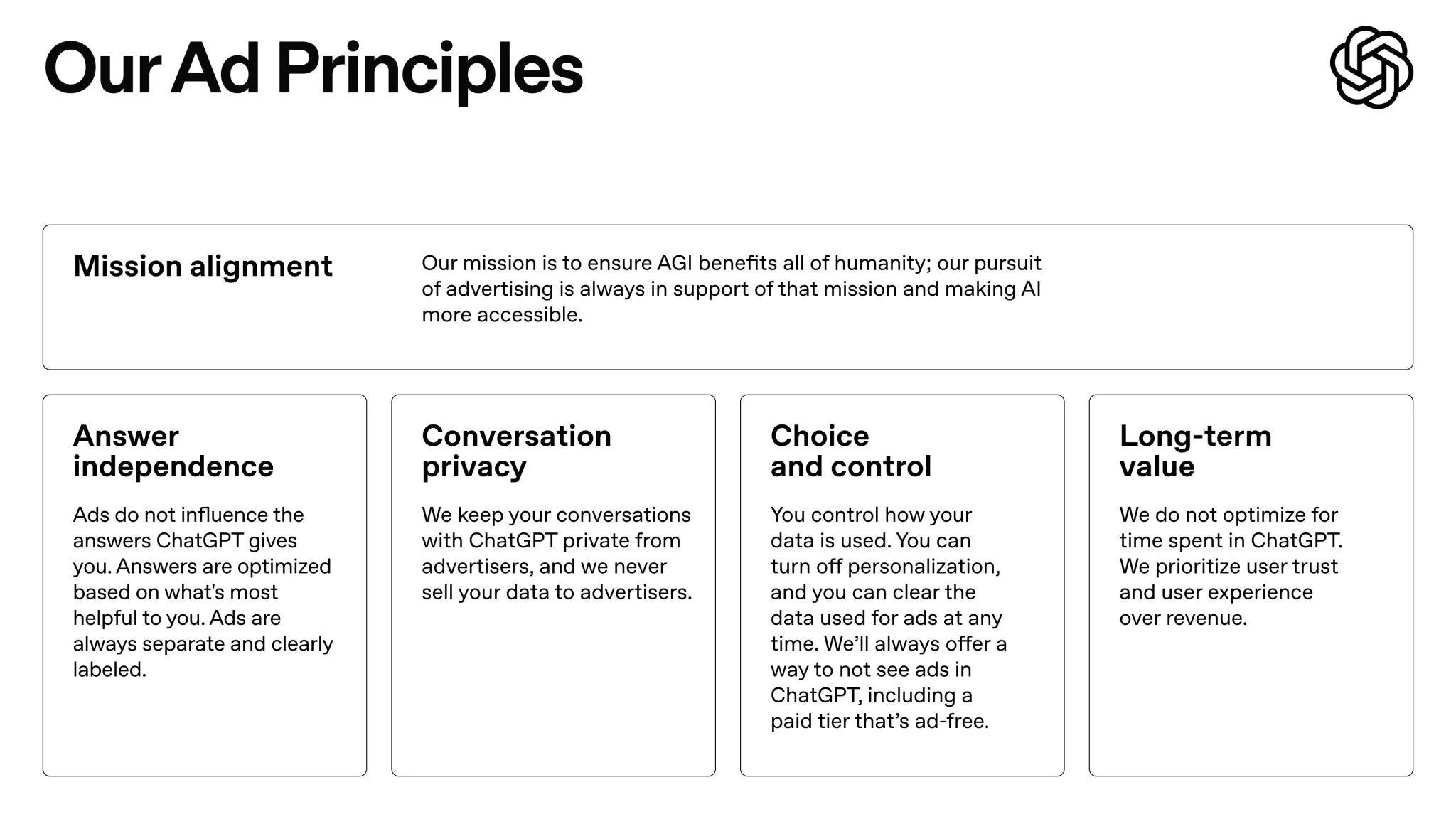
OpenAI's advertising framework is built around five principles: mission alignment, answer independence, conversation privacy, choice and control, ad creation, and long-term value. In practice, these principles imply ad experiences that behave more like a “useful next step” than a persuasion-first banner, with explicit controls and separation from the answer content.
Below is what each principle means for campaign design.
Mission alignment
Mission alignment means OpenAI positions ads as a way to expand access to ChatGPT by supporting the free and low-cost tiers, rather than optimizing for ad revenue alone. For marketers, that increases the probability of stricter ad load limits, higher relevance standards, and product experiences that prioritize useful machine learning insights and trust signals over aggressive monetization.
If OpenAI treats ads as an “access subsidy”, then the winning ads will look like helpful recommendations, not interruption marketing.
Answer independence
Answer independence means OpenAI commits that ads do not influence ChatGPT's answers, and that ads remain separate and clearly labelled. For advertisers, this removes the fantasy of “pay to change the model's answer” and shifts the battleground to: (1) being genuinely relevant to the conversation, (2) incorporating data analytics to have strong trust and conversion assets after the click.
Answer independence: The organic answer is optimised for helpfulness, and the sponsored placement is a separate unit, labelled as an ad.
Conversation privacy
Conversation privacy means OpenAI says it keeps conversations private from advertisers and does not sell user data to advertisers. If a user chooses to message an advertiser via an ad at the right time, the advertiser only sees what the user sends directly. This implies a lower-data, higher-context ad system, where contextual relevance and creative quality matter more than behavioural profiling.
Choice and control
Choice and control means users can turn off personalisation and clear data used for ads, and OpenAI states it will always offer a way to not see ads (including a paid, ad-free tier). For marketers, expect higher opt-out rates than classic social platforms, and plan for performance that depends more on intent, context, and effective data analysis than on long-lived user profiles.
Long-term value
Long-term value means OpenAI explicitly says it does not optimise for real time spent in ChatGPT and prioritises user trust and user experience over revenue. This matters because it signals OpenAI may resist dark patterns (endless scroll equivalents, excessive frequency), and it raises the bar for ad quality and usefulness in the conversational flow.
How ChatGPT ads likely work in practice
OpenAI says initial tests will show ads at the bottom of answers when there is a relevant sponsored product or service based on the current conversation, with labelling, separation, and feedback controls (“why am I seeing this”, dismiss, tell us why). This indicates a contextual matching system that uses the current conversational state as a primary signal for AI advertising, not simply a keyword.
It also indicates early formats will be closer to “sponsored recommendations” than display creative units, at least at launch, to achieve broad reach among audiences.
How a first-gen ChatGPT ad impression likely happens
User asks a question with commercial adjacency (explicit or implied).
ChatGPT produces an organic answer (optimized for helpfulness) aimed at a wide audience.
If an eligible sponsored product/service matches the conversation, an ad appears below the answer.
User can learn why they saw it, dismiss it, or provide feedback.
The bigger picture: AI answers are already an ad channel (Google + Microsoft)
AI-surface advertising is not starting from zero, Google and Microsoft already run ads inside generative AI search experiences with published guidance and performance claims. The strategic implication is that “ChatGPT ads” should be treated as part of a broader AI answer monetisation layer, not as a one-off new platform.
Google AI Overviews ads
Google documents that ads can trigger on a subset of queries where AI Overviews show, when conditions are met (commercial intent, quality/relevance), and that ads must be relevant to the AI Overview's content. Google also states existing Search, Shopping, and Performance Max ad campaigns can be automatically eligible if they win the auction and match both query and overview context.
Microsoft Copilot ads
Microsoft Advertising has publicly claimed that, compared to traditional search, Copilot users show 73% higher CTR and 16% stronger conversion rates, while market trends indicate that customer journeys are 33% shorter (based on Microsoft's own reporting). Treat these numbers as directional, but they signal why advertisers and agencies are shifting attention to conversational surfaces.
Comparing Traditional Advertising and AI-Powered Ad Approaches
When evaluating traditional advertising and AI-powered ad approaches, the key differences lie in their methodologies and effectiveness. Traditional marketing primarily relies on broad messaging across established channels, such as television, radio, and print media. This method often lacks the precision needed to target specific audiences, which can dilute its overall impact. In contrast, AI-powered advertising utilizes advanced algorithms and data analytics along with machine learning to create highly personalized and relevant ad experiences. This technology enables marketers to analyze consumer behavior in real-time, allowing for adaptive strategies that resonate better with users.
Moreover, traditional advertising can be resource-intensive, requiring significant time and budget investments for production and placement. AI-powered approaches, however, streamline these processes by automating tasks such as audience segmentation and ad optimization, utilizing advanced ai tools. This results in lower costs and improved ROI, as AI systems continuously refine their targeting based on performance data. Ultimately, while traditional advertising remains valuable for brand awareness, AI-powered advertising offers a more efficient and effective solution for engaging today's digital consumers.
Key differences between traditional and AI ads
| Aspect | Traditional Advertising | AI-Powered Advertising |
|---|---|---|
| Targeting | Broad demographic targeting | Precision targeting based on user behaviour by analysing vast amounts of data |
| Cost | High upfront costs for production | Lower costs with potential for higher ROI |
| Scalability | Limited scalability; resource-intensive | Easily scalable with data-driven insights |
| Efficiency | Time-consuming processes | Automated tasks for faster execution |
| Measurement | Difficult to track ROI | Real-time performance tracking and analysis |
Traditional advertising often relies on methods such as TV commercials and print ads, which may not effectively reach niche audiences. In contrast, AI-driven ads leverage real-time data to optimize campaigns continuously, leading to better results in campaign management. Advertisers can test multiple variations of their ads and adjust strategies quickly, ensuring that their messaging remains relevant to consumer interests. This adaptability is crucial in today's fast-paced digital landscape, where consumer preferences can shift rapidly. As a result, businesses that embrace AI-powered advertising can achieve more significant outcomes and maximize their marketing budgets efficiently.
Step-by-step: how to prepare for ChatGPT ads
To prepare for ChatGPT ads and write effective ad copy, prioritise three assets: (1) AEO/GEO-ready content that makes you “citable” in answers, (2) offer governance so paid placements do not destroy margin, and (3) incrementality measurement so you can prove lift rather than pay for what you would have earned organically. This approach aligns with OpenAI's trust-first ad principles and the mechanics of conversational intent.
Step 1: Build “answer-first” content modules for the top 10 buying questions
Answer-first modules are short, structured pages that directly answer one question with definitions, comparison tables, constraints, and a single next step, highlighting key differences. This matters because conversational ad systems reward relevance and usefulness, and because Google explicitly notes AI features still follow SEO fundamentals, including indexing eligibility and structured content quality.
Minimum checklist:
A one-paragraph direct answer
A comparison table
“Who this is for” and “when it's not a fit”
Proof (case study, reviews, certifications)
Clear CTA
Step 2: Make your offers “conversation-native”
Conversation-native offers reduce cognitive load: transparent pricing, clear constraints, and easy next steps. In conversational interfaces, users are already in a decision flow, so the best offer feels like the logical continuation of the answer for specific audiences. OpenAI's stated intent is “useful” ads, and early formats are sponsored recommendations at the bottom of answers.
Offer patterns that typically work:
“Compare 3 options” consult (short form)
A diagnostic (audit, assessment)
A risk-reversal (trial, guarantee, pilot)
Step 3: Design for trust and disclosure, not persuasion hacks
Trust-first design means your ad-to-landing experience must be consistent, transparent, and non-manipulative. OpenAI explicitly foregrounds user trust, performance data, ad labelling, privacy, and user control, so anything that looks like dark-pattern performance marketing is structurally mismatched to the platform's direction.
Practical executions:
Plain-language claims
Clear “why this is relevant” alignment
Fast proof near the top (logos, stats, citations)
Step 4: Measure incrementality from day one
Incrementality matters because conversational journeys may shorten (Microsoft claims 33% fewer steps), and because AI answers can pre-sell users before any click. If you measure only last-click, you will overpay and misattribute. Start with geo holdouts, time-sliced holdouts, and a strict marketing strategy with UTM governance.
If you cannot prove lift, you do not have an AI ads strategy, you have a spend strategy.
Step 5: Build two case studies before competition arrives
Case studies are the real moat in a new channel: they define your pricing power, your playbook, and your credibility. With OpenAI still in test mode and no long public history of “ChatGPT print ad experts”, the first credible cases with clean measurement will set the narrative.
Common mistakes and how to avoid them
The common failure mode in AI-surface advertising is assuming this is just “Google Ads with a new placement”. In reality, conversation context, trust expectations, and attribution patterns shift. Traditional methods of advertising, as outlined by OpenAI's own principles, make clear that user trust and transparency are non-negotiable, so aggressive tactics that might work elsewhere can backfire fast.
Mistakes to avoid:
Treating it as keyword-only: conversational intent is multi-turn.
Over-claiming: unsupported claims will be punished by users and platforms.
No opt-out resilience: assume personalisation opt-outs are meaningful and should be aware of customer data protection.
No sensitive-topic awareness: OpenAI excludes health, mental health, politics adjacency.
Measuring only last-click: you will misread performance in AI journeys.
Tools and options: where to run “AI answer ads” in 2026
AI answer ads can be tested today via Google and Microsoft surfaces, while OpenAI's ChatGPT ads are planned for a near-term test in the U.S. for Free and Go users. The practical strategy is to build one operating system across surfaces: conversational intent mapping, answer-first content, trust-safe creative, and incrementality measurement to achieve the best results.
| Option | Best for | Pros | Cons | Watch-outs |
|---|---|---|---|---|
| Google AI Overviews ads (Google Help) | Mass reach, high-intent discovery | Uses existing Search/Shopping/PMax eligibility, documented mechanics | Harder attribution, variable triggering | Ensure product data and landing pages match the AI Overview context |
| Microsoft Copilot ads (about.ads.microsoft.com) | Early conversational search advantage | Microsoft reports higher CTR and conversion rates | Microsoft ecosystem constraints vs Google | Validate performance yourself, don’t rely only on vendor benchmarks |
| ChatGPT ads (OpenAI test) (OpenAI) | New conversational placement with massive user base | Trust-first framework, clear placement logic (bottom of answers) | Not live externally yet, limited geography and tiers | Build trust-safe creatives, prepare for strict exclusions and user controls |
| Emerging GenAI ad networks | Experimental testing | Potential early CPM/attention | Inventory quality uncertainty | Brand safety, disclosure UX, and fraud controls are non-negotiable |
Use cases: who wins with ChatGPT ads first
ChatGPT ads will likely reward brands with clear product-market fit, high trust signals, and strong “decision support” content. The reason is simple: OpenAI is positioning ads as useful, clearly labelled recommendations in the flow of a conversation, not as invasive persuasion units, and it is starting with limited formats at the bottom of answers, tapping into the potential of digital advertising.
High-probability early winners:
B2B SaaS with clear “compare and choose” journeys (security, analytics, productivity) and effective social media ads
High-consideration ecommerce with strong product data, reviews, and clear differentiators, utilizing targeted social media ads
Local services where “next step” is booking, quote, or eligibility check supported by social media ads
Education and upskilling offers that match learning-oriented conversations
The role of machine learning and automation in optimizing AI ad campaigns
Utilizing machine learning significantly enhances the efficiency of AI ad campaigns through artificial intelligence. By analyzing vast amounts of customer data, predictive analytics informs advertisers about optimal ad placements and targeting strategies. Automation streamlines campaign management, reducing manual tasks while ensuring that ads are delivered to the right people at the right time. This synergy between advanced algorithms and real-time data analysis fosters higher engagement and conversion rates, ultimately driving better ROI for marketing strategies. Embracing these technologies positions brands for success in an evolving digital landscape.
Key Takeaways
OpenAI says ads are not live externally yet, testing is planned “in the coming weeks” in the U.S., with predictive analytics involved in optimizing their performance.
Ads will be bottom-of-answer, labelled, separate, and dismissible.
OpenAI's framework forces a trust-first playbook: privacy, control, and answer independence.
Treat “ChatGPT ads” as part of the broader AI answer monetisation layer (Google + Microsoft are already active).
The defensible moat is AEO/GEO readiness + offer governance + incrementality measurement.
Build case studies early, but avoid hype and unsupported stats.
Expect rapid competition once self-serve and broader rollout arrives.
FAQs (AI Answers-ready)
Are ads live in ChatGPT right now?
OpenAI's Help Centre states: “There are currently no ads in ChatGPT.” OpenAI has announced plans to begin testing ads for marketing campaigns targeting Free and Go users in the U.S., but they are not live externally yet.
Who will see ChatGPT ads first?
OpenAI plans to begin testing with logged-in adult users in the U.S. on Free and ChatGPT Go tiers.
Will Plus, Pro, Business, Enterprise, or Edu users see ads?
No. OpenAI states Plus, Pro, Business, Enterprise, and Edu accounts will not have ads.
Where will the first ChatGPT ads appear?
OpenAI plans to test ads at the bottom of answers when there is a relevant sponsored product or service based on the current conversation, delivering the right message to the right audience with clear labeling and separation from the organic response.
Do ads influence ChatGPT’s answers?
OpenAI says no: ads do not influence answers, and responses are optimised based on what is most helpful. Ads remain separate and clearly labelled.
Will OpenAI share my ChatGPT conversations with advertisers?
OpenAI states it does not share your conversations with advertisers. If you choose to message an advertiser through an ad, the advertiser only sees what you send directly.
Can users opt out of personalised ads in ChatGPT?
OpenAI says users can control their ads experience, including turning off personalisation and clearing data used for ads.
Will ads appear near sensitive topics like health or politics?
OpenAI says ads are not eligible to appear near sensitive or regulated topics like health, mental health, or politics, and it will not show ads where the user is under 18 (declared or predicted), ensuring more precise targeting in advertising campaigns.
Is there a self-serve ChatGPT ads platform yet?
OpenAI has not announced a self-serve platform in its official materials. The Help Centre says it is focused on early testing and will share more as it learns from usage, feedback, and social media activity.
How should advertisers prepare before ChatGPT ads roll out?
Prepare by building answer-first content and trust-safe landing pages, and set up incrementality measurement. This aligns with OpenAI's principles and with how conversational journeys may shorten in AI surfaces.
How are Google AI Overviews ads different from ChatGPT ads?
Google states ads can show when AI Overviews appear if commercial intent and relevance conditions are met, and that existing Search/Shopping/PMax campaigns can be eligible for various ad placements. OpenAI describes bottom-of-answer sponsored placements tied to the current conversation and governed by its ad principles.
Are Copilot ads actually performing better?
Microsoft reports higher engagement, including 73% higher CTR and 16% stronger conversion rates vs traditional search (per Microsoft's own reporting). Use this as a hypothesis, validate with your own tests.
How big is ChatGPT’s user base right now?
OpenAI has stated ChatGPT serves more than 800 million users every week, and reporting has quoted Altman citing 800M weekly active users.
Conclusion: the real land grab is trust, not inventory
OpenAI is signalling that it wants advertising to fund access without degrading the product. That changes what “good” looks like: relevance, transparency, and usefulness win. The agencies that will dominate this cycle are those that can operationalise AEO/GEO content systems and incrementality measurement, then translate that into repeatable results across Google AI Overviews, Microsoft Copilot, and (when it opens) ChatGPT, thus enhancing brand loyalty through effective advertising strategies.
About the author: Modi Elnadi
Modi Elnadi is the founder of Integrated.Social, a London-based AI Search, AEO (Answer Engine Optimisation), GEO (Generative Engine Optimisation), and performance marketing consultancy. He helps B2B and ecommerce teams win visibility inside AI answers (Google AI Overviews, AI Mode, Copilot-style search, and ChatGPT-style summaries) by improving entity clarity, product data readiness, and conversion-focused content and effective advertising strategies in paid media execution.
Free AI Growth Audit: https://integrated.social/free-ai-growth-audit
AI SEO + AEO + GEO services: https://integrated.social/ai-seo-aeo-geo-aio-agency-london
PPC + Performance Max strategy and execution: https://integrated.social/ppc-performance-max-agency-london