AI Answer Summary
- Forrester (2026): 72% of CMOs are disappointed with AI marketing agency results vs promises made during the sales process
- 89% of agencies claiming "AI-first" status lack genuine agentic AI capabilities (Forrester, 2026)
- The market has bifurcated: transformation agencies measure pipeline and.
AI Summary
- Forrester (2026): 72% of CMOs are disappointed with AI marketing agency results vs promises made during the sales process
- 89% of agencies claiming "AI-first" status lack genuine agentic AI capabilities (Forrester, 2026)
- The market has bifurcated: transformation agencies measure pipeline and revenue; production agencies measure content volume and activity
- The five credibility questions separate genuine AI-first agencies from rebranded content mills
- Gartner (2025): average AI marketing agency demonstrates only 14% proven revenue attribution against claimed impact
The Rebrand That Changed Nothing
In 2024 and 2025, virtually every marketing agency added "AI" to its positioning. Some added it to their name. Most added it to their capabilities deck. A smaller number added it to their pricing.
Very few added it to their actual workflows.
Forrester's 2026 research on AI marketing agency performance found that 72% of CMOs are disappointed with results relative to the promises made during the sales process. The most common complaint is not that AI tools failed to deliver — it is that the agency's AI capability turned out to mean faster content production rather than business transformation.
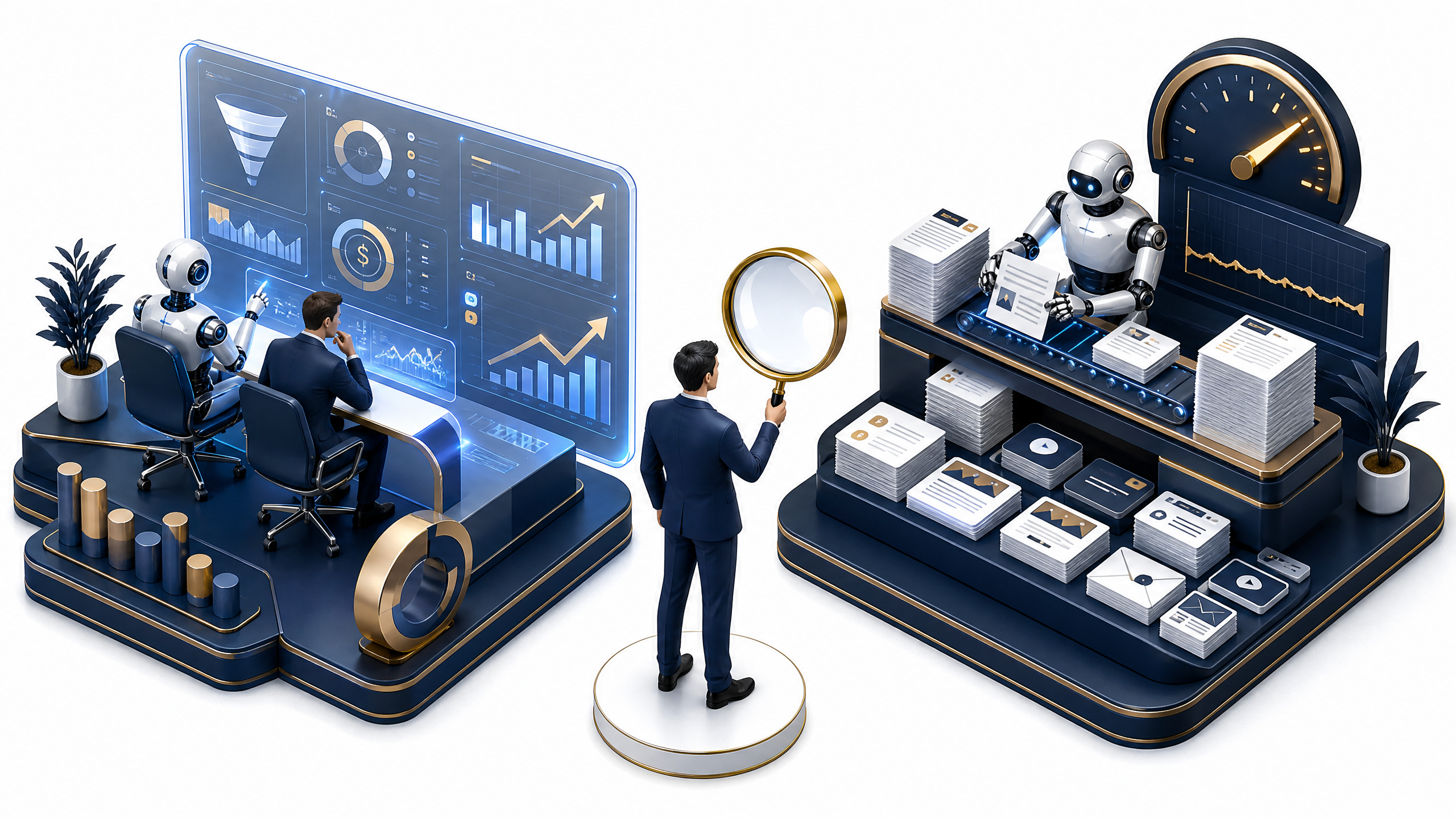
This is the core bifurcation in the AI marketing agency market. On one side are agencies that have genuinely rebuilt their operations around AI — deploying agentic systems, building proprietary data pipelines, and measuring outcomes in pipeline and revenue. On the other side are agencies that have added AI tools to existing production workflows and are selling the speed increase as transformation.
The distinction matters because the commercial outcomes are completely different. Production speed is a cost reduction. Business transformation is a revenue driver. CMOs who hire for the second and receive the first are not getting what they paid for.
The Five Credibility Questions
The following five questions will tell you which type of agency you are working with before you sign a contract.
Question 1: Can you show me the specific AI workflows you use for my account?
A genuine AI-first agency has documented, repeatable workflows that use AI at specific decision points — not just AI tools available to team members. They can show you a workflow diagram, explain which AI systems handle which tasks, and demonstrate how human judgment is applied at the points where it adds the most value.
An agency that responds with a capabilities slide showing logos of AI tools it has access to is not AI-first. It is AI-equipped.
Question 2: How do you measure success?
Ask for the specific metrics the agency will report on monthly. If the answer is impressions, clicks, content pieces published, campaigns launched, and social media engagement, the agency is measuring activity. If the answer is marketing-attributed pipeline, cost per qualified lead, customer acquisition cost by channel, and revenue influenced by marketing activities, the agency is measuring outcomes.
Activity metrics are easy to produce. Outcome metrics require genuine integration with your sales process and a willingness to be held accountable for commercial results.
Question 3: What proprietary AI capabilities do you have?
Any agency can subscribe to ChatGPT, Claude, Gemini, and Midjourney. Proprietary capability means the agency has built something — a custom model, a fine-tuned system, a proprietary data pipeline, a workflow automation that their competitors cannot easily replicate.
Agencies without proprietary capability are reselling commodity AI tools with a services wrapper. The margin they charge for that wrapper is not justified by the AI capability.
Question 4: Can you demonstrate agentic AI, not just AI-assisted work?
AI-assisted work means a human uses AI tools to work faster. Agentic AI means a system executes multi-step workflows autonomously — researching prospects, personalising outreach, optimising campaigns, updating CRM records — without requiring human intervention at each step.
The commercial difference is significant. AI-assisted work improves productivity within existing headcount. Agentic AI changes the economics of marketing operations by reducing the headcount required for a given level of output.
Ask the agency to demonstrate a specific agentic workflow they have deployed for a client. If they cannot, they are selling AI-assisted work as agentic transformation.
Question 5: Have you rebuilt your internal operations around AI?
The most reliable signal of genuine AI-first capability is whether the agency has applied AI to its own operations. Ask about their internal workflow for client onboarding, strategy development, content production, campaign management, and performance reporting. If the answer describes human-led processes with AI tools available, the agency has not made the operational transformation it is selling to clients.
Agencies that have genuinely rebuilt their operations around AI are faster, cheaper to run, and able to demonstrate the transformation they are selling because they have lived it.
What Genuine AI-First Looks Like
At Integrated.Social, we have rebuilt every client workflow around agentic AI — from initial research and strategy through content production, campaign management, and performance analysis. Our Agentic AI service deploys AI agents that operate autonomously across marketing workflows, and we measure success in pipeline and revenue, not deliverable volume.
We also apply the same credibility test to ourselves. If you ask us the five questions above, we can answer every one with specific evidence — workflow documentation, outcome metrics from client engagements, and demonstrations of agentic systems in operation.
The AI marketing agency market will consolidate around the agencies that can demonstrate genuine transformation. The agencies that rebranded without rebuilding will not survive the next two years of client scrutiny.
Frequently Asked Questions
What is the difference between an AI-first agency and a traditional agency using AI tools? An AI-first agency has rebuilt its core workflows around AI systems and measures success in pipeline and revenue. A traditional agency using AI tools has added AI to existing production workflows to increase output speed and measures success in deliverable volume.
How can I tell if my AI marketing agency is genuinely AI-first? Ask five questions: Can they show you specific AI workflows? Do they measure pipeline and revenue? Do they have proprietary AI capabilities? Can they demonstrate agentic AI? Have they rebuilt their internal operations around AI?
What should an AI marketing agency be able to measure? Marketing-attributed pipeline, revenue influenced by marketing, cost per qualified lead, and customer acquisition cost by channel — not just impressions, clicks, and content volume.
Sources: Forrester Research, "The State of AI Marketing Agencies," 2026; Gartner, "Marketing Technology Survey," 2025.
About the Author
Modi Elnadi is the founder of Integrated.Social, a London-based AI growth marketing agency specialising in agentic AI deployment, AEO, GEO, and B2B performance marketing. Modi has spent over a decade building and running AI-native marketing operations for B2B companies across financial services, technology, and professional services.