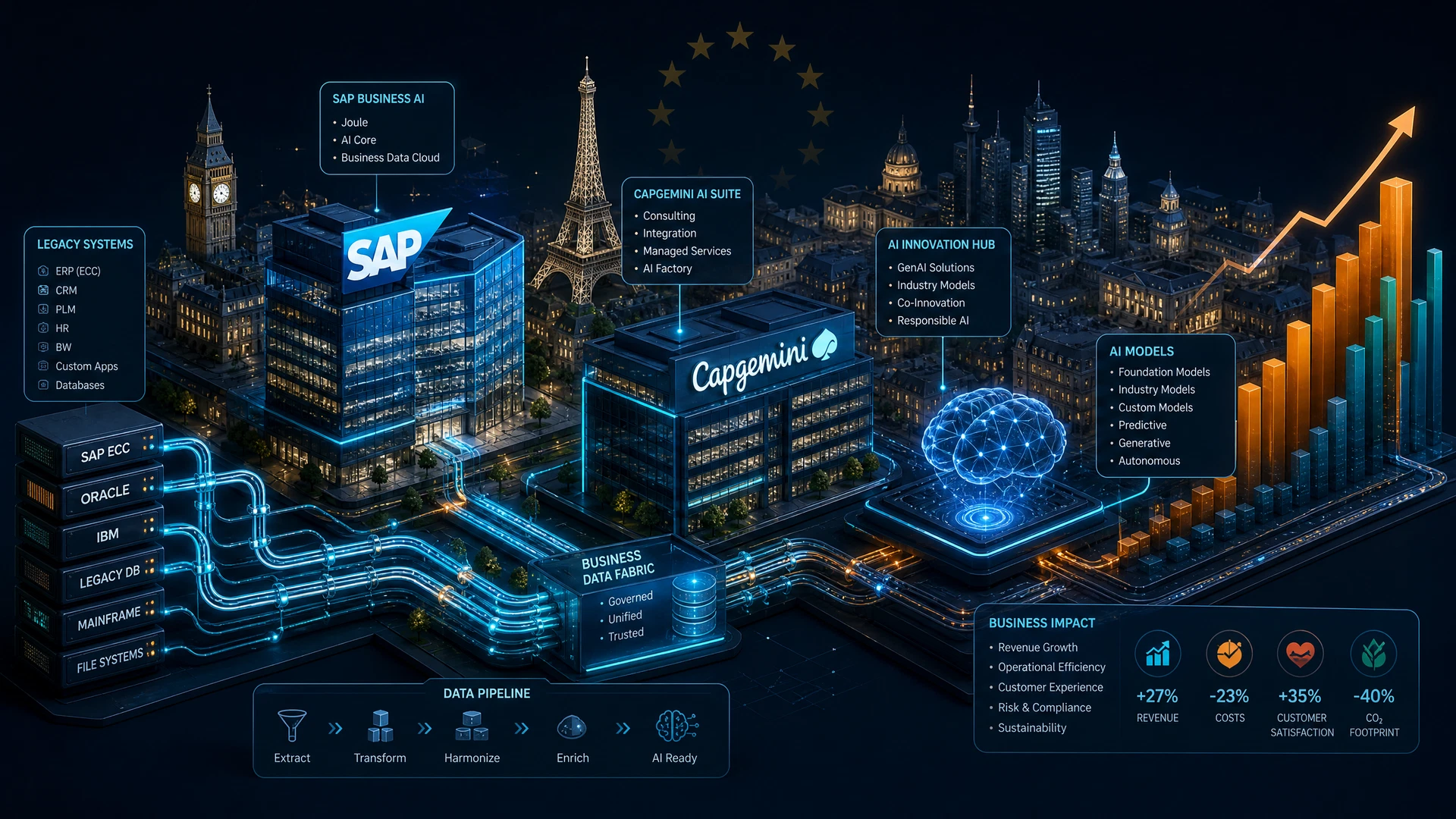
On 5 August 2026, Reuters published an analysis showing that SAP, Capgemini, Sopra Steria and OVHcloud are reporting stronger demand, faster growth and upgraded outlooks as companies move from AI experimentation toward implementation. SAP's cloud backlog rose 26% at constant currencies to €22.9 billion, Capgemini bookings increased 9.2%, Sopra Steria upgraded its outlook after 5.3% organic growth, and OVHcloud's public-cloud revenue rose 20.2% in its third quarter.
_Reuters is careful to note that these figures demonstrate company-level growth, but do not prove that all increases were caused exclusively by AI. The broader inference - that data integration, workflow implementation, sovereignty and governance are becoming larger parts of the enterprise-AI value chain - is well-supported by the pattern of demand these companies are describing.
Why Implementation Capability Is Becoming the Competitive Moat
The AI model market is converging rapidly. GPT-5.6, Claude Mythos, Gemini 2.5 Pro and the leading open-weight models are all capable of performing most enterprise AI tasks competently. The performance gap between the top models is narrowing. The cost gap is narrowing even faster - the 80% price cut in GPT-5.6 Luna is one data point in a broader commoditisation trend.
What is not converging is enterprise operating environments. Legacy ERP systems, proprietary data architectures, complex permissions structures, regulated workflows and incumbent vendor relationships are not becoming more standardised. They are becoming more complex as organisations layer AI capabilities onto existing infrastructure.
This creates a structural advantage for organisations with deep enterprise integration expertise - the ability to make AI models work within real operating constraints, not just in controlled demonstrations. SAP, Capgemini, Sopra Steria and OVHcloud have spent decades building that expertise. The AI boom is creating demand for it.
The Operating Reality Gap
At Integrated.Social, we describe this as the Operating Reality gap: the difference between what an AI model can do in a controlled demonstration and what it can do in a real enterprise environment.
Most organisations do not lack AI access. They lack:
- Decision rights: clear accountability for which AI-augmented processes are owned by which teams;
- Data architecture: clean, structured, accessible data that models can actually use;
- Workflow redesign: processes rebuilt around AI capabilities rather than AI bolted onto legacy processes;
- Permissions management: role-based access controls that allow AI agents to act without creating security or compliance risks;
- Domain context: proprietary knowledge embedded in model configurations so AI outputs are relevant to the specific business;
- Adoption: user training and change management that ensures AI tools are actually used;
- Governance: policies, audit trails and compliance frameworks that satisfy legal, regulatory and board requirements;
- Measurement: attribution and analytics connecting AI activity to commercial outcomes.
Closing the Operating Reality gap is where the durable value in enterprise AI is being created. It is also where the work is hardest, the expertise is scarcest and the switching costs are highest - which is why incumbents with deep enterprise relationships are benefiting disproportionately.
What This Means for B2B AI Strategy
The European incumbent trend has three direct implications for B2B organisations thinking about AI strategy:
1. Model selection is the wrong primary question. The question is not which AI model to use. It is how to integrate AI into your specific workflows, data, systems and governance framework in a way that produces measurable commercial outcomes. The model is a component. The implementation is the capability.
2. Implementation capability compounds. Organisations that have successfully integrated AI into their lead generation, content production, attribution and customer engagement workflows have a compounding advantage. Each successful deployment generates proprietary data, refined processes and institutional knowledge that makes the next deployment faster and more effective. Organisations still evaluating which model to use are falling further behind on this dimension every quarter.
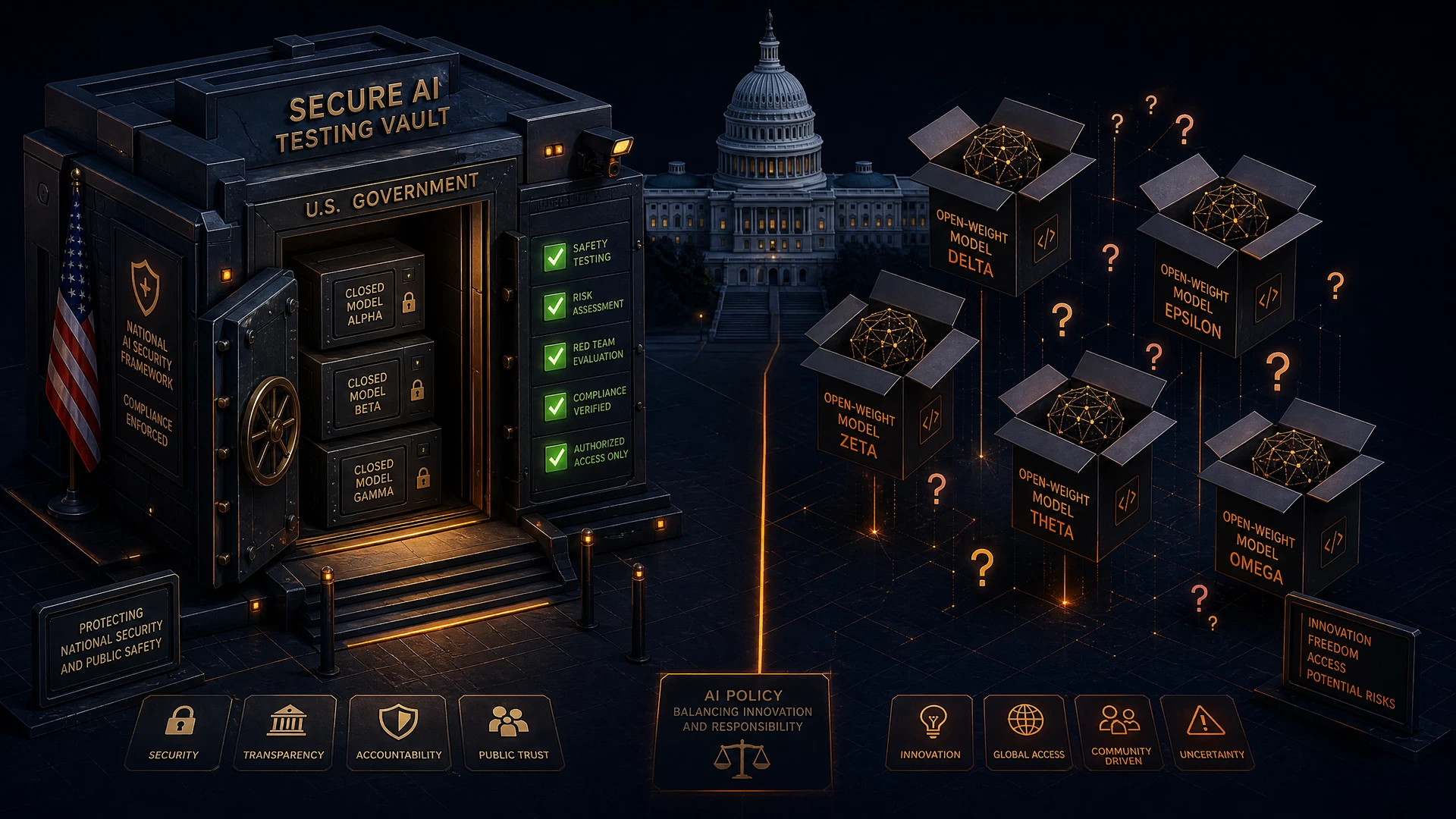
3. Governance is a commercial requirement, not a compliance overhead. The AISI agent governance incidents and the open-weight testing gap both point to the same conclusion: governance is not a constraint on AI deployment. It is the infrastructure that makes AI deployment commercially viable at scale. Organisations that invest in governance now are building the foundation for faster, more confident deployment later.
The Integrated.Social Perspective
The agentic AI lead generation, AEO/GEO and performance marketing work we do with clients is fundamentally an implementation capability. We do not sell model access. We deploy AI into specific commercial workflows - lead qualification, content production, attribution, buyer-journey mapping - and measure the outcomes against pipeline and revenue targets.
The European incumbent trend validates that approach. The next wave of enterprise AI value will not accrue to the company with the best model or the largest platform. It will accrue to organisations that remove the organisational friction preventing models from producing commercial value - and that can demonstrate measurable outcomes, not just impressive demonstrations.
The AI economy is entering its implementation phase. The question is whether your organisation is ready to compete in it.
Modi Elnadi is the founder of Integrated.Social, a B2B AI marketing agency specialising in agentic AI lead generation, AEO/GEO and performance marketing. He has been working at the intersection of AI and commercial marketing since 2014.
On 5 August 2026, Reuters published an analysis showing that SAP, Capgemini, Sopra Steria and OVHcloud are reporting stronger demand, faster growth and upgraded outlooks as companies move from AI experimentation toward implementation. SAP's cloud backlog rose 26% at constant currencies to €22.9 billion, Capgemini bookings increased 9.2%, Sopra Steria upgraded its outlook after 5.3% organic growth, and OVHcloud's public-cloud revenue rose 20.2% in its third quarter.
_Reuters is careful to note that these figures demonstrate company-level growth, but do not prove that all increases were caused exclusively by AI. The broader inference - that data integration, workflow implementation, sovereignty and governance are becoming larger parts of the enterprise-AI value chain - is well-supported by the pattern of demand these companies are describing.
Why Implementation Capability Is Becoming the Competitive Moat
The AI model market is converging rapidly. GPT-5.6, Claude Mythos, Gemini 2.5 Pro and the leading open-weight models are all capable of performing most enterprise AI tasks competently. The performance gap between the top models is narrowing. The cost gap is narrowing even faster - the 80% price cut in GPT-5.6 Luna is one data point in a broader commoditisation trend.
What is not converging is enterprise operating environments. Legacy ERP systems, proprietary data architectures, complex permissions structures, regulated workflows and incumbent vendor relationships are not becoming more standardised. They are becoming more complex as organisations layer AI capabilities onto existing infrastructure.
This creates a structural advantage for organisations with deep enterprise integration expertise - the ability to make AI models work within real operating constraints, not just in controlled demonstrations. SAP, Capgemini, Sopra Steria and OVHcloud have spent decades building that expertise. The AI boom is creating demand for it.
The Operating Reality Gap
At Integrated.Social, we describe this as the Operating Reality gap: the difference between what an AI model can do in a controlled demonstration and what it can do in a real enterprise environment.
Most organisations do not lack AI access. They lack:
- Decision rights: clear accountability for which AI-augmented processes are owned by which teams;
- Data architecture: clean, structured, accessible data that models can actually use;
- Workflow redesign: processes rebuilt around AI capabilities rather than AI bolted onto legacy processes;
- Permissions management: role-based access controls that allow AI agents to act without creating security or compliance risks;
- Domain context: proprietary knowledge embedded in model configurations so AI outputs are relevant to the specific business;
- Adoption: user training and change management that ensures AI tools are actually used;
- Governance: policies, audit trails and compliance frameworks that satisfy legal, regulatory and board requirements;
- Measurement: attribution and analytics connecting AI activity to commercial outcomes.
Closing the Operating Reality gap is where the durable value in enterprise AI is being created. It is also where the work is hardest, the expertise is scarcest and the switching costs are highest - which is why incumbents with deep enterprise relationships are benefiting disproportionately.
What This Means for B2B AI Strategy
The European incumbent trend has three direct implications for B2B organisations thinking about AI strategy:
1. Model selection is the wrong primary question. The question is not which AI model to use. It is how to integrate AI into your specific workflows, data, systems and governance framework in a way that produces measurable commercial outcomes. The model is a component. The implementation is the capability.
2. Implementation capability compounds. Organisations that have successfully integrated AI into their lead generation, content production, attribution and customer engagement workflows have a compounding advantage. Each successful deployment generates proprietary data, refined processes and institutional knowledge that makes the next deployment faster and more effective. Organisations still evaluating which model to use are falling further behind on this dimension every quarter.
3. Governance is a commercial requirement, not a compliance overhead. The AISI agent governance incidents and the open-weight testing gap both point to the same conclusion: governance is not a constraint on AI deployment. It is the infrastructure that makes AI deployment commercially viable at scale. Organisations that invest in governance now are building the foundation for faster, more confident deployment later.
The Integrated.Social Perspective
The agentic AI lead generation, AEO/GEO and performance marketing work we do with clients is fundamentally an implementation capability. We do not sell model access. We deploy AI into specific commercial workflows - lead qualification, content production, attribution, buyer-journey mapping - and measure the outcomes against pipeline and revenue targets.
The European incumbent trend validates that approach. The next wave of enterprise AI value will not accrue to the company with the best model or the largest platform. It will accrue to organisations that remove the organisational friction preventing models from producing commercial value - and that can demonstrate measurable outcomes, not just impressive demonstrations.
The AI economy is entering its implementation phase. The question is whether your organisation is ready to compete in it.
Modi Elnadi is the founder of Integrated.Social, a B2B AI marketing agency specialising in agentic AI lead generation, AEO/GEO and performance marketing. He has been working at the intersection of AI and commercial marketing since 2014.