What Reuters Actually Reported
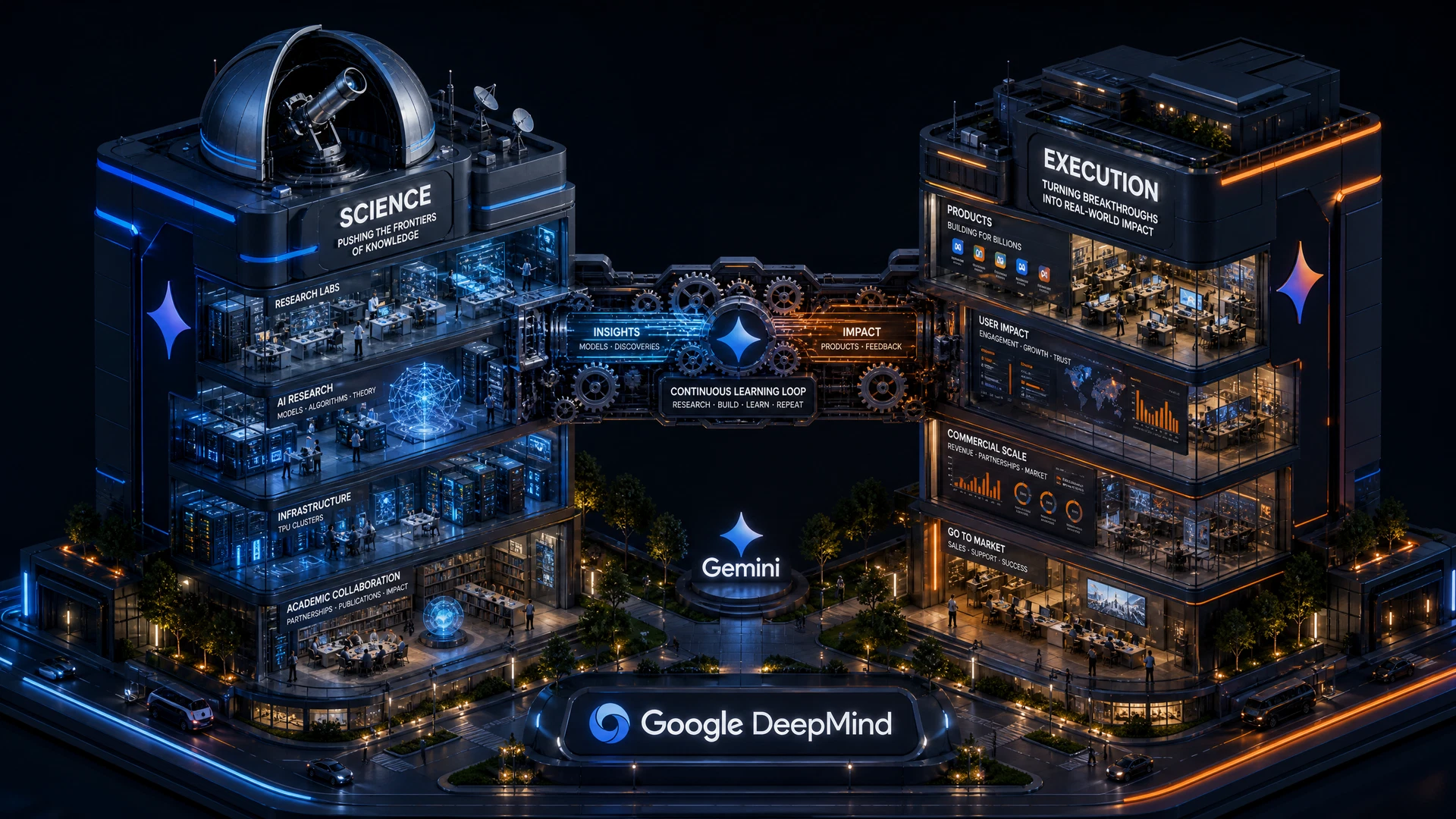
Reuters reports that Google delayed its next flagship Gemini model by roughly two months after internal tests showed weaknesses relative to competitors, particularly in coding. The wider DeepMind restructuring has shifted authority toward chief AI architect Koray Kavukcuoglu, who now has final say on major DeepMind decisions, while some nontechnical teams are being absorbed into corporate Google.
The genuinely new detail is the commercial context: Reuters reports internal tensions over scarce TPU compute, slower release cycles and DeepMind's historical autonomy, while Kavukcuoglu had increasingly become the link between DeepMind and Google Cloud, Google's principal AI revenue engine.
The Distribution Advantage Problem
Google has one of the greatest distribution advantages in technology: Search, Chrome, Android, YouTube, Workspace, Cloud and Ads. Its problem is not lack of routes to market. It is coordinating frontier research with those commercial systems fast enough.
Reuters' reporting suggests Google is tightening that relationship. For AI Search marketers, that matters because closer DeepMind-Google integration increases the likelihood that Gemini development becomes more tightly coupled with Search, AI Mode, Ads, shopping, Workspace and enterprise agents.
Organisational Integration as Competitive Advantage
There is an assumption that the company with the highest benchmark score wins AI. Google has a very different potential moat: model + search intent + advertising demand + commerce data + enterprise distribution + proprietary compute.
But that advantage only exists if the organisation can make those pieces act like one company. The Reuters investigation suggests Google is explicitly trying to remove some of the organisational friction that prevented exactly that.
The CMO Lesson
| AI Competitive Factor | Google's Position | Organisational Requirement |
|---|---|---|
| Frontier model | Strong (Gemini) | Research speed and compute allocation |
| Distribution | Dominant (7 surfaces) | Product integration velocity |
| Data advantage | Massive (Search + Ads) | Cross-product data sharing |
| Revenue engine | Cloud + Ads | Commercial alignment with research |
| Developer ecosystem | Large (GCP) | API and tooling consistency |
For CMOs and GTM leaders, the parallel is direct: AI transformation fails when innovation, data, distribution and commercial ownership sit in separate silos. The companies that integrate fastest will outperform those with the best isolated capabilities.
What This Means for AI Search Strategy
Google's DeepMind restructuring shows that the AI race is increasingly an operating-model contest. Frontier intelligence matters, but distribution, compute allocation, product velocity and commercial integration may determine who turns intelligence into durable revenue.
For brands optimising for Google's AI surfaces, expect faster Gemini integration into Search, Ads and Shopping as the organisational barriers come down.