AI Answer Summary
People now trust AI recommendations over advice from friends and family by a 2:1 margin, according to a November 2025 study of 330 consumers across eight countries by Conveo. A separate Fox 5 Atlanta report from July 2026 found 74% of Americans would let AI handle their shopping, with some trusting.
Why People Trust AI More Than Their Friends: Perception, Psychology, and What It Means for B2B Brands
People now trust AI recommendations over advice from friends and family by a 2:1 margin, according to a November 2025 study of 330 consumers across eight countries by Conveo. A separate Fox 5 Atlanta report from July 2026 found 74% of Americans would let AI handle their shopping, with some trusting chatbots more than their closest contacts. This is not a fringe trend. It is a structural shift in how trust is formed, and it has direct implications for how B2B brands need to show up in AI-generated responses.
The Numbers Are Not Close
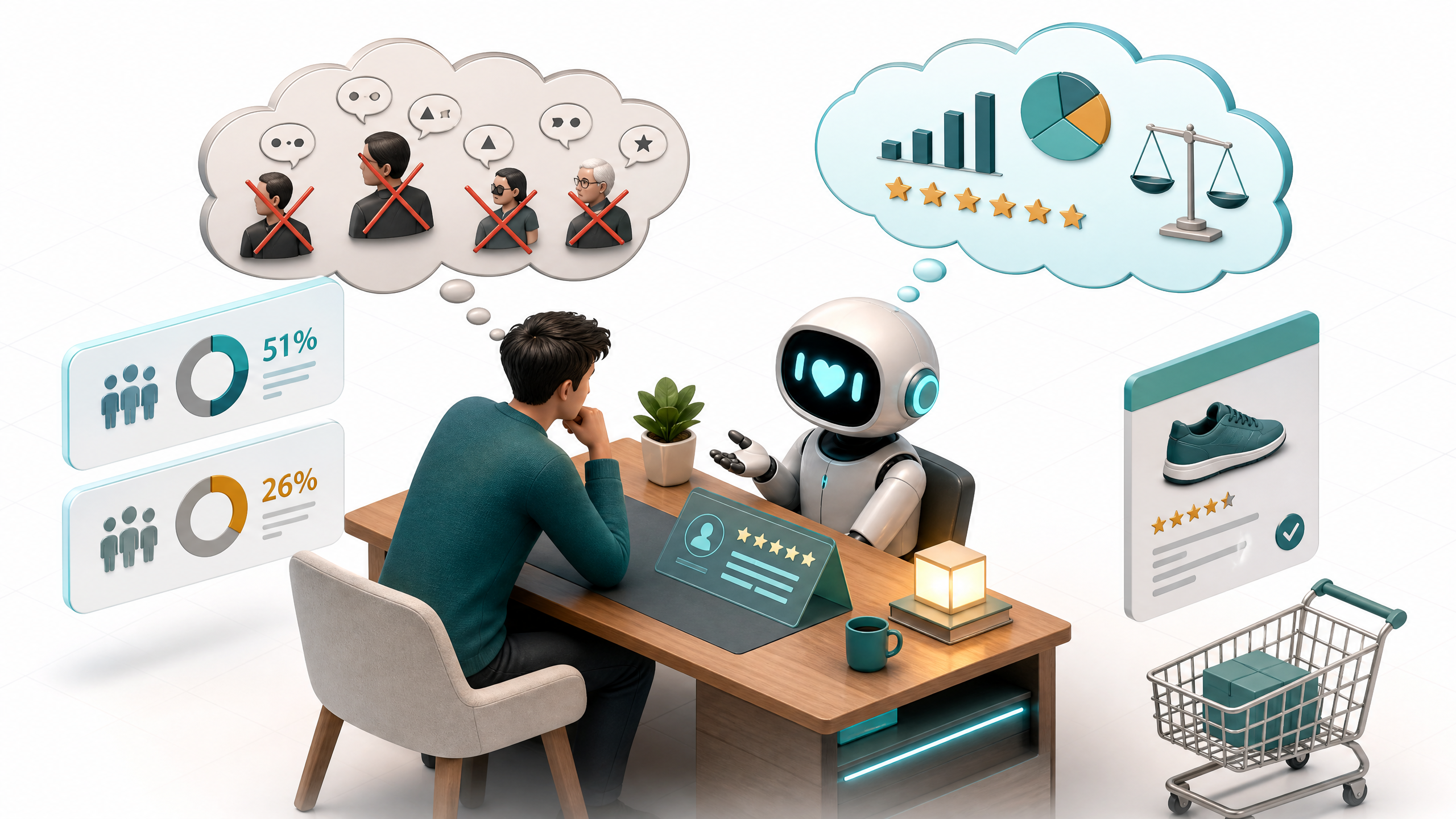
The Conveo AI-Powered Shopper Study, published in November 2025, surveyed 330 participants across the UK, France, Germany, the US, Mexico, Brazil, South Africa, and India. The headline finding: AI recommendations (51%) are twice as popular as advice from friends and family (26%), and five times more trusted than in-store staff or online reviews.
Over two thirds of UK participants said AI is their most trusted source for recommendations. Over 97% reported that AI has some degree of influence on their shopping behaviour, with 38% saying it influences them "a lot" or "completely."
This is not a narrow category finding. The Conveo data spans consumer electronics, travel, food and beverages, personal care, and fashion. It is broad-based, cross-demographic, and cross-national.
The Fox 5 Atlanta survey, reported on July 3, 2026, adds a sharper edge: 74% of Americans would let AI do their shopping, and 10% would let AI use their credit card without reviewing the purchase first. That last figure is the one that should stop CMOs mid-sentence. One in ten people are prepared to give an AI agent autonomous purchasing authority. That is not passive trust. That is delegated financial decision-making.
Why AI Beats Friends: The Psychology of Judgment-Free Advice
The data is clear. The more interesting question is why. The answer is not that AI is smarter than your friends. It is that AI is perceived as structurally incapable of the social behaviours that make human advice unreliable.
A 27-year-old male participant in the Conveo study put it plainly: "Store staff want to sell you a product, they get some kind of commission so they might not always have your best interest. Family members might suggest what they like but not consider your requirements. AI is unbiased toward the product it's going to recommend. It gives me facts instead of subjective feelings of how they feel toward a brand."
A 40-year-old female UK participant went further: "With AI, I find the fact that it is faceless and anonymous and there is no personality there... comforting because I feel like I can really, really trust the results."
These are not naive users. They are articulating a precise social calculus. Human advice carries hidden costs: the advisor's preferences, their social relationship with you, their desire to appear knowledgeable, their commission incentives, their emotional investment in being right. AI advice, in the perception of these users, carries none of those costs.
The Pearl.com study published in Forbes in February 2025, conducted by Censuswide across 1,000+ Americans, found that 83% of Gen Z experience anxiety when they need to ask a question in person or online. Fifty percent of Gen Z feel more comfortable confiding in AI about a work issue than their manager. The judgment-free dynamic is not just a preference. For a generation with elevated social anxiety, it is a functional requirement.
The Generational Gradient
The trust shift is not uniform across age groups, but the direction is consistent. The Pearl.com data shows 41% of Gen Zers trust AI more than humans, compared to 26% who trust humans more. Gen Z uses AI an average of 12 times a week, versus 7 for Gen X and 4 for Baby Boomers.
The TD Bank U.S. AI Insights Report, published March 31, 2026, surveyed 2,504 Americans and found that 62% now trust AI to provide honest, reliable, and competent information, up from roughly 50% the prior year. Gen Z leads at 90% AI adoption, with 77% using AI for financial management decisions.
Pew Research Center's June 2026 survey of 5,119 U.S. adults found that about half of Americans now use AI chatbots, up from a third in 2024. ChatGPT usage has more than doubled since 2023, from 18% to 44%. One in ten Americans now use chatbots for emotional support. Four percent use them for companionship.
That last figure deserves a moment. Companionship. Not productivity. Not efficiency. Companionship. The social function that humans have historically provided exclusively to each other is now being partially outsourced to AI, and a measurable segment of the population is choosing to do so.
The Nuance: Trust Is Situational, Not Absolute
The data is striking, but it is not a simple story of AI replacing human relationships. Three important qualifications apply.
First, trust is domain-specific. The TD Bank report found that while 62% trust AI for honest information, only 18% would trust AI to make financial recommendations autonomously. The Conveo data shows that 9 in 10 consumers validate AI outputs with other sources before making a purchase. Trust in AI for recommendations does not translate to blind faith in AI for high-stakes decisions.
Second, the trust hierarchy still places friends and family at the top for general information. TD Bank found that 90% of Americans trust friends and family for information, versus 62% for AI. The shift is not that AI has overtaken human relationships in absolute terms. It is that AI has overtaken human relationships in specific, consequential contexts: product recommendations, career advice, health information, and increasingly, purchasing decisions.
Third, Pew Research found that despite high adoption, Americans remain deeply sceptical of AI overall. Majorities think AI is advancing too quickly and will put their personal information at risk. The trust being extended to AI is conditional and context-dependent, not unconditional.
The picture that emerges is of a population that has developed a sophisticated, situational relationship with AI: high trust for objective, fact-based recommendations; lower trust for autonomous high-stakes decisions; and persistent scepticism about the technology's broader societal trajectory.
What This Means for B2B Brands and CMOs
The consumer data has a direct B2B parallel that most marketing leaders have not yet fully processed.
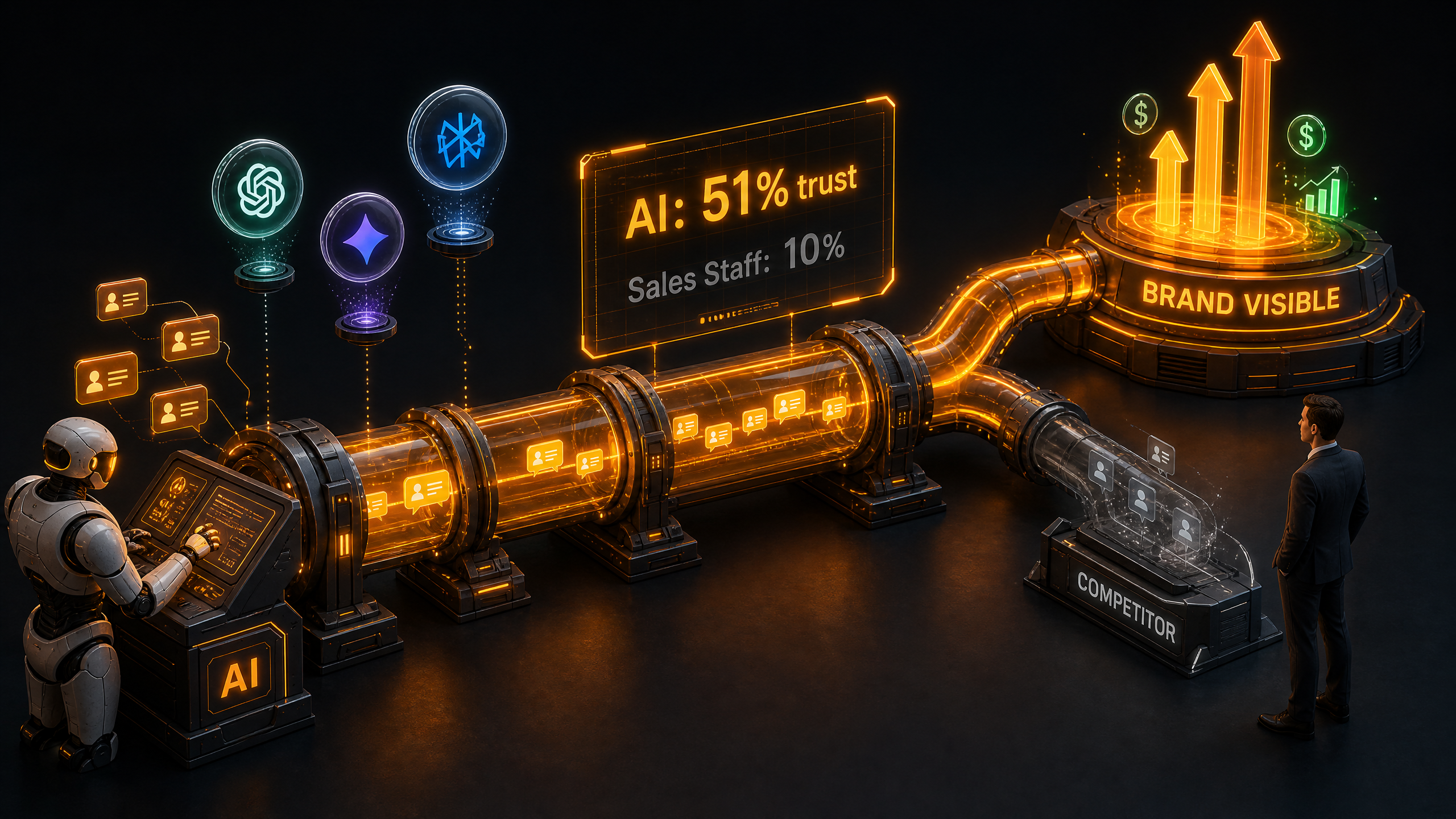
If 51% of consumers trust AI recommendations over friends and family for purchasing decisions, then the question for every B2B brand is not "how do we appear in Google search results?" It is "how do we appear in AI-generated responses when a buyer asks ChatGPT, Gemini, or Perplexity to recommend a vendor?"
The Conveo data shows that 53% of shoppers have tried new brands based on AI suggestions, and 15% have switched brands. In B2B terms, that is AI-driven pipeline displacement. A competitor that appears in AI responses for your category is not just winning organic traffic. It is winning the trust conversation before your sales team ever enters the picture.
The implication for AI search and AEO strategy is significant. Traditional SEO optimises for a human clicking a blue link. AEO (Answer Engine Optimization) and GEO (Generative Engine Optimization) optimise for an AI system citing your content as the authoritative answer to a buyer's question. The trust dynamic documented in these surveys is the demand-side evidence for why that shift matters commercially.
Three practical implications follow for B2B marketing leaders:
First, your brand's AI discoverability is now a trust infrastructure question, not just a traffic question. If buyers trust AI recommendations over their own network, then appearing in AI responses is equivalent to being recommended by a trusted advisor. The brand that is cited by ChatGPT when a CMO asks "which AI marketing agency should I consider?" has a trust advantage that no amount of paid media can replicate.
Second, the judgment-free dynamic explains B2B buyer behaviour that traditional demand gen models miss. B2B buyers are using AI to research vendors precisely because they can ask questions they would be embarrassed to ask a sales rep or a peer. "Is this vendor actually good or just well-marketed?" "What are the real failure modes of this approach?" "What would a competitor say about this?" These are the questions buyers are asking AI, and the answers are shaping shortlists before any human interaction occurs.
Third, the 10% who would let AI use their credit card autonomously are the early signal for agentic AI commerce. Within 18 to 24 months, AI agents will be making purchasing decisions on behalf of enterprise buyers within pre-approved parameters. The brands that have established trust with AI systems now, through structured data, authoritative content, and consistent citation in AI responses, will be the default choices when those agents start executing.
The Risk: When AI Trust Becomes a Liability
The same dynamics that make AI trust commercially valuable also create risk. Pearl CEO Andy Kurtzig noted in the Forbes report that ChatGPT gets programming questions wrong 52% of the time, yet 41% of Gen Zers trust AI more than humans. The gap between perceived reliability and actual reliability is a governance problem that B2B brands, and their buyers, need to take seriously.
The TD Bank data reinforces this: trust in AI for information is rising, but trust in AI for autonomous decision-making is not. The population is, broadly speaking, calibrating correctly. The risk is at the edges: the 10% who would let AI use their credit card without review, or the Gen Z employee who uses AI to answer a compliance question without verifying the output.
For CMOs deploying AI in their own marketing operations, the lesson is the same one that applies to enterprise agentic AI deployment: trust is earned through demonstrated reliability in bounded contexts, not assumed from the technology's general capability. The consumers in these surveys trust AI for recommendations because they have experienced AI being right often enough in low-stakes contexts. Enterprise AI deployment needs the same track record before trust is extended to high-stakes decisions.
Frequently Asked Questions
Why do people trust AI more than friends for recommendations?
People trust AI recommendations because AI is perceived as structurally free from the social biases that make human advice unreliable. Friends have preferences, emotional investments, and social incentives that colour their advice. AI is seen as objective, consistent, and without a commission motive. The Conveo 2025 study found that consumers specifically cite AI's "impartiality" and "faceless" quality as the source of their trust, not its technical capability.
Is the AI trust trend real or just a perception?
The trend is real and measurable across multiple independent studies. Conveo's 2025 study of 330 consumers across eight countries found AI recommendations trusted 2:1 over friends and family. TD Bank's 2026 survey of 2,504 Americans found 62% trust AI for honest information. Pew Research's 2026 survey found half of U.S. adults now use AI chatbots. The data is consistent across methodologies, geographies, and time periods.
Do people trust AI more than doctors or financial advisors?
Trust in AI is domain-specific. Consumers trust AI highly for product recommendations and information search, but trust drops sharply for high-stakes autonomous decisions. TD Bank found only 18% would trust AI to make financial recommendations on its own. Pew found 20% use chatbots for medical advice. The pattern is: high trust for objective, fact-based guidance; lower trust for autonomous execution of consequential decisions.
What does AI trust mean for B2B marketing strategy?
If buyers trust AI recommendations over their own professional network, then appearing in AI-generated responses is now a primary trust-building channel. B2B brands that optimise for AI citation, through AEO, structured data, and authoritative content, are building the equivalent of word-of-mouth trust at scale. Brands that are invisible in AI responses are absent from the trust conversation that happens before any sales interaction.
How is Gen Z's relationship with AI different from older generations?
Gen Z uses AI 12 times a week on average, compared to 7 for Gen X and 4 for Boomers. Fifty percent of Gen Z feel more comfortable confiding in AI about work issues than their manager. Eighty-three percent experience anxiety when asking questions in person. For Gen Z, AI's judgment-free quality is not a preference but a functional requirement driven by elevated social anxiety and distrust of institutional authority.
Will AI agents start making purchasing decisions autonomously?
The early signal is already present: 10% of Americans surveyed by Fox 5 Atlanta in July 2026 said they would let AI use their credit card without reviewing the purchase. As agentic AI capabilities mature and enterprise buyers set pre-approved purchasing parameters, AI agents making vendor selections within defined budgets and criteria will become standard. Brands that establish AI discoverability now will be the default choices when those agents activate.
What is the risk of over-trusting AI recommendations?
The primary risk is the gap between perceived and actual reliability. Research shows ChatGPT answers programming questions incorrectly 52% of the time, yet a significant share of users trust it more than human experts. For B2B buyers, the risk is using AI-generated vendor assessments or compliance guidance without verification. The appropriate model is AI as a starting point for research, validated against primary sources and human expertise for consequential decisions.
The Bottom Line
The surveys are measuring something real: a structural shift in how trust is formed in an era of social complexity, information overload, and elevated social anxiety. AI is winning trust not because it is more capable than human advisors, but because it is perceived as more neutral, more consistent, and less socially costly to consult.
For B2B brands, this is the demand-side evidence for a supply-side imperative. If your buyers are asking AI which vendors to consider, and AI is not citing your brand, you are not just missing traffic. You are missing the trust conversation entirely.
The brands that will win the next decade of B2B marketing are the ones that understand AI discoverability as a trust infrastructure investment, not a technical SEO exercise. The preferred sources strategy that earns AI citation today is the equivalent of the word-of-mouth reputation that drove referrals in the decade before. The mechanism is different. The commercial logic is identical.
If you want to understand where your brand stands in AI-generated responses for your category, book a discovery call to review your current AI citation rate and identify the gaps.
About the Author
Modi Elnadi is the founder of Integrated.Social, a London-based AI growth marketing agency specialising in agentic AI deployment, AI search optimisation, and B2B demand generation. With over 15 years of experience transforming marketing operations for enterprise technology, financial services, and professional services firms, Modi works with CMOs and AI Directors to build AI-first marketing systems that generate measurable pipeline. His work spans AEO strategy, multi-agent GTM architecture, and the organizational change management required to move from AI experimentation to AI-led revenue growth.