AI Answer Summary
In July 2026, S&P Global announced a significant reorganization of its business structure, creating new operating divisions designed to deliver intelligence products through AI-native workflows. The reorganization affected more than 35,000 employees and represented a fundamental redesign of how the.
What S&P Global Actually Did
In July 2026, S&P Global announced a significant reorganization of its business structure, creating new operating divisions designed to deliver intelligence products through AI-native workflows. The reorganization affected more than 35,000 employees and represented a fundamental redesign of how the company generates, packages, and delivers financial and market intelligence to enterprise clients worldwide.
S&P Global generates approximately $13 billion in annual revenue from intelligence products that enterprise clients use to make investment, credit, and strategic decisions. The company's decision to restructure around AI-native workflows is not a marginal operational adjustment. It is a signal that the economics of B2B intelligence production have shifted fundamentally, and that the competitive advantage in this market will increasingly belong to organisations that can deliver high-quality intelligence at AI-native speed and cost.
For enterprise leaders watching from adjacent industries, the S&P Global reorganization is a leading indicator. When one of the world's largest B2B intelligence providers rebuilds its operating model around AI, it changes the competitive baseline for every organisation that produces, consumes, or competes on the basis of intelligence.
The Economics That Are Driving This
The underlying economics of B2B intelligence production have changed more rapidly than most enterprise leaders have absorbed. The cost of generating a structured intelligence output, whether a market analysis, a credit assessment, a competitive landscape report, or a sector briefing, has declined by an order of magnitude in the past 24 months. AI systems can now produce first-draft intelligence outputs that would previously have required hours of analyst time in minutes, at a fraction of the cost.
This creates a structural problem for intelligence businesses built on human-intensive production models. If a competitor can deliver equivalent intelligence at one-tenth the cost, the pricing pressure on human-intensive production becomes unsustainable. The response is not to resist the shift but to redesign the operating model so that human expertise is applied where it creates irreplaceable value and AI handles the production work that can be reliably automated.
S&P Global's reorganization reflects this logic at scale. The company is not eliminating human expertise. It is repositioning human experts from primary producers of intelligence to quality governors, judgment authorities, and the interpreters of the contextual complexity that AI systems cannot reliably navigate. This is a fundamentally different operating model, and it requires a different organizational structure, different role definitions, and different measurement frameworks.
What an AI-Native Intelligence Operating Model Looks Like
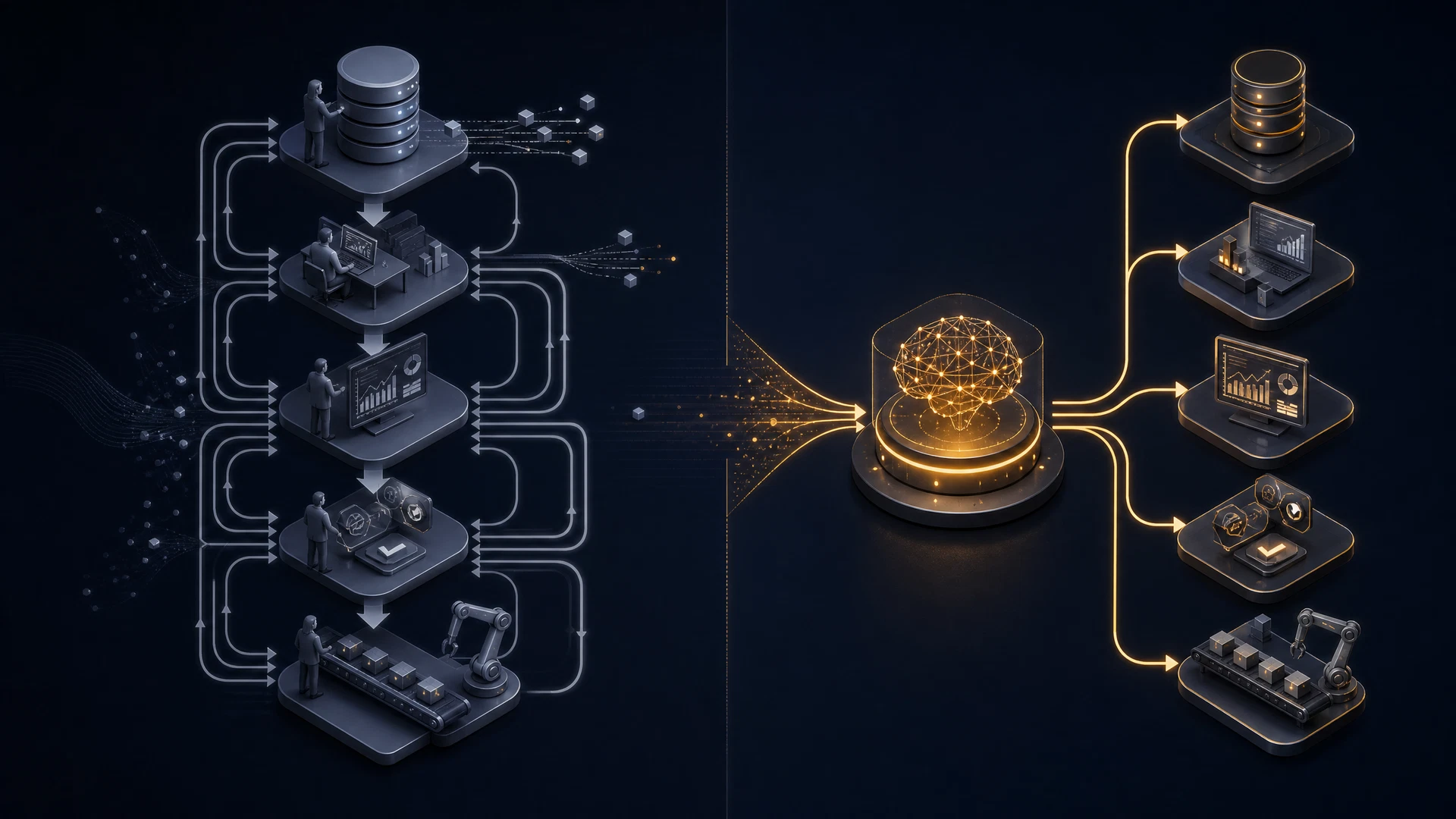
An AI-native operating model for B2B intelligence has three distinct layers. The first is AI-driven production: the systematic generation of structured intelligence outputs from data sources, using AI agents to aggregate, synthesise, and format information at scale. This layer handles the volume work that previously required large analyst teams.
The second layer is human quality governance: the expert review, validation, and calibration of AI-generated outputs. This layer is not about checking every output manually. It is about designing the quality assurance system, setting the accuracy thresholds, identifying the categories of output that require human review before delivery, and continuously improving the AI systems based on quality feedback. The humans in this layer are more senior, more specialised, and more commercially accountable than the analysts they replace.
The third layer is contextual judgment: the interpretive work that requires understanding of market dynamics, client context, regulatory environment, and the qualitative factors that data alone cannot capture. This is where the most experienced human experts operate, and it is the layer that creates the differentiated value that AI cannot replicate. The operating model is designed to concentrate human expertise at this layer while AI handles the production and quality governance layers operate as a systematic check between them.
The Implications for B2B Marketing Teams
For B2B marketing leaders, the S&P Global reorganization has direct implications for how marketing intelligence workflows should be designed. The question is not whether to use AI in marketing intelligence. It is whether the marketing function's operating model is designed around AI capability or whether AI tools have been added to a fundamentally human-intensive workflow.
The distinction matters commercially. A marketing team that uses AI tools to assist human analysts is operating at a different cost and speed profile from a marketing team that has redesigned its intelligence workflows around AI production with human quality governance. The first team is more productive. The second team is structurally different, and the gap between them will widen as AI capability improves.
For AI marketing strategy [blocked], this means auditing which marketing intelligence workflows are candidates for AI-native redesign. Audience research and segmentation, competitive landscape monitoring, content performance analysis, account prioritisation for ABM, and campaign insight synthesis are all workflows where AI-native production creates significant commercial leverage. The agentic AI deployment frameworks [blocked] that make this transition governable are the infrastructure investment that separates durable advantage from premature restructuring.
The S&P Global reorganization is a useful reference point for B2B marketing leaders making the case internally for operating model transformation. When one of the world's most sophisticated intelligence businesses restructures around AI-native workflows, it validates the strategic logic of the transition. The question for every B2B marketing leader is not whether this transition is coming to their function. It is whether they are leading it or waiting to be forced into it.
If you are building the business case for AI-native marketing intelligence workflows and need a framework for the operating model transition, the free AI growth audit [blocked] maps your current marketing intelligence workflows against the AI-native alternatives and identifies the highest-leverage transformation opportunities. The goal is not to restructure for its own sake but to build the operating model that creates durable competitive advantage as AI-native intelligence becomes the industry standard.
About the Author
Modi Elnadi is Founder and Director of Marketing and AI Growth at Integrated.Social, a London-based B2B AI growth marketing agency. Modi specialises in AI operating model transformation for B2B organisations, with particular focus on how enterprise marketing and intelligence functions redesign their workflows around agentic AI capability. He has worked with technology, financial services, and professional services clients to build AI-native marketing programmes that deliver measurable pipeline impact while maintaining the governance and quality standards that enterprise buyers require. His writing covers the intersection of AI capability, operating model design, and the commercial decisions that determine whether AI transformation creates durable advantage or premature disruption.