+## Stripe Just Bought the AI Control Layer
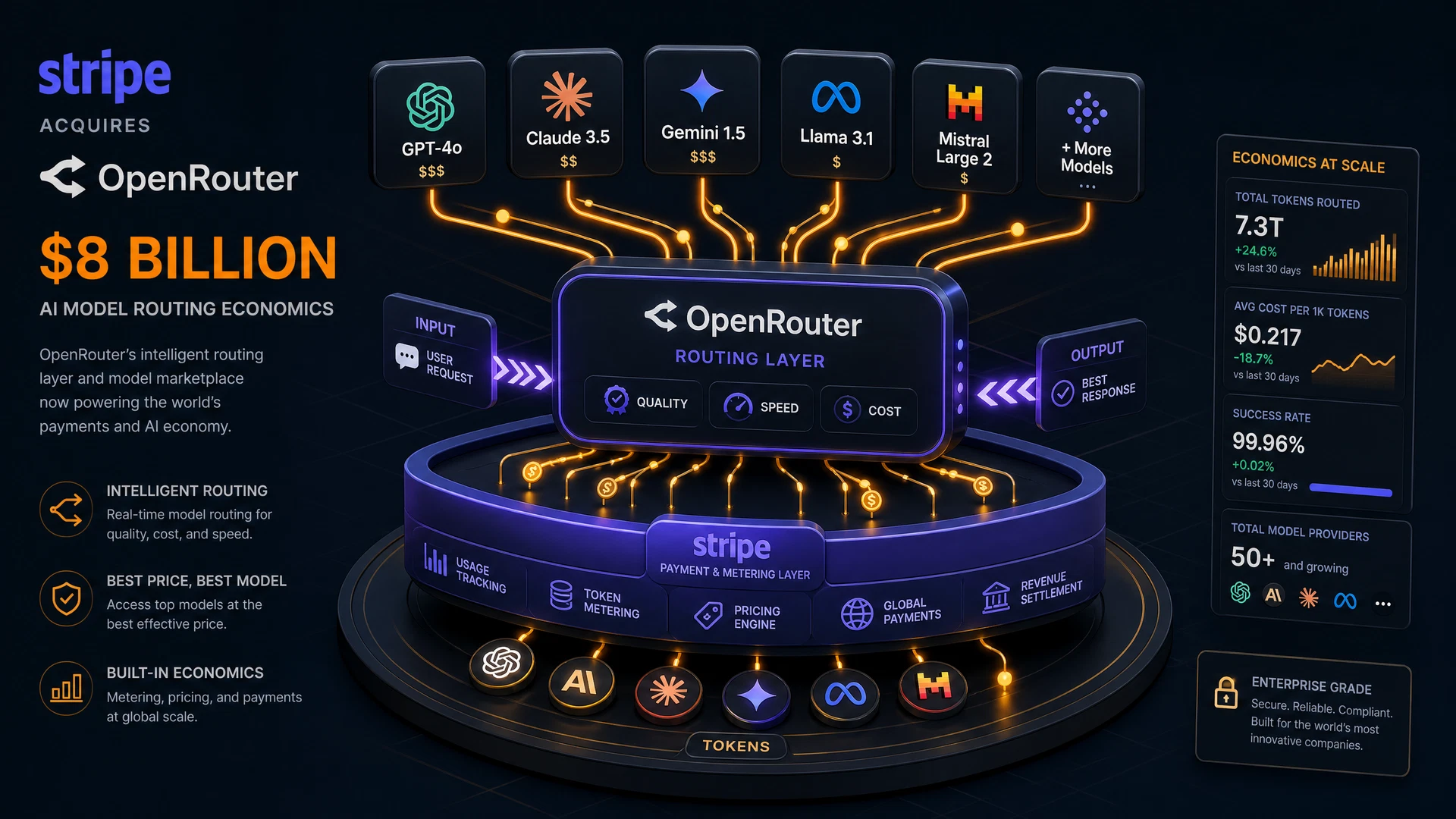
Stripe has agreed to acquire OpenRouter, a platform that provides one interface for accessing and routing requests across hundreds of AI models. Reuters reports the transaction values OpenRouter at slightly more than $8 billion.
OpenRouter says it processes more than 10 trillion tokens per day across more than 400 models for over 10 million developers and companies.
The obvious story is: Stripe bought an AI company.
The more interesting story is which layer Stripe bought.
Not the Model. The Meter.
Stripe did not acquire a frontier model. It acquired the routing and economic-control layer between the enterprise and the models.
OpenRouter lets an application use many model providers through one interface. That means an enterprise can theoretically choose:
- Cheapest adequate model for extraction and classification
- Strongest model for complex reasoning and strategy
- Fastest model for real-time interaction
- Specialist model for coding, legal or medical tasks
- Fallback model when one provider fails
The abstraction layer becomes strategically valuable as the underlying models become increasingly substitutable.
Use our AI Token Calculator [blocked] to see exactly how model pricing varies across 30 plus providers — the cost differences that make intelligent routing economically significant.
The Stack That Matters
Stripe can now connect:
AI consumption → routing → metering → billing → payment
That is an unusually powerful commercial stack.
CEO Patrick Collison described tokens as the "central currency" for companies building with AI. If that is correct, Stripe has just acquired the mint.
The Meter Moat
The AI operating system may belong to whoever owns the meter, not whoever owns the model.
Enterprise buyers do not ultimately care whether Model A or Model B completes a routine workflow. They care about:
Reliability + latency + cost + quality + outcome.
If a routing layer dynamically chooses the optimal intelligence and can meter the cost of every step, it becomes something resembling AWS for cognition plus Stripe for the economic transaction.
For GTM operations, that matters because sophisticated agentic AI systems [blocked] should probably not use one expensive frontier model for everything. The economics of agent workflows depend on intelligent routing — using the right model for each step.
What This Means for Enterprise AI Strategy
The Stripe-OpenRouter deal signals a broader shift in where enterprise AI value accumulates:
| Layer | Example | Strategic Value |
|---|---|---|
| Frontier models | GPT-5, Claude, Gemini | Increasingly commoditised |
| Routing and orchestration | OpenRouter (now Stripe) | Growing — controls cost and quality |
| Metering and billing | Stripe | Growing — controls economics |
| Application and workflow | Enterprise-specific | Highest — controls outcomes |
As models become more interchangeable, the valuable control point shifts toward platforms that decide which intelligence handles each task and meter the resulting economic value.
The Implication for AI Marketing
For AI marketing strategy [blocked], this acquisition reinforces a principle we apply at Integrated.Social: the competitive advantage is not access to AI models. Everyone has that. The advantage is building the economic logic, measurement architecture and operating processes that let AI make commercially correct decisions.
Stripe is betting that the AI economy will be built on routing and metering, not on model supremacy. That is a bet worth watching.
As frontier models become increasingly interchangeable, the valuable control point shifts to whoever controls routing, metering and payment. Stripe just bought that layer for $8 billion.
See how model costs compare across 30+ providers. Open AI Token Calculator → [blocked]