AI Answer Summary
A weekly series examining the gap between what organisations say they want and what their operating models actually permit.
The Operating Reality: Leadership Beyond the Slide Deck
A weekly series examining the gap between what organisations say they want and what their operating models actually permit.
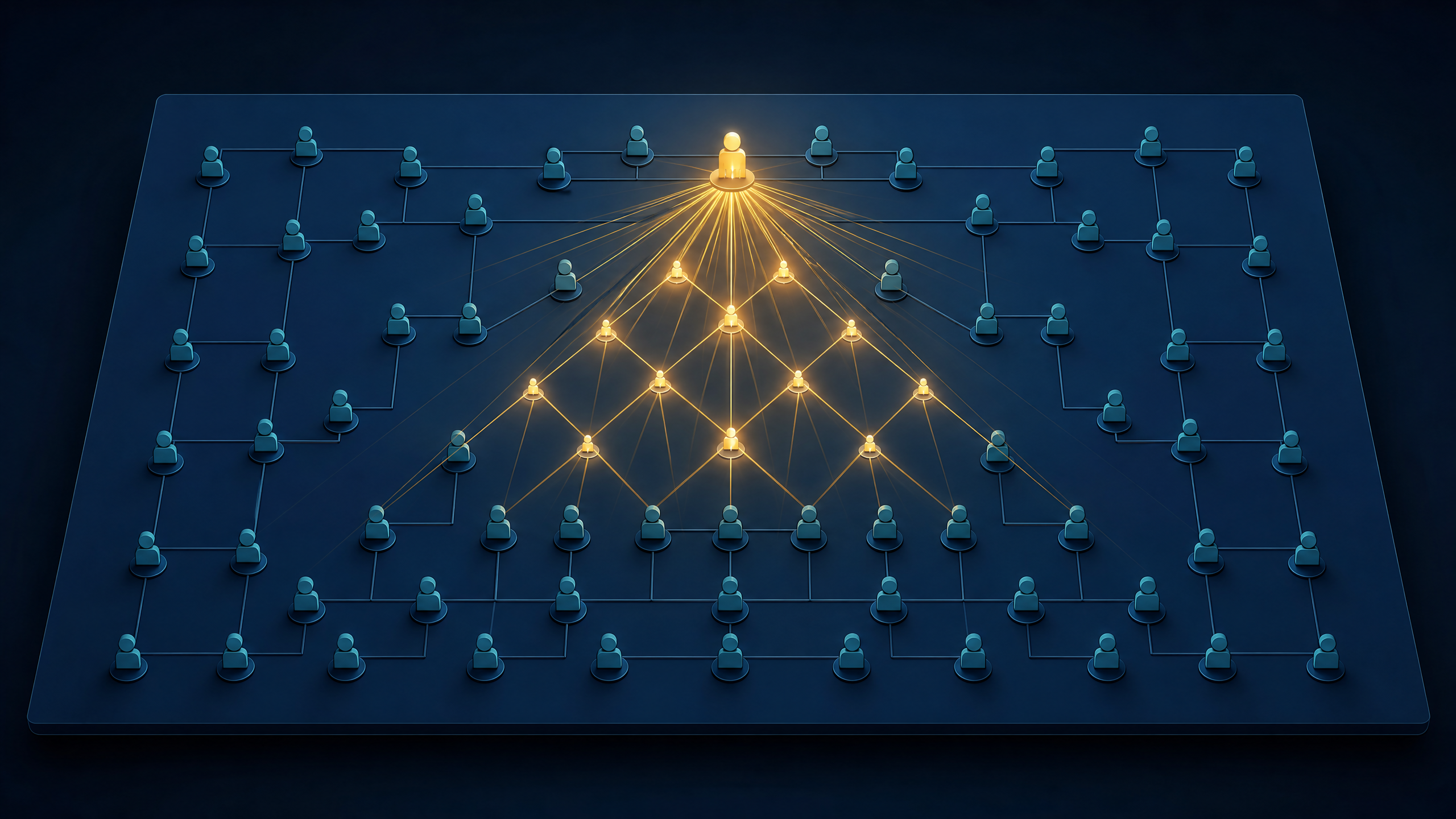
There is a meeting happening in your organisation right now where twelve people are being consulted on a decision that one person should be making. Nobody will say that out loud. The meeting will be described as collaborative, cross-functional, and stakeholder-aligned. The decision will be deferred until the next meeting. That meeting will also have twelve people in it.
This is not collaboration. It is accountability avoidance with better branding.
The Legitimate Case for Consultation
Let me be clear about what I am not arguing. Consultation is essential. Decisions that affect multiple functions, carry significant risk, or require implementation by people who were not in the room need input from those people. A strategy built in isolation by one executive who then announces it to the organisation is not leadership. It is a press release with a salary attached.
The case for broad input is real. People closest to the work often see consequences that senior leaders miss. Diverse perspectives reduce blind spots. And people who are consulted are more likely to implement decisions they had a hand in shaping.
None of that is the problem.
Where Consultation Becomes Dysfunction
The problem begins when consultation is confused with shared decision rights. When every participant in a discussion acquires an informal veto. When the goal of the meeting shifts from gathering input to achieving consensus - and consensus becomes the condition for any decision being made at all.
At that point, the organisation has not distributed accountability. It has dissolved it.
Here is the distinction that matters:
| What it should be | What it becomes |
|---|---|
| One owner gathers input from relevant stakeholders | Every stakeholder must agree before anything moves |
| Consultation informs the decision | Consultation replaces the decision |
| Disagreement is noted and the owner decides | Disagreement means the decision is deferred |
| The owner is accountable for the outcome | Nobody is accountable because everybody was involved |
The second column is not a failure of process. It is a failure of leadership design. Somebody, somewhere, decided not to assign clear decision rights - or assigned them and then failed to protect them when a more senior person expressed a view.
Why Intelligent Leaders Fall Into This Trap
Management by committee does not emerge because leaders are stupid. It emerges because the incentives that shape leadership behaviour push strongly toward it.
Consider the pressures a leader faces when making a significant decision unilaterally. If it goes well, the credit is shared. If it goes badly, the blame is concentrated. Consulting broadly distributes both the credit and the blame. It also provides political protection: if twelve people were involved, it is harder for any one of them to publicly criticise the outcome.
There is also a legitimate fear of exclusion. Leaders who have made unilateral decisions and later discovered that an excluded stakeholder had critical information - or became an active blocker during implementation - learn to consult more broadly. The lesson is correct. The overcorrection is to consult so broadly that the decision never gets made.
And then there is the culture problem. In organisations where disagreement carries a career cost, people do not say "I think this is the wrong decision." They say "I have some concerns I would like to explore further." The meeting ends without a decision. The concerns are never formally resolved. The decision is deferred indefinitely. Everyone leaves feeling that the process was thorough.
The Organizational Cost
The cost of management by committee is not primarily the time wasted in meetings, though that is real. The deeper cost is what happens to the organisation's operating tempo and talent over time.
Decision cycles lengthen. Work that depends on a decision cannot begin. Teams build contingency plans around unresolved assumptions, which means some of that work will be discarded when the decision is eventually made. The organisation learns that urgency is performative - things described as priorities are not actually prioritised.
Strong performers leave. The people most capable of making good decisions are also the people most frustrated by organisations that prevent them from making any. They go somewhere that lets them exercise judgement. The people who remain are those who have adapted to the culture of deferral - which means the organisation's decision-making capacity gradually degrades.
And the CEO becomes the de facto decision-maker for everything, because every decision that cannot achieve consensus eventually escalates. Which is its own problem, and one I will address directly in a later piece.
What Good Looks Like
The fix is not to stop consulting. It is to separate consultation from decision rights, and to make that separation explicit.
Consultation should be broad. Decision rights should be narrow.
Every significant decision should have one named owner. That owner is responsible for gathering input, weighing trade-offs, and making the call. They are also accountable for the outcome. Other stakeholders are consulted - their input is genuinely sought and genuinely considered - but they do not have a veto. If they disagree with the decision, they can say so. The owner notes the disagreement and decides anyway.
This requires two things that are harder than they sound. First, the organisation must actually assign decision rights, not just assume they are implied by job titles. Second, senior leaders must protect those decision rights when they are exercised - including when they personally disagree with the decision. A manager who makes a reasonable call and is then overruled by their director because the director had a different preference has not been empowered. They have been set up to fail.
The practical test is simple: for any significant decision in your organisation, can you name the one person who will make the final call? Not the person who will facilitate the discussion. Not the person who will present the recommendation. The person who will decide, and who will be accountable for what happens next.
If you cannot name that person, the decision will be made by committee. And it will take longer than it should, be worse than it could be, and belong to nobody when it goes wrong.
Three Diagnostic Questions
- In the last three significant decisions your team made, who was the named decision owner? Was that person actually able to decide, or did the decision require escalation or consensus?
- How many people were consulted on the last major decision in your organisation? How many of them had a genuine veto? How many of them knew they did not?
- When did your organisation last make a significant decision quickly? What made that possible?
Where does consultation end and decision avoidance begin in your organisation?
About the Author
Modi Elnadi is Founder and Director of Marketing and AI Growth at Integrated.Social [blocked], a London-based AI growth marketing agency specialising in Answer Engine Optimisation, agentic AI deployment, and B2B demand generation. He has led transformation programmes for scaling B2B technology, SaaS, fintech, and professional services businesses across the UK and US. Connect at integrated.social/about [blocked].
Ready to improve your AI search visibility? Request a free AI growth audit [blocked] from the Integrated.Social team and discover how your brand appears across ChatGPT, Perplexity, and Google AI Overviews.