The Question Every Retail and B2B Leader Should Be Asking Right Now
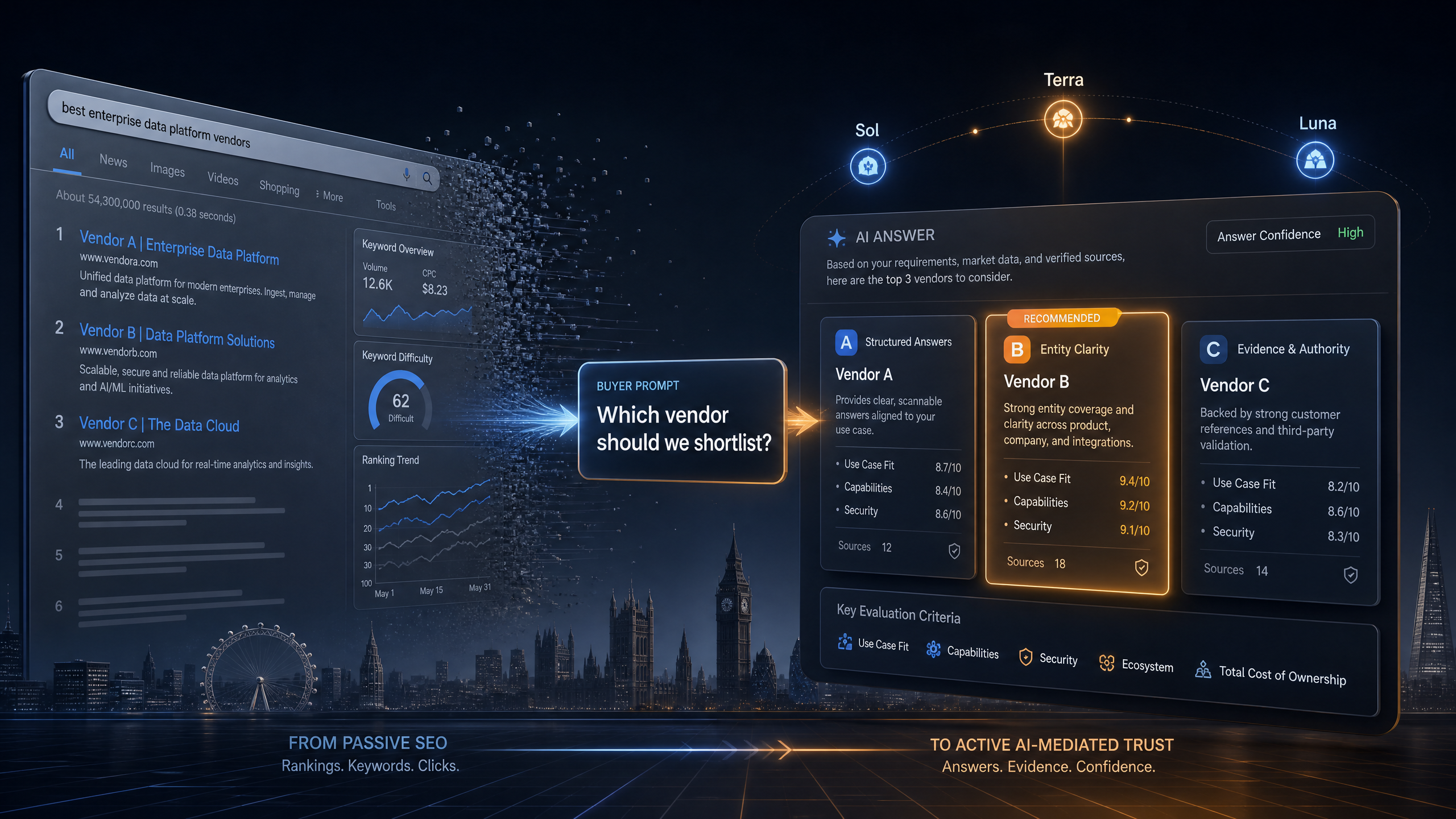
For years, the central question in digital marketing was: can customers find us? Brands invested in search rankings, paid media, and SEO because discovery happened through search engines. Google was the gatekeeper, and ranking on page one was the goal.
That question is being replaced by a different one: will AI recommend us?
When a shopper asks ChatGPT, Gemini, or Perplexity what running shoes to buy, what CRM to implement, or which logistics provider to trust, the answer does not come from a ranked list of pages. It comes from an AI system that has synthesised product data, customer reviews, delivery performance, pricing signals, brand trust indicators, and structured content to generate a specific recommendation. The brand that gets cited is not necessarily the one with the highest domain authority. It is the one that scores highest on the AI's real-time evaluation criteria.
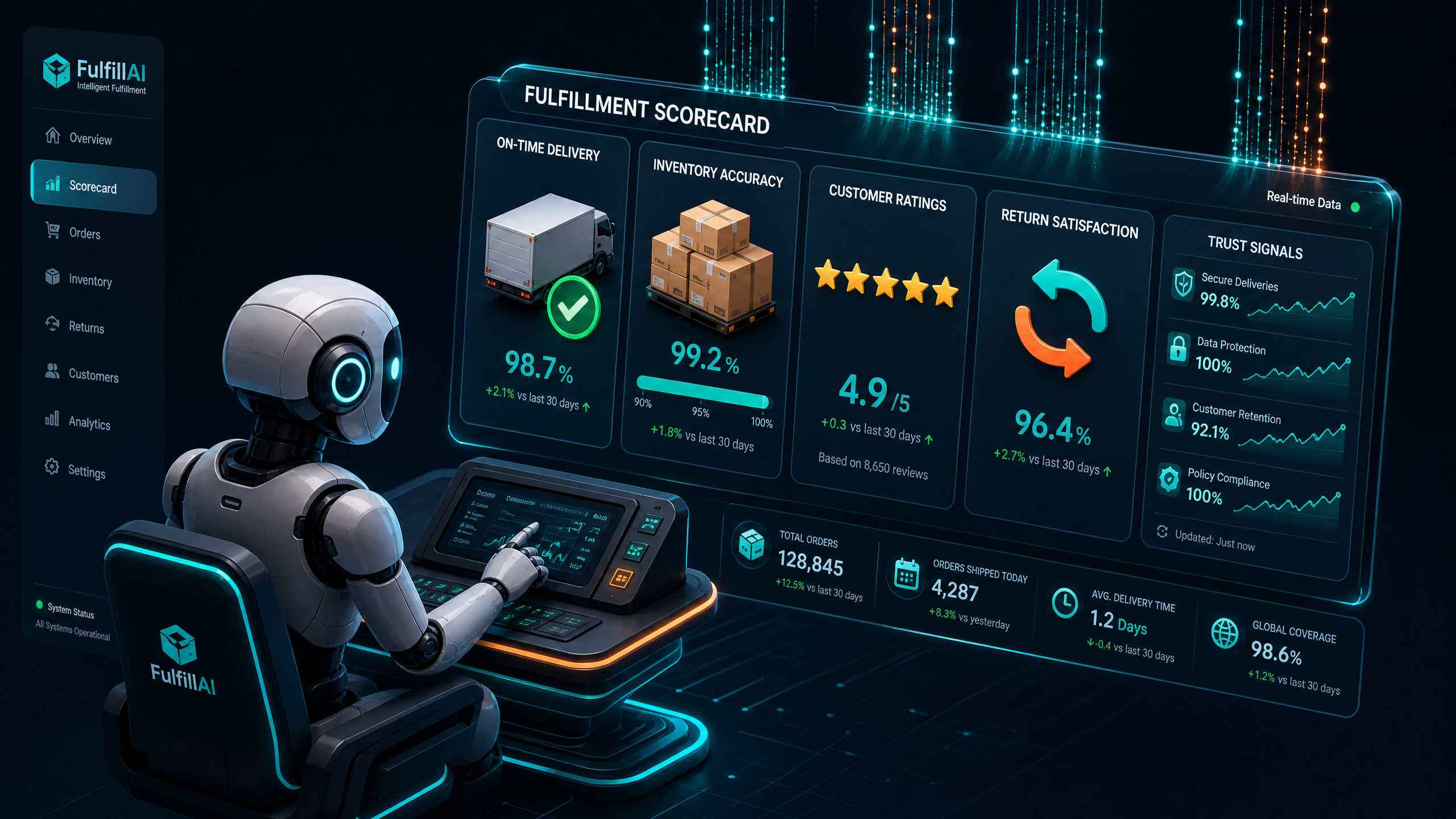
This is the AI fulfillment scorecard. And it is already live.
Why Search Rankings Are No Longer Enough
Gartner forecasts that traditional search volume will drop 25% by 2026 as AI-mediated discovery expands. By 2028, Gartner projects that 75% of B2B commerce transactions will be influenced or automated by AI. These are not distant projections. The shift is already measurable in consumer behaviour.
A Gartner survey of 846 US consumers conducted in late 2025 found that among those who used AI while shopping for a recent purchase, 54% had to double-check the accuracy of all information GenAI tools provided, and 62% said information from GenAI tools ended up being a waste of their time. These figures are often read as a caution against AI shopping tools. They should be read differently: they reveal that consumers are already using AI for shopping decisions at scale, and the brands that provide accurate, well-structured, trustworthy data are the ones that survive the accuracy check.
The same Gartner research found that only 11% of US consumers are willing to let AI make purchase decisions autonomously, even in low-stakes categories like personal care and household supplies. But 31% are willing to let AI narrow choices for household supplies, and 28% for personal electronics. The majority of consumers want AI to help them research, compare, and shortlist, while keeping the final decision for themselves.
That is the commercial opportunity. The brands that get onto the AI shortlist win the consideration phase before a human ever visits a website.
The Operational Signals That AI Systems Evaluate
Traditional SEO optimised for signals that search engines could measure: keywords, backlinks, page speed, structured data. AI recommendation engines evaluate a different and broader set of signals.
Delivery reliability is the first operational signal. A brand with consistent on-time delivery generates positive reviews and low complaint rates across third-party platforms. AI systems that aggregate review data, returns data, and customer sentiment scores will weight high-reliability fulfillment operations favourably when making recommendations.
Inventory accuracy is the second. When a brand's website says a product is in stock but it is not, the resulting negative customer experience creates review signals that suppress AI recommendation frequency. Accurate, real-time inventory data, especially when exposed through structured product schema, gives AI systems confidence in the reliability of the information they are citing.
Return experience is the third. Deloitte and MHI's 2026 Annual Industry Report found that 71% of supply chain leaders say AI is disrupting supply chains, with 48% rating the impact as significant or greater, up 25 percentage points since 2025. The brands that are investing in AI-powered returns management and frictionless reverse logistics are not just reducing operational costs. They are generating the positive customer sentiment signals that AI recommendation engines use to evaluate trustworthiness.
Customer sentiment and trust signals are the fourth. Gartner's research found that 72% of consumers said generative AI appears in their internet and app use whether they asked for it or not. Passive exposure to AI is already shaping consumer expectations. Brands with strong, consistent, verified customer sentiment across Google, Trustpilot, and sector-specific review platforms are building the trust signal infrastructure that AI systems rely on.
The Commercial Case: AI Recommendations Drive Measurable Conversion Lift
The commercial case for optimising for AI recommendations is not speculative. Retailers using AI-powered recommendation and chat systems already see conversion rates of 12.3% compared to 3.1% for sites without AI, a 4x improvement, according to Elogic's 2026 AI in Ecommerce analysis. Purchases are completed 47% faster when shoppers engage with AI. And consumers are 20% more likely to convert when a product or store is recommended by AI, according to Stord's 2026 retail research.
The AI-powered ecommerce market was valued at $8.65 billion in 2025 and is projected to exceed $50 billion by 2033. Gartner reports that 91% of retail IT leaders are prioritising AI as their top technology investment by 2026. 89% of retailers have already adopted AI in some form, according to Elogic.
The adoption curve is not ahead of us. It is already underway. The question is not whether to engage with AI-driven commerce. It is whether your brand is structured to be recommended or ignored when AI systems make their evaluations.
Operational Excellence as a Demand Generation Strategy
The most significant strategic shift in this new environment is that operational excellence becomes a demand generation strategy. This is a structural change in how marketing and operations relate to each other.
In the traditional model, marketing generated awareness and demand, operations fulfilled it. Marketing owned the customer acquisition funnel. Operations owned the post-purchase experience. The two functions were connected but sequential.
In the AI recommendation model, the post-purchase experience feeds directly back into the pre-purchase recommendation. A brand's fulfillment performance, return rates, customer satisfaction scores, and review quality are all inputs into the AI system that determines whether that brand gets recommended to the next buyer. Operations and marketing are no longer sequential. They are a feedback loop.
This means that the CMO and the COO need to be working from the same scorecard. The fulfillment network is part of the marketing engine. Delivery reliability is a brand signal. Inventory accuracy is a trust signal. Returns experience is a recommendation signal.
Deloitte's Wanda Johnson, Supply Chain Technology Fellow at Deloitte Consulting, put it clearly in the MHI 2026 Annual Industry Report: "Those who connect operational excellence, AI-driven orchestration, and workforce readiness into a single playbook will not just withstand disruption; they will convert it into sustained performance and growth."
What B2B Brands Need to Do Now
The practical response to the AI recommendation shift is not a single campaign or a technology purchase. It is a systematic audit and restructuring of how your brand presents itself to AI systems.
First, audit your AI visibility. Run your website and brand presence through an AI readiness assessment. Are your service and product pages structured with the schema markup that AI crawlers need to parse your offerings? Is your entity graph consistent across your website, Google Business Profile, LinkedIn, and third-party directories? Can an AI system accurately describe what you do, who you serve, and why you are trustworthy?
Second, implement AEO-first content. Answer Engine Optimisation means creating content that directly answers the questions your buyers are asking AI assistants. Not keyword-stuffed pages designed for Google's algorithm. Structured, evidence-led, answer-first content that gives AI systems the precise information they need to cite you accurately. Integrated.Social's AEO, GEO, and SEO service [blocked] covers the full implementation: content architecture, schema markup, entity consistency, and citation monitoring.
Third, align your operational signals with your marketing signals. If your marketing claims best-in-class delivery reliability but your Trustpilot reviews show a pattern of late shipments, AI systems will weight the review data over the marketing copy. Operational excellence and marketing credibility need to be consistent. The AI scorecard does not distinguish between what you claim and what customers report. It weights the evidence.
Fourth, deploy agentic AI to monitor and respond. The brands that will win in the AI recommendation era are those that use AI to monitor their own AI visibility, track competitor citation rates, identify gaps in their recommendation scorecard, and respond systematically. Integrated.Social's Agentic AI and Gemini AI service [blocked] builds the monitoring and response infrastructure that turns AI recommendation optimisation from a one-time project into a continuous competitive advantage.
Fifth, build your AI marketing strategy around the new buyer journey. The buyer journey now begins with an AI query, not a search result. Integrated.Social's AI marketing strategy service [blocked] maps the full AI-mediated buyer journey for your specific market, identifies the AI systems your buyers are using, and builds the content and data infrastructure that ensures your brand is visible, accurate, and recommended at every stage.
The Strategic Framing: From Search Rankings to AI Scorecard
The shift from search rankings to AI recommendations is not an incremental change in digital marketing tactics. It is a structural change in how markets work.
Search rankings were a proxy for relevance and authority. AI recommendations are a direct evaluation of trustworthiness, accuracy, and operational reliability. The brands that built their digital presence around gaming search algorithms will find that those tactics do not transfer. The brands that built genuine operational excellence, consistent customer satisfaction, and credible, structured content will find that the AI recommendation era rewards exactly what they have been building.
The question for every retail and B2B leader is not whether this shift is coming. It is already here. The question is whether your brand is positioned to be recommended or overlooked when AI systems make their evaluations in real time.
Your fulfillment network is becoming part of your marketing engine. Your operational scorecard is becoming your demand generation strategy. The brands that understand this connection first will build a compounding advantage that is very difficult for competitors to replicate.
Frequently Asked Questions
Will AI replace search engines for product discovery? AI is not replacing search engines entirely, but it is taking a significant share of product discovery queries. Gartner forecasts a 25% drop in traditional search volume by 2026 as AI-mediated discovery expands. For high-consideration purchases, AI assistants are already being used to research, compare, and shortlist options before a buyer visits a website. Brands need to be optimised for both traditional search and AI recommendation systems simultaneously.
What operational metrics matter most for AI recommendations? The operational metrics that matter most for AI recommendations are on-time delivery rate, inventory accuracy, return experience rating, customer satisfaction score, and review quality across third-party platforms. These signals feed into the trust and reliability indicators that AI recommendation engines evaluate. Brands with strong operational metrics generate positive customer sentiment at scale, which creates the review and trust signal infrastructure that AI systems weight heavily.
How quickly is the AI ecommerce market growing? The AI-powered ecommerce market was valued at $8.65 billion in 2025 and is projected to exceed $50 billion by 2033. 89% of retailers have already adopted AI in some form. Gartner reports that 91% of retail IT leaders are prioritising AI as their top technology investment by 2026. The adoption curve is already well underway, with early movers building compounding advantages in AI recommendation frequency and conversion rate.
About the Author
Modi Elnadi is the founder of Integrated.Social, a B2B AI marketing agency in London specialising in Agentic AI lead generation, Answer Engine Optimisation, and AI-native website builds. Modi has been building performance marketing systems since 2014, with a focus on the intersection of AI capability and commercial outcomes for FinTech, SaaS, and B2B brands across the UK and USA. This article draws on data from Gartner (May 2026), Deloitte and MHI (2026 Annual Industry Report), and Elogic's 2026 AI in Ecommerce Statistics report.