
How Persona-Led Targeting Delivered 4.8x ROAS for an East African Tourism Board
A national tourism board was losing ground to competing destinations in the UK luxury travel market. By moving from broad destination awareness to four distinct traveller persona archetypes, each with bespoke creative, channel strategy, and A/B testing , the campaign transformed booking enquiry volume and slashed cost per lead.
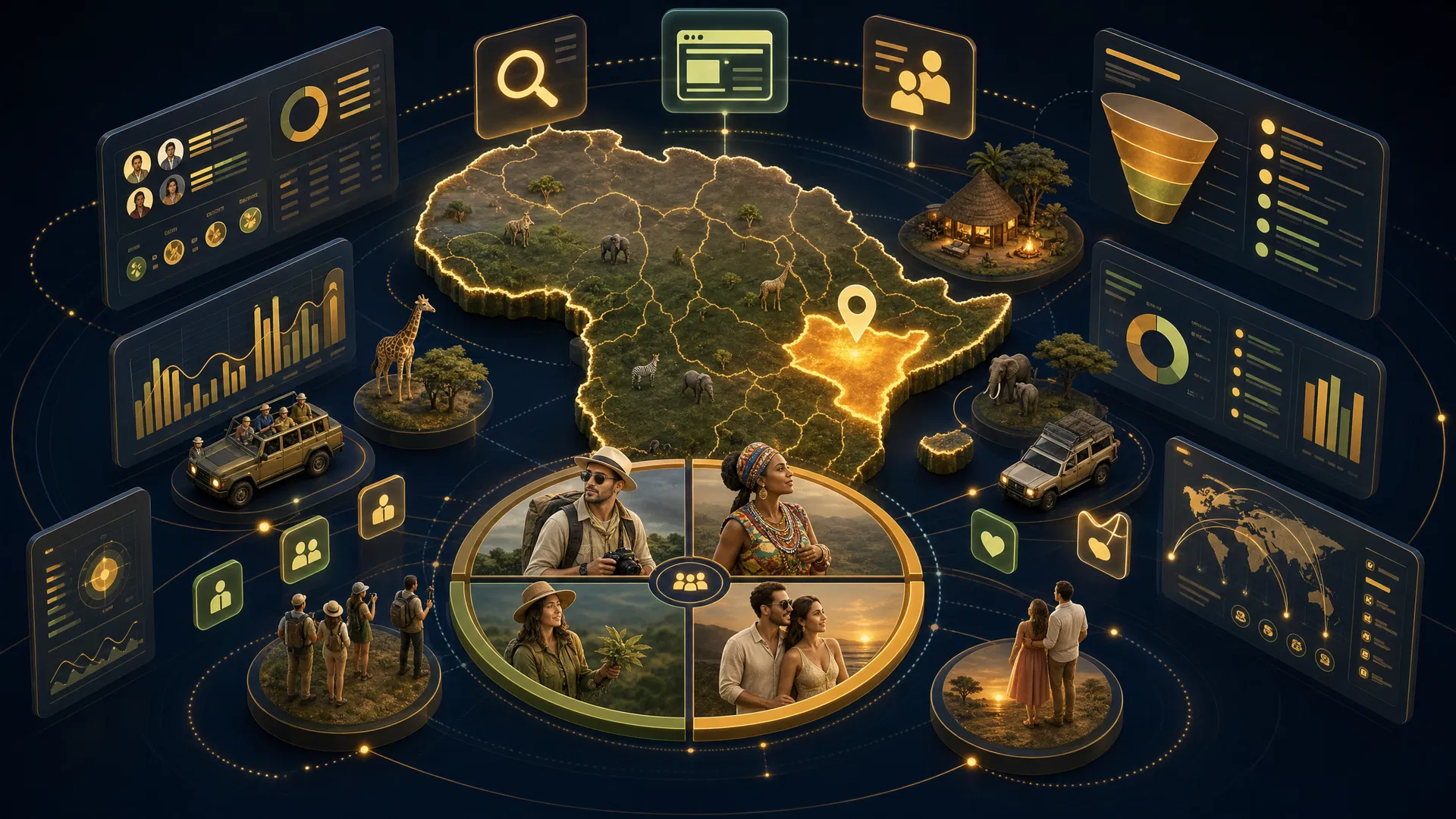
Persona targeting transforms destination marketing economics
ROAS
vs. 2.1x baseline
CPL Reduction
vs. generic campaigns
Booking Enquiries
high-value segments
Persona Archetypes
each with bespoke strategy
Paid Channels
search, social, programmatic
Markets Reached
UK, EMEA, North America
The Situation
An East African national tourism board had a world-class destination product, dramatic landscapes, extraordinary wildlife, rich cultural heritage, and a growing luxury lodge infrastructure, but was struggling to convert that product quality into measurable booking enquiry volume from high-value UK and European travellers.
The existing digital marketing approach treated all potential visitors as a single audience: broad destination awareness campaigns featuring generic wildlife imagery and "experience Africa" messaging. The result was high impression volume, poor engagement, and a cost per booking enquiry that made the program economically unsustainable at scale.
The fundamental insight was that "luxury traveller" is not a single persona. A high-net-worth couple planning a honeymoon has entirely different motivations, search behaviors, and booking triggers than a conservation-conscious eco-traveller or a culturally curious explorer. Treating them identically was the root cause of the campaign's underperformance.
Key Challenges
The Insight: One Destination, Four Distinct Buyers
Audience research using GWI data, search intent analysis, and historical campaign performance revealed four distinct high-value traveller archetypes, each with different motivations, search behaviors, content preferences, and booking triggers.
The Luxury Adventurer responds to exclusivity signals: private camps, champagne sundowners, bespoke itineraries. The Cultural Explorer is motivated by authenticity and immersion. The Eco-Traveller wants proof of conservation impact. The Honeymoon Couple is buying a memory, not a trip.
The strategic shift was to stop competing on destination awareness and start competing on persona relevance, delivering the right emotional trigger to the right archetype at the right moment in their research journey.

Four Archetypes. Four Strategies. One Destination.
Luxury Adventurer
High-net-worth travellers seeking premium safari experiences with exclusivity signals, private camps, champagne sundowners, bespoke itineraries.
Cultural Explorer
Intellectually curious travellers motivated by authentic local experiences, heritage, and immersion in Maasai culture and ancient landscapes.
Eco-Traveller
Conservation-conscious travellers who want their visit to contribute to wildlife protection and community development, sustainability as a purchase driver.
Honeymoon Couple
Couples seeking a once-in-a-lifetime romantic experience combining dramatic landscapes, intimate lodges, and unforgettable shared memories.
Persona-Led Multi-Channel Strategy
A six-stage program that moved from audience research to continuous optimization, with each stage feeding data back into the targeting and creative loop.
Audience Research
GWI data, search intent analysis, and historical campaign performance used to identify four high-value traveller archetypes with distinct booking triggers.
Persona Architecture
Each persona mapped to specific search queries, social interests, content preferences, and booking objections, creating a targeting blueprint for each segment.
Creative Development
Bespoke creative assets developed for each persona: exclusivity signals for Luxury Adventurers, authenticity cues for Cultural Explorers, conservation proof for Eco-Travellers, romance framing for Honeymoon Couples.
Multi-Channel Activation
Paid search captured high-intent queries; programmatic display built awareness; paid social (Facebook/Instagram) drove upper-funnel engagement and retargeting.
A/B Testing Program
Structured testing across messaging, imagery, and CTAs for each persona segment, identifying the specific emotional triggers that drove booking intent.
Attribution & Optimization
Multi-touch attribution model tracked the full journey from impression to booking enquiry, with continuous bid and budget reallocation to highest-ROAS segments.
The Results
The shift from generic destination awareness to persona-led targeting transformed the economics of the program. ROAS improved from 2.1x to 4.8x, a 128% improvement , while cost per booking enquiry fell by 62% as the higher relevance of persona-specific creative drove significantly better click-to-enquiry conversion rates.
High-value booking enquiries, defined as enquiries from travellers with a stated budget above the program's target threshold, increased by 38%. The persona architecture proved particularly effective at attracting Luxury Adventurers and Honeymoon Couples, the two segments with the highest average booking value.
The A/B testing program generated a library of persona-specific creative insights that informed not just the digital campaign but the broader destination marketing strategy, including content partnerships, influencer briefs, and trade marketing materials.
"The moment we stopped talking to 'luxury travellers' and started talking to four distinct people with four distinct dreams, everything changed. The Honeymoon Couple doesn't want a safari, they want a story they'll tell for the rest of their lives. That's a completely different brief."
Services Used in This Engagement
About the Strategist
Modi Elnadi is a Director of Marketing and AI Growth with 16+ years of experience across destination marketing, luxury travel, FinTech, SaaS, FMCG, and enterprise technology. He has managed £20m+ paid media portfolios and delivered ROAS improvements in the 5x to 35x range across B2C and B2B programs.
His approach combines the science of data-driven audience segmentation and structured A/B testing with the art of persona-led creative strategy, building marketing systems that are both analytically rigorous and emotionally resonant.
Today, Modi leads AI-first growth marketing at Integrated.Social, combining agentic AI orchestration with 16+ years of performance marketing expertise to help ambitious brands build scalable, measurable growth engines.
Credentials
Frequently Asked Questions
What was the core challenge for the destination marketing campaign?+
How were the four traveller personas identified and activated?+
Which channels drove the strongest performance?+
What role did A/B testing play in the campaign?+
How was the campaign measured and attributed?+
What were the key lessons for destination marketing?+
Ready to Build a Persona-Led Growth Engine?
Whether you're in travel, SaaS, or enterprise technology, the same principles apply. Identify your distinct buyer archetypes, build bespoke strategies for each, and let data drive continuous optimization.