Understanding AI Governance: Quality Control in 2026
AI Governance: Ensuring Quality at Scale in 2026
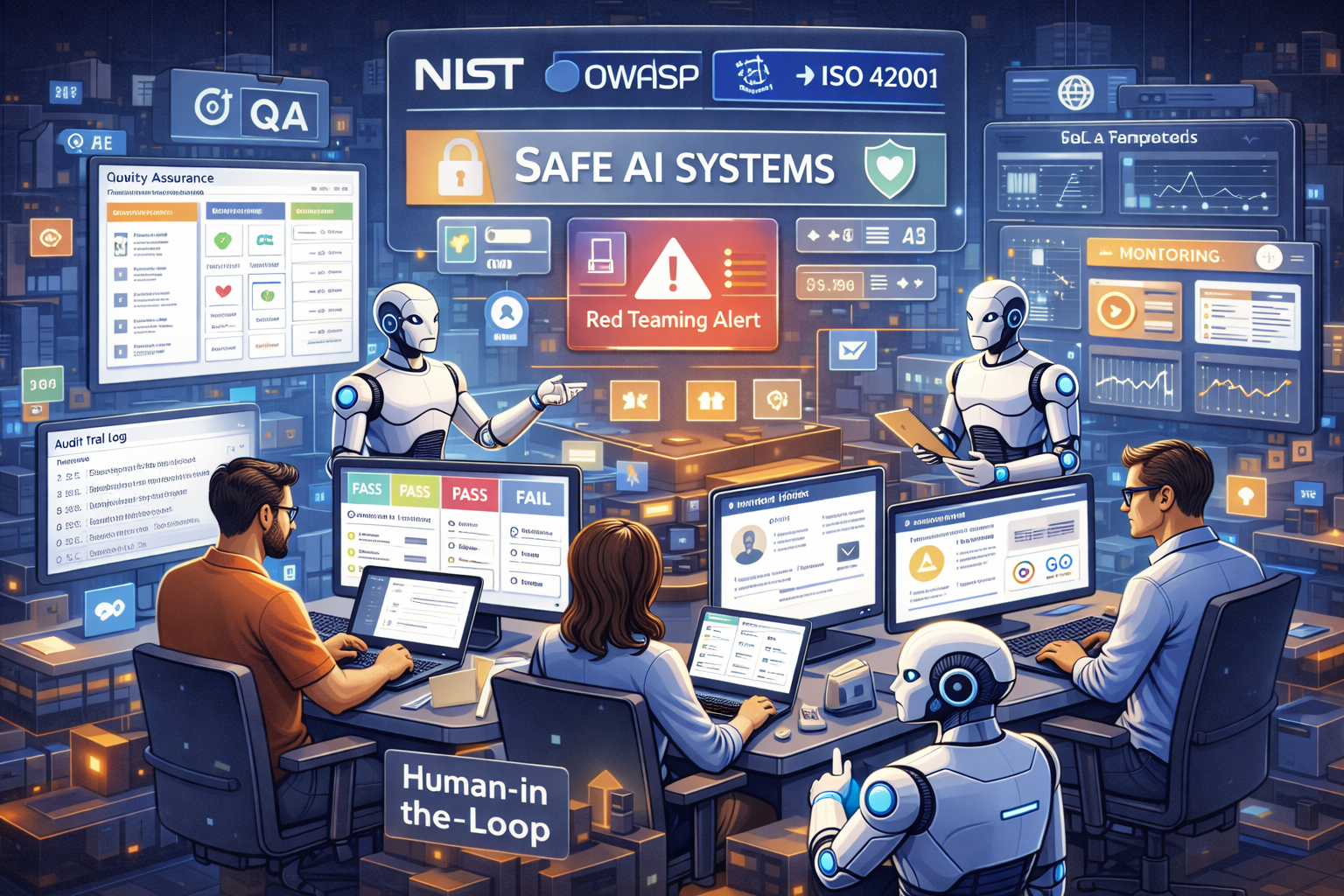
Introduction
Governed quality at scale means using AI only with measurable controls: QA gates, red teaming, continuous monitoring, and an audit trail that proves what the system did and why. In 2026, this is how teams ship AI safely, meet compliance expectations where applicable, and avoid confidently wrong outputs that damage revenue and trust. The fastest teams are not the least governed, they are the most operationally disciplined.
TL;DR
- The real advantage of working with AI is not speed, it is governed quality at scale, meaning you can prove outputs are reliable.
- “Human-in-the-loop” only works when it is designed as QA gates with escalation rules, not vague approvals.
- Prompt injection and agent failures are structural risks, so controls must live outside prompts (permissions, logs, validation).
- Use recognised frameworks: NIST AI RMF, NIST GenAI Profile, OWASP Top 10 for LLMs, EU AI Act, ISO/IEC 42001.
- Build an audit trail that captures inputs, outputs, actions, model versions, and human overrides.
- Continuous assurance is evals + monitoring + incident response + change control, not a one-time policy document.
- Teams that can prove quality win procurement, trust, and performance.
What is “governed quality at scale” in AI?
Governed quality at scale is an operating model where AI outputs are treated like production software, not drafts. You define quality criteria, enforce QA gates, run red teaming, log decisions in an audit trail, and use human-in-the-loop escalation involving data scientists for high-risk actions. The goal is provable reliability, not optimistic velocity.
Definition: Governed quality at scale = AI output reliability you can prove, not just claim.
It requires QA gates, continuous assurance, red teaming, and an audit trail tied to ownership.
Why “governed quality” beats “speed”
Speed is now cheap. Every team can generate drafts quickly. What very few teams can do is:
keep quality consistent across thousands of outputs,
reduce security and compliance risk,
explain errors when something goes wrong,
and demonstrate accountability to procurement, legal, and leadership.
That is the competitive gap.
Why does this matter right now?
It matters now because AI systems are embedded in customer-facing journeys (search, support, commerce), and regulators and security bodies are treating risks like prompt injection, misinformation, and unsafe automation as persistent. At the same time, governance frameworks and standards are pushing organisations toward evidence-based controls, including necessary human oversight, rather than “trust us” policies.
Three shifts driving urgency
The surface area expanded: AI answers and assistant experiences compress decision time and errors look authoritative. Human feedback can play a role in optimizing these interactions.
Risk is harder to patch: Prompt injection is not reliably solved by better prompts alone, highlighting the importance of integrating human feedback.
Proof beats promises: Procurement and stakeholders increasingly ask “show me the controls” not “tell me you are careful.”
If you can't prove quality, you're not working with AI, you're outsourcing accountability.
Key Concepts: How governed AI works
Governed AI works through two loops:
a quality loop (define, test, gate, monitor),
and a responsibility loop (log, approve, audit, improve).
Security guidance emphasises that controls must exist outside the prompt, because prompt injection is a practical and persistent risk.
Mini-glossary
QA gates: checkpoints that block publishing/execution unless criteria are met to support effective digital transformation
Continuous assurance: ongoing testing and monitoring throughout the lifecycle to enhance digital transformation initiatives
Red teaming: adversarial testing to break the system (prompt injection, data leaks, tool misuse), ensuring robust systems in a landscape driven by digital transformation
Audit trail: logged evidence of inputs, outputs, actions, versions, and human overrides
Human-in-the-loop (HITL): human escalation and approval by risk threshold, not vague review
QA gates: what they are and how to design them
QA gates are explicit checkpoints where AI outputs must meet criteria before they can be published, sent, or acted on, ensuring that algorithms can be effectively monitored. Gates can be automated (eval thresholds) or human (approval), but they must be rule-based, role-owned, and logged.
Common gate types
Brand/claims gate: factual claims require citations, tone requirements, and safety checks to ensure fairness.
Data gate: no PII leakage, correct scope, approved sources only
Action gate: any tool call that changes state (refund, price change, ad spend) requires approval
Compliance gate: regulated language checks, record retention, and disclosures
Good governance does not slow teams down, it prevents rework and incidents.
Continuous assurance: keep it good after launch
Continuous assurance means quality is monitored and improved throughout the lifecycle, not only during launch. NIST's approach emphasises lifecycle governance and ongoing review, which translates operationally into evals, monitoring, and incident-driven improvements, potentially proving ROI on governance efforts.
Minimum Viable Set: What to monitor
Output quality score trend (eval pass rate)
Escalation rate (how often humans intervene)
Incident rate (policy violations, wrong answers)
Cost per task and latency
Drift indicators (changes in user intent, data, model version)
Red teaming: adversarial testing for real-world misuse
Red teaming is structured adversarial testing where you attempt to break the system: prompt injection, data exfiltration, unsafe actions, and policy bypasses, often involving principles from computer science. OWASP categories and UK NCSC guidance underline why prompt injection needs architectural controls beyond prompting.
Red team scenarios to run
Prompt injection in user content
Retrieval leakage (RAG returning sensitive data)
Tool abuse (refunds, spend, deletion)
Hallucinated citations and false claims
Authority errors in sensitive topics
Audit trail: what to log and why it matters
An audit trail is the evidence layer that records key inputs, outputs, actions, model versions, tool calls, and human overrides, creating a feedback loop that supports compliance, forensics, and trust, especially for agentic systems where actions matter.
Minimum audit trail fields
Timestamp, user/session ID (privacy-safe)
Prompt/instruction version
Model/version identifier
Retrieved sources and snippets (if RAG)
Output text and confidence/score (if available)
Tool calls and parameters
Approvals, edits, overrides (who, what, why)
Final published/executed outcome
Step-by-step: How to prove AI quality at scale
To prove AI quality at scale, implement a seven-step governance loop: classify risk, define quality metrics, build QA gates, red team threats, deploy with monitoring, maintain audit trails, and run incident-driven improvements. This aligns with lifecycle risk management and security guidance that pushes controls outside the prompt and can go a long way.
7 Important Steps
Risk classification
Quality metrics and thresholds
QA gates (automated + human)
Red teaming
Monitoring and drift detection
Audit trail
Incident response and change control
1) Classify use cases by risk and “blast radius”
Start by splitting AI use cases into low, medium, and high risk based on impact, reversibility, and regulatory exposure. A copywriting assistant is lower risk, an agent that changes prices or sends legal responses is higher risk in terms of understanding natural language.
Checklist:
Can it cause financial loss, legal exposure, or safety harm?
Does it trigger irreversible actions?
Does it touch personal data?
Is it customer-facing?
2) Define quality in measurable terms
Quality must be measurable or it is not governable. Define success metrics like accuracy, completeness, groundedness, policy compliance, latency, and cost. Tie quality to real business outcomes.
3) Design QA gates mapped to risk
Build QA gates that match risk level. Use automated evals for consistency and human approvals for high-stakes outputs. Assign owners. Log every pass/fail/override.
4) Red team the system, not only the model
Red team prompts, retrieval, tool permissions, connectors, and user inputs. Assume prompt injection risk and design for containment.
5) Ship with monitoring and drift detection
Monitoring is the proof layer that quality stays within thresholds as the world changes. NIST GenAI Profile treats ongoing monitoring and review as governance activities.
6) Build an audit trail that supports investigations and audits
Log inputs, sources, versions, tool calls, outputs, and human overrides. Make logs queryable and privacy-aware.
7) Treat incidents as learning loops
When failures occur, run incident response like production software: root cause, containment, remediation, and regression tests. Then update gates, evals, and permissions.
Common mistakes and how to avoid them
The most common failures come from vague ownership and “governance theatre”: teams say HITL but do not define gates, they rely on system prompts as security boundaries, they do not log decisions, and they skip adversarial testing. Moreover, these issues may lead to ignored biases in machine learning processes. Engineering communities repeatedly flag over-trust and brittleness as real production risks.
Mistake 1: HITL with no threshold
Fix: define escalation triggers (uncertainty score, policy risk, action type).
Mistake 2: Prompts as security boundaries
Fix: implement least-privilege permissions, allowlists, and external validation.
Mistake 3: No evals, only subjective review
Fix: build workflow-specific test sets and track pass rates over time.
Mistake 4: No audit trail
Fix: log inputs, outputs, actions, versions, and overrides by design.
Mistake 5: Governance as paperwork
Fix: embed gates and logging into the tools people already use.
Tools and options
Direct Answer: You do not need one “magic governance tool,” you need a coherent stack: risk frameworks (NIST AI RMF), GenAI implementation guidance (NIST GenAI Profile), security threat models (OWASP Top 10 for LLMs, NCSC prompt injection guidance), compliance anchors (EU AI Act where applicable), and a management system (ISO/IEC 42001).
| Option | Best for | Pros | Cons | Watch-outs |
|---|---|---|---|---|
| NIST AI RMF 1.0 | Enterprise risk framing | Clear lifecycle functions, widely referenced | Not prescriptive about tooling | Needs translation into workflow controls |
| NIST GenAI Profile (AI 600-1) | GenAI-specific governance | Maps GenAI risks to controls, continuous review | Dense document, requires tailoring | Treat as implementation guide, not checkbox |
| OWASP Top 10 for LLMs | AppSec and security teams | Practical threat categories (prompt injection, leakage) | Not a full governance model | Use for red teaming and secure design |
| EU AI Act (where applicable) | Regulated/high-risk AI in EU | Formal obligations: oversight, transparency, record-keeping | Scope complexity, evolving enforcement | Map obligations to logs, gates, instructions |
| ISO/IEC 42001 | Management system and certification | Governance credibility, continual improvement model | Can become bureaucracy | Implement “minimum viable AIMS” first |
| Model cards + datasheets | Documentation for transfer and accountability | Makes intended use and limits explicit | Often ignored without incentives | Tie docs to release gates |
| HITL orchestration patterns | Operational approvals | Standardises escalation and approval flows | Can slow delivery | Gate only where it matters |
Use cases
Governed quality is most valuable where mistakes are expensive: customer-facing AI, regulated workflows, and any agentic automation that changes state. In these contexts, maintaining high data quality is crucial, as one “confidently wrong” response can outweigh months of automation savings.
Marketing and AI search content ops: claims review, citations, and change control for AEO/GEO pages, using a human-in-the-loop approach for enhanced accountability and transparency.
Customer support copilots: draft responses, escalate refunds and complaints, implementing a human-in-the-loop approach to ensure thorough review and decision-making.
Sales enablement: proposals with retrieval constraints and logged approvals, incorporating a human-in-the-loop approach to bolster compliance and clarity.
Ecommerce operations: catalogue enrichment, promo QA gates, pricing suggestions
Sensitive domains: strict oversight, testing, and auditability expectations
Who oversees responsible AI governance?
In today's rapidly evolving AI landscape, the responsibility for overseeing AI governance is shared across various levels of an organization, as it aligns with today's newest trend. Key stakeholders include the CEO and senior leadership, who set the tone for ethical AI use and establish a culture of accountability. They are supported by legal and compliance teams that ensure adherence to relevant laws and regulations, as well as audit teams tasked with validating data integrity and system operations. This collective approach fosters a comprehensive governance framework that can effectively manage risks associated with AI deployment.
Furthermore, the role of AI governance extends beyond compliance; it involves continuous monitoring and adaptation to emerging challenges. As organizations increasingly rely on AI technologies, ensuring responsible governance best practices becomes paramount to maintain trust and mitigate potential biases. By embracing a collaborative model, organizations can better equip themselves to navigate the complexities of AI governance and uphold ethical standards.
Key Takeaways
Speed is commoditised, provable quality is differentiated.
QA gates turn HITL from a slogan into a system.
Red teaming must target the whole system, not only prompts.
Audit trails are your chain of responsibility and your forensic layer.
Continuous assurance means evals and monitoring, not one-off review.
Controls must live outside prompts because prompt injection persists.
Recognised frameworks converge when translated into workflow controls.
FAQs
1) What does “governed quality at scale” actually mean?
It means you can demonstrate AI output reliability with evidence: QA gates, eval scores, red-team results, audit logs, and human overrides in relation to ML models. If something goes wrong, you can show what happened, when, why, and who approved it.
2) Isn’t “human-in-the-loop” enough?
Not by itself. HITL works only when it is an escalation design with thresholds, owners, and logs. Otherwise it becomes inconsistent, slow, and sometimes ignored under pressure.
3) What are QA gates for AI?
QA gates are checkpoints that prevent low-quality or high-risk outputs from being published or executed, similar to the standards set by IBM. Gates can be automated (eval thresholds) or human (approval), and they must be explicit, role-owned, and logged.
4) What should an AI audit trail include?
At minimum: inputs, retrieved sources (if any), outputs, model and prompt versions, tool calls, system actions, and human edits or overrides to ensure relevance. Include timestamps and a final decision path within privacy rules.
5) What is red teaming for GenAI?
Red teaming is adversarial testing: prompt injection, data leakage, unsafe tool actions, policy bypasses, and hallucinated claims. It matters because many LLM risks are exploit-driven.
6) Can prompt injection be fully solved?
Assume residual risk. Use least-privilege tool permissions, allowlists, external validation, and escalation gates to limit consequences.
7) What is continuous assurance in AI?
It is ongoing evaluation and monitoring to keep quality within thresholds as data, prompts, models, and users change. NIST's GenAI Profile frames ongoing monitoring and review as governance activities.
8) Which frameworks should we start with?
Start with NIST AI RMF for lifecycle risk management, OWASP Top 10 for LLMs for security prioritisation, and EU AI Act mapping if you have regulated/high-risk uses that also incorporate human input. Add ISO/IEC 42001 if you need a formal management system.
9) Do we need ISO/IEC 42001 certification?
Only if buyer pressure or governance maturity goals justify certification overhead. Many teams should implement a minimum viable AI management system first, then certify later.
10) How do we prevent governance from slowing teams down?
Gate only what matters. Use automated evals for routine checks and reserve human approvals for high-stakes actions and claims. Good governance reduces incidents and rework, improving throughput over time.
11) How do model cards and datasheets help in practice?
They clarify intended use, limitations, and evaluation context, reducing misuse and enabling consistent review. They work best when required as part of release gates.
12) What’s the biggest failure pattern?
“Vibes-based AI adoption”: pilots work, then production breaks because there are no evals, no gates, no audit trail, and prompt-only security. Communities flag over-trust and brittleness as real production risks.
13) How does this relate to SEO, AEO, and AI answers visibility?
AI answers amplify mistakes. If your content is inconsistent or unclear, models can summarise it incorrectly, increasing support costs and brand risk. Governance applies to content ops too: citations, claims review, and change control, particularly during the machine learning process.
14) What is the minimum viable governance stack?
Risk classification, evals, QA gates, monitoring, audit trail, and an incident playbook. Add red teaming early if the system is customer-facing or tool-using.
Principles and standards of responsible AI governance
In the realm of responsible AI governance, establishing clear principles and standards is crucial for ensuring ethical and effective AI deployment, including in software development. Key ethical considerations include transparency, accountability, and bias control. Transparency involves openly communicating how AI systems operate and make decisions, allowing stakeholders to understand the underlying processes. Accountability ensures that organizations take responsibility for the outcomes of their AI systems, fostering trust among users and regulators alike.
Moreover, bias control is essential to prevent AI systems from perpetuating existing inequalities. Active learning organizations must rigorously evaluate training data and algorithms to identify and mitigate biases, ensuring fair and equitable outcomes. As regulations like the AI Act emerge, aligning governance practices with these principles will help organizations not only comply with legal standards but also build a foundation for ethical AI that prioritizes the well-being of all stakeholders.
What regulations require AI governance?
As AI technologies become more pervasive, regulatory frameworks are evolving to ensure their responsible use, recognizing the need for human intervention in the process. The EU AI Act stands out as a comprehensive regulatory initiative that categorizes AI systems based on their risk levels, imposing stricter requirements on high-risk applications. Organizations developing or deploying AI in the EU must adhere to these regulations, which include transparency obligations, risk assessments, and human oversight mechanisms.
In addition to the EU AI Act, various countries are implementing their own AI governance frameworks. For instance, Canada's Directive on Automated Decision-Making outlines the requirements for AI systems used in government decision-making processes, emphasizing the need for transparency and accountability. As the regulatory landscape continues to shift, organizations must remain vigilant and proactive in adapting their governance practices to comply with emerging standards, thereby ensuring ethical AI governance and deployment.
The EU AI Act
The EU AI Act is a landmark piece of legislation designed to regulate the development and use of artificial intelligence across member states. This act categorizes AI systems into various risk levels, mandating different compliance requirements based on the potential risks they pose to individuals and society. High-risk AI systems, for instance, must undergo rigorous assessments and implement specific safeguards, including human oversight and transparency measures. This regulation plays a crucial role in shaping the future of AI. Non-compliance can result in substantial fines, underscoring the importance of adhering to these regulations.
As organizations navigate the implications of the EU AI Act, they must establish robust governance frameworks that align with the act's requirements. This includes documenting decision-making processes, ensuring accountability, and maintaining an audit trail to track AI system performance, including performance alerts. By prioritizing compliance with the EU AI Act, organizations can mitigate risks and foster trust in their AI applications, ultimately contributing to a safer digital landscape.
Canada’s Directive on Automated Decision-Making
Canada's Directive on Automated Decision-Making serves as a guiding framework for the use of AI in governmental contexts. This directive emphasizes the importance of transparency, accountability, and human expertise oversight in AI processes, particularly when decisions impact citizens. Organizations developing AI systems for government use are required to assess the potential risks and ensure that adequate safeguards are in place to protect individuals' rights.
The directive also mandates public disclosure of automated decision-making practices, helping to build trust and accountability. By complying with these guidelines, organizations can not only fulfill legal obligations but also demonstrate a commitment to ethical AI tool practices that respect the rights and interests of all stakeholders involved.
Europe’s evolving AI regulations
The regulatory landscape for AI in Europe is rapidly evolving, with the European Commission actively working to establish comprehensive frameworks that address the challenges associated with AI technologies, particularly with regards to training data. Following the introduction of the EU AI Act, additional regulations are being developed to cover various aspects of AI deployment, including ethical considerations, data protection, and governance standards. These evolving regulations aim to create a cohesive and transparent environment for AI innovation while safeguarding fundamental rights.
Organizations must stay informed about these developments and adapt their governance frameworks accordingly, similar to a financial services firm. By aligning with emerging regulations, businesses can not only ensure compliance but also enhance their reputation as responsible AI innovators. This proactive approach fosters trust among users, regulators, and the broader public, paving the way for sustainable AI growth in Europe.
AI governance regulations and guidelines in the Asia-Pacific region
The Asia-Pacific region is witnessing a surge in AI governance initiatives aimed at promoting responsible AI development and deployment, supported by a robust AI governance platform. Countries like China, Singapore, and Australia are implementing regulations and guidelines that emphasize ethical considerations, transparency, and accountability in AI systems. China's Interim Measures for the Administration of Generative Artificial Intelligence Services, for instance, outlines specific requirements for AI service providers to ensure compliance with data protection and privacy standards.
Furthermore, Singapore has introduced a governance framework that addresses ethical AI use in the private sector, while Australia is exploring regulatory measures to manage the ethical considerations and risks associated with AI technologies. As these regulations continue to evolve, organizations operating in the Asia-Pacific region must prioritize compliance and adopt best practices to ensure responsible AI governance, thereby fostering public trust and safeguarding individuals' rights.
Feel free to reach out if you need further adjustments or additional content!
Conclusion
If you want AI to create durable advantage, optimise for provable quality, not novelty. Governed quality at scale is a discipline: QA gates, red teaming, audit trails, monitoring, and human escalation. This is how you ship faster without betting your brand on “hopefully it works.” A recent 2024 study from Stanford highlighted the importance of optimising quality in AI models.
Work with Modi Elnadi
Modi is the founder of Integrated.Social, a London-based AI Search and performance marketing consultancy. He helps B2B and ecommerce teams scale pipeline by blending AI-driven performance marketing (predictive lead scoring, intent-led personalisation, conversational qualification, and automation) with AEO/GEO/LLMO; so brands earn visibility inside AI answers while still converting those visits into measurable revenue.
Modi’s work focuses on making AI growth operational and provable: improving data readiness and structured content, building always-on experimentation across SEO and paid media, and tightening measurement from MQL volume to SQL quality, using multi-touch attribution and revenue forecasting. He has led growth programmes across the UK, EMEA, and global teams; turning fast-moving AI platform shifts into practical playbooks, governance, and repeatable outcomes.
Get a Free AI Growth Audit: https://integrated.social/free-ai-growth-audit
AI SEO + AEO + GEO (AI Answers visibility): https://integrated.social/ai-seo-aeo-geo-aio-agency-london
PPC + Performance Max strategy and execution with AI models: https://integrated.social/ppc-performance-max-agency-london
AI Marketing Strategy + GenAI Content Ops: https://integrated.social/ai-marketing-strategy-genai-content-ops-london