
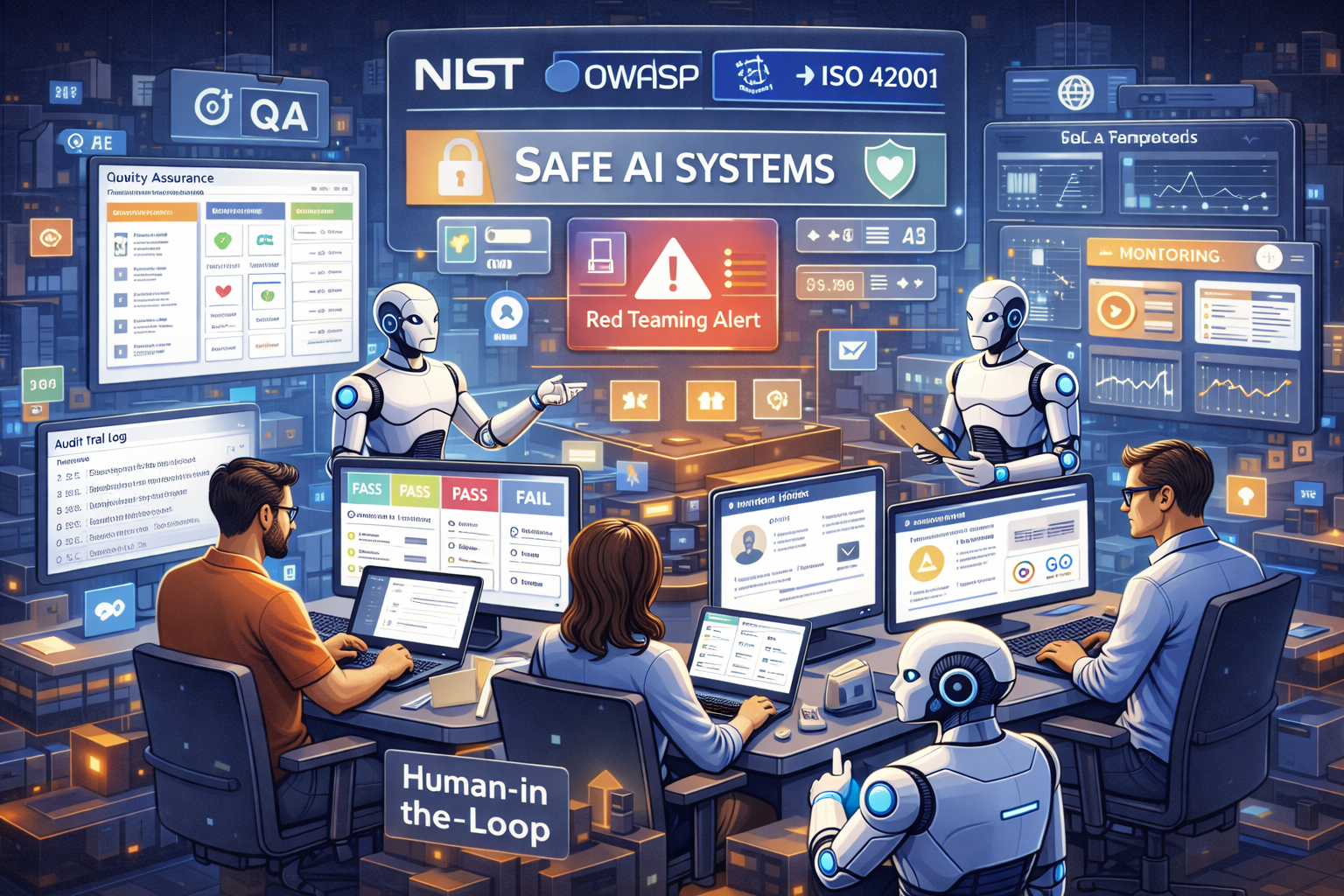
Understanding AI Governance: Quality Control in 2026
AI adoption is no longer a race for speed, it is a competition for provable quality. In 2026, “work with AI” only works if you can demonstrate governed outputs at scale: QA gates, red teaming, audit trails, monitoring, and human-in-the-loop controls where risk is real. This guide explains the frameworks (NIST, OWASP, EU AI Act, ISO 42001) and gives a practical step-by-step system to ship AI safely, credibly, and profitably.
44 Jobs OpenAI Uses to Measure AI Capability
GDPval is OpenAI’s “real-work” evaluation: instead of exam questions, it measures whether AI can produce economically valuable deliverables professionals would actually ship. It spans 44 knowledge-work occupations across nine U.S. GDP-leading sectors, selected using BLS wage data and O*NET task analysis with a 60% digital-work threshold. The benchmark includes 1,320 expert-designed tasks (plus a 220-task open gold subset) requiring artifacts like legal briefs, nursing care plans, financial spreadsheets, sales decks, and multimedia. Outputs are graded with blind, head-to-head expert preference judgments, complemented by an experimental automated grader. OpenAI notes models can be faster and cheaper on inference, but human oversight and integration matter. In this guide, you’ll get the full list of jobs, the methodology, what the early results imply for AI productivity and AI search, and what comes next: more roles, more multimodal context, and more iterative, ambiguity-heavy workflows. (integrated.social)

OpenAI's ChatGPT o1 Model is out! the Future of AI Reasoning is Here
🚀 Embracing the future of AI with OpenAI's new ChatGPT hashtag #o1 model—slower, smarter, and designed for deeper reasoning! Ready to rethink how we measure AI success? 🌐💡 #ArtificialIntelligencehashtag #MachineLearninghashtag #AIInnovationhashtag #TechTrendshashtag #AIhashtag#AGIhashtag #OpenAihashtag #ChatGPT