OpenAI IPO Hurdles vs Anthropic
ChatGPT AI Ads Revenue, Cashflow, Copyright, and Regulation (2026)
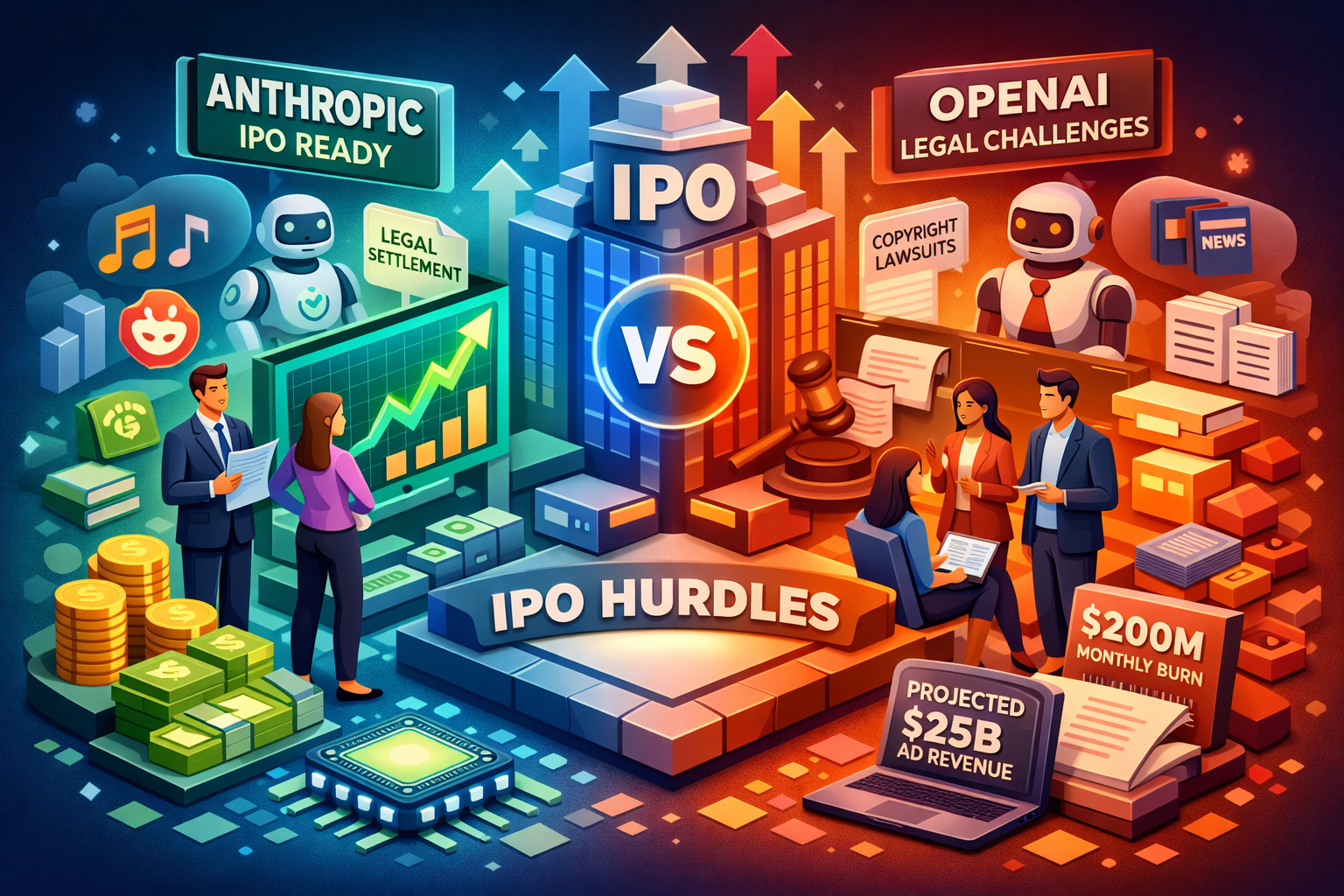
Quick Summary
OpenAI's advertising business could exceed $25B in annual app revenue by 2030, with a plausible path to several billion in 2026, according to Evercore ISI analyst Mark Mahaney (as reported by Business Insider). OpenAI is an artificial intelligence research organization known for developing advanced AI models and systems, such as ChatGPT, that help individuals and businesses with tasks like natural language processing, content generation, and data analysis.
OpenAI's CFO reported annualised revenue exceeded $20B in 2025, rising from $6B in 2024 and $2B in 2023, while compute capacity expanded materially, highlighting the importance of technological advancement. Reuters (citing The Information) reported OpenAI projected cash burn of $115B through 2029, including >$8B in 2025 and $17B in 2026. To use ChatGPT from OpenAI for free, simply visit the official OpenAI website and sign up for an account. The free version provides access to the basic ai capabilities of ChatGPT, making it easy for anyone to experience this technological advancement without cost.
Reuters (citing The Information) reported OpenAI projected cash burn of $115B through 2029, including >$8B in 2025 and $17B in 2026.
Anthropic looks more “IPO-ready” because it is actively reducing uncertainty, including a major settlement that turns open-ended risk into defined cost.
Regulation is now an IPO factor, not background noise: EU AI Act GPAI obligations apply from 2 August 2025, plus ongoing SEC scrutiny of AI claims (“AI-washing”).
OpenAI has just confirmed it will begin testing paid AI advertisements within ChatGPT in early February 2026. This shift marks a significant departure for the company, which previously relied almost exclusively on subscriptions for revenue.The upcoming ad trials will include several key features and restrictions:
Target Audience: Ads will appear for adult users in the United States who are logged into the Free tier or the new ChatGPT Go ($8/month) subscription.
Ad-Free Tiers: Higher-priced plans, including Plus, Pro, Business, and Enterprise, will remain completely ad-free.
Placement and Format: Advertisements will be clearly labeled and placed at the bottom of chat responses when there is a relevant sponsored product or service.
Pricing Model: Unlike the standard cost-per-click model used by search engines, OpenAI is reportedly testing a cost-per-view (impression) model.
Privacy Protections: OpenAI has stated that ads will not influence the chatbot's answers and that users' personal conversation data will not be shared with marketers.
Content Restrictions: Ads will not appear for users under 18 or in conversations involving sensitive or regulated topics like health, mental health, or politics.
Key Numbers Investors Will Quote
| Metric | OpenAI | Anthropic | Why it matters for IPO underwriting |
|---|---|---|---|
| Annualised revenue (latest reported) | >$20B (2025) (Reuters) | Not disclosed at same level | Supports valuation, but margins decide durability |
| Ads potential (estimate) | $25B+ by 2030, “several $B” in 2026 (Business Insider) | Not the same public push | Monetisation lever for profitability narrative |
| Projected cash burn (reported) | $115B through 2029 (Reuters) | Capital intensive, but less public detail | Capital intensity drives financing needs and risk |
| Major copyright posture signals | Broad, high-profile disputes | Settlement converts risk to cost | Public markets price bounded risk more easily |
| EU AI Act timing | GPAI obligations from 2 Aug 2025 (Digital Strategy) | Same | Compliance is recurring cost and enforcement exposure |
Why this matters to investors in 2026
AI IPOs are no longer priced purely on growth; they are priced on uncertainty management. Copyright exposure, regulatory obligations, and compute-driven cash burn can delay IPO windows or force valuation discounts. OpenAI, led by Sam Altman, may build a major ads business, but Anthropic may reach public-market readiness sooner by reducing legal ambiguity. For the latest updates or news about OpenAI, investors can visit OpenAI’s official website and follow the company on its social media channels, as well as monitor reputable technology and business news outlets for breaking developments.
The underwriting problem: “Can liability be bounded?”
Underwriters and institutional investors can price known costs, but they struggle to price unbounded downside from unresolved litigation or unclear regulatory duties concerning key products. In AI, legal timelines often run longer than IPO calendars. That mismatch increases risk factor disclosure, increases diligence friction, and typically increases the valuation discount. Notably, industries such as technology, finance, healthcare, and legal services are among those using OpenAI’s technologies the most, which amplifies these underwriting and liability challenges as they work to integrate cutting-edge AI solutions into regulated environments.
What “IPO-ready” means for an AI model company
For AI model companies, “IPO-ready” usually means audited financial controls, repeatable revenue, defensible unit economics, and governance that can withstand continual scrutiny. It also means credible compliance programmes for emerging AI regulation and a litigation posture that does not create existential downside scenarios in datasets that are impossible to quantify in a prospectus. To answer your question, yes, a ChatGPT mobile app is available for both iOS and Android devices. The app allows users to interact with ChatGPT on the go, offering features similar to the desktop version, such as conversational AI responses, chat history, and the ability to use advanced capabilities depending on your subscription or plan.
IPO readiness checklist investors apply
Investors typically assess five readiness pillars: (1) revenue quality and concentration, (2) cost structure and gross margin ceiling, (3) compliance maturity (EU AI Act, privacy), (4) speech recognition in litigation and IP exposure, and (5) disclosure discipline to avoid "AI-washing" allegations. The last two have become decisive for AI listings. For those seeking alternatives to OpenAI for AI tools or chatbots, options such as Google Bard, Anthropic’s Claude, Cohere, and Meta’s Llama models are leading choices, offering innovative features and differing approaches to AI development.
Anthropic’s IPO readiness signals
Direct Answer (40–60 words): Anthropic appears to be taking classic “IPO prep” steps earlier: engaging IPO-experienced counsel and leadership, while narrowing legal uncertainty relative to peers. Notably, Ilya Sutskever has emphasized the importance of strategic moves in preparation. Reuters reported Anthropic preparing for a potential IPO as early as 2026, with IPO counsel engaged and early-stage bank discussions, even if a firm timetable is not set.
Why Anthropic’s legal path looks more underwritable
Direct Answer (40–60 words): Anthropic's biggest underwriting advantage is that it can convert uncertainty into defined cost using natural language processing techniques. Reuters reported a $1.5B settlement related to an author class action tied to pirated books, including requirements to destroy pirated copies. Settlements do not eliminate future claims, but they bound existing exposure in a way public markets can price.
What this implies for 2026 IPO timing
Direct Answer (40–60 words): If Anthropic keeps reducing headline litigation and demonstrates compliance readiness for the EU AI Act's GPAI obligations, it may be able to move faster in 2026 because its prospectus can describe risk with narrower ranges. That does not guarantee an IPO, but it makes an IPO easier to underwrite at scale, similar to how DALL-E revolutionized image generation.
OpenAI’s IPO hurdles: the “bigger business, noisier risk” trade-off
Direct Answer (40–60 words): OpenAI's IPO hurdle is not demand, it is disclosure-grade clarity. OpenAI is scaling rapidly, but faces a heavier legal and regulatory narrative, and capital intensity that requires sustained confidence in their customer service offerings. That combination often forces a choice: IPO sooner with discounts and thick risk factors, or later with cleaner resolution and stronger margins.
Copyright litigation risk: why it is harder to quantify for OpenAI
Direct Answer (40–60 words): OpenAI's copyright exposure to copyright infringement is challenging because statutory damages can be large and the corpus used to train frontier models can be massive. Even if “fair use” succeeds in some contexts, litigation is slow and fact-specific. For IPOs, the key risk is not just losing, it is uncertainty that cannot be bounded in a credible way.
Why licensing deals can be a double-edged sword
Direct Answer (40–60 words): Licensing can reduce disputes and improve data provenance, but it can also complicate legal messaging by signalling that a market for training rights exists for tools like the OpenAI API. In IPO diligence, licensing looks like governance, but it does not fully neutralise claims about past training practices. Investors will treat licensing as a risk reducer, not a risk eliminator.
OpenAI ads: the monetisation lever that could change the IPO math
Direct Answer (40–60 words): OpenAI ads matter because they can monetise free-tier usage at scale without requiring every user to subscribe, improving revenue per user and potentially helping the profitability narrative. Business Insider reported an Evercore ISI estimate that OpenAI could reach early access to $25B+ annual ad revenue by 2030, with a plausible path to several billion in 2026.
What the Business Insider analysis adds, in financial terms
Direct Answer (40–60 words): The Business Insider piece frames the competitive threat using comparative ads economics. It reports Mark Mahaney's view that Google Search and YouTube generated close to $300B in ad revenue in 2025, Meta about $180B, and that these ads businesses can run at roughly 40% operating margins (analyst estimate). This is the profit pool targeted by the artificial intelligence company OpenAI.
Where ads could show up in the ChatGPT user journey
Direct Answer (40–60 words): The initial ads approach described in the reporting places ads at the bottom of responses and aims for relevance to the user's conversation, with clear labelling and limits on sharing conversation data with advertisers. For IPO readiness, the big question is whether ads, influenced by deep learning, can scale without degrading trust, retention, and brand safety.
“Conversational ads” and why Google should care
Direct Answer (40–60 words): The strategic risk is query diversion. If users conduct product discovery and decision-making inside ChatGPT, ad budgets could shift away from traditional search and social toward a conversational environment that captures high-intent signals, ultimately enhancing the customer experience. Business Insider reports this as a direct challenge to Google's core commercial query moat, even if market share shifts slowly.
OpenAI cashflow: revenue growth is real, but so is burn
Direct Answer (40–60 words): OpenAI's latest revenue signal is strong, but cashflow risk remains central because frontier AI, including innovations like Sora, is capital intensive. Reuters reported OpenAI's CFO said annualised revenue exceeded $20B in 2025, up from $6B in 2024 and $2B in 2023. Separately, Reuters reported OpenAI projected substantial cash burn through 2029.
The OpenAI CFO revenue and compute expansion narrative
Direct Answer (40–60 words): OpenAI's CFO framed the business as scaling with “the value of intelligence,” linking growth to expansion in compute, product surface area, and optimized workflows. Reuters summarised that OpenAI's compute capacity expanded significantly across 2024–2025 alongside revenue growth. The underwriting implication is simple: investors will demand a credible margin bridge, not only top-line momentum.
Reported cash burn numbers investors will model
Direct Answer (40–60 words): Reuters reported that The Information said OpenAI projected $115B in cash burn through 2029, including more than $8B in 2025, $17B in 2026, $35B in 2027, and $45B in 2028. Whether these projections prove accurate, they shape IPO questions about funding, pricing power, and cost per inference.
Cash burn snapshot table (reported projections)
| Year | Reported projected cash burn | Source |
|---|---|---|
| 2025 | >$8B | Reuters citing The Information (Reuters) |
| 2026 | $17B | Reuters citing The Information (Reuters) |
| 2027 | $35B | Reuters citing The Information (Reuters) |
| 2028 | $45B | Reuters citing The Information (Reuters) |
| Through 2029 | $115B total | Reuters citing The Information (Reuters) |
Regulation in 2026: the EU AI Act and SEC disclosure scrutiny
Direct Answer (40–60 words): Regulation is now a first-order IPO input because it creates recurring compliance cost and enforcement exposure. The European Commission states that obligations for providers of general-purpose AI models under the EU AI Act enter into application on 2 August 2025, which means frontier model providers, potentially including those based in San Francisco, must operationalise governance well before a 2026 IPO.
EU AI Act GPAI obligations: what IPO diligence will ask
Direct Answer (40–60 words): IPO diligence will focus on whether GPAI providers can evidence compliance, including governance, documentation, and risk processes. The Commission's guidance clarifies that the GPAI obligations apply from 2 August 2025, and it provides interpretive direction on scope regarding the various versions of ChatGPT available. The practical test is whether compliance is an auditable system, not a slide deck.
SEC “AI-washing” risk: why it matters even if you are genuinely AI-native
Direct Answer (40–60 words): The SEC has demonstrated that AI claims, such as those generated from text prompts, must be accurate, evidenced, and not misleading. The SEC charged two investment advisers in 2024 for false or misleading statements about AI use, often cited as a warning against “AI-washing.” For AI IPOs, this increases the bar for product, model, and safety claims in filings and roadshows.
Why Anthropic may be “IPO-ready” sooner even if OpenAI is bigger
Direct Answer (40–60 words): The simplest explanation is that markets reward bounded risk. OpenAI may be bigger and faster-growing, but if its downside risk remains hard to quantify, it can face a larger discount. Anthropic's strategy of reducing uncertainty via machine learning, settlements, and IPO preparation steps, can shorten the path to a “cleaner” S-1 narrative.
The “IPO discount stack” for AI companies
Direct Answer (40–60 words): AI IPO valuation discounts usually stack across five areas: unresolved litigation, unclear regulatory readiness, high capital intensity, margin uncertainty, and reputational trust risk. OpenAI reduces some of this with revenue scale and ads potential, but increases some of it through high visibility and complexity. Predictive analytics may help Anthropic face fewer stacked discounts if it keeps narrowing uncertainty.
What this means for marketers: ChatGPT ads are an early land-grab, not a mature channel
Direct Answer (40–60 words): Marketers should treat ChatGPT ads as an early-stage performance surface where first movers can learn faster, but where measurement and governance will determine whether it is profitable. If OpenAI products execute and ads become multi-billion-dollar revenue by 2026 as analysts suggest, the channel will quickly professionalise, and late entrants will face higher costs and less signal.
Practical playbook: how to prepare for ChatGPT-style “conversational performance”
Direct Answer (40–60 words): Preparation is mostly operational: (1) restructure product and service content for advanced language models answer engines, (2) harden offer governance to avoid margin leakage, (3) design incrementality measurement, and (4) create brand-safe conversation-based creative that is helpful, not disruptive. These are the same foundations needed for Google AI Overviews and AI commerce surfaces.
Measurement table: what to track early
| KPI | Why it matters | How to implement quickly |
|---|---|---|
| Incrementality (holdouts) | Prevents paying for users you would have won anyway | Geo split tests, time-based holds, matched markets |
| Assisted conversion rate | Conversational ads often assist before they convert | Multi-touch attribution, survey “how did you hear” |
| Query intent mix | Shows whether the channel captures high-intent queries | Classify prompts by stage, problem, product, brand |
| Trust and churn | Ads can degrade user trust quickly | Monitor retention, complaint rate, brand sentiment |
| CPA vs LTV | Capital-intensive AI channels must prove profitability | Cohort LTV, payback period, margin-adjusted ROAS |
What to watch next
Direct Answer (40–60 words): The highest-signal checkpoints in 2026 are: (1) whether OpenAI ads expand with stable retention and clear governance, (2) whether cash burn moderates relative to revenue growth, (3) whether major copyright disputes move toward settlement or decisive rulings, and (4) whether artificial general intelligence (AGI) compliance with EU AI Act GPAI can be evidenced at audit depth.
Who owns OpenAI?
OpenAI's ownership structure is quite unique, as it operates under a hybrid model that combines nonprofit governance with a capped-profit subsidiary. The nonprofit parent organization oversees OpenAI LP, the for-profit arm that allows for investment while still prioritizing its mission to benefit humanity. Key figures in the organization include co-founders Sam Altman, Greg Brockman, Ilya Sutskever, and Reid Hoffman, as well as early supporter Elon Musk, who has since stepped away from the company. Microsoft plays a significant role as a major investor, which further intertwines its commercial interests with OpenAI's innovative pursuits.
The capped-profit model, introduced in December 2019, allows investors to earn returns up to a predefined limit while ensuring that profits beyond that threshold are redirected back to the nonprofit. This structure seeks to balance the need for substantial funding to develop cutting-edge AI technologies with a commitment to ethical governance and transparency. As such, OpenAI remains dedicated to its mission while navigating the complexities of a profit-driven market.
Will OpenAI IPO in 2026?
Direct Answer (40–60 words): A 2026 IPO is plausible but not committed. Public reporting suggests OpenAI, backed by Microsoft, has discussed IPO groundwork, yet IPO timing depends on litigation clarity, regulatory readiness, and whether revenue growth can offset high infrastructure costs. The more unresolved uncertainty remains, the more likely OpenAI is to delay or accept a larger valuation discount.
Why does Anthropic look more IPO-ready than OpenAI?
Direct Answer (40–60 words): Anthropic looks more IPO-ready because it is actively reducing uncertainty and signalling public-company preparation. Reuters reported IPO preparation steps and early-stage bank discussions. Separately, major settlements that convert uncertain copyright exposure into defined cost make a future prospectus easier to underwrite than open-ended, multi-year disputes, which could also include elements of open research.
How big could OpenAI’s ads business become?
Direct Answer (40–60 words): Business Insider reported an Evercore ISI estimate that OpenAI could generate $25B+ in annual ad revenue by 2030, with a plausible path to several billion dollars in 2026 if it executes well, especially considering advancements in image generation. This is meaningful because it creates a scalable monetisation lever tied to user intent inside ChatGPT conversations.
Where will ads appear in ChatGPT?
Direct Answer (40–60 words): The reporting describes initial test ads appearing at the bottom of ChatGPT responses and aiming to be relevant to the user's conversation, with clear labelling and safeguards. The business risk is that poor execution could lead to inaccurate information being provided, which would reduce trust and retention, damaging both ad yield and subscription growth.
What is OpenAI’s latest revenue signal?
Direct Answer (40–60 words): Reuters reported OpenAI's CFO said annualised revenue exceeded $20B in 2025, up from $6B in 2024 and $2B in 2023. That is a major growth signal, but IPO investors will still focus on cost per inference, gross margins, and whether ads materially improve profitability without hurting trust. The leadership of Greg Brockman at OpenAI has been influential in this progress.
What is OpenAI’s reported projected cash burn through 2029?
Direct Answer (40–60 words): Reuters reported The Information said OpenAI projected $115B in cash burn through 2029, including ">$8B in 2025 and $17B in 2026, rising further in 2027–2028. These numbers drive IPO questions about capital strategy, pricing power, and whether compute efficiency can improve faster than demand grows, especially with frameworks like OpenAI Gym for testing AI models.
Why does the EU AI Act matter for AI IPOs?
Direct Answer (40–60 words): The EU AI Act matters because it creates enforceable obligations and ongoing compliance cost for providers of general-purpose AI models, including those related to artificial general intelligence (AGI). The European Commission states these obligations enter into application on 2 August 2025, which means a 2026 IPO will be scrutinised for evidence-based compliance maturity, not just future plans.
What is “AI-washing” and why does the SEC care?
Direct Answer (40–60 words): “AI-washing” is overstating or misrepresenting AI capabilities in ways that can mislead investors. The SEC has brought enforcement actions tied to misleading AI statements, and commentary highlights exam focus on scrutinising AI claims, including ethical concerns. For IPOs, this increases the bar for defensible, audited product and risk disclosures across marketing and filings.
Could OpenAI ads threaten Google and Meta’s profit pool?
Direct Answer (40–60 words): The threat is gradual but real if conversational product discovery, like products from ChatGPT Plus, diverts high-intent commercial queries. Business Insider reports an analyst view that Google Search and YouTube produced close to $300B ad revenue in 2025 and Meta $180B, with high margins. Even small share shifts in that profit pool can fund massive AI infrastructure.
What would make OpenAI materially more “IPO-ready” by late 2026?
Direct Answer (40–60 words): The biggest improvements would be: (1) reduced litigation uncertainty via settlements or clearer rulings, (2) demonstrable EU AI Act GPAI compliance, (3) improved unit economics through inference efficiency and pricing, and (4) a proven ads model that scales without degrading trust, similar to a chatbot system. These reduce valuation discounts and underwriting friction.
What does the “capped-profit” model mean for OpenAI?
The capped-profit model serves as a pivotal framework for OpenAI's operations as an American artificial intelligence organization, allowing the organization to attract significant investment while maintaining a commitment to its foundational goals. Under this model, investors can earn returns up to a set multiple of their investment—typically capped around 100x—after which any additional profits revert to the nonprofit parent. This innovative approach enables OpenAI to fund expensive research and development projects while ensuring that the overarching mission of benefiting humanity remains intact.
By implementing this structure, OpenAI can engage with venture capital and institutional investors without sacrificing its ethical stance on AI development. The capped-profit model mitigates the risk of prioritizing profits over safety and societal benefit, fostering an environment where groundbreaking AI advancements, including reinforcement learning, can occur with a focus on responsible governance and sustainable growth.
OpenAI’s “open vs. closed” model: transparency and access debate
OpenAI has long grappled with the tension between its origins as an open research organization and its current operations, which increasingly lean toward a closed model. Initially founded with a commitment to transparency, OpenAI has shifted its approach in response to the evolving landscape of artificial intelligence. The closed model allows for enhanced control over its powerful AI technologies and mitigates risks related to misuse or potential harm. However, this transition has sparked debates about access and accountability, raising concerns among stakeholders about the implications for public trust and collaboration.
As OpenAI navigates these complexities, the challenge lies in striking a balance between fostering innovation and maintaining ethical standards. Transparency remains crucial, as it nurtures public confidence in AI technologies while ensuring that OpenAI continues to align its goals with the broader mission of benefiting humanity. This ongoing debate is emblematic of the broader discussions surrounding AI governance and the responsibilities of organizations developing these transformative technologies.
What's up with the OpenAI IPO?
The OpenAI IPO is generating buzz due to its potential impact on the AI landscape. However, challenges include regulatory scrutiny, market conditions, and competition from companies like Anthropic. Investors are closely monitoring developments as OpenAI seeks to balance innovation with compliance and strategic growth in this rapidly evolving sector.
About Modi Elnadi
Modi Elnadi is the founder of Integrated.Social, a London-based AI Search and performance marketing consultancy specialising in AEO (Answer Engine Optimisation), GEO (Generative Engine Optimisation), customer support, and LLMO (Large Language Model Optimisation). He helps B2B and ecommerce brands win visibility inside AI answers across Google AI Overviews and AI Mode, ChatGPT-style experiences, and Perplexity-style discovery by combining entity-led SEO, content systems, and conversion-focused paid media.
Modi's work focuses on making AI search measurable: improving structured content and schema, tightening product and service data readiness, and building incrementality-driven testing across SEO and PPC, while leveraging insights from various programming languages. He has led and executed growth programmes across multiple markets (UK, EMEA, and global teams), translating complex AI platform shifts into practical playbooks, governance, and repeatable outcomes.