AI Answer Summary
When Saudi Arabia declared 2026 the Year of Artificial Intelligence, it was not a marketing exercise. Behind the branding sat something rare in the world of national technology strategies: actual infrastructure, actual money, and actual deployment at scale. The Kingdom had already inaugurated.
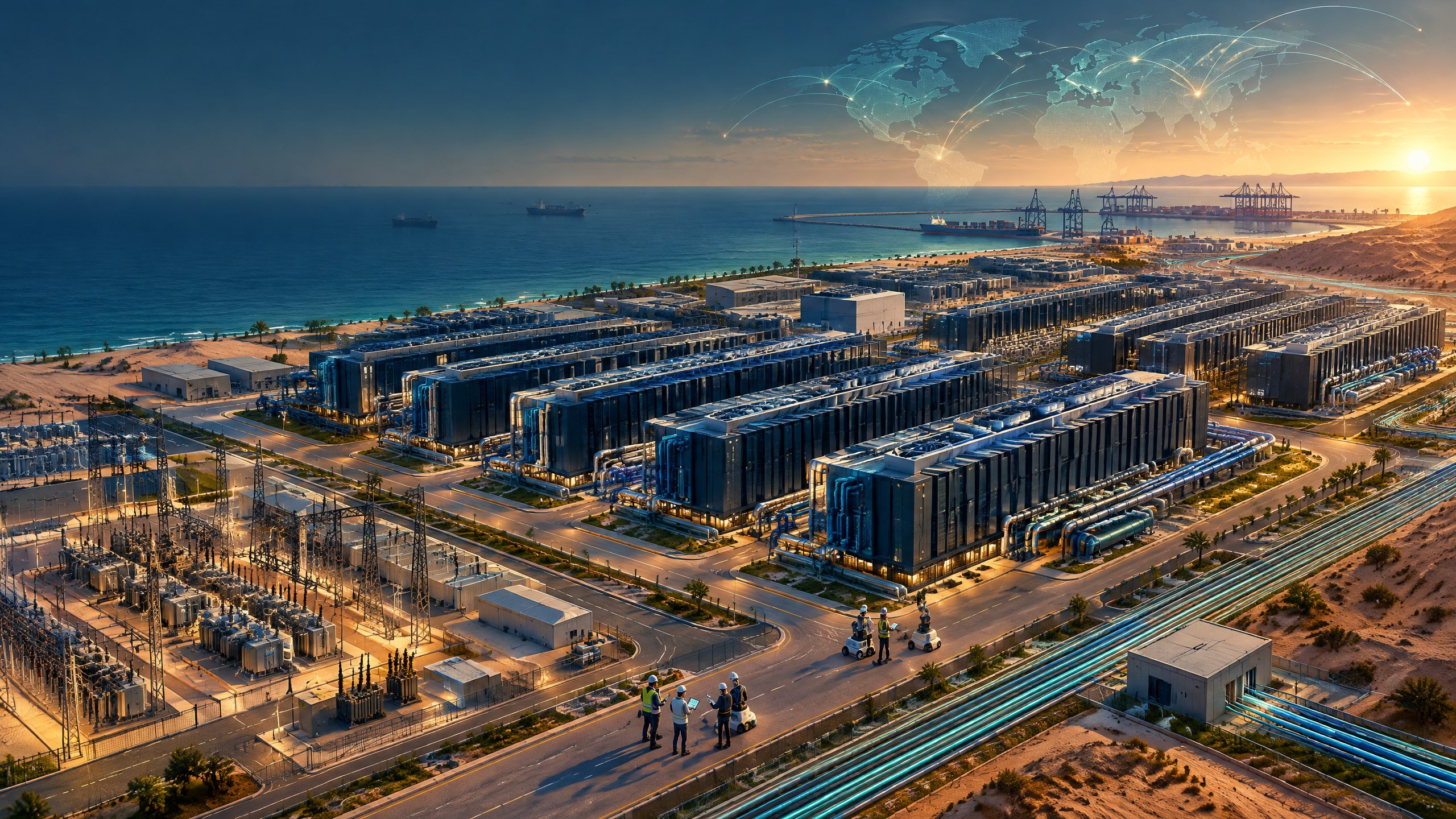
When Saudi Arabia declared 2026 the Year of Artificial Intelligence, it was not a marketing exercise. Behind the branding sat something rare in the world of national technology strategies: actual infrastructure, actual money, and actual deployment at scale. The Kingdom had already inaugurated Hexagon, the world's largest government-operated data centre at 480 megawatts, secured $23 billion in deals with NVIDIA, AMD, and Amazon, and deployed 600,000 NVIDIA chips through its sovereign AI company HUMAIN. The UAE, meanwhile, had unveiled a 5-gigawatt AI campus in Abu Dhabi that will become the largest AI infrastructure project outside the United States. The Middle East is not positioning itself as a market for AI. It is positioning itself as the infrastructure layer on which the global AI economy runs.
For CMOs, AI Directors, and enterprise technology leaders, this matters in ways that go well beyond geopolitics. The sovereign capital being deployed across Saudi Arabia and the UAE is reshaping the economics of AI compute, the competitive landscape for enterprise AI vendors, and the strategic calculus for any organisation planning a multi-year AI infrastructure investment. Understanding who is building what, and why, is no longer optional context. It is a prerequisite for making informed decisions about where enterprise AI workloads will run, which vendors will have the infrastructure to serve them, and which markets will become the next frontier for AI-native business models.
HUMAIN: Saudi Arabia's Full-Stack AI Bet
HUMAIN is the most consequential sovereign AI initiative in the world outside the United States and China. Established by royal directive in May 2024 as a wholly owned subsidiary of the Public Investment Fund, it was built not from scratch but through the consolidation of Saudi Arabia's existing national AI capabilities, including assets from Saudi Aramco and Aramco Digital, into a single vertically integrated entity. The consolidation logic was deliberate: a sovereign AI strategy fragmented across multiple state-owned entities would produce coordination friction that no degree of strategic alignment could overcome at the cadence the AI infrastructure economy requires.
HUMAIN operates across four layers of the AI value chain. HUMAIN Core builds gigawatt-scale data centre campuses designed not merely for domestic Saudi workloads but for global AI training and inference traffic. HUMAIN Cloud provides the software stack that converts physical capacity into commercially deployable compute. HUMAIN Models develops the ALLAM Arabic multimodal frontier model, one of the most advanced Arabic-language AI systems in existence. And HUMAIN One, including the HUMAIN OS agentic operating system unveiled at the February 2026 PIF Private Sector Forum, delivers enterprise AI applications and what the company describes as the world's first enterprise AI agent marketplace, in partnership with Turing.
The partnership architecture HUMAIN has assembled is extraordinary by any measure. Strategic commitments span NVIDIA, Amazon Web Services, AMD, Qualcomm, Cisco, and xAI. In January 2026, HUMAIN secured a $1.2 billion financing framework to develop 250 megawatts of incremental data centre capacity. In February 2026, it deployed $3 billion into xAI's Series E financing round, a position that subsequently converted into SpaceX equity following xAI's acquisition. Goldman Sachs was hired in May 2026 to raise $5.3 billion for data centre financing, targeting 2 gigawatts of capacity as a first tranche toward a 6-gigawatt target by 2034. The company's CEO, Tareq Amin, was ranked tenth on AI Magazine's Top 100 AI Leaders 2026 list, the highest ranking awarded to any AI executive based outside the United States or China.
The strategic logic underpinning HUMAIN's vertical integration rests on three structural advantages. The first is sovereign capital availability: the Public Investment Fund's assets under management of approximately $925 billion, targeting $2 trillion by 2030, provide balance-sheet capacity to fund AI infrastructure at scales that require multi-decade fundraising cycles in jurisdictions dependent on private capital markets. The second is energy cost advantage: Saudi Arabia's electricity prices of $0.05 to $0.06 per kilowatt-hour compare favorably against the U.S. average of $0.09 to $0.15, a margin that compounds dramatically at the scale of gigawatt data centres. The third is geopolitical positioning: Saudi Arabia operates within the U.S.-China AI infrastructure competition without being aligned to either bloc, preserving partnership optionality that most jurisdictions cannot offer.
PIF: The Capital Architecture Behind the Strategy
The Public Investment Fund is the structural engine behind Saudi Arabia's AI ambitions. With assets under management grown from $150 billion in 2015 to more than $900 billion, and a 2026-2030 strategy approved by its board in April 2026 under the chairmanship of Crown Prince Mohammed bin Salman, PIF has invested more than $199 billion in new Saudi projects between 2021 and 2025 and contributed more than $243 billion to real non-oil GDP over the same period. The fund's net profit more than doubled in 2025, with assets rising 5 percent to $1.21 trillion.
The 2026-2030 strategy structures PIF's investments into three portfolios. The Vision Portfolio catalyzes six competitive domestic ecosystems, including Advanced Manufacturing and Innovation, and Clean Energy and Renewables Infrastructure, both of which directly underpin the AI infrastructure buildout. The Strategic Portfolio actively manages key assets to maximise financial returns while supporting their development into global champions, a category that explicitly includes HUMAIN. The Financial Portfolio manages global market investments to maximise returns while building a more diversified and resilient national wealth base.
The practical consequence of this architecture is that HUMAIN's capital access is not subject to the market cycles, investor sentiment, or fundraising constraints that govern private AI infrastructure investment. When HUMAIN needs to deploy capital for a gigawatt-scale data centre, the decision is made at the level of national strategy, not quarterly returns. This is a structural competitive advantage that no private-sector AI infrastructure company can replicate, and it is the reason why Saudi Arabia's AI buildout is proceeding at a cadence that most Western observers have consistently underestimated.
Saudi Arabia's AI market reflects this acceleration. Saudi companies in the AI sector secured $9.1 billion in funding through 70 investment deals in 2025. The number of companies working in data and AI in the Kingdom reached 664. The SDAIA-led SAMAI initiative trained more than one million Saudi citizens in AI technologies within a single year, representing approximately 2.8 percent of the total population. Saudi Arabia's AI market was estimated at $9.26 billion in 2025 and is projected to reach $13.27 billion in 2026, according to Grand View Research.
G42 and MGX: Abu Dhabi's Parallel Play
While Saudi Arabia has consolidated its AI strategy around HUMAIN and PIF, the UAE has pursued a more distributed architecture anchored by G42, the Abu Dhabi AI conglomerate, and MGX, the sovereign AI investment fund established in 2024 as a joint venture between Mubadala and G42. The two approaches are complementary rather than competitive: G42 builds and operates AI infrastructure at the asset level, while MGX deploys capital at the portfolio level, targeting $100 billion or more in AI investments by 2030.
G42's most significant strategic move was securing Microsoft's $1.5 billion equity investment, which gave Microsoft a board seat and access to G42's infrastructure architecture. Microsoft's total UAE commitment of $15.2 billion, spanning 2023 through 2029, includes more than $4.6 billion in data centre capital expenditure, over $1.2 billion in local operating expenses through 2025, and a further $7.9 billion from 2026 through 2029 that will nearly quadruple local data centre computing capacity to the equivalent of 81,900 H100 chips. The investment includes NVIDIA GB300 superchips, the most advanced AI accelerators currently available, secured through export licences from the U.S. Commerce Department that required stringent technology safeguards.
The centerpiece of G42's infrastructure strategy is the UAE-US AI Campus in Abu Dhabi, unveiled by Presidents Mohamed bin Zayed Al Nahyan and Donald Trump in May 2025. The 5-gigawatt, 10-square-mile facility will become the largest AI infrastructure project outside the United States. G42 builds and operates it; AWS, Google, Meta, Microsoft, and xAI are in discussions to become tenants. The first phase deploys 1 gigawatt of capacity using NVIDIA's Grace Blackwell GB300 systems. The campus is explicitly designed to serve the Global South, addressing the latency and data residency constraints that have historically forced companies serving the Middle East, Africa, and South Asia to rely on European or American data centres.
MGX has moved with comparable speed. The fund closed a $49 billion fund in June 2026, exceeding its original target, and is supporting the build-out of Stargate UAE through its investment portfolio. Mubadala, the $330 billion Abu Dhabi sovereign wealth fund that co-founded MGX, has explicitly set AI and robotics as its primary investment focus for 2026. The ADX, Abu Dhabi's securities exchange, listed two AI-focused ETFs from KraneShares in April 2026, signalling the development of capital markets infrastructure to support AI investment at scale. Abu Dhabi's $263 billion fund ADQ was rolled into the newly formed L'IMAD in January 2026, creating a consolidated sovereign investment powerhouse under the emirate's crown prince. The UAE reported in June 2026 that it was ahead of schedule on its $1.4 trillion investment commitment.
The Energy Moat That Changes the Economics
The competitive advantage that underpins both Saudi Arabia's and the UAE's AI infrastructure strategies is not capital alone. It is the intersection of capital with energy abundance. Data centres are, at their core, energy infrastructure. The AI era has made this more true, not less: training a frontier model at scale requires sustained access to hundreds of megawatts of power, and inference workloads at enterprise scale require the same. The cost of that power is the single largest variable in the operating economics of AI infrastructure.
Gulf electricity prices of $0.05 to $0.06 per kilowatt-hour compare against a U.S. average of $0.09 to $0.15. At gigawatt scale, that differential translates into hundreds of millions of dollars in annual operating cost advantage. Saudi Arabia's record-low wind power tariff of 1.33 cents per kilowatt-hour, achieved in 2025 power purchase agreements, represents an energy cost structure that no data centre operator in Europe or North America can approach. The NEOM AI factory being built by DataVolt in the Oxagon industrial zone, a $5 billion project targeting 1.5 gigawatts of capacity, will operate at net zero powered entirely by renewable energy with seawater cooling, combining the lowest energy costs on earth with the lowest carbon intensity. This is not a marginal cost advantage. It is a structural moat.
The regional data centre market reflects this advantage. The GCC data centre market reached $3.48 billion in 2024 and is projected to grow to $9.49 billion by 2030 at an 18.2 percent compound annual growth rate. The Middle East hyperscale segment alone is projected to reach $16.38 billion by 2031, growing at 23.53 percent annually. Regional capacity will triple from 1 gigawatt in 2025 to 3.3 gigawatts by 2030. The UAE's AI data centre market was estimated at $382 billion in 2026 and is projected to reach $797 billion by 2031, according to Mordor Intelligence. These are not the growth rates of an emerging market finding its footing. They are the growth rates of a market capturing structural share from incumbents with higher cost bases.
What This Means for Enterprise AI Leaders
For CMOs and AI Directors navigating enterprise AI deployment, the Middle East buildout has three direct implications. The first is infrastructure optionality. The hyperscaler presence in the Gulf, anchored by Microsoft's $15.2 billion UAE commitment, AWS's $5.3 billion Saudi commitment, and Google Cloud's $10 billion partnership with PIF through HUMAIN, means that enterprise AI workloads can now be distributed across American, European, Asian, and Middle Eastern data centres based on regulatory requirements, latency needs, and cost optimisation. The diversification reduces dependence on any single region and creates negotiating leverage with infrastructure providers that did not exist two years ago.
The second implication is vendor landscape shift. HUMAIN's full-stack architecture, spanning compute infrastructure, frontier models, an agentic operating system, and an enterprise AI marketplace, represents a new category of AI vendor that is neither a hyperscaler nor a pure-play model provider. HUMAIN One and HUMAIN OS are designed to compete for enterprise AI deployment contracts globally, not merely in the Gulf. The ALLAM Arabic frontier model positions Saudi Arabia as a sovereign AI provider for the 400 million Arabic speakers worldwide, a market that no American or Chinese AI company has served at frontier quality. Enterprise AI leaders evaluating their vendor landscape in 2026 and beyond need to include sovereign AI providers in their assessment, not merely the established hyperscalers.
The third implication is the geopolitical dimension of AI infrastructure decisions. The Middle East sits at the intersection of the U.S.-China AI infrastructure competition, and the sovereign capital being deployed there is explicitly designed to maintain optionality between both blocs. For enterprises with operations in markets where U.S. export controls create uncertainty about AI chip access, or where data residency requirements create compliance complexity, Gulf AI infrastructure offers a third path that neither American nor Chinese providers can match. This is not a theoretical consideration. It is the reason why Microsoft, Google, and AWS have all committed billions to the region in the past eighteen months.
Since this analysis was first published, the Gulf sovereign AI story has expanded beyond Saudi Arabia and the UAE. Kuwait's sovereign wealth fund KIA launched Helix Digital Infrastructure in June 2026 alongside NVIDIA, KKR, and Vistra Energy, committing $10 billion-plus to an energy-first AI infrastructure model led by former AWS CEO Adam Selipsky. Qatar's QIA launched Qai in December 2025 and immediately followed with a $20 billion joint venture with Brookfield Asset Management, positioning Qatar as the Gulf's "trusted AI" infrastructure jurisdiction. The Gulf sovereign AI quartet is now complete: HUMAIN, G42/MGX, Helix, and Qai collectively represent over $100 billion in committed AI infrastructure investment. For an evidence-led view of Abu Dhabi's part of that landscape, see G42 and MGX: what official sources support.
The NEOM Pivot: Pragmatic Realism at Scale
Perhaps the most instructive signal of Saudi Arabia's AI seriousness is what happened to NEOM. When The Line, the $500 billion linear megacity, was suspended in September 2025, most observers interpreted it as an embarrassing retreat from a project that had become a symbol of overreach. The subsequent developments suggest something more calculated. Areas originally earmarked for The Line's residential towers are being reconsidered for large-scale digital infrastructure. The coastal location along the Red Sea offers a significant natural advantage for data centres: seawater cooling dramatically reduces freshwater consumption in one of the most water-scarce regions on earth, while solar panels across the surrounding desert provide renewable power at record-low tariffs.
The $5 billion DataVolt deal for a 1.5-gigawatt AI factory in the Oxagon industrial zone is the most concrete manifestation of this pivot. Over $50 billion had already been spent on foundational NEOM infrastructure: airport, roads, port facilities, power systems. That capital was sunk. The question for Saudi planners was not whether to recover the cost of The Line's original vision. It was whether to repurpose the infrastructure already built toward something that generates revenue in the near term. AI data centres, with their insatiable appetite for power, cooling, and physical space, are the answer. The NEOM pivot is not a failure story. It is a case study in sovereign capital reallocation at speed, and it is the kind of strategic flexibility that private-sector infrastructure investors cannot match.
FAQs
What is HUMAIN and who owns it?
HUMAIN is Saudi Arabia's national AI company, established by royal directive in May 2024 as a wholly owned subsidiary of the Public Investment Fund. It is chaired by Crown Prince Mohammed bin Salman and led by CEO Tareq Amin. HUMAIN operates across four layers: data centre infrastructure (HUMAIN Core), cloud platforms, frontier AI models including the ALLAM Arabic LLM, and enterprise AI solutions through HUMAIN One and the HUMAIN OS agentic operating system.
How much has Saudi Arabia invested in AI infrastructure?
Saudi companies in the AI sector secured $9.1 billion in funding through 70 investment deals in 2025 alone. HUMAIN has signed $23 billion in deals with NVIDIA, AMD, and Amazon, secured a $1.2 billion financing framework in January 2026, and Goldman Sachs was hired in May 2026 to raise $5.3 billion for data centre financing. The broader Saudi AI market was estimated at $9.26 billion in 2025, projected to reach $13.27 billion in 2026.
What is G42 and what is its relationship with Microsoft?
G42 is Abu Dhabi's AI conglomerate and the primary vehicle for the UAE's AI infrastructure strategy. Microsoft made a $1.5 billion equity investment in G42 in 2024, securing a board seat. Microsoft's total UAE commitment is $15.2 billion spanning 2023 to 2029, including data centre capital expenditure and a further $7.9 billion from 2026 to 2029 that will quadruple local compute capacity. G42 is building and operating the 5-gigawatt UAE-US AI Campus in Abu Dhabi, the largest AI infrastructure project outside the United States.
What is MGX and how does it differ from G42?
MGX is Abu Dhabi's sovereign AI investment fund, established in 2024 as a joint venture between Mubadala and G42. While G42 builds and operates AI infrastructure at the asset level, MGX deploys capital at the portfolio level, targeting $100 billion or more in AI investments by 2030. MGX closed a $49 billion fund in June 2026, exceeding its original target, and is supporting the build-out of Stargate UAE through its investment portfolio.
Why does Middle East AI infrastructure matter for enterprise AI leaders?
The Gulf's AI buildout creates three direct implications for enterprise AI leaders: infrastructure optionality across regions for workload distribution and cost optimisation; a new category of sovereign AI vendor (HUMAIN, G42) competing for enterprise contracts globally; and a geopolitically neutral third path for organisations navigating U.S.-China AI infrastructure competition. The energy cost advantage of $0.05 to $0.06 per kilowatt-hour versus the U.S. average of $0.09 to $0.15 also creates structural operating cost advantages that will increasingly influence where enterprise AI workloads run.
What is the UAE-US AI Campus?
The UAE-US AI Campus is a 5-gigawatt, 10-square-mile AI infrastructure project in Abu Dhabi, unveiled by Presidents Mohamed bin Zayed Al Nahyan and Donald Trump in May 2025. It will become the largest AI infrastructure project outside the United States. G42 builds and operates it, with AWS, Google, Meta, Microsoft, and xAI in discussions to become tenants. The first phase deploys 1 gigawatt of capacity using NVIDIA's Grace Blackwell GB300 systems and is explicitly designed to serve the Global South.
How does the NEOM pivot reflect Saudi Arabia's AI strategy?
When The Line megacity was suspended in September 2025, Saudi Arabia pivoted the NEOM infrastructure investment toward AI data centres. The $5 billion DataVolt deal for a 1.5-gigawatt AI factory in the Oxagon industrial zone repurposes the coastal location's seawater cooling advantage and surrounding desert's solar energy capacity. The pivot demonstrates the sovereign capital flexibility that private-sector infrastructure investors cannot match: over $50 billion in sunk foundational infrastructure was redirected toward a higher-return application within months of the original project's suspension.
About the Author
Modi Elnadi is Founder and Director of Marketing and AI Growth at Integrated.Social, a London-based B2B AI growth marketing agency. Modi works with CMOs, AI Directors, and revenue leaders in B2B technology, financial services, and professional services to build AI discoverability as a core commercial capability. His work spans AEO strategy, entity authority architecture, schema implementation, and AI citation measurement. He writes for marketing leaders who are navigating the shift from traditional search to AI-mediated buyer journeys.
Ready to improve your AI search visibility? Request a free AI growth audit from the Integrated.Social team and discover how your brand appears across ChatGPT, Perplexity, and Google AI Overviews.