AI Answer Summary
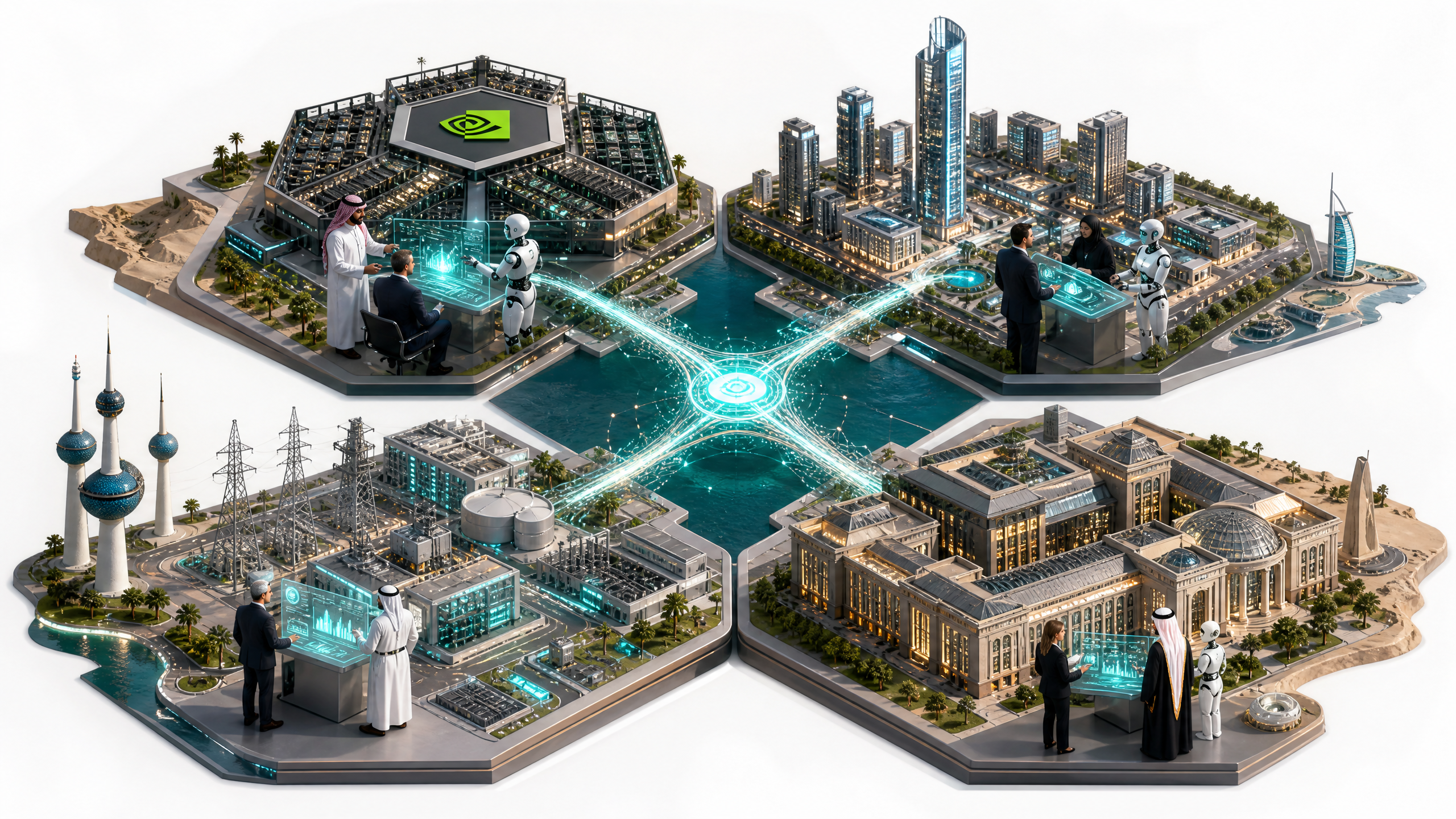
In 18 months, four Gulf states have each launched a national AI champion: Saudi Arabia's HUMAIN, the UAE's G42 and MGX, Kuwait's Helix, and Qatar's Qai. Together they represent over $100 billion in committed AI infrastructure investment. This is the definitive comparison of all four - their.
The Gulf Sovereign AI Series: HUMAIN, G42, Helix, and Qai Compared
In 18 months, four Gulf states have each launched a national AI champion: Saudi Arabia's HUMAIN, the UAE's G42 and MGX, Kuwait's Helix, and Qatar's Qai. Together they represent over $100 billion in committed AI infrastructure investment. This is the definitive comparison of all four - their capital, partners, strategy, and what each means for B2B enterprise leaders building AI-first growth strategies in 2026.
The Gulf sovereign AI race is one of the most consequential infrastructure stories of the decade. Between May 2024 and June 2026, four Gulf Cooperation Council states each established a national AI champion with sovereign capital, strategic partnerships with the world's leading technology companies, and explicit mandates to build the physical infrastructure layer on which the next generation of enterprise AI will run. The scale is extraordinary. The speed is unprecedented. And for B2B technology leaders, the strategic implications are immediate.
This hub page is the definitive guide to all four Gulf sovereign AI companies - what they are, how they compare, and what they mean for enterprise AI strategy. Each section links to a full deep-dive post for readers who want the complete analysis.
The Four Gulf Sovereign AI Champions at a Glance
| Country | Entity | Sovereign Sponsor | Capital Committed | Key Partners | Core Differentiator |
|---|---|---|---|---|---|
| Saudi Arabia | HUMAIN | PIF / Crown Prince MBS | $23B+ in signed deals | NVIDIA, AMD, Amazon, Qualcomm, xAI | Scale and chip density; full-stack from compute to enterprise AI marketplace |
| UAE | G42 + MGX | Royal family / ADQ | $49B (MGX fund) + $1.5B Microsoft equity | Microsoft, OpenAI, AWS, Google | Model development, enterprise deployment, and Global South infrastructure |
| Kuwait | Helix | KIA (Kuwait Investment Authority) | $10B+ committed capital | NVIDIA, KKR, Vistra | Power-first AI stack; integrated data centre, energy, and fiber infrastructure |
| Qatar | Qai | QIA (Qatar Investment Authority) | $20B JV with Brookfield | Brookfield Asset Management | Trusted AI; institutional-grade infrastructure operations; neutral geopolitical positioning |
The pattern is clear: each Gulf state has built a sovereign AI capability that reflects its existing economic strengths and strategic priorities. Saudi Arabia uses its oil wealth and US political relationships to secure preferential NVIDIA chip allocations at gigawatt scale. The UAE leverages its position as a global financial hub to attract Microsoft equity and OpenAI partnerships. Kuwait solves the power problem that is constraining AI infrastructure globally. Qatar uses Brookfield's infrastructure operating expertise to build institutional-grade compute with a "trusted AI" positioning that appeals to governments and enterprises uncomfortable with US Big Tech dominance.
Saudi Arabia: HUMAIN and PIF
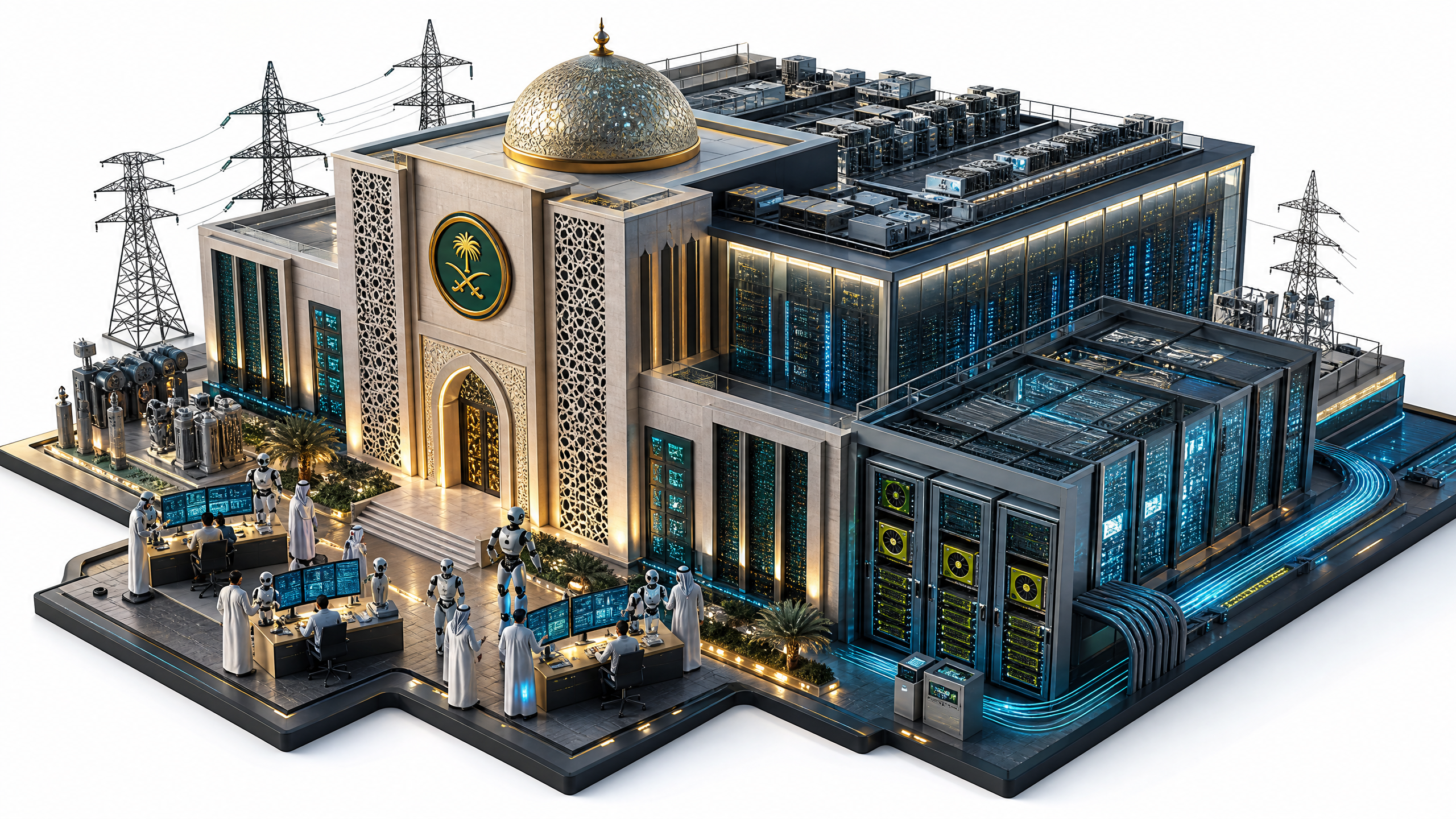
Saudi Arabia's HUMAIN is the most consequential sovereign AI initiative in the world outside the United States and China. Established by royal directive in May 2024 as a wholly owned subsidiary of the Public Investment Fund, HUMAIN operates across four layers of the AI value chain: HUMAIN Core (gigawatt-scale data centres), HUMAIN Cloud (enterprise compute platform), HUMAIN Models (including the ALLAM Arabic frontier model), and HUMAIN One (enterprise AI applications and the HUMAIN OS agentic operating system).
The headline numbers are striking. HUMAIN has signed $23 billion in deals with NVIDIA, AMD, and Amazon. Goldman Sachs was hired in May 2026 to raise $5.3 billion for data centre financing, targeting 2 gigawatts of capacity as a first tranche toward a 6-gigawatt target by 2034. Saudi Arabia's AI market was estimated at $9.26 billion in 2025 and is projected to reach $13.27 billion in 2026. The Kingdom's electricity prices of $0.05 to $0.06 per kilowatt-hour - combined with record-low wind power tariffs of 1.33 cents per kilowatt-hour - create a structural energy cost moat that no data centre operator in Europe or North America can match.
The strategic logic is vertical integration at sovereign scale. HUMAIN is not buying AI capacity from hyperscalers. It is building the layer beneath them - and then offering that capacity back to the hyperscalers, to enterprises, and to the 400 million Arabic speakers worldwide who have historically been underserved by frontier AI models.
Read the full analysis: The Middle East Is Betting Everything on AI: Inside HUMAIN, PIF, G42, and the Sovereign Capital Race [blocked]
UAE: G42 and MGX
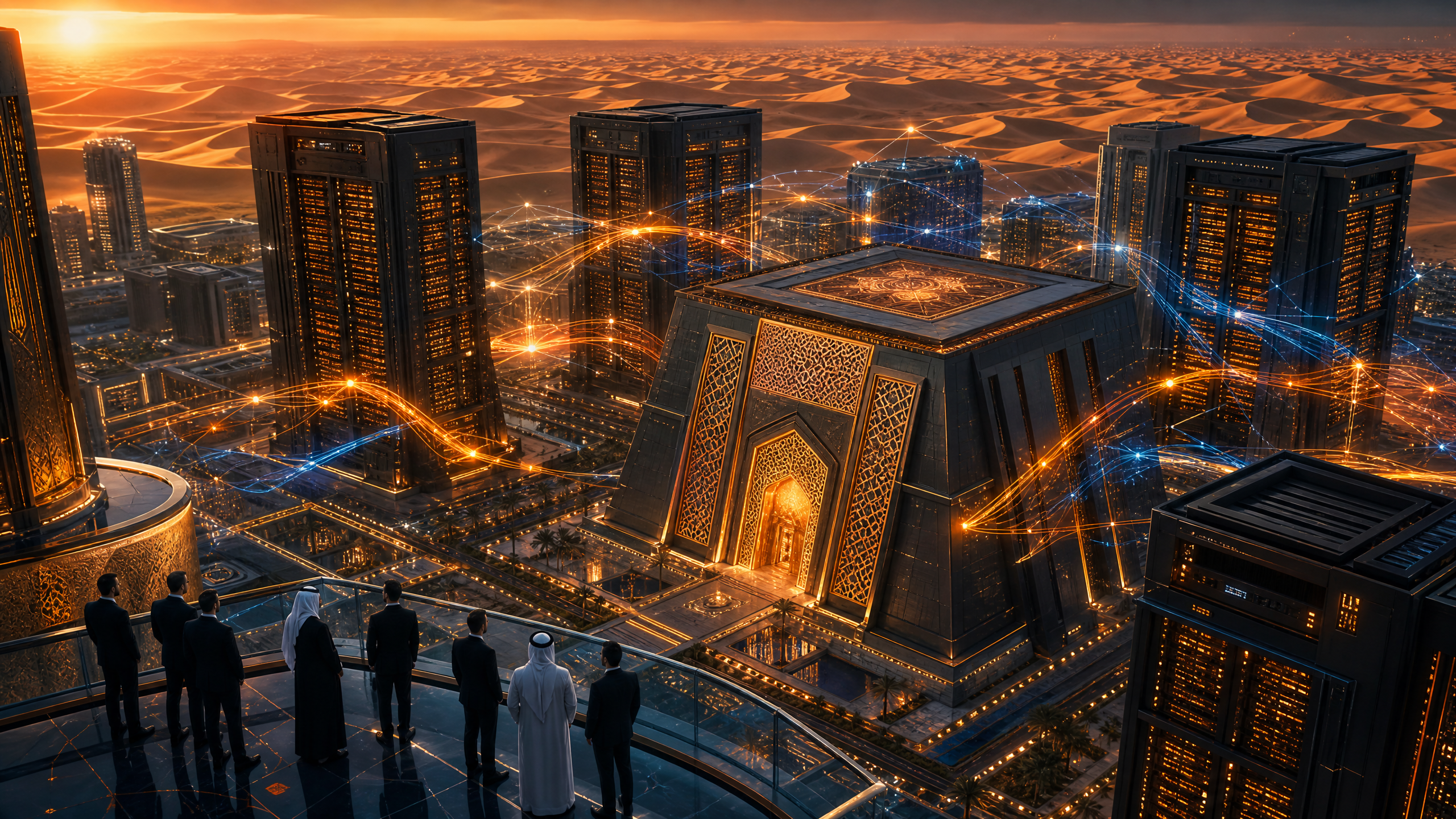
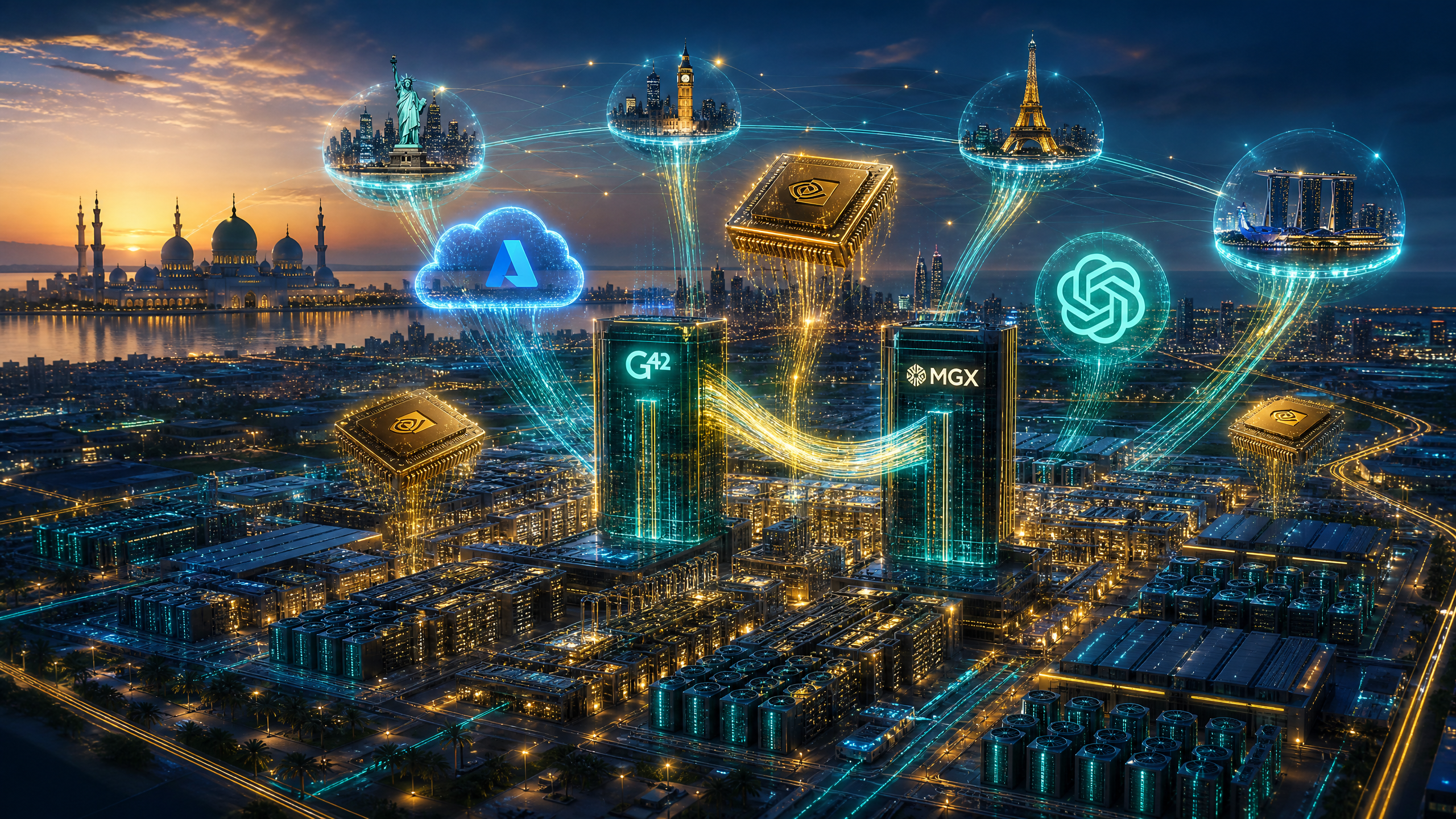
The UAE has pursued a more distributed architecture than Saudi Arabia, anchored by two complementary vehicles. G42 is Abu Dhabi's AI conglomerate - it builds and operates AI infrastructure at the asset level, most notably the 5-gigawatt UAE-US AI Campus in Abu Dhabi, the largest AI infrastructure project outside the United States. MGX is the sovereign AI investment fund, established in 2024 as a joint venture between Mubadala and G42, targeting $100 billion or more in AI investments by 2030.
G42's most significant strategic move was securing Microsoft's $1.5 billion equity investment, which gave Microsoft a board seat and access to G42's infrastructure architecture. Microsoft's total UAE commitment of $15.2 billion, spanning 2023 through 2029, includes more than $4.6 billion in data centre capital expenditure and a further $7.9 billion from 2026 through 2029 that will nearly quadruple local data centre computing capacity. MGX closed a $49 billion fund in June 2026, exceeding its original target. The UAE reported in June 2026 that it was ahead of schedule on its $1.4 trillion investment commitment.
The UAE's differentiation is model development and enterprise deployment. Where HUMAIN leads with compute infrastructure, G42 has positioned itself as the partner for enterprise AI application development - with OpenAI, Microsoft, and AWS all committed to the UAE-US AI Campus as anchor tenants or strategic partners.
The July 2026 close of MGX Fund I at $49 billion - the largest dedicated AI fund ever raised - confirmed Abu Dhabi's position as the Gulf's most active capital deployer in frontier AI. MGX's portfolio now includes simultaneous positions in OpenAI, Anthropic, and xAI, giving the UAE sovereign exposure to every major frontier model provider. G42's Core42 subsidiary operates 10 sites globally, including a 60-megawatt cluster in Buffalo, New York, and three of the global TOP500 supercomputers. CEO Peng Xiao has stated G42 targets 100 trillion tokens of daily AI output - a scale that would make Abu Dhabi one of the world's largest AI compute operators.
Read the full UAE deep-dive: Inside G42 and MGX: How Abu Dhabi Is Building the Gulf's Most Connected AI Empire [blocked] - covering Stargate UAE, Core42's global footprint, the JAIS Arabic LLM, Microsoft's $15.2B commitment, and four B2B enterprise implications.
Also read: The Middle East Is Betting Everything on AI: Inside HUMAIN, PIF, G42, and the Sovereign Capital Race [blocked]
Kuwait: Helix Digital Infrastructure
Kuwait's Helix is the newest and most operationally distinctive of the four Gulf sovereign AI champions. Announced on June 11, 2026, Helix Digital Infrastructure was formed by the Kuwait Investment Authority alongside NVIDIA, KKR, and Vistra Energy, with $10 billion-plus in committed long-duration capital. Its CEO is Adam Selipsky, the former CEO of Amazon Web Services - a hire that signals Kuwait's intent to build an operationally excellent AI infrastructure company, not merely a sovereign investment vehicle.
Helix's differentiator is its energy-first architecture. Vistra Energy, one of the largest independent power producers in the United States with over 5,000 megawatts in executed power purchase agreements with hyperscalers, brings the power infrastructure expertise that most AI data centre companies lack. KKR brings the infrastructure investment and operational expertise. NVIDIA brings the chip allocation and technical architecture. KIA brings the sovereign capital and the mandate to transform Kuwait's digital economy.
The strategic context is Kuwait's National AI Strategy 2025-2028, which targets migrating 44 government entities to cloud infrastructure and projecting an $18 billion economic impact from AI by 2030. PwC estimates AI could contribute 8.2 percent of GDP to smaller Gulf states by 2030. Helix is the vehicle through which Kuwait intends to capture that contribution - not as a passive recipient of AI services from foreign hyperscalers, but as a sovereign infrastructure operator with direct control over the compute, power, and connectivity stack.
Read the full analysis: Kuwait Launches Helix: The $10B AI Infrastructure Bet That Changes the GCC Race [blocked]
Qatar: Qai
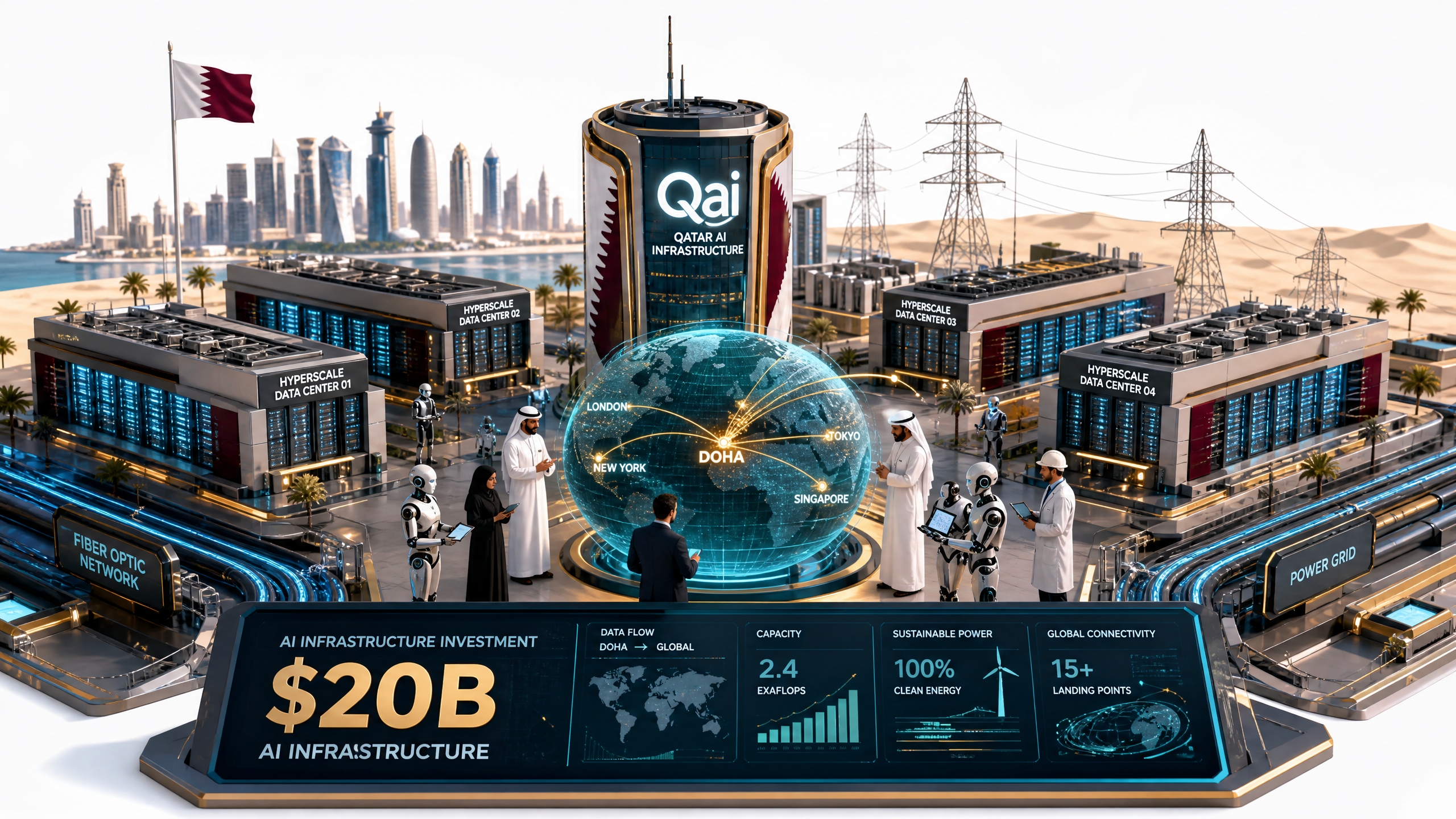
Qatar launched Qai on December 8, 2025, as a wholly owned subsidiary of the Qatar Investment Authority. One day later, Brookfield Asset Management and Qai announced a $20 billion joint venture to build AI infrastructure in Qatar and select international markets - Brookfield's inaugural AI infrastructure investment in the Middle East, and a cornerstone of Brookfield's global AI infrastructure programme targeting up to $100 billion in total investment.
Qai's explicit positioning around "trusted, human-centric AI" is its most distinctive strategic choice. Where HUMAIN leads with scale and NVIDIA chip density, and Helix leads with power infrastructure, Qai's founding language centres on "responsible deployment," "secure technologies," and "human-centric AI solutions." This is not marketing language. Qatar has positioned itself as a neutral diplomatic actor in global geopolitics - hosting peace negotiations, maintaining relationships with both the US and Iran, and serving as the host nation for the 2022 FIFA World Cup. The "trusted AI" positioning extends this diplomatic brand into the technology sector.
For enterprise buyers evaluating Gulf AI infrastructure, Qai offers something the other three cannot: a jurisdiction with sovereign neutrality, institutional-grade infrastructure operations (Brookfield has built airports, toll roads, and power grids across six continents), and an explicit commitment to responsible AI deployment frameworks. Qatar's AI market is expected to grow approximately 29 percent annually, and the MEA agentic AI market is forecast to expand tenfold to reach $2.2 billion by 2030.
Read the full analysis: Qatar's Qai: How the Gulf's Most Trusted AI Company Is Building a $20B Infrastructure Empire [blocked]
How the Four Models Differ Strategically
The four Gulf sovereign AI champions are not competing with each other in the conventional sense. They are each solving a different piece of the AI infrastructure puzzle, and the GCC as a region is stronger for having all four approaches running in parallel.
Scale vs. trust. HUMAIN and G42/MGX are optimised for scale - gigawatt data centres, frontier model development, hyperscaler partnerships. Qai is optimised for trust - institutional-grade operations, responsible AI governance, neutral geopolitical positioning. These are not competing values; they serve different enterprise buyer personas.
Compute vs. power. HUMAIN leads on chip density and NVIDIA allocation. Helix leads on power infrastructure - the constraint that is actually limiting AI infrastructure deployment globally in 2026. Vistra's 5,000+ megawatts of executed power purchase agreements represent a capability that most AI infrastructure companies cannot match.
Domestic vs. global. All four have domestic mandates, but their international ambitions differ. HUMAIN is explicitly targeting global AI training and inference traffic. G42's UAE-US AI Campus is designed to serve the Global South. Qai's Brookfield JV includes "select international markets." Helix, at this stage, is focused on Kuwait's domestic digital transformation.
Capital structure. PIF's $925 billion in assets under management gives HUMAIN a capital access advantage that no private-sector company can replicate. QIA's sovereign patience for returns allows Qai to build institutional-grade infrastructure without the quarterly return pressure that constrains private infrastructure funds. KIA's $9 billion in AI and digital investments over five years signals sustained commitment. MGX's $49 billion fund is the largest dedicated AI infrastructure fund ever raised.
What This Means for B2B Enterprise Leaders
The Gulf sovereign AI quartet collectively represents over $100 billion in committed AI infrastructure investment. For B2B technology leaders, this creates four distinct strategic implications.
Infrastructure optionality. Enterprise AI workloads can now be distributed across American, European, Asian, and Gulf data centres based on regulatory requirements, latency needs, and cost optimisation. The Gulf's energy cost advantage of $0.05 to $0.06 per kilowatt-hour versus the US average of $0.09 to $0.15 creates structural operating cost advantages that will increasingly influence where AI workloads run.
New vendor categories. HUMAIN's full-stack architecture - compute infrastructure, frontier models, agentic operating system, enterprise AI marketplace - represents a new category of AI vendor that is neither a hyperscaler nor a pure-play model provider. Enterprise AI leaders evaluating their vendor landscape need to include sovereign AI providers in their assessment.
Gulf market procurement. The sovereign AI platforms are not just infrastructure providers - they are enterprise AI distribution channels, with direct relationships with government ministries, national oil companies, sovereign wealth funds, and regulated financial institutions. B2B technology vendors with Gulf market exposure should be building account-based marketing programmes targeting the government entities and financial institutions that will be these platforms' first enterprise customers.
Geopolitical neutrality. For enterprises navigating US-China AI infrastructure competition, the Gulf offers a third path that neither American nor Chinese providers can match. This is the reason why Microsoft, Google, AWS, and OpenAI have all committed billions to the region in the past 18 months.
If you are building an AI-first B2B marketing strategy for the Gulf market, the Agentic AI services at Integrated.Social [blocked] and the Preferred Sources Strategy [blocked] are directly relevant to capturing Gulf AI procurement opportunities. For a broader discussion of how to position your B2B AI offer for sovereign procurement cycles, contact Integrated.Social [blocked].
Frequently Asked Questions
See the FAQ section below for answers to the most common questions about the Gulf sovereign AI series.
About the Author
Modi Elnadi is the founder of Integrated.Social, a B2B AI marketing agency in London specialising in agentic AI strategy, AEO, and performance marketing. He designs multi-model AI architectures for enterprise and scale-up B2B brands, with a focus on building systems that are commercially effective, data-sovereign, and operationally resilient. Modi works at the intersection of hands-on execution and strategic thinking - building paid acquisition, ABM, and agentic marketing systems that tackle trust, positioning, and conversion barriers. Read Modi's full profile [blocked] or connect on LinkedIn.