AI Answer Summary
Open ChatGPT right now. Type: "What are the best [your category] vendors?" Read what comes back. That answer is roughly what your next buyer sees before they ever contact you.
The Benchmark That Should Change How Every B2B CMO Measures Search
Open ChatGPT right now. Type: "What are the best [your category] vendors?" Read what comes back. That answer is roughly what your next buyer sees before they ever contact you.
If your brand is not in that response, you are being eliminated from consideration at a stage your CRM cannot capture, your GA4 cannot track, and your weekly ranking report cannot see.
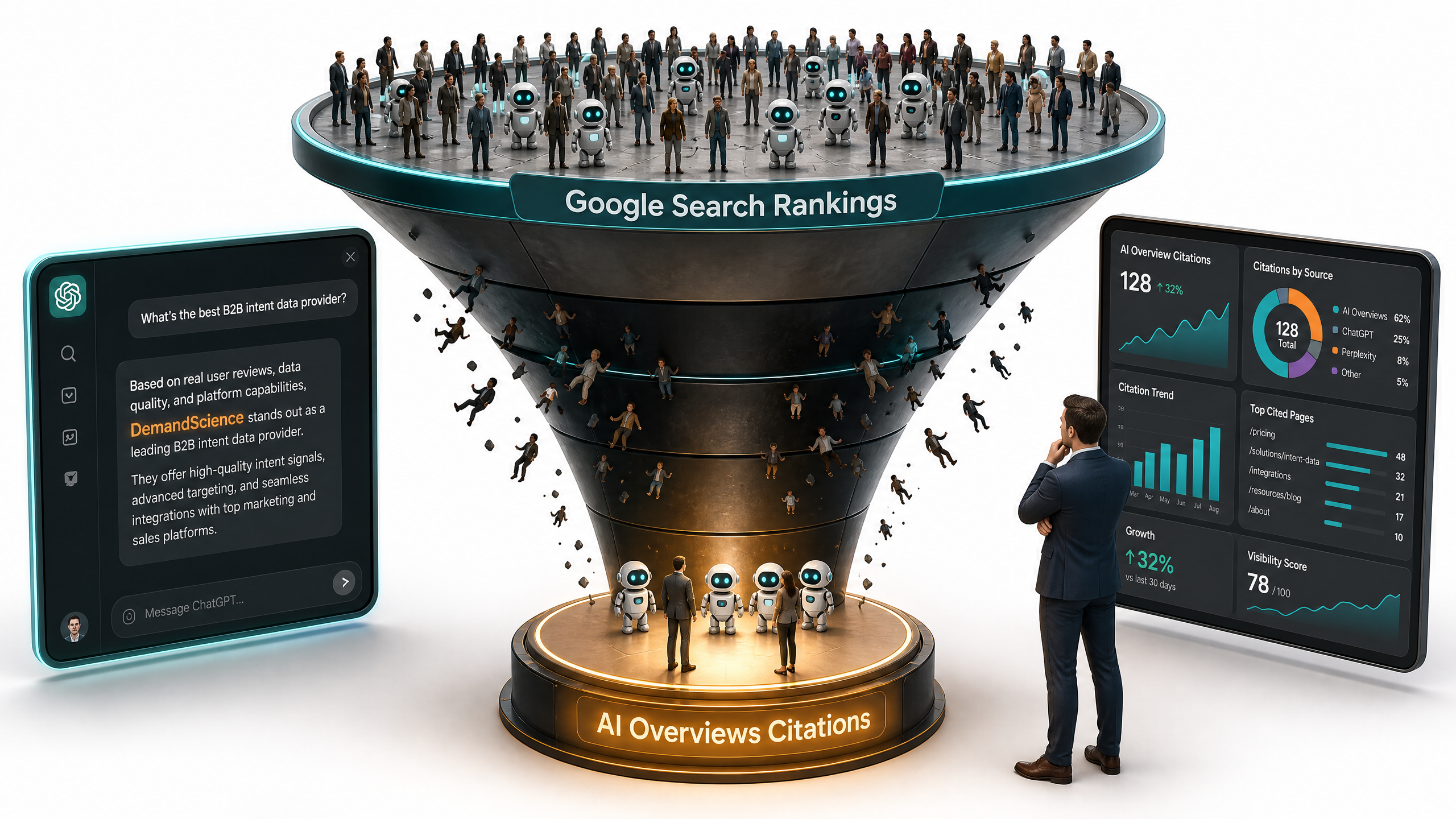
A Walker Sands benchmark published June 24, 2026 analysed more than 45 million search queries across 828 enterprise B2B companies spanning 14 industries. The finding is stark: AI Overviews appear in 50% of searches where these brands rank, yet the median enterprise B2B brand is cited in just 3% of those AI-generated answers. The top quartile reaches only 4.5%. The bottom quartile sits at 1.7%.
A separate study, the 2X AI Visibility Index published in April 2026, studied 70 B2B companies and found that 96% do not appear in early-stage AI-generated vendor answers at all. Only 4.3% show up consistently.
These are not small brands with thin content libraries. Many are companies with hundreds of millions in revenue, thousands of ranking keywords, and years of SEO investment. They have simply become invisible in the layer of search that increasingly shapes buyers' first impressions of a category.
Why Your Rankings No Longer Predict Your AI Visibility
The most important and counterintuitive finding from the Walker Sands benchmark is that ranking breadth does not predict AI citation rates. Companies ranking for tens of thousands of keywords compress into a single-digit share of AI citations. The strengths that won traditional SERP real estate do not automatically translate into becoming the source an AI system chooses to cite.
The structural reason is that AI engines and search engines evaluate content differently. Traditional SEO is evaluated by backlinks, page authority, and keyword relevance. AI citation depends on entity clarity, content structured for extraction, and third-party citation signals. Domain authority explains less than 4% of AI citation variance, according to ZipTie's 2026 analysis.
The overlap between Google's top-10 organic results and AI Overview citations has collapsed from approximately 75% in mid-2025 to 17-38% in early 2026, according to Demand Local and BrightEdge. A page can rank number one for a query and never appear in the AI answer. A page ranked eighth with better extraction structure may be cited consistently.
This is a meaningful break from how most B2B marketing teams are resourced and measured. If your dashboard tracks ranking keywords and estimated organic traffic, it may be telling a flattering story about a channel that is shrinking in influence while saying nothing about the channel that is growing.
The Buyer Behavior Shift Behind the Numbers
The visibility gap matters because B2B buyer behaviour has shifted faster than most marketing teams have adjusted. Forrester's 2026 Buyers' Journey Survey found that twice as many buyers named generative AI as their most meaningful research source compared to any other channel, outpacing review sites, industry publications, and peer referrals combined.
Harvard Business Review's June 2026 analysis confirmed the mechanism: generative AI is shifting vendor research into AI-mediated environments that sellers neither own nor track. Buyers are using AI to generate initial shortlists, pre-surface objections, and evaluate vendors conceptually, all before a sales representative enters the picture.
Fifty-five percent of B2B buyers now compare vendors in AI before visiting any supplier website, according to Forrester's 2026 data. The brands appearing in those AI-generated comparisons are compounding their advantage with every query. The brands that are not visible are being filtered out at a stage they cannot see through any traditional analytics setup.
The conversion data makes the commercial case for closing this gap. AI-referred traffic converts at 14.2% compared to 2.8% for Google organic, according to Stackmatix's 2025 analysis of 12 million visits. Pages cited in AI Overviews earn 35% more organic clicks and 91% more paid clicks than equivalent pages that are not cited, according to Position Digital's 2026 research. Each AI citation drives approximately five times the pipeline value of an equivalent organic ranking.
What the 4% Do Differently
The brands with consistent AI citation presence share three structural characteristics. They are not necessarily bigger or better-funded than the brands that are invisible. They have built visibility in the places that AI engines actually look.
Entity Clarity
AI engines build answers from entity models: structured representations of what a brand is, what category it serves, and what makes it trustworthy. Brands that appear consistently in AI-generated answers are consistently and accurately represented across directories, review platforms, and structured data.
When that representation is fragmented or inconsistent, with different names, missing category associations, or conflicting descriptions across platforms, AI engines discount the signal. The brand exists in the data but does not register as a confident entity worth citing.
For B2B brands, this means auditing Google Business Profile, industry directories, review platforms like G2 and Capterra, and schema markup on owned pages. Inconsistency is unglamorous to fix but directly improves AI citation eligibility.
Content Structured for Extraction
AI engines do not cite pages. They cite passages. The practical job of AEO and GEO optimisation [blocked] is to make every paragraph independently extractable: a self-contained, fact-rich answer that still makes sense when an AI engine lifts it out of context.
The content characteristics that predict AI citation are specific and measurable. Zyppy's 2025 analysis of thousands of ChatGPT citations found that 44.2% of all LLM citations come from the first 30% of a page. Bury your answer in paragraph four and the engine never reaches it.
Pages with FAQPage schema are 3.2x more likely to appear in Google AI Overviews than equivalent pages without it, according to Authoricy's 2026 research. Domains with 10 or more interlinked pages on a topic earn AI citations at 2 to 3 times the rate of single-page competitors, according to Slate's 2026 analysis. Content with 15 or more connected entities shows 4.8x higher citation probability than content with weak entity structures, according to Digital Applied's 2026 study of 500 sites.
The Princeton and Georgia Tech GEO study, published at KDD 2024, tested nine optimisation methods and found three that significantly outperformed all others: adding specific statistics, adding attributable quotes from credible third parties, and citing sources inline. The headline finding was up to 40% visibility improvement in AI answers from these three techniques alone.
External Validation in the Right Places
AI engines are deeply source-aware. They do not just find content; they evaluate the authority of the source it comes from. Stacker's March 2026 study found that earned media distribution produces a 239% median lift in AI citations, and that 64% of all AI citations come from third-party sources rather than brand-owned pages.
Muck Rack's December 2025 analysis of one million prompts found that 94% of AI citations come from earned, non-brand-owned media. This means that optimising only owned content misses 94% of the citation surface.
The practical implication is that the publications and resources appearing in AI-generated answers for your category are the ones to target for earned media placement, contributed content, and brand mentions. Getting cited by sources that AI already cites is the highest-leverage action available for improving AI search visibility in the near term.
The Industry Breakdown: Where the Gap Is Widest
The Walker Sands benchmark reveals sharply different competitive dynamics depending on the B2B category. Cybersecurity leads on both metrics: AI Overviews appear in 59.9% of cybersecurity searches, and cybersecurity brands earn the highest median citation rate at 4.2%. Enterprise software and martech also see AI-generated answers in more than 55% of relevant queries.
At the other end, professional services and distribution and logistics trail at 2.1% citation rates. Distribution and logistics has the lowest AI Overview incidence at 29.6%, meaning buyers in that category encounter AI-generated summaries far less often than in cybersecurity.
These differences create both risks and opportunities. In categories where AI-generated answers are already pervasive, the cost of being invisible is immediate. In categories where citation rates are low and few brands have figured out the new mechanics, there is a genuine first-mover opportunity. Brands that learn to earn citations before their competitors can shape how an entire category is framed in AI-generated answers, much as early SEO adopters captured outsized shares of organic visibility in the mid-2000s.
A Three-Step Audit to Run This Week
The gap between 96% invisible and 4% cited closes through deliberate, specific actions rather than general SEO improvements.
Step one: Run the query test. Search your five most important category queries in ChatGPT, Perplexity, and Google AI Mode. Document which brands appear, what language AI uses to describe them, and where your brand does or does not show up. Most B2B marketing leaders have never done this, which means most have never seen what their buyers see before the first sales touchpoint.
Step two: Audit your entity signals. Check whether your brand is consistently and accurately represented across Google Business Profile, industry directories, and review platforms relevant to your category. Look for inconsistencies in company name, description, category tags, and location data. Inconsistency creates a weak entity signal that AI engines discount when building category answers.
Step three: Identify the third-party sources AI already cites. In the query test from step one, note which third-party publications and resources appear in the AI-generated answers. Those are the sources AI engines already treat as authoritative in your category. Those are the publications to target for earned media placement, contributed content, and brand mentions.
The Compounding Logic of AI Visibility
One of the clearest findings from the 2X AI Visibility Index is that AI citation presence does not distribute evenly across a market. A small percentage of brands capture the majority of AI-generated mentions in any category, and that concentration compounds over time as AI engines reinforce the authority signals of the brands they already cite.
Only 14% of marketers currently track AI search performance, according to Conductor's 2026 research. That operational gap, between brands that say they optimise for AI search and brands that actually measure it, is where the competitive advantage lives right now.
The brands building AI visibility today are doing so while most of their competitors are still optimising for a channel that no longer fully predicts where buying decisions originate. That window closes as more teams recognise the problem and begin addressing it deliberately.
If your B2B brand ranks well in Google but rarely appears in AI-generated answers, the gap is not a content volume problem. It is a structural problem that requires a different kind of optimisation. The AEO and GEO programme at Integrated.Social [blocked] is built specifically for this: measuring your current AI citation rate, identifying the structural gaps, and building the entity, content, and earned media signals that move you from the 96% to the 4%.
About the Author
Modi Elnadi is the Founder and Director of Marketing and AI Growth at Integrated.Social, a London-based B2B AI growth marketing agency. Modi specialises in Answer Engine Optimization, Generative Engine Optimization, and AI search visibility strategy for enterprise B2B brands. He works with commercial, technology, and media businesses to build the entity clarity, content architecture, and earned media signals that earn citations in ChatGPT, Perplexity, Google AI Overviews, and Google AI Mode. His work sits at the intersection of technical SEO, AI-native content strategy, and B2B pipeline generation. Read more about Modi's approach to AI search.