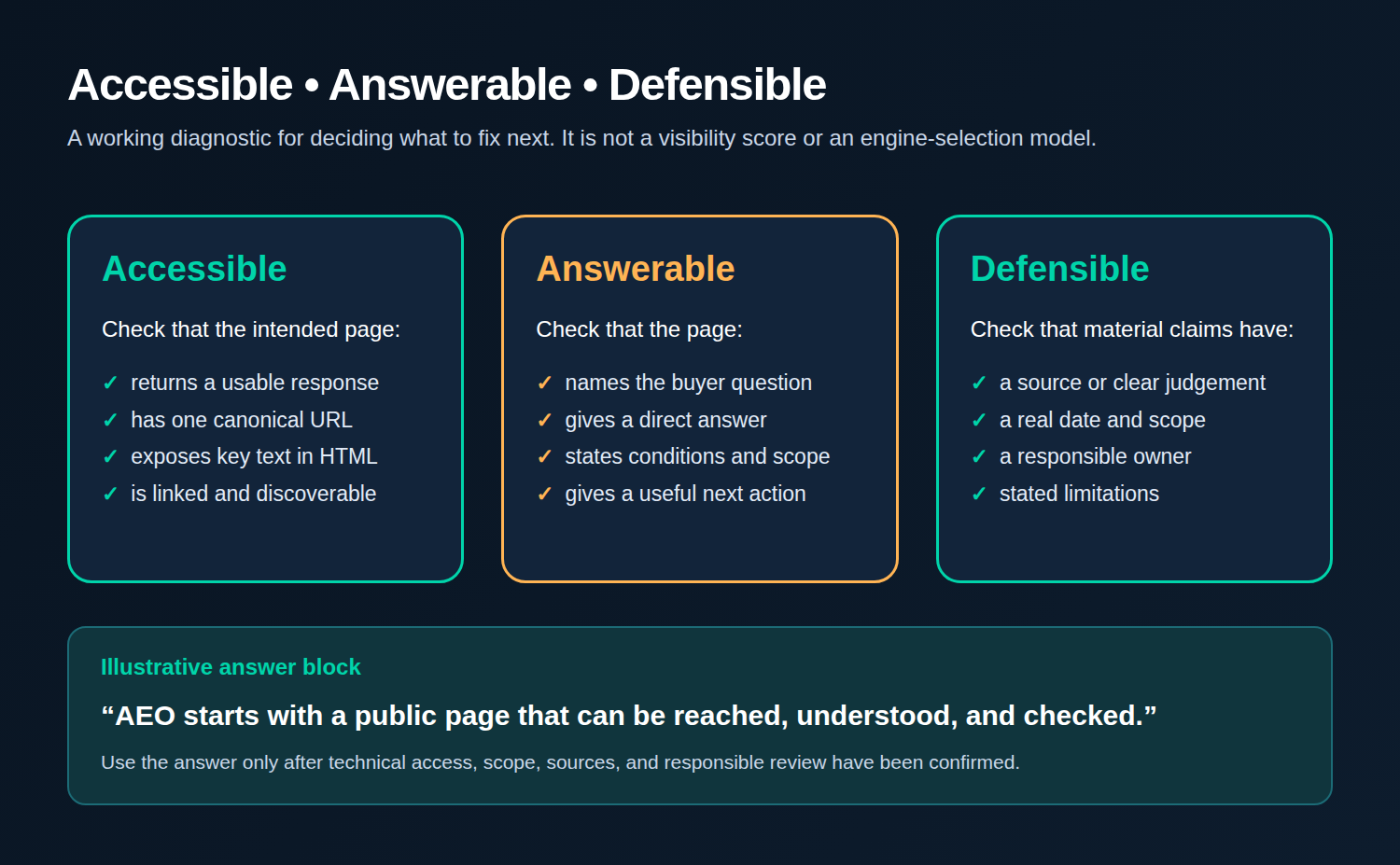
Answer engine optimization starts with making a useful answer accessible and supportable. For Google AI Overviews and AI Mode, the established foundations of Search still apply: a page needs to be eligible for Google Search, answer a real buyer question, and make material claims possible to check. These conditions support eligibility and trust. They do not guarantee a citation, a ranking, a lead, or revenue.
AEO is a working scope, not a replacement for SEO
AEO is a useful working label for the work of making public answers easier for people and answer systems to find, understand, and verify. It overlaps with SEO because both depend on accessible pages, useful content, and clear site architecture. GEO and LLMO are related labels that different teams use differently. They should not be sold as separate technical stacks before the basic search work is sound.
Google is unusually clear about the point for its own products. Its guidance says the same SEO best practices apply to AI Overviews and AI Mode. It does not require a special AI schema type, a new AI file, or an additional technical eligibility layer. That statement is limited to Google Search. It is not evidence that every assistant uses the same retrieval system or follows the same policy.
The useful management question is therefore not, “Which acronym should we optimize for?” It is, “Can the buyer and the relevant system reach a stable page, understand the answer, and inspect the support for its important claims?”
Modi’s POV: The most expensive AEO mistake is polishing an answer before anyone has confirmed that the right page is available, current, and defensible.
Access is only the first step
A page can be reachable without being indexed, indexed without being retrieved for a particular question, and retrieved without being cited in an answer. Treating those stages as one linear pipeline creates poor diagnoses and exaggerated promises.
Crawling is a system fetching a URL. Indexing is a search system processing a page for its searchable corpus. Retrieval is finding material that may help answer a specific query. Citation is an answer experience displaying or attributing a source. The exact implementation differs by platform, and a citation is not a commercial outcome.
That distinction changes the first investigation. If the server returns an error to the intended crawler, start with delivery. If a page is blocked by a robots directive, identify whether the goal is to control crawling, indexing, snippets, or training access. If a page is indexed but not useful for a buyer question, improve the answer and evidence instead of adding another markup type. If a page is shown as a source, do not leap from that observation to a conclusion about recommendation, conversion, or revenue.
Accessible: remove technical blockers before rewriting copy
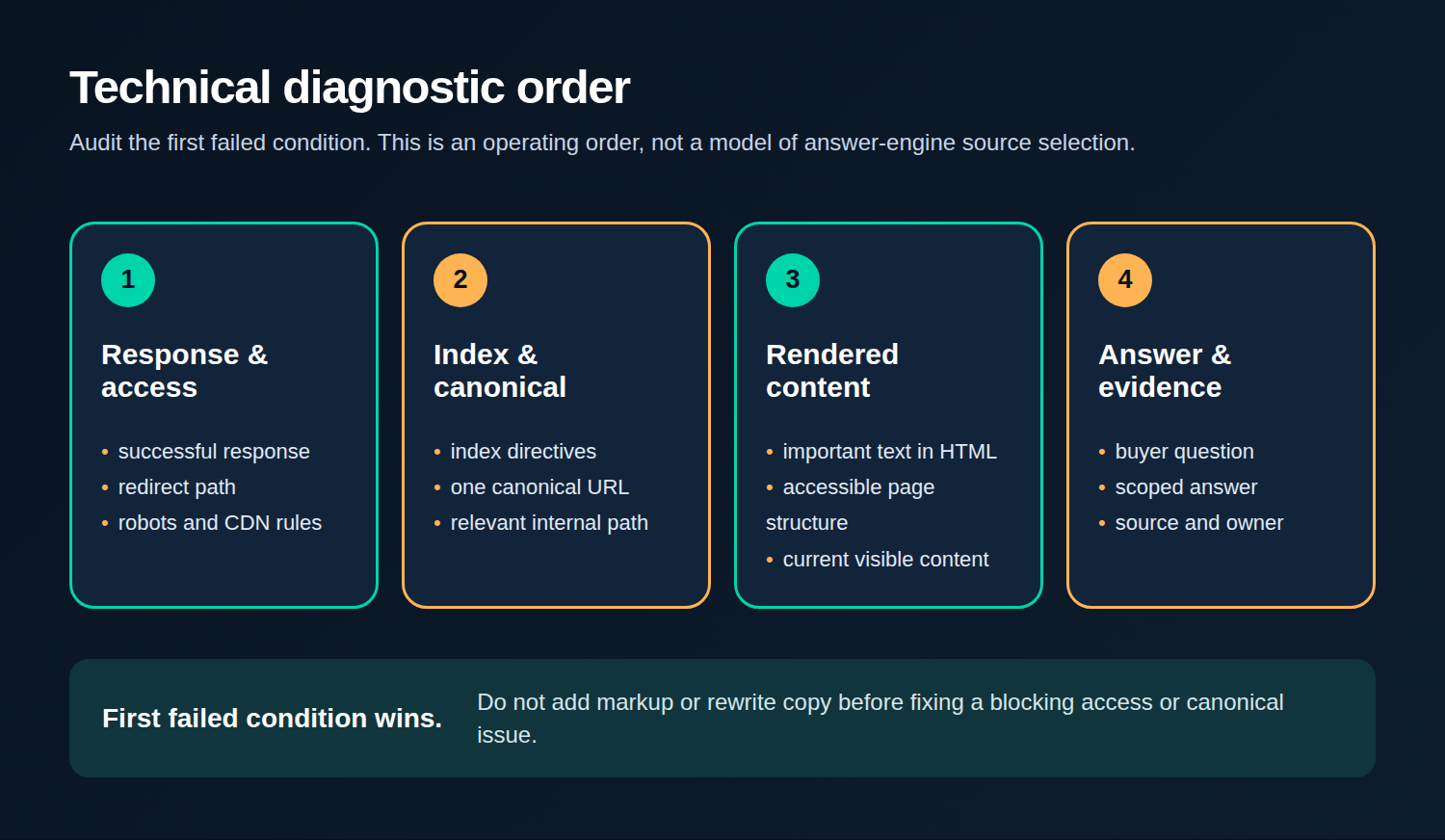
The first layer is accessible delivery. Check the final HTTP response, redirect path, CDN behavior, robots.txt, robots meta directives or response headers, self-canonical, and the text that actually appears in the rendered document. The test should name the engine and the purpose under review. “Allow all bots” is not a complete policy.
A robots.txt rule is primarily a crawling control. Google states that a disallowed URL can still appear in Search when other pages link to it. If the objective is to keep a page out of Google results, noindex or an appropriate access control is the relevant discussion, and Google needs to be able to see the directive. Conversely, blocking essential scripts or content can make a public page harder to understand.
For a commercial site, a short diagnostic sequence is usually more useful than a long technical checklist:
- Does the canonical URL return a successful response to the intended crawler and a normal browser?
- Is the page allowed to be crawled and eligible to appear in the intended search experience?
- Does the rendered HTML contain the key answer rather than leaving it behind an interaction or script failure?
- Does the page declare one clear canonical and receive internal links from relevant pages?
- Is the supporting sitemap current and does it use the same canonical URL form?
Fix the first failed condition before refining headings. A well-written answer cannot overcome a page that a required system cannot fetch or interpret.
Answerable: resolve a buyer question with conditions and a next action
An answerable page begins with a real question that a buyer, customer, sales team, or support team needs resolved. Paid-search queries, sales-call notes, CRM reasons, site-search terms, and customer interviews can help surface questions. None of those inputs alone proves market demand, so record what the evidence actually says.
A useful answer gives the direct conclusion first, then its scope, conditions, and next action. For example, a page about AI-search readiness should not simply say that “schema matters.” It should explain that structured data should accurately describe visible content, help systems interpret the page, and be treated as documentation rather than a mechanism for promised inclusion.
The goal is not to compress every subject into a short answer. It is to ensure that a reader who lands on the page can understand what is being answered, who the advice applies to, and what would change the recommendation. Detailed content-production methods belong in a separate editorial workflow. This guide’s job is to keep the first buyer answer and the underlying page conditions connected.
Defensible: make the important claim possible to inspect
A defensible answer separates evidence from judgement. Put a source near a material factual claim. Name the scope and date of a recommendation. Show a genuine update date when the substance changes. Attribute an opinion as an opinion rather than disguising it as independent research.
Human review is especially valuable where a page makes a commercial promise, interprets a platform policy, names a competitor, or uses a number that could be repeated in a sales deck. A reviewer should be named only when one actually reviewed the work. The same applies to an author: a real author profile can help a reader understand who is accountable, but an invented credential or generic “expert reviewed” label weakens trust.
Defensibility also means saying what the evidence cannot support. A dated manual observation can show what one answer displayed in that context. It cannot establish stable prevalence. A source link can support a statement, but it does not prove a buyer’s preference. A citation can be worth investigating, but it does not establish an incremental commercial outcome.
Structured data should describe the page, not manufacture an outcome
Use structured data to describe the content that is actually visible. For an editorial guide, a properly connected Article or BlogPosting node can identify the headline, image, author, publisher, dates, canonical page, and breadcrumbs where those are real. Google’s Article documentation recommends adding applicable properties and linking the author to a genuine identifying profile.
That is helpful documentation, not “AI citation schema.” Google says it does not need special markup to appear in AI Overviews or AI Mode. Google also removed FAQ rich-result documentation in 2026 after ending that feature in Search. A visible FAQ section can still help a buyer navigate a topic. It should not be presented as a rich-result tactic or a citation guarantee.
The same restraint applies to llms.txt. It may be useful for services that choose to read it, and maintaining a clear discovery file can be a sensible site operation. Google says it does not use llms.txt as a positive or negative visibility signal for Google Search. Keep the file accurate, but do not treat it as a prerequisite for Google AI features.
Prioritize the next fix with a working diagnostic
The Accessible–Answerable–Defensible model is an Integrated.Social working diagnostic. It is not a validated score or an engine-selection model. Use it to create an accountable sequence rather than to produce a single “AI visibility” number.
| If the blocker is | Run this diagnostic check | Assign an owner | Keep this evidence of completion |
|---|---|---|---|
| The page cannot be reliably reached | Check response, redirect, CDN, robots and rendered document behavior for the intended system | Technical owner | Dated response and rendered-page check against the canonical URL |
| The page does not answer the buyer question | Compare the opening answer, conditions, and next action with the documented question | Content owner | Approved revision with the question and answer captured together |
| The claim is too broad or unsupported | Check source, scope, date, attribution, and reviewer status | Subject-matter or commercial owner | Source record and an approved, scoped claim |
| The site sends mixed signals | Compare canonical, internal links, sitemap, visible headings, and page metadata | SEO owner | One canonical path and a recorded correction |
The order matters. Resolve access and ownership conflicts before polishing answer blocks. A strong new paragraph cannot repair a blocked document, a stale canonical, or a claim that nobody can approve.
A practical first week
Start with one commercially meaningful buyer question. Select the existing page that should own it. Confirm its canonical URL, rendering, access controls, and internal path. Rewrite only the opening answer needed to remove ambiguity. Attach the best available support to any factual or commercial claim. Then record who will review the page when the product, policy, or evidence changes.
This is slower than adding a generic FAQ block across every template. It is also more useful. The result is a page that a buyer can understand, a technical team can inspect, and an editor can keep current without pretending that a platform’s source-selection systems are predictable.
For a broader technical and editorial review of your public search foundations, explore our SEO, AEO, and GEO services. For detailed implementation perspectives, see our guide to technical SEO for AI search, our evidence-led AI visibility scoring guide, and our guidance on writing content for cited ChatGPT answers.
For an external contribution on diagnosing technical SEO before rewriting buyer-facing copy, see Modi in the news, including the Grit Daily roundup. This is related practitioner commentary, not independent verification of this guide or proof of an SEO recovery.
About the Author
Modi Elnadi is the founder of Integrated.Social. He writes about how technical access, buyer-focused content, evidence standards, and accountable review affect commercial discovery across search and AI-mediated research. His focus is practical: make public claims easier for a buyer to inspect, keep the evidence and limitations clear, and improve the next decision without promising a citation, ranking, or revenue outcome.