Use paid search terms for AEO by turning permissioned query observations into buyer questions, checking the evidence needed to answer them, and assigning each question to an existing page wherever possible. Keep the searched wording separate from your interpretation, redact sensitive information, and name the reviewer responsible for the answer. Paid data can sharpen an editorial brief; it cannot prove buyer intent, represent all demand, or buy an AI citation.
Highlights
- Know what the report can tell you.
- Use the query-to-question worksheet.
- Validate the answer before release.
- Separate publishing from measurement.
What paid search terms can tell you
A search term is the wording someone searched. A bid keyword is the advertiser's targeting input. They are different objects: matching can connect an advertiser keyword with searched wording that is not identical to it. Google distinguishes them in its documentation for the Google Ads search terms report.Source 1
The report gives insight into searches that triggered ads and their performance. Google also describes using those insights to inform creative and landing-page ideas.Source 1 That makes the report a useful starting point for paid search and SEO collaboration.
It remains an ad-triggered observation. Campaign targeting, matching, timing, and eligibility shape what reaches the report. Google withholds some low-activity queries under its privacy standards, so the visible rows are incomplete.Source 1 Missing wording does not establish missing demand.
Do not turn a query into a claim about who searched, what every buyer believes, or how frequently the wider market asks that question. A reported conversion can add context where its use is authorized; it still does not explain the person's reasoning. Nor is typed wording evidence of voice-search demand.
Make a permissioned editorial handoff
Start with a bounded export or approved internal view, not an unrestricted account dump. Have the account owner confirm who may use the data, for what purpose, and in which tools. Access to campaign reporting does not automatically authorize public quotation or uploads to an external writing assistant.
Record the account owner, observation period, campaign context, permitted purpose, and redaction status. Include conversion or sales context only when the organization has authorized that use. Keep personal information, customer identifiers, confidential negotiations, and sensitive records out of the editorial handoff. If a query cannot safely retain its original wording, record that it was redacted or paraphrased rather than presenting the rewrite as verbatim.
Give the writer context for the question, not information that could identify a searcher.
Turn wording into a decision question
Preserve two separate lines: what the report observed and what the editor thinks it might mean. The second line is a hypothesis about search intent, not another reported fact.
For example, wording about exporting data before cancellation might indicate an exit concern. It could also come from an existing customer looking for instructions. The editor should not silently classify it as a prospective buyer's objection.
Ask what decision an answer would help someone make. “CRM export” is a topic; “Can an administrator export records before cancellation, and what remains accessible afterward?” is an answerable decision question. Keep unresolved alternatives in the brief until evidence or authorized customer context narrows them.
Group related wording by the decision it raises, rather than creating a page for every variation. Check the existing service, product, support, and editorial pages first. The guide to which page owns an AI-search follow-up answer handles that ownership decision in more depth. This handoff should identify a likely destination, not override its owner.
A query-to-question worksheet you can use
Copy this structure into an approved document. Complete one card per decision question, retaining the distinction between observation and interpretation.
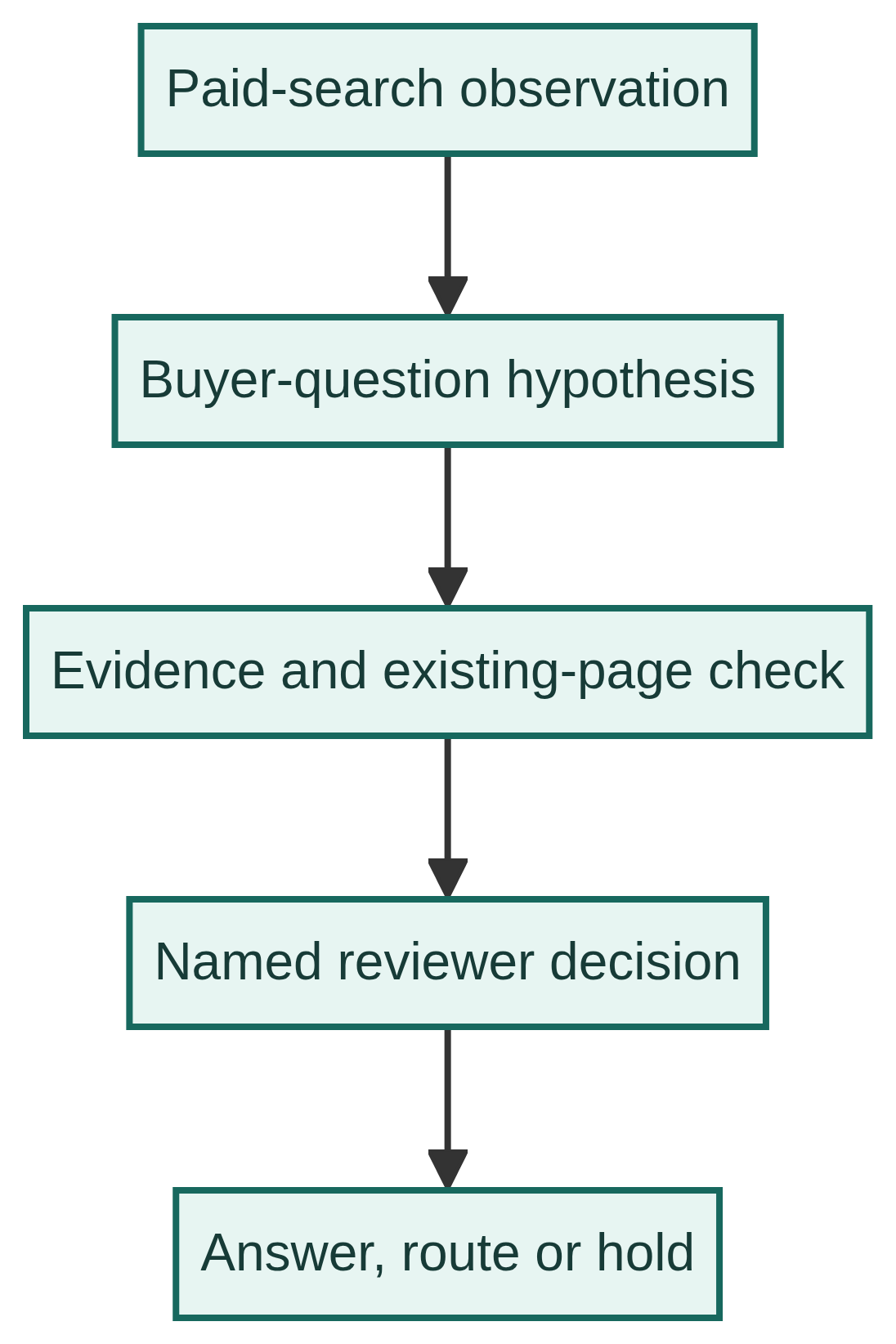
Text steps: observe the query; propose a question; check evidence and the existing page; obtain reviewer approval; answer, route, or hold.
Optional animated sequence
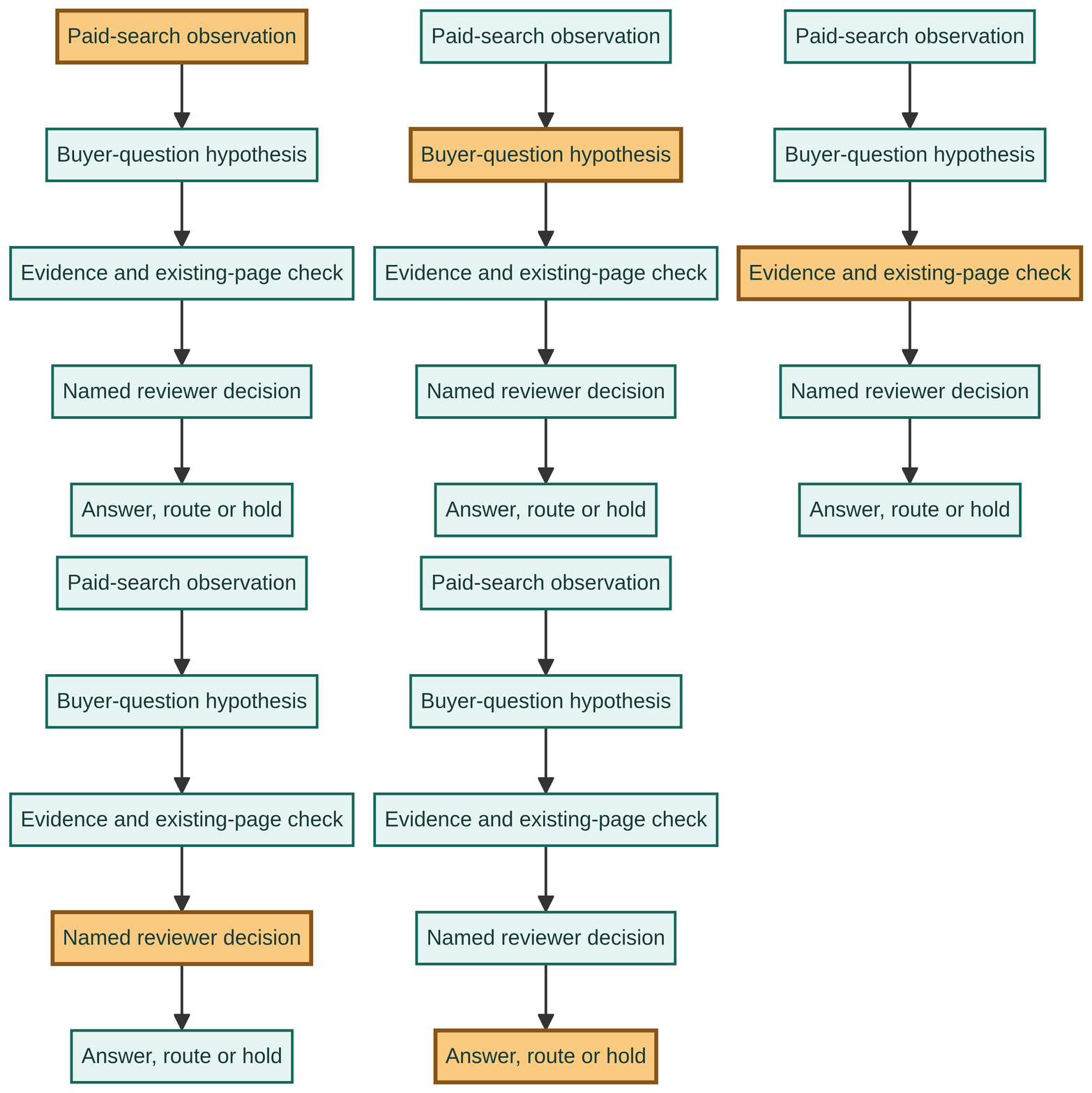
Optional sequence: conceptual step highlighting, not result data. The static diagram carries the same meaning.
Fictional example: Every entry below is illustrative. It is not a client record, a search-volume estimate, or an account test.
| Worksheet field | Fictional example and required action |
|---|---|
| Source and permission | Fictional CRM vendor's search account. Account owner must approve sanitized editorial use; no raw records leave approved tools. |
| Observation period and context | Illustrative October reporting period; campaign targeting CRM evaluation. Record actual dates and matching context before using a real query. |
| Observed wording | “crm data export before canceling contract.” Fictional wording, not a quotation from a live report. |
| Inferred buyer meaning | Possible concern about retaining data during exit. Could instead be a current customer's support question. |
| Proposed buyer question | Can administrators export CRM records before cancellation, and what remains accessible afterward? |
| Evidence required | Current export documentation, applicable access terms, and confirmation of supported roles and data types. |
| Existing-page check | Check the vendor's existing export or cancellation page before commissioning a new URL. Confirm the real page and owner. |
| Named reviewer | Alex Morgan, fictional senior product reviewer. Replace with the authorized person accountable for accuracy. |
| Disposition | Hold until documentation resolves access after cancellation; then update the existing owner if appropriate. |
| Release record | Record approved wording, supporting source versions, reviewer approval, and the actual destination only after release. |
This AEO content brief supplies a question, evidence requirements, destination, and accountable reviewer. It does not invent the unsupported answer.
Answer when evidence and ownership are clear. Route to another team or existing page when appropriate. Hold when inference, permission, or evidence is insufficient. A hold can prevent a misleading commercial claim from reaching a sales conversation.
Validate the answer before release
Have the reviewer answer four concrete questions. Does the source support the exact claim? Does it apply to the product, plan, market, or situation discussed? What exception would make the answer misleading? Can a reader follow the evidence and understand its limits?
For the fictional cancellation question, a general export tutorial would not establish post-cancellation access. The reviewer needs the applicable terms or documented policy. Until then, omit that claim or hold the answer. A plausible sentence is not sufficient evidence.
Write the direct answer first, followed by conditions, source context, and the next useful action. Avoid expanding a narrow operational answer into unsupported promises about cost, speed, compatibility, or outcomes. The guide to writing content for ChatGPT answers covers the broader writing task; the paid-search handoff supplies a qualified input to it.
Before approval, read the answer without the surrounding article. If that passage becomes misleading when quoted alone, revise it. Evidence-led content must survive that separation.
Keep release and measurement separate
A signed-off answer is ready for the publisher's checks. It is not yet live, indexed, or cited. Record the actual page and release date after publication, then measure against the question and commercial purpose you approved.
Google says ordinary SEO foundations apply to AI Overviews and AI Mode. Supporting pages must meet Search eligibility requirements, and eligibility does not guarantee inclusion. Those features may produce different responses and supporting links.Source 2 Answer engine optimization should improve the usefulness and accuracy of the page without claiming a universal AI-answer formula.
OpenAI documents OAI-SearchBot as supporting website visibility in ChatGPT search. Crawler access is an access condition, not a promise that a particular answer will be selected or cited.Source 3 Paid-search observation and subsequent AI visibility therefore belong in separate evidence records.
If the team runs a repeatable citation sample, use the AEO citation panel operating sheet rather than turning a few answers into market share. Keep observed sources, referrals, and qualified inquiries distinct. None proves that the original paid query caused a citation.
For recurring work, an accountable retainer should maintain this connection between query review, evidence checks, page updates, and later measurement. Integrated.Social's SEO, AEO and GEO service describes a combined program with buyer-question prioritization and named senior review. Ask who will approve the answers and maintain them when the underlying facts change, rather than buying an output quota.
References
Google Ads Help: About the search terms report