The direct answer
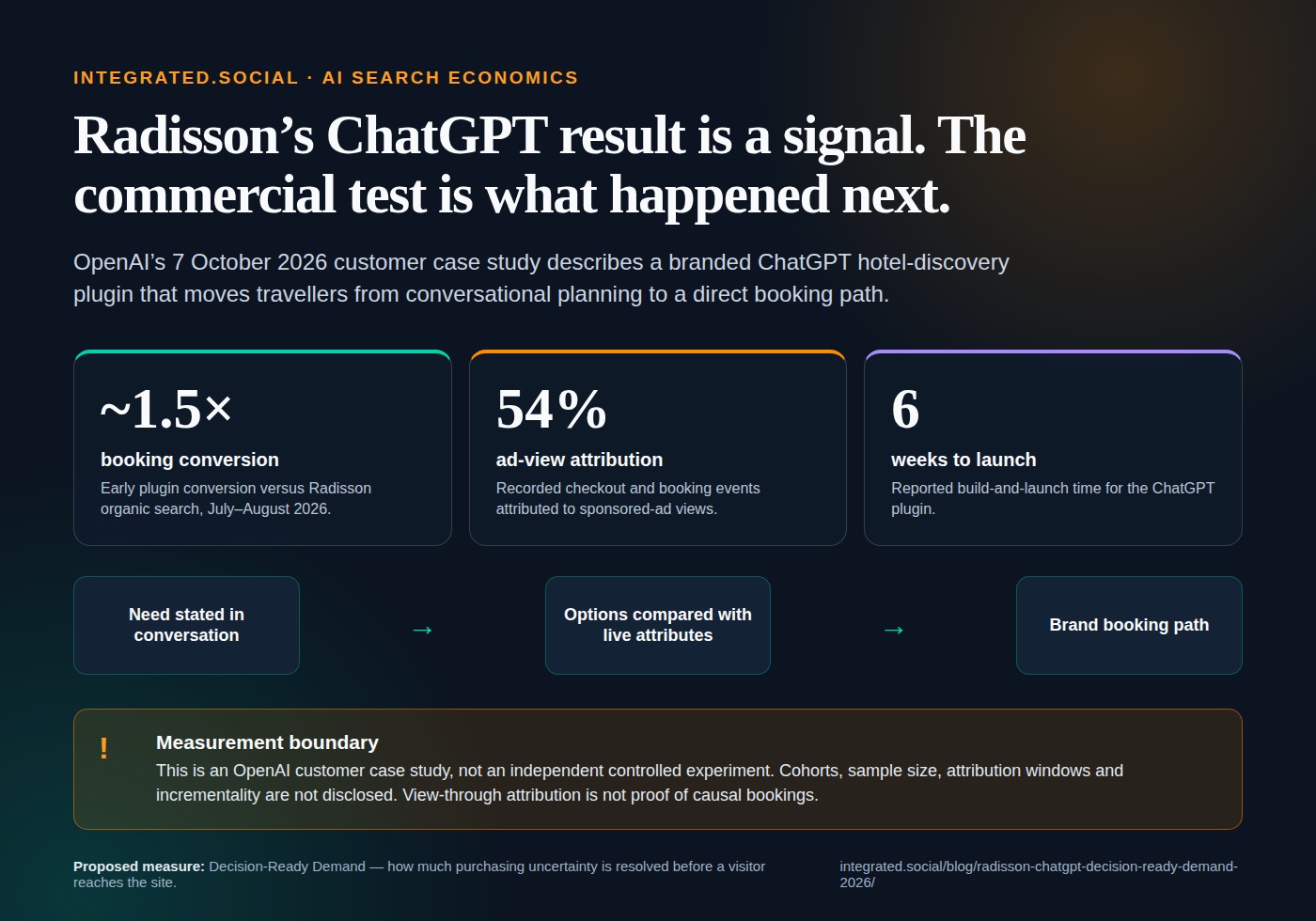
Radisson Hotel Group reports that its ChatGPT hotel-discovery experience converted visits to bookings at approximately 1.5× its organic-search conversion rate during July and August 2026. That is an important early commercial signal, not a universal rule about ChatGPT or Google. The evidence comes from an OpenAI customer case study rather than an independent controlled experiment, so marketers should treat it as a measurement hypothesis to test, not a benchmark to promise.
What Radisson reported about ChatGPT hotel discovery
On 7 October 2026, OpenAI published a case study describing Radisson Hotel Group's branded ChatGPT experience, developed with Accenture. The experience lets travellers explore hotels, compare locations, review amenities and prices, then continue to Radisson's direct booking journey.
The case study reports three notable observations from Radisson's rollout:
| Reported observation | What it may indicate | What it does not prove |
|---|---|---|
| About 1.5× organic-search visit-to-booking conversion | AI-referred visitors may arrive with more research completed | That ChatGPT universally converts better than organic search |
| 54% of recorded checkout and booking events in ChatGPT advertising measurement attributed through ad views | Some influence may occur without a direct click | Incremental bookings caused by the advertising exposure |
| 6 weeks to build the experience | A branded conversational experience can be deployed relatively quickly in this case | A standard implementation time for every business |
The first figure is the headline. The context matters just as much. A hotel shopper using a conversational experience may have already stated dates, location, party size, amenities and price preferences before reaching a booking page. That is a different consideration state from a broad organic visitor. Cohort intent, selection, tracking design and sample size can all affect conversion comparisons.
Why the 1.5× figure is commercially interesting
The figure is commercially interesting because it shifts the question from how much traffic did AI send? to how much uncertainty had the visitor already resolved? A customer who has compared locations, availability and amenities in a conversation may be closer to a booking decision when they reach the brand's site.
That does not make referral traffic irrelevant. It makes it incomplete. A low-volume AI referral source could be valuable if it supplies qualified visitors with a higher likelihood of completing a meaningful action. Equally, it can disappoint if the AI experience gives inaccurate prices, availability or policy information.
The evidence boundary: reported result, not transferable benchmark
Radisson's result is provider-reported through an OpenAI customer case study. It is not an independent controlled experiment, and the published material does not establish incremental conversions. View-through attribution is useful evidence to investigate, but it is not evidence of causation on its own. Teams should not apply the 1.5× figure to another sector, market or traffic mix without their own experimental design and commercial data.
From referral traffic to decision-ready demand
The useful idea here is Decision-Ready Demand: demand in which a customer has already reduced a meaningful share of their purchase uncertainty before they reach the brand's own experience.
Traditional search often follows this path:
Query → search results → website → conversion
Conversational discovery can look more like this:
Need → AI conversation → comparison → recommendation → brand experience → booking
The customer may have already:
- articulated their requirements;
- compared alternatives;
- examined practical trade-offs;
- formed a shortlist; and
- identified the next action they want to take.
That can change the economics of a visit. It can also raise the stakes for information quality. If a conversational system presents stale availability, incomplete cancellation terms or misleading accessibility information, it can create a highly confident visitor who then has a poor experience.
A practical AI Search revenue measurement model
A commercial AI Search programme needs more than a citation dashboard. It needs a chain of evidence from visibility to business outcome.
| Measurement layer | Question to ask | Useful evidence |
|---|---|---|
| AI visibility | Is the brand included for an agreed prompt panel? | Engine, prompt, date, response capture and cited sources |
| Representation quality | Is the information accurate and differentiated? | Attribute checks, price/policy freshness, human review |
| Qualified demand | Do referred or assisted users show stronger intent? | Engagement, assisted paths, CRM qualification and consented analytics |
| Conversion quality | Do relevant actions complete? | Bookings, leads, revenue or margin by defined cohort |
| Incrementality | Did the activity change an outcome that would not otherwise happen? | Holdouts, geo tests, matched-market tests or carefully designed experiments |
The model should be segmented by engine, prompt set, customer market, device, date and evidence source. There is no universal AI visibility score or universal conversion multiple. A number becomes commercially useful only when its methodology remains visible.
What CMOs should do next
1. Audit the information an AI needs to make a useful comparison
Start with product facts that are decisive in a real buying journey: prices, availability, eligibility, specifications, service levels, exclusions, accessibility, cancellation terms and differentiators. The objective is not to feed every detail into an AI system. It is to identify the facts that must remain current, precise and explainable.
2. Separate brand visibility from commercial influence
A citation, a recommendation, a referral and a booking are different events. Report them separately. If an AI mentions the brand but a customer never visits, that might still be meaningful influence, but it should not be counted as a completed commercial outcome without evidence.
3. Instrument the owned journey without overclaiming attribution
Use consented analytics and clean campaign naming to understand what happens after users arrive. Preserve referral context where available, reconcile with CRM or booking data, and document the blind spots. Avoid turning a view-through or last-click figure into a universal ROI claim.
4. Test a decision-ready demand hypothesis
Choose a high-intent journey with sufficient volume. Define a prompt panel, an audience, a period and a conversion event. Compare outcomes against an appropriate baseline, then use an experiment or holdout where feasible. The test may show no advantage; that result is valuable too.
5. Treat data accuracy as part of conversion optimisation
In a conversational journey, an outdated fact can travel farther than an outdated landing-page paragraph. Establish owners and review cadences for commercially important attributes. AEO and GEO work must connect editorial governance to the information customers actually use to decide.
The Integrated.Social POV: visibility is not the final metric
The Radisson example suggests AI Search may become a revenue channel, not just a discovery channel. But the relevant commercial asset is not a generic promise of more AI traffic. It is a verifiable ability to help the right customer make a better-informed decision, then measure what happened with appropriate restraint.
For teams building an SEO, AEO and GEO programme, that means combining answer-ready evidence with accurate commercial data and a measurement plan that can survive scrutiny. It also means recognising that a brand may be represented, considered and influenced before a conventional click is recorded.
What this case study does not settle
The Radisson case study does not settle whether every category benefits equally from conversational discovery. It does not prove a standard conversion uplift. It does not establish that advertising view-through events are incremental conversions. And it does not remove the need for a brand-controlled website, booking flow or customer relationship.
It gives commercial leaders a stronger question: where in our journey can better-informed, higher-intent customers arrive, and how would we prove whether that changes economics?
Frequently asked questions
Does Radisson's ChatGPT result prove AI Search converts better than Google organic search?
No. Radisson reported approximately 1.5× visit-to-booking conversion versus its organic-search rate in an OpenAI customer case study covering its own experience. The published case study is not an independent controlled experiment, and its cohorts may differ in intent and context. It is a useful prompt to test whether conversational discovery changes conversion quality, not a transferable benchmark or performance promise.
What is decision-ready demand in AI Search?
Decision-ready demand describes visitors who may have resolved meaningful purchase uncertainty before reaching a brand's owned journey. In conversational discovery, a user can state requirements, compare options and narrow a choice before clicking through. It is a practical measurement concept rather than an established industry standard. Teams should test it with clearly defined cohorts, outcomes and evidence rather than assume it creates higher conversion.
How should a hotel or travel brand measure AI-assisted bookings?
A hotel or travel brand should separate prompt-level visibility, referral context, booking-path behaviour, completed bookings and incremental impact. Capture engine, prompt, date and evidence where possible; maintain accurate prices, availability and policies; then reconcile consented analytics with commercial systems. Where volume permits, use holdouts or other experimental designs. Do not treat view-through events as proof of incremental revenue without a methodology that supports that conclusion.
Why does AI data accuracy matter for conversion?
AI-assisted comparisons can make an inaccurate fact feel highly persuasive because the customer may receive it as part of a tailored recommendation. Price, availability, eligibility, accessibility, cancellation and service information therefore need clear ownership and review. Accuracy protects customer trust and reduces avoidable conversion friction. It also gives AI systems better evidence from which to represent the brand consistently.
What should CMOs do before investing in AI Search experiences?
CMOs should select one high-intent journey, define the customer question, assess the factual data needed to answer it and agree the outcome they will measure. Build a source-qualified prompt panel, a data-freshness process and an attribution plan before making a broad claim. Start with a testable hypothesis about qualified demand or conversion quality, then expand only where evidence supports the investment.
About the Author
Modi Elnadi is the founder of Integrated.Social, a London AI growth marketing agency working across SEO, AEO, GEO, paid media and governed agentic workflows. He writes about the commercial evidence behind AI-mediated discovery: how brands are found, compared, represented and measured when a customer journey begins in an AI interface rather than a conventional search result.