PwC announced critical-thinking and judgment training for more than 85,000 partners and employees across its US, Mexico, and Acceleration Centers offices. Starting in December 2026, the planned program responds to AI changing foundational work. My concern is the apprenticeship: automating research and first drafts may remove practice that develops judgment. Whether this program improves skills remains to be measured.
What exactly has PwC announced?
On November 9, 2026, PwC announced a Critical Thinking & Judgment Certificate covering more than 85,000 professionals in the specified operations, not its entire global workforce. The rollout starts in December 2026, with completion targeted for June 2027. PwC plans to make its framework available to universities beginning in early 2027, according to “PwC US to equip 85,000+ professionals with critical thinking and judgment certification as AI transforms work”._
The curriculum includes diagnostic scenarios, masterclass-style videos, personalized simulations, on-the-job tools, and team collaboration. Human Resources Director's “Can judgment be taught? PwC is putting 85,000 people to the test” describes a planned AI coach, role-specific simulations including tax scenarios, a final assessment applying the framework, and work observation and performance feedback. These are implementation plans, not published pass rates or measured improvement._
Bloomberg Law's “PwC US to Roll Out Certification on Critical Thinking in AI Era” reports the firm's estimate of more than $100 million in total investment, including program development and university funding. That is neither classroom-only spending nor realized return on investment._
| Issue | What is supported | What remains unknown |
|---|---|---|
| Coverage | Planned training for 85,000+ partners and employees in US, Mexico, and Acceleration Centers offices. | Participation, completion, and proficiency outcomes. |
| Timing | December 2026 start; June 2027 completion target; university framework planned for early 2027. | Whether delivery meets these targets. |
| Investment | Bloomberg reports a firm-estimated total above $100 million, including development and university funding. | Verified disbursements and realized business returns. |
| Assessment | Planned applied assessment, work observation, and feedback. | Demonstrated skill retention, reduced errors, or causal impact on employment. |
Is your organization gaining AI productivity while losing the skills it depends on? Explore AI Training for Leaders as a starting point for responsible adoption._
Why do junior tasks matter for developing expert judgment?
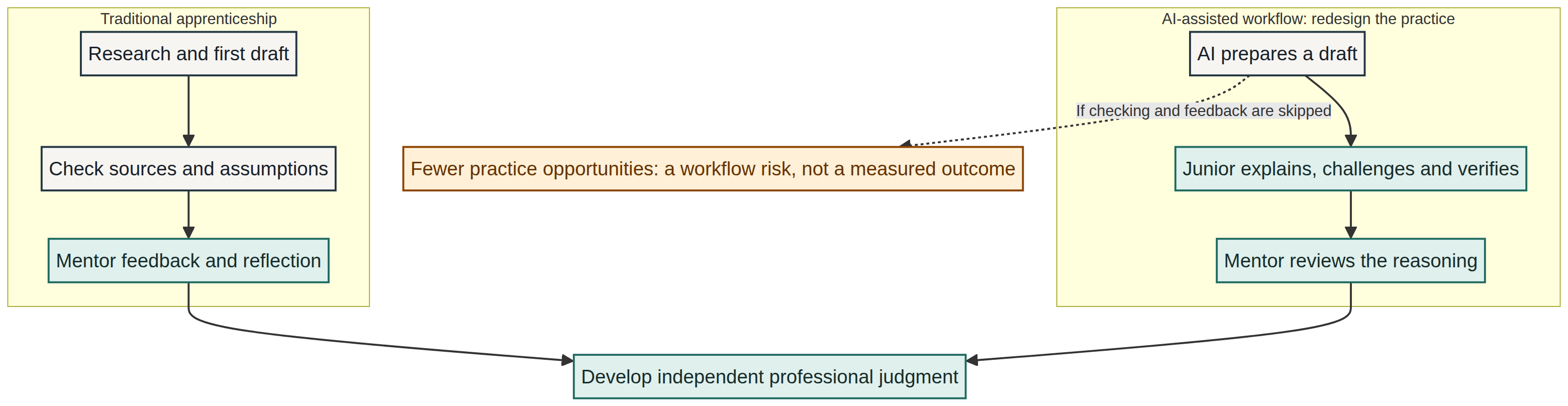
My interpretation is that the most consequential displacement could be the displacement of learning itself. Researching, drafting, reconciling conflicting evidence, and correcting mistakes can teach people what a defensible answer looks like. If those activities disappear, employers need another route to expertise.
Consider a hypothetical consulting assignment. AI produces a market assessment recommending expansion. A junior analyst should still trace the figures, distinguish addressable demand from reachable customers, question pricing assumptions, and explain uncertainty. A supervisor then challenges the argument. The learning comes from that exchange, not from formatting the slides.
The counterargument matters: not all grunt work is educational. Repeated copying, mechanical formatting, or searching without feedback may teach little. AI could free a trainee for better problems, generate contrasting cases, or provide feedback before a mentor reviews the reasoning. Preserving every manual step would confuse inefficiency with apprenticeship.
I would manage two balance sheets: immediate productivity and enduring capability. Hours saved belong on the first. Independent judgment, error detection, and a credible succession pipeline belong on the second. A faster deliverable is not necessarily a stronger future professional.
Can AI cause cognitive offloading and skill erosion?
What is cognitive offloading?
Cognitive offloading means delegating mental work to an external aid. Calendars, calculators, and search engines do it too. The question is not whether outsourcing effort is inherently harmful, but whether the worker still practices capabilities they will need when the aid is unavailable or wrong.
| Term | Meaning | What would establish it? |
|---|---|---|
| Task automation | A tool performs a defined activity previously performed by a person. | Observed workflow changes and task records. |
| Job displacement | Employment is eliminated or a worker is displaced from a role. | Employment evidence, with attribution assessed separately. |
| Skill erosion | A previously held capability deteriorates. | Comparable assessments over time, not output volume alone. |
| Cognitive offloading | Mental effort moves to an external tool. | Evidence about how the task is performed; decline does not automatically follow. |
| AI-assisted learning | AI supports practice, explanation, or feedback. | Demonstrated learning and retention, not merely access to a tool. |
When does AI support learning rather than replace it?
Microsoft Research and Carnegie Mellon authors' CHI 2025 paper, “The Impact of Generative AI on Critical Thinking: Self-Reported Reductions in Cognitive Effort and Confidence Effects From a Survey of Knowledge Workers”, surveyed 319 knowledge workers who reported weekly workplace GenAI use. Greater confidence in AI was associated with less reported critical-thinking effort or activity. This was an international, cross-sectional self-report study, not a randomized experiment measuring IQ, skill decline, or causation._
That distinction changes the management response. Reduced effort might represent useful efficiency, misplaced trust, or both across different tasks. To assess learning, compare an independent first attempt, an AI-assisted revision, and a later unaided attempt on a matched problem. Ask the trainee to explain what changed and why. Polished prose alone cannot distinguish understanding from dependence.
Which jobs and tasks are most exposed to generative AI?
Exposure describes technical potential within tasks, not a verdict on an occupation. Administrative document processing, customer-support drafts, marketing production, coding assistance, research synthesis, and legal-document review can contain automatable components. Client interpretation, unusual exceptions, accountability, and consequential decisions can still require people. These are illustrative task categories, not a new ranking of occupations.
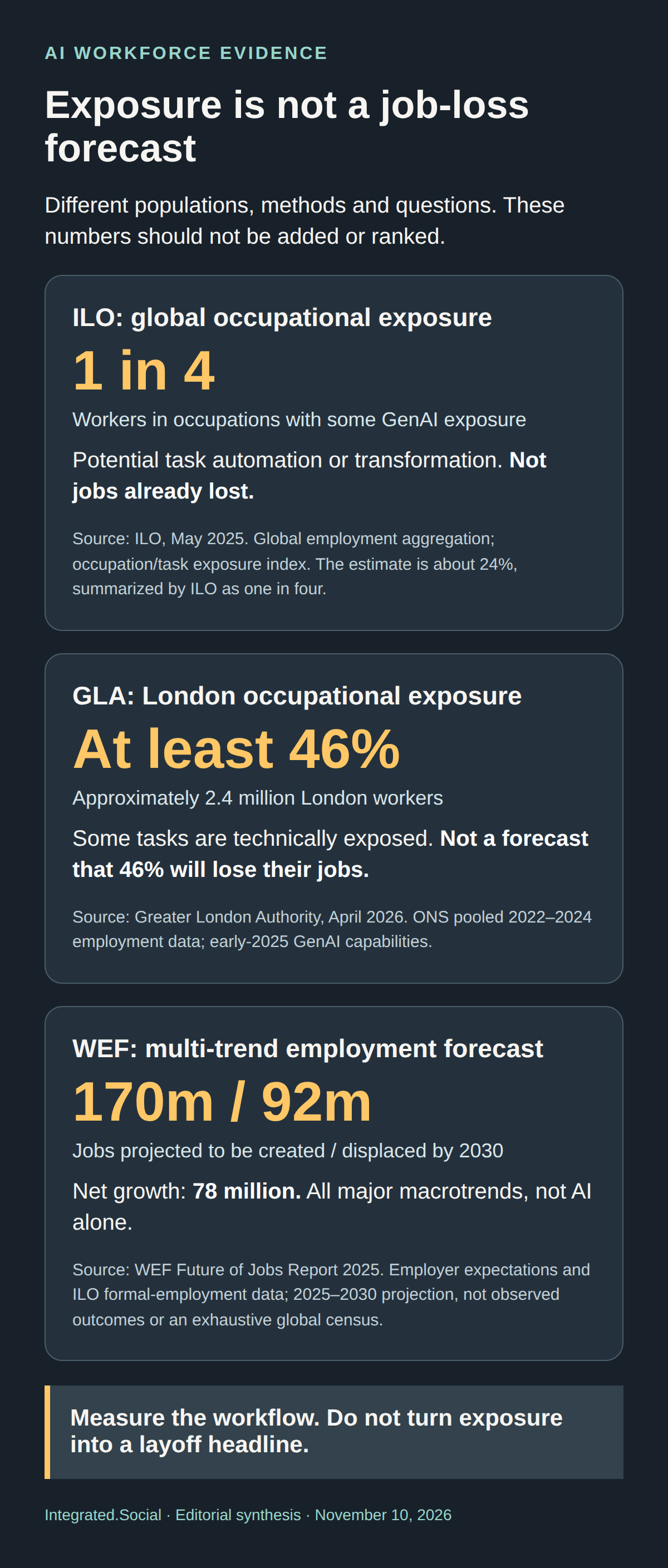
The ILO's May 2025 “Generative AI and jobs: A 2025 update” places one in four workers worldwide in occupations with some GenAI exposure; it favors transformation over full replacement, conditional on continued human input. London's April 2026 “London's workforce exposure to generative artificial intelligence” estimates at least 46%, around 2.4 million workers, have some occupational exposure. It uses pooled 2022–2024 employment data and early-2025 capabilities, not a job-loss forecast. The WEF's “Future of Jobs Report 2025: Jobs outlook” projects 170 million jobs created and 92 million displaced globally through 2030 across multiple macrotrends, not AI alone. Employer expectations and employment data underpin projections, not observed outcomes; coverage is limited, not a complete workforce census._
These figures answer different questions. None establishes how many US graduates will lose jobs or how many PwC roles will disappear. Employers should map their actual tasks before making staffing or training decisions.
Will AI replace entry-level jobs or change what employers expect from graduates?
Both are possible, but neither follows automatically from PwC's announcement. Employers could automate tasks, redesign roles, reduce junior recruitment, expand services, or create new work. Those mechanisms produce different employment and learning outcomes. The announcement does not demonstrate an observed change in graduate hiring.
The strongest optimistic case is that lower delivery costs expand demand and give beginners access to expert guidance. A junior could learn through realistic simulations instead of months of mechanical production. The difficult question is whether organizations actually invest the saved time in supervised development.
PwC's “Companies risk losing AI-savvy employees”, reporting its 2026 Global Workforce Hopes and Fears Survey, adds useful context. It surveyed 49,364 workers across 48 countries and regions in May and June 2026, with age and gender weighting. Only 51% reported access to needed learning resources. That is a self-reported access measure, not proof of deskilling or the effectiveness of this new certificate._
For employers, the issue is opportunity as much as tool proficiency. A graduate can become better at operating AI while receiving fewer chances to make and defend a decision. Access to software cannot substitute for access to feedback.
Why should CMOs worry about the next generation of marketing talent?
Marketing makes the distinction concrete. In a hypothetical workflow, AI drafts an SEO audit, PPC budget recommendation, and performance summary. A junior marketer must identify unsupported technical findings, distinguish attribution from incrementality, and question whether rising conversions reflect the campaign or another change. This is an illustrative exercise, not a measured client case.
If the recommendation claims a campaign caused growth, the learner should propose an appropriate causal test, consider a holdout or other credible comparison where feasible, and explain its limitations. If the audit flags an indexing problem, they should inspect the underlying evidence rather than accept a fluent diagnosis.
My view is that an AI-generated media plan is not a marketing strategy. Strategy requires a business objective, defensible assumptions, customer understanding, and choices someone owns. AI Marketing Strategy should connect those choices to delivery, not merely increase output._
The same principle applies to AI-powered enterprise B2B ABM: generated personalization is not evidence of buyer intent or revenue. Train people to distinguish a useful hypothesis from a substantiated commercial claim._
A practical human-plus-AI apprenticeship framework
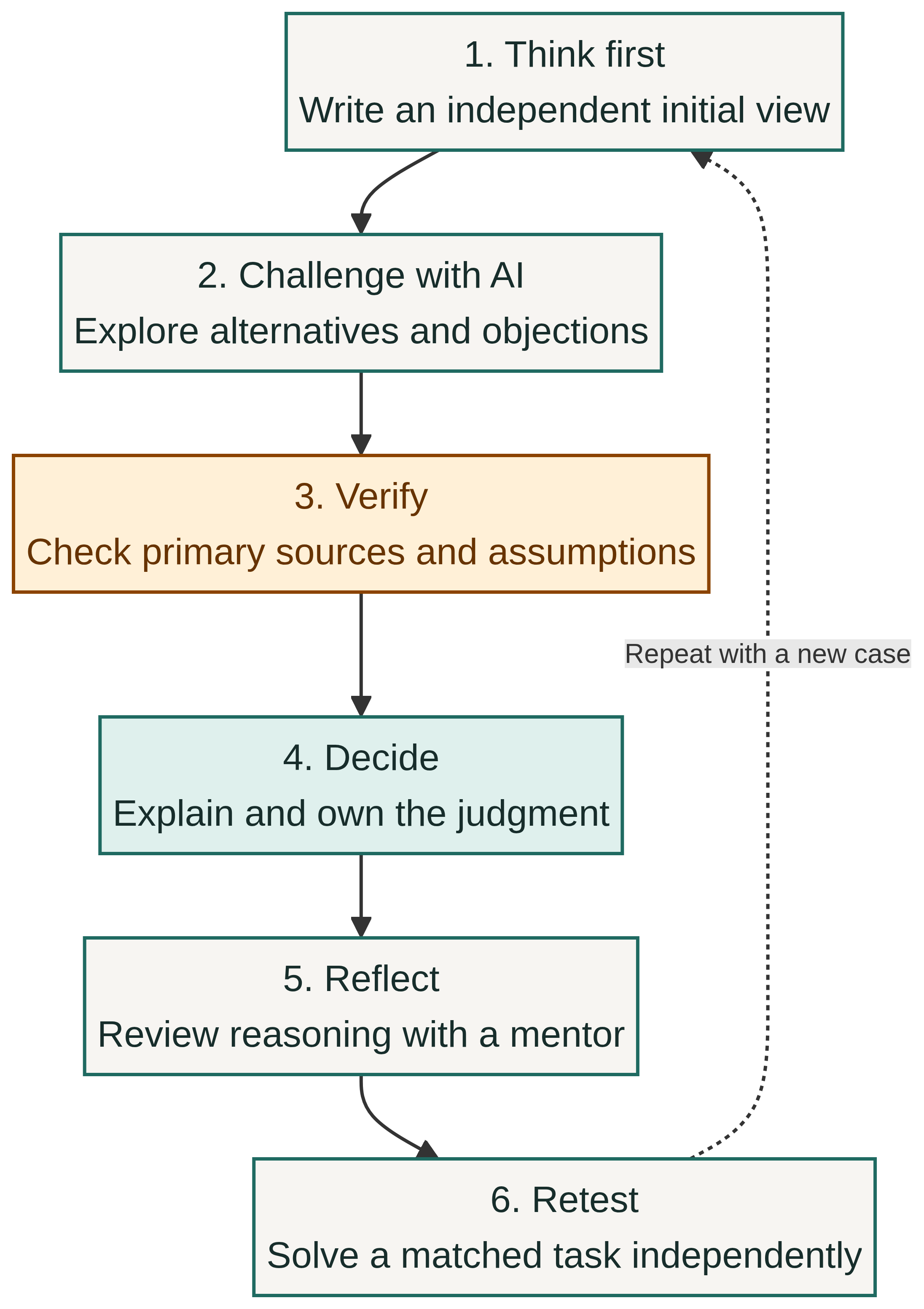
A six-step learning loop
The following framework is my recommendation, not PwC's curriculum or a tested training benchmark. It preserves reasoning while allowing AI to remove avoidable work.
- Think first. Write an initial hypothesis, assumptions, and evidence requirements before opening AI. Keep the attempt so a mentor can see the starting reasoning.
- Ask AI to challenge. Request competing explanations, counterexamples, and missing information. Treat proposed sources as leads to check, not verified evidence.
- Verify. Inspect original data, definitions, calculations, and permissions. Separate facts from assumptions and record what cannot be established.
- Decide. Explain the trade-off and name the person accountable for consequential action. Escalate uncertainty rather than allowing the tool to silently resolve it.
- Reflect. Have a mentor assess reasoning, not only polish. Discuss which challenge changed the decision and which AI suggestion was rejected.
- Retest. Use a later, comparable problem without AI for the core capability. Assess retained understanding, not memorization of a previous answer.
A Judgment Preservation Scorecard
Track seven measures: independent reasoning accuracy; source-verification accuracy; error-detection rate; performance without AI; improvement after feedback; human review minutes; and task outcome quality. Define each before the pilot, including what qualifies as an error or acceptable decision. Establish a baseline and compare matched cases of similar difficulty.
For accuracy measures, record correct judgments against assessed opportunities. For detection, use known errors in approved test cases rather than hidden traps in client work. Compare unaided performance and post-feedback improvement on equivalent tasks. Log review minutes consistently, and define outcome quality with the business owner. Report sample size and case mix so a small favorable result does not become a general claim.
Do not invent universal pass scores. A tax simulation, media-budget recommendation, and customer-support response need different criteria. Use AI marketing evaluation sets to make task-specific testing repeatable rather than selecting impressive outputs after the fact._
Review time is a cost measure, not a standalone quality target. Less review could mean a safer workflow or missed problems. Pair it with accuracy and outcomes. Use authorized cases, protect confidential information, respect data rights, and document who owns assessment and escalation.
Mentor quality matters too. Calibrate reviewers on sample cases, explain disagreements, and preserve time for feedback. Otherwise the scorecard can reward whoever receives the easiest assignments or most attentive supervisor.
What should employers do in the next 90 days?
Days 1–30: map practice and establish a baseline
Inventory junior tasks and distinguish low-value repetition from activities that develop judgment. Ask employees and supervisors where mistakes become visible and feedback occurs. Select capabilities that staff must retain independently, then baseline performance on approved, representative cases. These phases are recommendations, not PwC's rollout schedule.
Days 31–60: compare supervised workflows
Run bounded human-first and AI-first pilots with matched cases and comparable supervision. Record time, accuracy, rework, escalation, and reasoning quality. Use delayed unaided assessments to examine retention. Limit personal and client data to authorized purposes, and confirm tool permissions before any upload or action. AI Governance should establish those boundaries alongside learning objectives._
Days 61–90: scale only what earns expansion
Compare productivity gains with retention, review costs, and outcome quality. Investigate differences in case difficulty or mentor support before attributing changes to AI. Expand successful workflows, revise weak ones, and retain independent practice where the capability matters. A certificate completion count is an activity metric, not a business return.
Our AI governance quality-control guide explains why release gates and audit trails belong beside automation. Learning needs equally explicit ownership._
Request an AI Workforce Readiness Review. Discuss scope and availability through our existing enquiry form; this is an enquiry, not a free consultation or certification. Review our privacy policy before sharing information. Do not include confidential client material in an initial message.
What should graduates and early-career professionals do?
Build a reasoning portfolio, not just a folder of generated deliverables. It should show how you investigated a problem, evaluated evidence, and responded to feedback without exposing information you lack permission to share.
- Develop domain knowledge. Explain the business problem and constraints before demonstrating the tool.
- Trace important claims. Retain source references, definitions, and calculation checks, including contradictions you found.
- Show your first attempt. Compare your initial reasoning with the AI-assisted revision and explain the changes.
- Practice independent decisions. Solve fresh problems without AI, then seek specific feedback on weaknesses.
- Document responsible outcomes. Separate observed results from assumptions and attribution, with permissions for any examples you share.
This checklist is not a credential promise or guarantee of employment. It is a way to make your judgment visible to a mentor or hiring manager. Being able to explain why you rejected an answer can be more useful than demonstrating another generated output.
Final POV: Don't automate away the apprenticeship
PwC's announcement makes a serious capability question visible. It does not prove that AI has lowered workers' intelligence, displaced the covered professionals, or that certification will solve the problem. Those claims require different evidence.
I do not want employers to preserve tedious work for nostalgia. I want them to preserve investigation, safe mistakes, feedback, and independent judgment. AI can make those experiences richer if learning is designed into the workflow.
The commercial test is whether a team can deliver better work today while developing people who can challenge tomorrow's unfamiliar answer. Productivity and capability should improve together. If leaders measure only the first, they may automate away the apprenticeship their future leaders need.