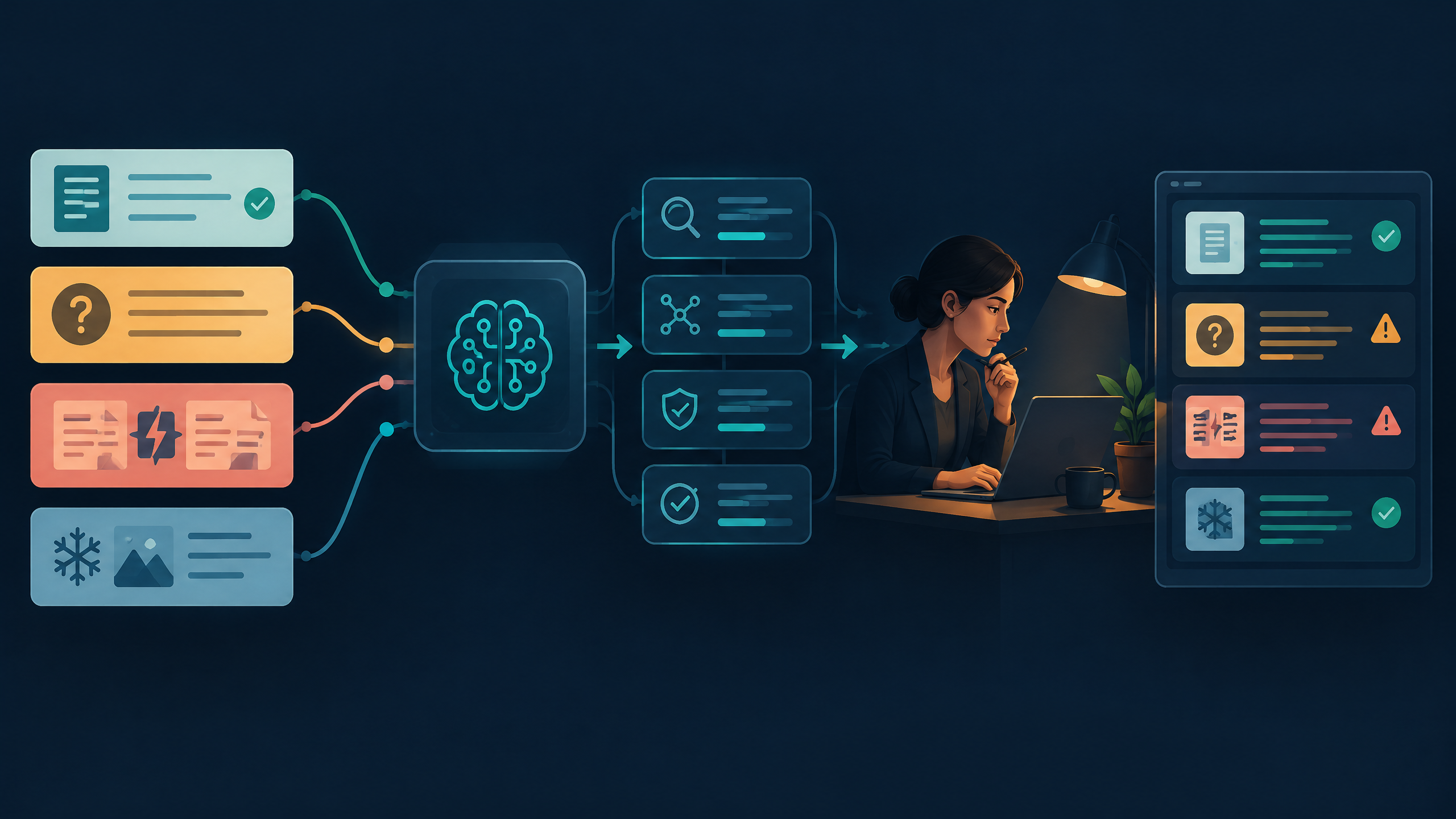
AI workplace productivity should be measured by the human effort needed to deliver accepted work, alongside elapsed delivery time, quality, and workload. Longer digital workdays among AI users do not establish that AI caused longer hours or reduced output. ActivTrak’s latest findings make a narrower but useful case: measure verification, correction, and handoffs within a complete workflow before treating faster generation as time saved.
What the November 3 coverage actually establishes
CIO’s November 3, 2026 analysis asks whether AI really saves employees time. The underlying ActivTrak Productivity Lab research was published on October 29, not November 3. It examined digital work patterns from 9,140 knowledge workers across 467 enterprises between April 1 and September 25, 2026. This is vendor-produced observational research, not a randomized experiment or a representative census of employees. [1] [2]
ActivTrak reports workdays of 8.42–9.08 hours for AI users versus 7.58 hours for classified non-users. Those figures are decimal hours, not hours-and-minutes notation. Although CIO describes the range in connection with heavy users, the original research’s range statement says AI users generally. The public text does not map each endpoint to a particular usage-intensity group, so that narrower description should not be imposed. [1] [2]
The company’s accompanying announcement calls the measure a workday span. Its earlier report’s glossary defines a workday as the interval between the first and last activity reported on an employee’s computer. A span can contain breaks and gaps. It is not necessarily paid labor, continuous activity, or useful output. [3] [4]
The focus comparison is more specific. Light AI users, defined as using AI for less than ten minutes daily, averaged 48.2 minutes per uninterrupted focus session. Heavy users, defined as more than 45 minutes across at least five daily sessions, averaged 37.8 minutes. ActivTrak describes that as approximately 22% shorter focus sessions, not 22% less total daily focus time. [1]
Application switching uses a different comparator: the vendor reports heavy users switched about 15% more frequently than non-users, not light users. Heavy, light, and non-user groups were classified from observed behavior; they were not randomly assigned. Their responsibilities, workloads, tool access, and job mix may differ. These comparisons identify patterns worth investigating, not an AI treatment effect. [1] [3]
Why the earlier study is not a clean contradiction
ActivTrak’s earlier 2026 State of the Workplace report, released March 11, used more than 443 million hours of digital activity from 163,638 employees across 1,111 organizations. Its main population covered January 2023 through December 2025. The report says average workday span declined from 8 hours 53 minutes in 2023 to 8 hours 44 minutes in 2025. [4] [5]
It also reports 19 more minutes of daily “productive time,” reaching 6 hours 36 minutes. That term means time in applications and sites categorized as productive, including focus, collaboration, and multitasking. It does not establish that more valuable business output was delivered. The workday decline was an aggregate change across years, not proof that adopting AI shortened an individual’s day. [4]
Comparable study populations have not been established. The latest analysis compares usage groups during a different period in a smaller population. The earlier report also contains a separate before-and-after AI-adoption analysis of 10,584 users at 376 companies, comparing 180 days on either side of adoption; that is not its main population. Public materials do not establish sample overlap, matched job composition, or harmonized calculations across the analyses. [3] [4]
CIO is right to question confident productivity claims. But presenting these figures as one continuous trend would answer a question neither study tested. The evidence supports different observed patterns under different comparisons, not a demonstrated reversal from AI saving time to AI causing longer days. [2]
Verification costs are a measurement question, not a reported finding
Neither the latest report nor its workday figures quantify how long people spend checking AI output, correcting it, or repairing a downstream mistake. Verification is a plausible workflow cost to investigate, not the established explanation for the longer spans.
That distinction matters in marketing operations. An AI-generated campaign report might require checking source dates, reconciling platform totals, and distinguishing observations from recommendations. A content draft might require a subject-matter reviewer to confirm a product claim. These are illustrative activities, not results observed in ActivTrak’s sample.
CIO also highlights an instrumentation problem: undetected AI use can leave someone classified as a non-user. Unmanaged devices and background agents can sit outside desktop observation. Application switching is visible in a way that shifts of attention within one application may not be. Treat activity data as one evidence source, not a complete account of human effort. [2]
Our existing AI ROI analysis addresses the broader gap between adoption and provable commercial return. The more immediate operational question here is different: whose effort changed between the request arriving and the work becoming usable?
Measure one accepted work unit from request to handoff
The following is a proposed Integrated.Social measurement framework, not an ActivTrak finding. Start with one recurring workflow and a completion rule. “Generate a campaign report” is too loose. “Deliver a reconciled report that the campaign owner accepts for the weekly decision” names an inspectable endpoint.
1. Hold the work definition and quality bar steady
Record the workflow version, input complexity, required evidence, approver, and completion criteria before comparing approaches. A shorter draft that omits a required analysis is not the same work completed faster. Use the existing evaluation-set method to establish representative cases and acceptance checks rather than creating a new generic quality score.
Compare similar work under similar conditions. Where feasible, a local experiment can assign comparable incoming tasks to an existing or AI-assisted route. Randomization must be designed and documented; it cannot be inferred from naturally occurring usage groups. If a team uses a before-and-after comparison instead, record changes in staffing, demand, task mix, and approval rules beside the result.
2. Record labor separately from elapsed time
Capture active human effort for preparation, generation or execution, evidence checking, correction, coordination, and final approval. Include the requester, operator, reviewer, and downstream recipient where they contribute effort. Otherwise apparent savings can simply move from the person using AI to the colleague who must make its output usable.
Separately timestamp request arrival, first usable draft, review entry, approval, and final handoff. Waiting in an approval queue affects delivery time but is not automatically labor. Overlapping work by two people contributes two people's effort; it should not be treated as one person's continuous session. State the recording method and leave unobserved effort unknown rather than silently recording zero.
3. Keep failed attempts and transferred work visible
Record retries, rejected deliverables, reopened tasks, and post-handoff corrections. For a defined batch, divide total human effort across all attempts by the number of accepted work units. Do not count only successful attempts in the effort total. If nothing is accepted, report the effort and failure rather than inventing a meaningful per-unit productivity ratio.
Pair that measure with defect severity and unresolved exceptions. Less review time is not inherently better if reviewers stop checking material claims. A deliberate increase in verification might improve the quality of accepted work; it needs to be assessed against the agreed purpose, not automatically labeled waste.
4. Check what happened to the released capacity
At the agreed checkpoint, ask whether the team delivered more accepted work, reduced a backlog, protected working time, or absorbed additional demand. Capture workload and after-hours concerns through a proportionate process that employees understand. Do not use longer spans or lower AI usage as automatic individual performance judgments.
A process can improve delivery while leaving the workday unchanged because demand increased. It can also look faster at the drafting stage while making a review queue worse. Recording incoming demand and unfinished work helps distinguish these situations without pretending to isolate every cause.
Apply the record to one marketing reporting workflow
Consider a proposed pilot for a weekly paid-media report. Keep the same source exports, reporting window, reconciliation rules, and acceptance criteria across routes. The AI-assisted route may prepare a narrative, but a named owner still checks whether the figures support it. Record that review instead of burying it inside “report completed.”
If the narrative arrives sooner but requires repeated source checking, investigate the source packaging and instructions. If review effort falls but corrections rise after handoff, revisit the acceptance checks. If human effort falls while elapsed delivery remains unchanged, examine the queue before buying another generation tool. These are diagnostic possibilities, not promised outcomes.
Supplier consumption belongs in a separate cost record. Use the AI API budget worksheet to connect forecast and actual spending. The free-to-use AI Token Calculator estimates API token charges; it does not measure human verification, subscription economics, or the full cost of this workflow.
Modi’s POV: faster generation is not the completion event
My view is that leaders should stop asking employees to prove productivity through heavier AI use. Ask the workflow owner to show what became usable, the effort required across the team, and what happened to workload. That is a more defensible operating decision than treating either longer spans or more prompts as success or failure.
Continue a bounded pilot when accepted work improves under its agreed quality and workload conditions. Redesign it when verification or handoffs absorb the apparent benefit. Pause expansion when defects, unobserved effort, or overloaded reviewers make the result unclear. Set those decision rules before seeing the results rather than selecting whichever metric looks favorable afterward.
For teams needing help with integration and handoffs, agentic AI workflow support is the relevant path. For review authority, escalation, and measurement boundaries, consider AI governance support. Neither replaces local evidence. ActivTrak’s findings justify a closer look at complete workflows; they do not supply a universal verdict on whether AI saves time.