
The first 30 days with a B2B marketing agency should establish a shared buyer definition, approved access, documented account ownership, separate measurement baselines, and a bounded first action. Agree how sales will assess quality and who approves spending, claims, and publication. Keep an exit-ready record from the start. This checklist is an illustrative operating sequence, not a promise of leads, revenue, rankings, or AI citations within one month.
Consider a fictional marketing director who has signed an agency contract. The agency is ready to launch, finance assumes the client controls billing, and sales cannot explain which form submissions deserve a conversation. Nobody has agreed who can change the account. More activity would deepen the disagreement.
My view is that onboarding should make the next commercial decision defensible before making execution faster. This guide begins after selection. If you are still evaluating a B2B marketing agency in London, compare London B2B marketing agencies first; that page owns the shortlist, not this operational register.
Stage 1: Align the buyer and decision before access
Define the commercial problem together
Bring the client sponsor, agency delivery lead, sales owner, and relevant product reviewer into one kickoff. Finance should approve spending responsibility; the security or privacy owner should approve access boundaries. These can be responsibilities held by fewer people, not mandatory new hires.
Write the offer, priority market, buying decision, exclusions, and bottleneck. Identify the buying committee's relevant responsibilities, such as operational evaluation, technical review, and budget approval. Do not infer purchase authority from a job title or a persona from one query.
An integrated B2B marketing agency should connect channel work through shared buyer and product truth, not flatten every observation into one success metric. A B2B digital marketing agency may own several platforms, but the client still needs an accountable commercial sponsor.
Agree what sales will accept
Define an inquiry as the response being counted. Define sales acceptance as an owner agreeing that the response supports an appropriate next step. Define an opportunity using the company's documented commercial criteria. Record who reviews, the expected review interval, reasons for returning a response, and when progression will be assessed.
Use aggregated, permission-appropriate CRM evidence. Keep identifiable customer records in approved systems. A conversion event does not independently establish account fit, buying authority, or a qualified opportunity. For an account-specific role record, use the existing ABM buying committee handoff worksheet rather than duplicating it here.
Acceptance checkpoint: the sponsor and sales owner approve the buyer definition, qualification terms, and first decision. Unknown evidence becomes an assigned research task, not an optimistic assumption.
Stage 2: Grant proportionate access during days 1 to 7
Separate ownership from permission
Document five distinct responsibilities: platform control, agency permission, billing, change approval, and permitted data use. A platform's administrative owner is not automatically the contractual owner of creative files or every dataset. Agree rights, licenses, and transfer terms in writing.
NIST defines least privilege as restricting access to the minimum necessary for assigned tasks. Apply that principle to each work package, not as a claim that this checklist certifies compliance. [1] Use individual, provider-supported invitations or approved manager links, organizational authentication controls, and multifactor authentication. Never share passwords or give uncontrolled administrator access to accelerate kickoff.
Google says linking a manager to an existing Google Ads account does not grant administrative ownership by default. Existing user access and history remain intact; billing does not change unless consolidated billing is configured. [2] Record the actual account relationship before accepting it. New-account arrangements need separate review; do not assume the existing-account rule describes every setup.
Complete the access and ownership register
This table is a fictional completion aid, not evidence of a client engagement. Roles are proposed tasks awaiting platform-specific approval, not universal permission names. Store actual assignees and secure system references internally. Do not put passwords, account numbers, verification tokens, or customer records in a public worksheet.
Table 1. Access and ownership register: fictional, unapproved examples
| Asset | Client owner | Agency access needed | Approved role | Billing/data owner | Expiry and exit | Status |
|---|---|---|---|---|---|---|
| Google Ads | Marketing lead | Initial reporting | Owner to confirm minimum role | Finance pays; data terms agreed | Review date unset; inspect manager dependencies before removal | Pending |
| GA4 | Analytics lead | One-property analysis | Property permission to confirm | Client; permitted analytics only | Review effective and inherited access | Pending |
| Search Console | Website owner | Baseline inspection | Owner to confirm task-limited access | Client; property evidence | Review users and verification dependencies | Pending |
| CMS | Website lead | Draft priority-page change | Draft-only task; publishing excluded | Client; content rights agreed | Remove access after accepted handoff | Pending |
| CRM | Sales operations | Aggregated quality feedback | No personal-data access assumed | Client; approved purpose only | Review purpose and retained exports | Pending |
| Domain and DNS | IT owner | Diagnosis, if required | No change authority assumed | Client pays; client control | Client retains recovery and renewal control | Pending |
| Creative files | Brand lead | Approved working assets | Project-limited collaboration | Rights and licenses to confirm | Deliver editable files permitted by contract | Pending |
| Reporting workspace | Analytics lead | Agreed evidence view | Limited project access | Client; approved report data | Transfer connections; remove agency access | Pending |
Google Analytics supports adding users by their own registered Google email at account or property level. Initial property-level access applies to that property, while account-level permissions extend to its properties and cannot be reduced at a lower level. [3] Ask the authorized administrator to inspect effective permissions, not just the label on one invitation.
Acceptance checkpoint: the system owner confirms each necessary invitation, actual role, approver, review date, and revocation responsibility. Unresolved billing or recovery control holds dependent changes; it does not justify wider access.
Stage 3: Establish separate baselines during days 8 to 14
Give each observation a definition
Bring paid search, SEO, answer engine optimization, or AEO, and sales into the same evidence review. Ask which buyer question each workstream answers. Assign the relevant existing page and product reviewer before requesting more content.
Record baseline source, dates, geography, units, filters, and instrumentation gaps. Keep paid spend and platform conversions separate from organic impressions and visits. Keep sampled AI answers separate from both, and keep CRM acceptance and opportunity progression in their own record. A paid conversion is not a qualified opportunity, and ads do not buy organic citations.
Search Console site impressions are not market search volume. Paid-query reports reflect available campaign observations, not every buyer question. CRM categories reflect your definitions and review completeness. Missing linkage should remain unknown rather than be repaired with an invented attribution story.
For sampled AI observations, run a buyer-question citation panel with its own conditions and limitations. That guide owns panel design; onboarding only needs the agreed evidence reference and responsible reviewer.
Accept a starting position, including gaps
For each priority page, record whether the team has checked retrieval, canonical ownership, useful visible evidence, and the next step. Distinguish an observed defect from a diagnostic still pending. A baseline does not require a flattering dashboard; it requires a reproducible starting position.
Resolve reporting disagreements now. If two teams count different conversion events, retain both definitions until the owner decides which question each measure answers. Do not silently rewrite historical reports to make totals agree.
Acceptance checkpoint: reviewers approve the baseline's scope and limitations. Each consequential unknown has an owner and repair action. No claimed revenue contribution is required to declare this operational checkpoint complete.
Stage 4: Approve a bounded action and handoff during days 15 to 30
Choose one obstacle worth addressing
For a small team, start with the smallest useful package. A capped paid test may suit an urgent demand-capture problem when the destination, approvals, and sales response are ready. A scoped technical or evidence fix may come first when the source page cannot support discovery or substantiate the promise. These are illustrative choices, not a mandatory channel split.
A B2B marketing strategy agency should explain why that obstacle matters to the buyer's next decision. Separate agency fees, media, tools, production, and internal effort. Confirm included work and exclusions without treating an unpriced recommendation as approved expenditure.
Use the existing SEO and AEO budget worksheet to compare incremental cash, internal capacity, commitments, and deferred alternatives without duplicating shared work.
Write acceptance criteria before execution
Name the deliverable, source evidence, implementation owner, approver, dependencies, spending ceiling and currency, review trigger, and stop condition. Specify who can approve claims, publish, alter targeting, or change spend. A reporting permission is not an execution mandate.
Before a campaign or content change goes live, agree the audience, evidence, owner, budget limit, approval, and review method. Paid search, SEO, and AEO can share buyer insights, but a paid conversion, an organic visit, and an AI citation are different observations. Human approval must precede material action.
Keep a first-month decision log
These entries are fictional and unapproved. Copy the structure into a permissioned workspace and replace hypotheses with authorized observations. Relative days are planning checkpoints, not real client dates. Preserve earlier decisions when new evidence arrives.
Table 2. First-month decision log: fictional examples, not outcomes
| Buyer problem | Observation and date | Source/definition | Proposed action | Owner/approver | Scope/cost ceiling | Next review | Unknowns |
|---|---|---|---|---|---|---|---|
| Inquiries not qualified | Linkage unknown; day 8 illustrative | CRM stage definitions pending | HOLD activation; inspect handoff | Sales owner/client sponsor | No additional media approved | Date to agree | Fit, linkage, and baseline unknown |
| Priority answer hard to find | Crawl check pending; day 10 illustrative | Diagnostic, not verified failure | PENDING: inspect canonical and rendering | SEO owner/website owner | Diagnostic scope to approve | After authorized inspection | Indexing and cause unknown |
| Implementation concern | Buyer question unvalidated; day 15 illustrative | Workshop hypothesis | HOLD claim; request approved evidence | Product owner/commercial reviewer | Existing materials only; scope unapproved | When proof is available | Actual objection and source unknown |
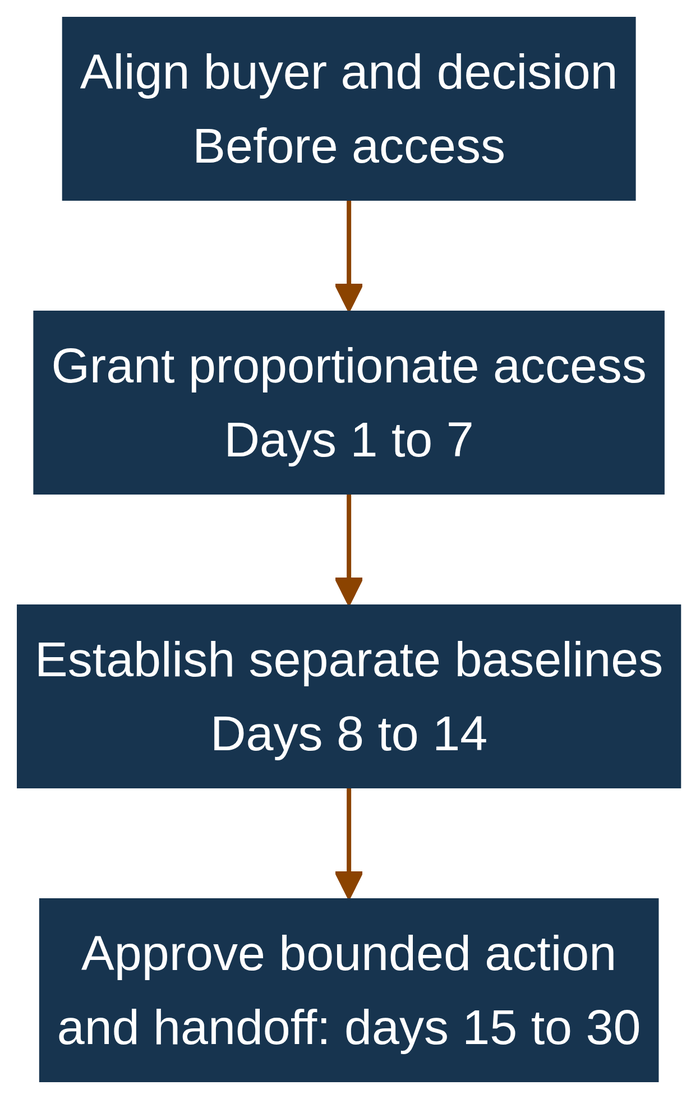
The four-stage process is: align the buyer and decision, grant proportionate access, establish separate baselines, and approve a bounded action and handoff. Sales and customer feedback return to buyer alignment. It is an illustrative dependency sequence, not an automatic-publishing workflow.
Agree external campaign naming before launch. The owned free UTM Campaign Builder helps prepare consistently tagged URLs. Exclude personal information and leave ordinary internal links untagged. Have the analytics owner reconcile manual tags with Google Ads auto-tagging and the actual measurement configuration. URL preparation does not fix consent, measure citations, or prove ROI.
Make the sales handoff usable
Agree the response route, permitted information, receiving owner, acceptance or return reasons, and feedback cadence. Keep personal details in the approved CRM, not the shared public checklist. If a response is awaiting review, report it as pending rather than rejected or qualified.
At the month-end checkpoint, review accepted deliverables, actual costs, quality, and missing evidence separately. Long sales cycles may prevent a meaningful closed-revenue verdict. Continue, narrow, repair, or stop the next package based on the record, not on one screenshot.
Make the engagement exit-ready from day one
Handover should let an authorized successor understand what exists without reconstructing the month. Agree editable assets, permitted exports, source references, reporting definitions, change history, open dependencies, licenses, and remaining commitments. Specify delivery format and who confirms receipt.
Google says unlinking an individual Ads account preserves its campaign history. However, shared remarketing lists and cross-account conversion tracking can be affected. Monthly invoicing under the departing paying manager can stop ad serving unless billing is changed beforehand. [4] Inspect those dependencies before removal; retaining history is not a continuity guarantee.
Accept the exit handover only when client-controlled access and recovery are confirmed, agreed materials are received and usable, billing and measurement dependencies have a transition owner, and authorized administrators have reviewed agency users, manager links, and other integrations. Confirm data retention or deletion under the contract and policy; removing a login alone does not remove copies already exported.
If your teams still disagree about the buyer or channel responsibilities, explore persona-led AI marketing strategy and discuss a scoped review. Use your own register first. An additional retainer is not the automatic answer to an unresolved internal decision.
References
Official access and ownership guidance was reviewed November 19, 2026. Platform requirements remain subject to the current account, hierarchy, contract, and authorized administrator's checks.