Account fit: define the decision before activation
Modi's POV: A useful handoff is not a score or a pile of contacts. It is an accountable decision another person can inspect, accept, return, or hold. More distribution does not repair missing evidence, permission, or ownership.
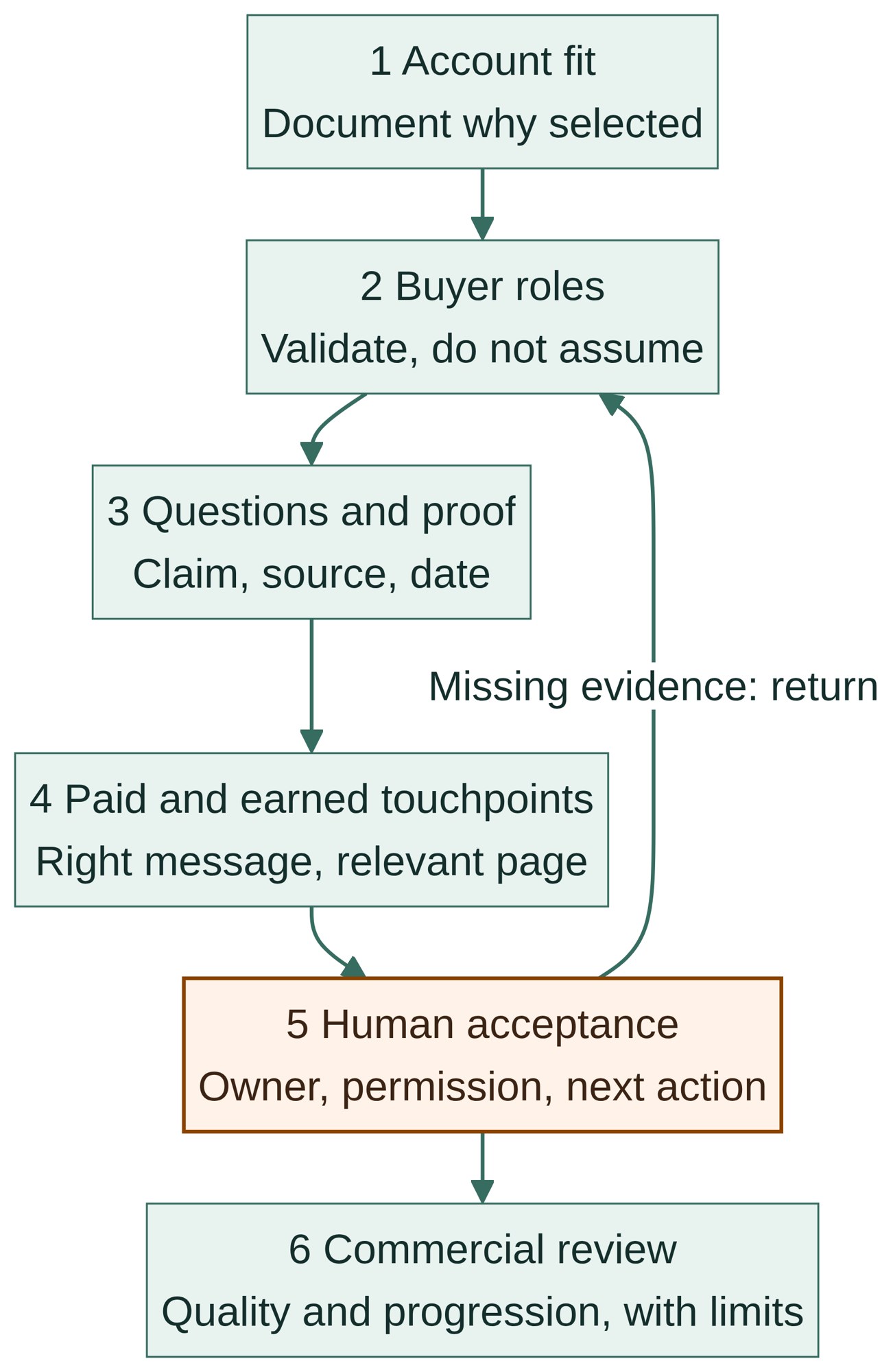
Start with an account decision, not a campaign audience. This worksheet helps marketing and sales prepare one reviewable handoff for a bounded B2B software pilot. It contains six editorial workflow stages, three illustrative roles, and two blank templates. Those are resource quantities, not measured business results.
Write the pilot boundary and acceptance rule
In the acceptance record, describe the account category, why it might fit, the purchase decision under discussion, and what would disqualify it. Set a capacity or spending ceiling and a review date before activation. Use an internal organization reference rather than placing personal information in the worksheet. Keep sensitive supporting records in your approved system.
Salesforce recommends selecting accounts with sales and connecting account-specific marketing with CRM context. LinkedIn's March 2023 guidance also recommends shared goals, relevant decision-makers, and explicit responsibilities. These provider recommendations support coordination, not a claim that this worksheet creates pipeline. [1] [2]
Agree what sales will accept: documented fit, a relevant question, usable evidence, an accountable response owner, and a permitted next action. An account can fit your segment while its buying decision remains unknown. Record that uncertainty rather than promoting it to an opportunity.
Separate known information from hypotheses
Use authorized CRM records, permitted conversations, and available campaign information. Record an observation with its source and date. Label an interpretation as a hypothesis. If a job title suggests technical responsibility, write "technical role unvalidated," not "technical decision-maker confirmed." Assign the verification task before choosing a message.
Buyer roles: complete the blank role record
Create one row for each relevant decision role. Roles are responsibilities, not a universal committee size or a list of people to contact. One person may cover several responsibilities; a purchasing decision may require others not shown here.
Fill the decision, objection, evidence, and route
Write the question the role needs answered and the objection that could block its next decision. Specify evidence that addresses that objection. Record the source location, source date, evidence state, existing canonical page, and responsible team. "Security approved" is not a source; an authorized document reference and its review date are.
The table is an illustrative completion aid. None of its documents, roles, permissions, or decisions is verified for a real account. The blank CSV beneath it is the reusable record.
| Illustrative role | Decision or question | Objection | Evidence source and date | Existing page / owner | Appropriate channel | Next decision |
|---|---|---|---|---|---|---|
| Operations lead | Will this fit our process? | Workflow disruption | Workflow description needed; source and date unknown | Owning page unverified / operations team | Relevant public answer; permitted sales discussion | Confirm requirements |
| Technical reviewer | How is data handled? | Integration and data risk | Architecture and security evidence needed; source and date unknown | Technical page unverified / technical team | Public technical answer; permitted expert discussion | Review integration scope |
| Budget owner | What is the total commitment? | Affordability and exclusions | Current quote and exclusions needed; source and date unknown | Commercial page unverified / commercial team | Public scope answer; permitted scoped meeting | Decide whether to scope |
| Blank reusable row |
On a narrow screen, focus the table or its surrounding region to scroll horizontally. Download the blank role-message-evidence CSV or copy the CSV below into a spreadsheet. The file has no buyer records or personal data. Duplicate the empty row as needed; do not substitute the illustrative roles for validated account information.
Give the answer an existing page owner
Check whether a service, technical, or proof page already answers the question. Verify its canonical, accessibility, current claims, and owner before requesting new content. Keep missing proof visible. A new page cannot repair an unsupported claim.
For the broader method, see how AI search affects buying committees. That guide owns the AI-answer analysis; this worksheet owns the operational handoff record.
Questions and proof: check a filled fictional handoff
Use a rehearsal to expose gaps before committing spend. The following account is fictional, unnamed, and not a client case study. No person, company, source document, consent record, deal value, campaign response, or commercial outcome is claimed to exist.
Complete the account-level exception record
Account reference: fictional B2B software account. Fit: a workflow-software purchase is the proposed use case; CRM fit evidence is not supplied. Decision: whether to investigate an integration, not whether to buy. Capacity boundary: one account rehearsal; no spend authorized. Buyer question: "How would this fit the workflow and handle data?" This is a workshop hypothesis, not an observed buyer statement.
Role record: operations asks about disruption; technical review asks about integration and data handling; budget ownership asks about total commitment. All three roles remain unvalidated. Message: offer to clarify the workflow question only after evidence and the permitted route are established. Proof: workflow documentation, architecture information, and current scope terms are needed; source locations and dates remain unknown. Existing pages: unverified, with the responsible teams identified in the table above.
Observed action: none recorded. Response owner: sales function, with the individual assignment still unresolved in the approved system. Sales disposition: RETURN_FOR_RESEARCH. Reason: fit, roles, proof, and ownership are incomplete. Permission state: UNVERIFIED. Activation disposition: HOLD. Next internal action: account planning gathers authorized fit evidence; technical ownership identifies reviewable integration material. Review trigger: re-present only when those gaps and the permission decision are resolved.
This is a completed exception handoff, not an activation-ready opportunity. The record gives the receiving team a decision and a repair task without fabricating the missing inputs.
Re-present the record without rewriting its history
Keep the original disposition and append the new evidence, source date, review date, and decision rationale. If evidence later supports technical discovery, sales must still accept that specific action. Acceptance does not automatically authorize advertising, email, a budget increase, or a CRM stage change.
For more planning context, use the enterprise ABM evidence guide, rather than expanding this record into another general ABM framework.
Paid and earned touchpoints: route each next step
Assign a channel only after you know the question, evidence, and permitted next action. Paid distribution, an organic source page, and a sales response have different jobs. LinkedIn's historical guidance recommends adapting messages and choosing channels around the account; it does not verify current targeting features or identify an individual buyer's role. [2]
Match the message to a proportionate response
For a workflow question, use a clear public explanation and offer a requirements discussion when appropriate. For an integration question, use verified technical material and a qualified expert response. For a commitment question, use current scope and exclusions before inviting commercial discussion. Do not send three cosmetic versions of the same claim.
Organic SEO makes the source page findable; answer engine optimization makes the answer clear and supportable. Google's guidance says ordinary SEO foundations remain relevant to AI features. An indexed, snippet-eligible page may qualify as a supporting link, but eligibility does not guarantee crawling, indexing, or inclusion. [3]
Paid ads do not purchase organic rankings or AI citations. Treat available search language and campaign responses as inputs to investigate, not proof of identity, permission, or purchase readiness. An AI-generated summary can organize authorized material; a human must verify its source and claims before use.
Tag campaign links without overstating attribution
Agree source, medium, and campaign labels for eligible external campaign links. The free UTM Campaign Builder is a practical URL-building aid. Do not tag internal navigation or put personal information in campaign parameters. Building a tagged URL does not measure AI citations, resolve permission, establish a sales opportunity, or prove ROI.
Human acceptance: accept, return, or hold
Use the acceptance record as a decision log, not an automatic lead score. Every required field needs a responsible function and evidence. Replace function-level ownership with an accountable assignee in your approved internal system before an action is accepted.
Check required fields and record the exception
The examples below describe the fictional rehearsal. They are not evidence of real approval or consent. The blank template retains the required fields and return paths so the team can complete its own record.
| Field | Example | Owner | Evidence | If missing |
|---|---|---|---|---|
| Account fit | Workflow-software hypothesis | Sales | Authorized fit record needed | Return for fit review |
| Buyer question | Integration question unvalidated | Account planning | Permitted source needed | Research before activation |
| Proof and source date | Technical evidence unknown | Technical team | Reviewable source needed | Return for evidence |
| Permission state | Unverified | Privacy/compliance | Approved route record needed | Hold activation |
| Observed action | None recorded | Revenue operations | Dated observation needed | Do not infer intent |
| Next action / owner | Internal evidence review / assignment unresolved | Sales | Acceptance record needed | Assign before acceptance |
| Decision / review | Return for research; activation held | Sales and privacy/compliance | Rationale recorded; review date unset | Set a review trigger |
Download the blank sales-acceptance and exception CSV. Its return/hold guidance is prefilled; your account evidence, assignments, and decisions remain blank.
Keep permission separate from commercial fit
Record permission as VERIFIED, UNVERIFIED, or NOT_PERMITTED for the specific proposed action, supported by your approved policy and source record. "Verified" is a workflow state, not a declaration that every channel is lawful. Consent is not the only possible basis, and this worksheet does not determine which basis applies. Ask your privacy or legal owner when uncertain; this is not legal advice.
Use ACCEPT only for an agreed, evidenced handoff with an accountable owner. Use RETURN_FOR_RESEARCH when fit, role, question, or evidence needs repair. Use HOLD for unresolved permission or an action outside approved scope. A research return can coexist with an activation hold, as in the fictional example. Human sign-off is required before outreach, publication of buyer-specific claims, or spending changes.
Commercial review: decide whether to continue
At the agreed review, compare delivery, source-page health, AI observations, and CRM-qualified progression separately. An impression records delivery; a visit records an observed response; a sales acceptance records an internal decision. None alone demonstrates causal revenue.
Review the record, not just contact volume
Record the dates, source limitations, and missing observations. Small pilots have limited samples, buying decisions take time, and channels overlap. Do not attribute all later pipeline to the last visible click or a favorable AI answer. For the existing measurement procedure, use a repeatable citation panel; do not create a competing citation system here.
Continue only when the agreed decision is better supported and capacity remains appropriate. Narrow the pilot when questions or evidence are unresolved. Stop activation when permission, economics, or ownership fails the agreed boundary. Completing a worksheet proves preparation, not business performance.
Match outside support to the unresolved task
A team with available owners and access can use these records itself. If ownership or implementation capacity is missing, define the bounded task first. The ABM agency operating guide explains partner responsibilities. If useful, explore account-based marketing support against your existing evidence, scope, and budget. No supplier, tool, or service removes the need for your team's acceptance and permission decisions.
References
These sources provide process or platform context, not validation of the fictional example or proof of worksheet results. The primary-source ledger was checked November 11, 2026. Read the original scope and subsequent updates before activation.
- Salesforce: account-based marketing guide. Provider guidance on account selection, CRM context, and sales alignment; no publication date established in the supplied ledger.
- LinkedIn: What Is Account Based Marketing, Why You Should Adopt It, And How. Tequia Burt, March 2, 2023; historical operating advice, not current targeting or pricing verification.
- Google: AI features and your website. Displayed update December 10, 2025; eligibility and ordinary SEO foundations, not promised citations or ABM attribution.