The short answer
A useful citation panel makes observations comparable. It fixes a small set of buyer questions, the engine or surface being checked, the date, the environment, and the reviewer. It then records the answer shown, the visible sources, and the limit of that observation. First-party reporting sits alongside that record instead of being mixed into a single number.
Modi’s POV: A dashboard becomes dangerous when it turns different kinds of evidence into one flattering score. I would rather see a small panel of important buyer questions, a clear record of what was actually observed, and a named person willing to explain the next decision.
Why a fixed panel is more useful than a blended score
A blended score can hide the question that matters. A brand might have a visible source in one answer, a broad Bing citation trend, and no relevant Google-reported GenAI visibility in the market it cares about. Combining those observations into a single percentage creates an apparent answer without a clear commercial decision.
Start with a finite set of questions a buyer would actually ask before a short list, comparison, technical review, or first conversation. The point is not to simulate every possible prompt. It is to preserve repeatable observations about commercially meaningful questions.
The wider AEO measurement framework connects visibility, context, conversion evidence, and business impact. This operating sheet sits one layer earlier: it makes an answer observation clear enough to decide whether to investigate.
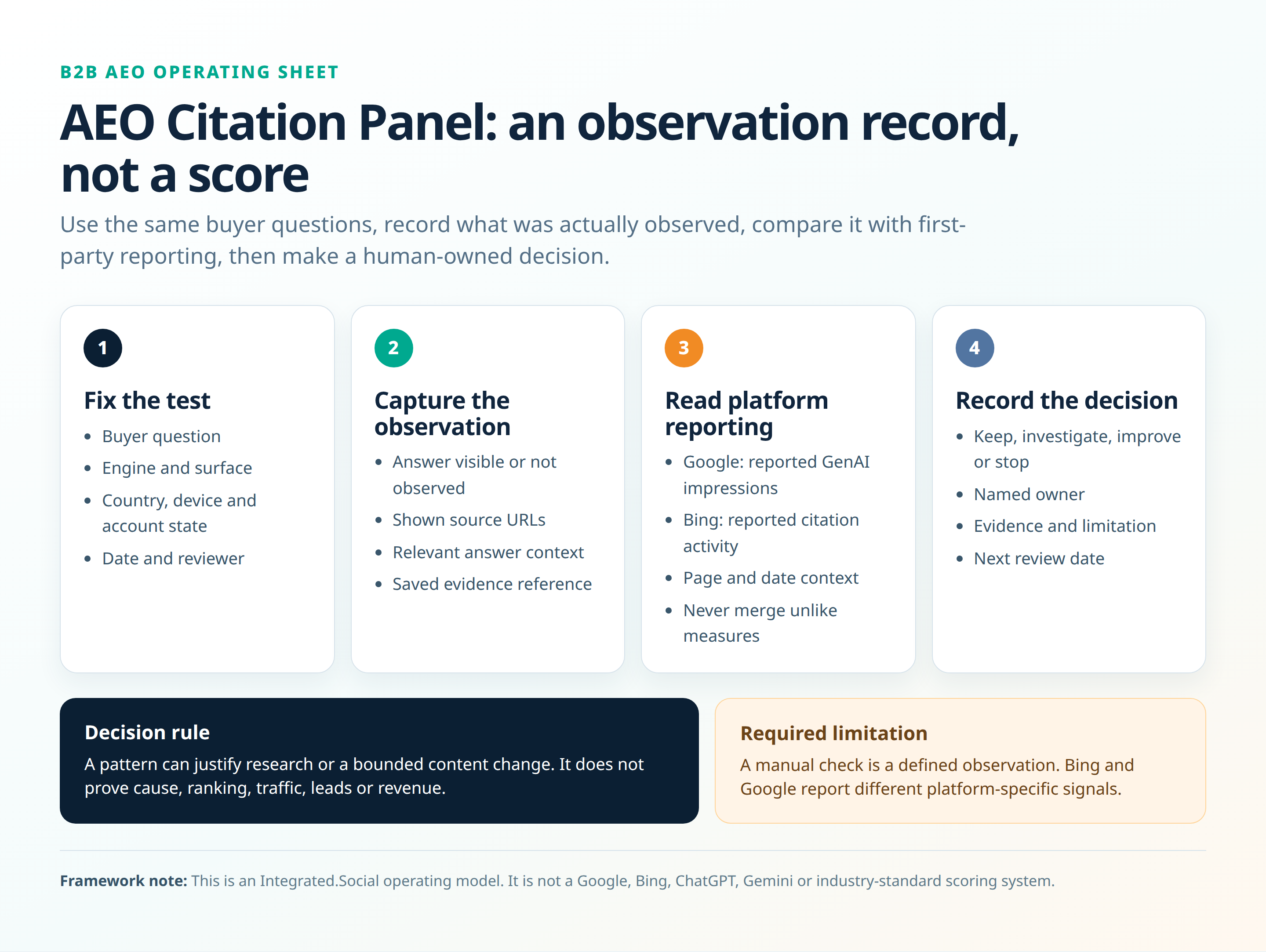
The four stages of a citation-panel operating sheet
1. Fix the test before looking at the result
Write the exact buyer question in plain language. Then record the engine or surface, country or market, device, signed-in or signed-out state where relevant, date, and reviewer. Do not casually change several variables and compare the outputs as though they came from one test.
Choose questions that matter even if no brand appears. A neutral buyer question reveals source types, proof, and objections more usefully than a self-serving prompt that names the company.
Keep the inclusion rule visible
Add one line explaining why each question belongs in the panel. It prevents a collection of vanity prompts and makes irrelevant questions easier to remove.
2. Capture the observation, not an interpretation
Record whether a relevant answer was visible in the defined check, the source URLs visibly shown, a short description of the answer context, and a saved evidence reference. Avoid converting a single observation into “we rank,” “we are trusted,” or “we are absent from AI.” A result can change with the query wording, user context, location, product changes, source availability, and model behavior.
Microsoft’s Bing documentation makes a related distinction. Its grounding queries are grouped phrases used to summarize citation activity, not complete user questions or a log of individual prompts. A manual buyer-question panel should therefore be labeled as a manual observation protocol, not as a reconstruction of platform-level demand.
For a more detailed neutral prompt-testing process, see how to check whether ChatGPT recommends your brand. That guide covers saved outputs and careful separation of a mention, a citation, and a recommendation.
3. Keep first-party reporting in its own lane
A manual check and a platform report can complement one another, but they are not interchangeable. Google’s generative-AI reporting is designed to show reported visibility signals such as impressions, pages, countries, devices, and dates. Bing AI Performance documents visible citation activity for pages and grouped grounding-query phrases across its supported experiences.
Use each report for the claim it actually supports. Google-reported GenAI impressions are not a complete log of citations in individual answers. Bing citation activity is not a click, a traffic measure, a ranking, or proof that a page improvement caused a change. The practical benefit of two evidence lanes is that the team can see a pattern without pretending the measures have the same meaning.
This is why organic rank is not the same as an AI citation. Conventional organic visibility, reported generative-AI impressions, visible citations, referral visits, and influenced pipeline are connected commercial signals, but they are not one metric. A credible measurement conversation names the difference before reporting the movement.
4. Make a human-owned decision record
The final field is not a score. It is a decision: keep observing, investigate, improve a priority page, commission evidence, or stop spending effort on the question for now. Add the named owner, the rationale, the limitation, and the next review date.
This makes the panel useful to a commercial team. If a comparison question repeatedly shows source material that buyers would consider more complete than the company’s own page, the next action may be a review of scope, evidence, or clarity. It does not automatically mean “publish more content.” If the evidence is thin or the query is not commercially important, the appropriate action may be to do nothing.
For teams that need a senior-led programme around this kind of evidence, SEO, AEO and GEO connects technical clarity, answer-first content, evidence review, and measurement. The AI Citation Programme is a monthly, defined-scope option for priority pages and buyer questions. Neither is a promise of a citation, ranking, click, lead, or revenue result.
A practical weekly review without a vanity dashboard
A short review can be enough. Start with changes in the defined panel, then read the limitation beside each observation. Ask whether the buyer question remains relevant, whether the business has a defensible answer, whether the cited source pattern raises a specific research question, and whether a small change is worth testing.
Do not let the meeting end with a number alone. A useful note looks like this: “For this evaluation question and the defined UK desktop observation on this date, our page was not visibly shown. Bing’s reported citation activity for the related topic is inconclusive. The current page lacks a clear scope boundary, so the next action is an editorial review by the service owner.” That statement has a possible next step and an explicit limit.
The same discipline matters when a panel looks positive. A one-off visible source does not establish lasting coverage, buyer preference, or commercial impact. Compare it with first-party reporting and qualified commercial feedback where available. For the wider attribution boundary, read why GA4, Search Console, and CRM data are not full AI attribution.
What the panel should never claim
A citation panel should never claim to cover every AI answer, buyer, or market. It should not present a manual observation as market share, a Bing citation as a quality score, or a Google impression as a direct answer citation.
It also should not become an excuse for keyword stuffing or unnecessary schema. Google says there are no special additional requirements for AI Overviews or AI Mode. The enduring work is crawlable pages, helpful content, clear internal links, visible text, accurate structured data, and claims that match the evidence. Read Google’s guidance on AI features and your website before turning an observation into an implementation plan.
Sources
- Bing Webmaster Tools: AI Performance
- Microsoft Bing: Topics Portfolio Beta
- Google Search Central: AI features and your website
- Google Search Central: Generative AI performance reports
- Google Search Console: Performance report overview
About the Author
Modi Elnadi is the founder of Integrated.Social. He works with B2B teams on evidence-led SEO, AEO, GEO, and AI-assisted marketing decisions. His approach favors a clear buyer question, traceable source context, and a named person who owns the public claim and the next commercial decision. He helps teams turn AI-search observations into disciplined editorial and technical priorities without promising citations, rankings, or revenue.