The direct answer
OpenAI's 7 October 2026 GPT-6 Intelligent UI announcement describes ChatGPT responses that can combine text with interactive elements such as charts, graphics, buttons, forms and task-specific tools. The commercial implication is not yet proven: interactive responses do not establish that every comparison becomes transactional or that a brand will control the generated interface. They do suggest that teams should prepare accurate, structured product evidence for a customer journey that may increasingly unfold inside AI.
What OpenAI announced with GPT-6 Intelligent UI
OpenAI announced GPT-6 and Intelligent UI on 7 October 2026. The core product direction is not merely a model answering in longer prose. It is a system that can choose a useful interface for a question: an interactive explanation, a chart, a visual comparison, buttons, a form or a task-specific tool.
That matters because interfaces shape decisions. A static response asks the user to interpret. An interactive comparison can ask for preferences, expose trade-offs and update a recommendation as assumptions change.
OpenAI has demonstrated interactive responses and tools. It has not established that every product comparison will automatically become a fully transactional interface, that any particular brand will appear in one, or that such interfaces improve conversion. That is the essential distinction between a confirmed capability and a commercial inference.
Confirmed capability versus commercial inference
| What is confirmed | What remains to be tested |
|---|---|
| ChatGPT can produce responses using interactive UI elements | Whether AI-generated interfaces improve commercial outcomes across categories |
| A response can be shaped around a user's question | Which data sources, brands and comparison criteria will be selected |
| Users can interact with certain generated controls and tools | Whether a brand can reliably control the presentation of its differentiators |
| OpenAI is extending the experience through its model rollout | How attribution, consent and transaction ownership will work at scale |
The distinction matters because product announcements can easily become marketing folklore. A CMO should not turn an emerging interface capability into a forecasted revenue line. They should decide what evidence and data would make the brand useful if an AI-generated interface becomes part of the buyer journey.
From search result to AI-generated experience
For decades, the website was the principal place where a brand designed the decision environment. It published the comparison table, calculator, landing page, form and next step. Search sent a visitor to that environment.
A possible AI-mediated journey is different:
Search result → AI answer → AI recommendation → AI-generated interface → customer action
This sequence is a strategic model, not a claim that every customer journey will follow it. Yet it exposes a real preparation question. If a user asks an assistant to compare three products by price, availability, service terms and lifetime cost, the quality of the resulting interface will depend on the facts available to the system and the criteria it chooses to prioritise.
Why comparison criteria become a brand issue
Consider a product whose value comes from reliability, warranty coverage, service reach or a lower operating cost over time. An AI-generated comparison that shows only headline price and a single technical specification may make that product look weaker than it is. Conversely, an overly promotional data feed can make a recommendation less trustworthy.
Brands need evidence that is both machine-readable and customer-meaningful. The goal is not to force a generated interface to repeat a slogan. It is to make important distinctions clear enough that a system can use them accurately.
A proposed framework: Generative Experience Optimisation
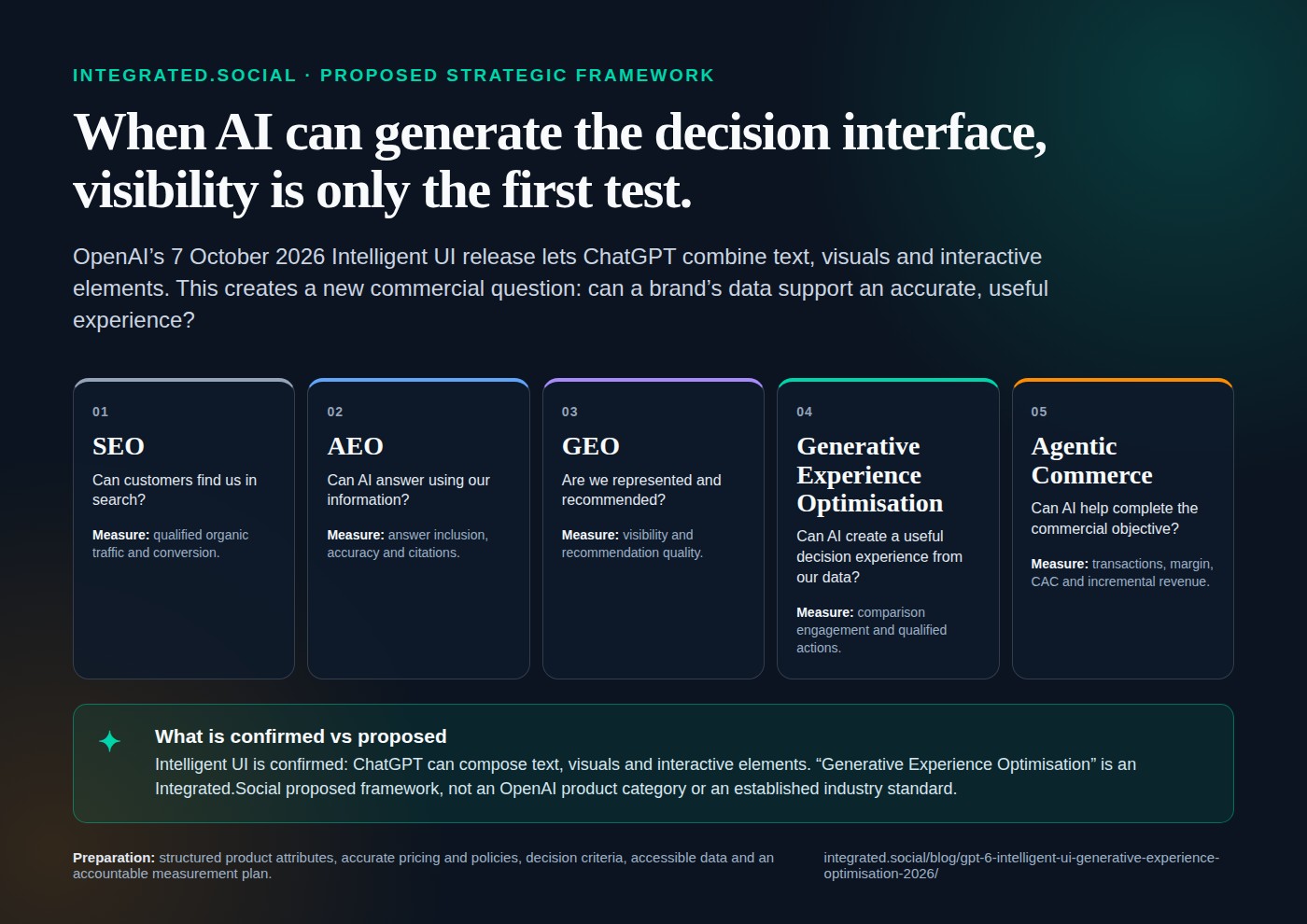
I call this emerging preparation discipline Generative Experience Optimisation. It is a proposed strategic framework, not an established industry standard or a promise that AI platforms will adopt the term.
The framework asks a practical question: can an AI system construct an accurate, useful and differentiated decision experience from a brand's authorised information?
| Stage | Primary question | Evidence to prepare |
|---|---|---|
| SEO | Can customers find the source? | Crawlable pages, clear entities and useful content |
| AEO | Can an AI answer a question accurately? | Direct answers, sources and defined terms |
| GEO | Is the brand represented and cited appropriately? | Verifiable claims, context and differentiated evidence |
| Generative Experience Optimisation | Can an AI create a useful decision interface from the information? | Product attributes, constraints, comparison logic and freshness controls |
| Agentic commerce | Can an approved action be completed safely? | Permissions, transaction rules, audit trails and customer consent |
The point is not to replace SEO, AEO or GEO. It is to connect them to the next part of a decision journey: the interface in which a customer weighs options.
What data does an AI-generated experience need?
An AI interface is only as useful as the information and constraints it can apply. Different sectors will require different evidence, but the following categories recur.
Product attributes and comparison logic
A product catalogue needs more than a title and a price. It may need compatibility, dimensions, capacity, lead time, warranty, availability, exclusions and the rules that determine whether two options are truly comparable.
Fresh commercial information
Prices, offers, stock status, eligibility and service conditions change. A generated experience built from stale information can create a confident but unhappy customer. Data freshness needs ownership, timestamps and an escalation path, not a vague promise that a feed will stay current.
Differentiators that can withstand comparison
Brands should identify the attributes that materially change a recommendation. These can be service levels, total cost of ownership, security controls, accessibility, support coverage, implementation limits or return conditions. The evidence should be precise enough to explain, not merely advertise.
Permissions and customer protection
If an AI interface progresses from explanation to action, customer consent, authentication, payment boundaries and auditability become critical. The best commercial experience is not one that lets an agent do everything. It is one that makes authorised actions clear, reversible where possible and accountable.
A five-step preparation plan for marketing and product teams
1. Map the questions that lead to a decision
List the questions a buyer asks before comparing or acting. Include the constraints, not only the category keyword. For example, a buyer may ask about integration requirements, total operating cost, suitability for a regulated use case or cancellation terms. These questions reveal the facts an AI-generated interface would need.
2. Build an evidence inventory
For each important claim, identify its source, owner, date and scope. Separate a verified product attribute from a positioning phrase. This creates a defensible input layer for content, sales conversations, product pages and potential AI interfaces.
3. Define the comparison criteria you want represented accurately
Do not assume an AI will infer every differentiator. Document the customer-relevant criteria, the conditions under which they matter and the evidence supporting them. Use plain language alongside structured data. A criterion that is invisible or vague cannot be relied upon to shape a fair comparison.
4. Establish freshness and approval controls
Assign owners for data that changes frequently. Use review dates and clear publishing routes for price, availability, policy and regulated claims. For connected experiences, define what may be shown, what may be recommended and what requires a human or customer confirmation.
5. Test an experience without overstating the result
Choose a contained journey and define what success means: accuracy, completion, qualified interest, reduced support burden or a commercial outcome. Compare a well-instrumented experience with an appropriate baseline. Document limitations. A useful test tells the organisation where an AI-generated interface helps and where it introduces risk.
The commercial risk: losing control of the decision frame
The opportunity is not only that an AI can create a useful interface. The risk is that it may choose a frame that ignores the reason a customer should prefer a brand. If a comparison privileges a single price, a complex service proposition may disappear. If it omits important constraints, it can cause poor-fit enquiries and avoidable service failures.
That makes AEO and GEO more concrete. The task is not simply earning a mention. It is maintaining accurate, source-qualified information that can survive a comparison, explain a trade-off and protect the customer from an unsuitable next step.
For organisations reviewing an SEO, AEO and GEO strategy, this is a reason to align marketing, product, operations and governance teams. A response, comparison or calculator will only be as credible as the data and approval model behind it.
What should not be assumed yet
Intelligent UI does not mean every AI answer will become an interactive buying environment. It does not mean an AI platform will provide transparent attribution for every influence event. It does not mean a brand can fully control the comparison logic, the interface design or the selection of sources. And it does not remove the value of a fast, accessible, brand-owned website.
It does mean that owning evidence, differentiation and customer relationships becomes more important. The best preparation is to make those assets accurate, structured, accessible and commercially accountable.
Frequently asked questions
What is GPT-6 Intelligent UI?
GPT-6 Intelligent UI is OpenAI's term for ChatGPT responses that can use interactive formats alongside text, such as charts, graphics, buttons, forms and task-specific tools. The confirmed capability is interface-aware response generation. It should not be interpreted as proof that every answer becomes a transaction, that every brand will be included or that the experience will improve commercial results in every category.
How could AI-generated interfaces affect SEO and AEO?
AI-generated interfaces could move more comparison and consideration activity into an assistant's response, making accurate evidence and product attributes more important. SEO remains necessary for discoverable source pages, while AEO and GEO help an AI interpret and represent information. The commercial effects remain to be tested by sector, query, engine and journey rather than assumed from a product announcement.
What is Generative Experience Optimisation?
Generative Experience Optimisation is a proposed framework for preparing brand information so an AI can construct accurate, useful decision experiences around it. It focuses on product attributes, constraints, comparison criteria, freshness controls and customer protection. It is not an established industry standard or a guarantee of AI visibility. It is a way to organise cross-functional preparation for a potentially more interactive AI-mediated journey.
Can a brand control an AI-generated comparison interface?
A brand cannot assume full control over an AI-generated comparison interface. The system may select sources, criteria and presentation formats according to its own policies and the user's question. A brand can improve its readiness by publishing accurate, differentiated and well-governed information with clear scope and update ownership. It should avoid treating structured content as a mechanism for guaranteed inclusion or preferred ranking.
What should a CMO prioritise before testing AI-generated experiences?
A CMO should begin with one high-intent customer question, a mapped evidence set and an agreed measurement outcome. Prioritise factual accuracy, product-data ownership, comparison criteria, accessibility, consent and a controlled test design. Ask what an experience must never get wrong, who approves changing information and how the team will separate a helpful interaction from a proven commercial effect. This prevents novelty from outrunning accountability.
About the Author
Modi Elnadi is the founder of Integrated.Social, a London AI growth marketing agency working across SEO, AEO, GEO, paid media and governed agentic workflows. He helps commercial teams turn AI-search and agentic-market shifts into evidence-led preparation rather than unqualified platform promises.