The short answer: AI shopping agents can reduce decision friction, but the published claims are not a retail benchmark
Google Cloud’s 8 October 2026 Gemini at Work announcement says that Ulta Beauty uses an AI shopping assistant built with Gemini Enterprise to help guests shop 30,000 products. Google reports that the assistant has increased digital sales conversion three-fold. The same announcement says shopping agents at Kmart and Officeworks, part of Wesfarmers’ portfolio, have increased conversion rates by up to three times.
That is a meaningful signal for retailers and consumer brands. It suggests that an AI-assisted journey may help a customer move from an ambiguous product question to a more useful recommendation, comparison or cart. But it is not evidence that every retailer will get the same result.
Google’s announcement does not publish the comparison population, time period, traffic mix, experimental design, attribution rules, return rate, margin effect, customer-satisfaction effect or incremental lift. These are supplier-published customer outcomes. They should be treated as reported examples to investigate, not as a conversion promise or a universal agentic-commerce benchmark.
The practical implication: do not start by asking, “How do we add an AI agent?” Start by asking where a buyer currently loses confidence, what evidence they need to decide, and which part of the journey can be measured without degrading trust.
Why AI shopping agents can change product discovery
Traditional retail search often assumes the buyer can name a product or knows which filter to use. Many real purchase journeys do not begin that way. A customer may ask for a fragrance-free serum for sensitive skin, a laptop that fits a software workflow, or a gift within a budget and delivery window. The work is not merely retrieving an item. It is interpreting constraints, surfacing relevant attributes and explaining trade-offs.
A capable AI shopping agent can potentially compress that work. It may translate a conversational question into product discovery, compare structured attributes, assemble a shortlist and help a customer progress to a cart. The useful commercial outcome is not “more chat”. It is less decision friction: fewer unanswered questions between intent and an informed action.
What the Google examples establish—and what they do not
The announcement establishes that Google and named retail customers are presenting shopping-agent deployments as an active commercial use case. It identifies catalogue navigation and personalised recommendations as part of Ulta’s experience, and discovery plus cart-building as part of the Wesfarmers examples.
It does not establish that the reported results were caused solely by the agent. A reported conversion change can be affected by merchandising, traffic source, promotional activity, seasonality, product availability, audience mix, interface changes and measurement definitions. It does not establish that a B2B buying journey, a regulated category or a low-frequency purchase will behave the same way.
A decision-friction model for AI-mediated commerce
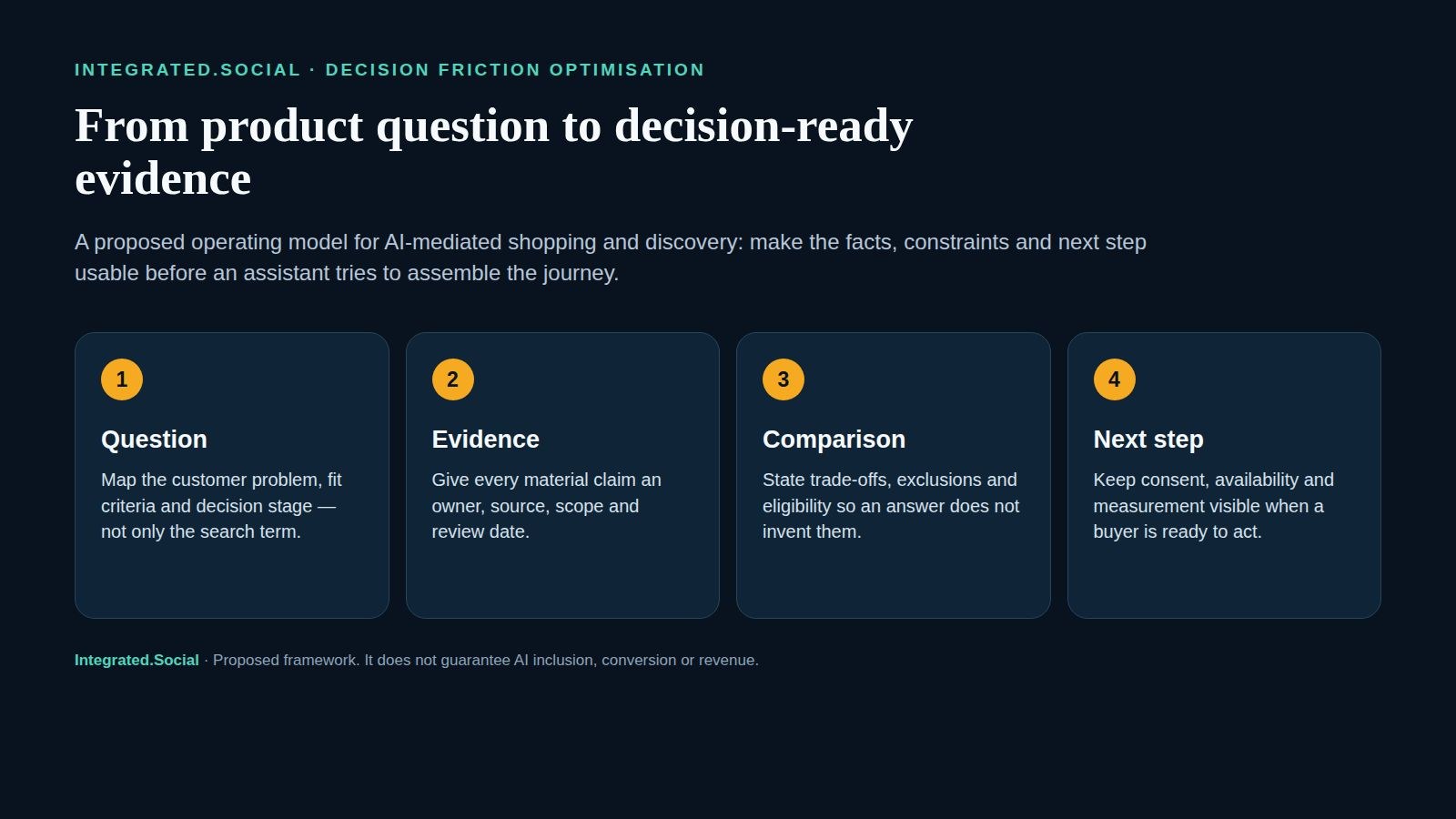
Integrated.Social uses Decision Friction Optimisation as a proposed operating model. It is not a vendor product or industry standard. It describes the work required to make a customer journey accurate and useful when an AI interface helps shape discovery.
1. Map the question, not only the keyword
Start with the decision a customer is trying to make. Record the outcome, exclusions, budget, timing, compatibility needs and confidence barriers. A search term can indicate demand, but it rarely captures every requirement that makes a recommendation suitable.
For a beauty retailer, the relevant evidence may include ingredients, sensitivities, shade context, routine compatibility and stock. For a B2B software provider, it may include deployment model, integration requirements, security conditions, contract terms and the role of the buyer. The question must be specific enough for a team to tell whether an answer is useful.
2. Build an evidence inventory before asking an AI to compare
Every important claim needs a source, owner, date and scope. Product specifications, compatibility rules, prices, stock, policy restrictions and regulated claims change. When those attributes are scattered across PDFs, supplier emails or individual team knowledge, a conversational layer can create a polished answer from incomplete inputs.
The inventory should distinguish a verified attribute from a marketing phrase. It should state the conditions under which a claim applies. It should identify who can approve a change. This is the foundation for both an owned retail assistant and a brand’s representation in external AI search or comparison environments.
3. Make comparison criteria explicit
An AI cannot be relied upon to infer every differentiator a brand considers important. Define the criteria that a buyer should see, the evidence that supports them and the cases in which a product should not be recommended. Clear criteria protect customer fit as well as commercial performance.
The test is whether the answer can explain a trade-off
A useful comparison does more than recommend the item with the most generic relevance. It can explain why one option fits the stated requirement, where a second option is better and where neither should be selected. If an experience cannot state its uncertainty or exclusions, it needs a human or specialist handoff rather than a more persuasive interface.
4. Keep the next step governed
A recommendation can create a customer, compliance or service risk if it implies availability, price, eligibility or consent that the business cannot honour. Agree the permitted next steps: add to cart, request a quote, book a consultation, ask a clarification question or escalate to a person. Record which actions require confirmation.
What should retailers measure in an AI shopping-agent pilot?
Start with a narrow, high-intent journey and a defined audience. A conversion rate may be one measure, but it should not stand alone. Review task completion, recommendation accuracy, product returns, customer satisfaction, support contacts, basket composition, gross-margin effect and the rate at which the system appropriately escalates uncertainty.
| Measure | Why it matters | Control question |
|---|---|---|
| Completion | Shows whether buyers reach a sensible next step | Was the next step appropriate, not merely completed? |
| Recommendation accuracy | Tests product fit and factual integrity | Which evidence supported the suggestion? |
| Conversion and margin | Measures commercial value | What baseline and attribution model are being used? |
| Returns and contacts | Detects misleading confidence | Did the recommendation create avoidable service work? |
| Escalation quality | Tests safe uncertainty handling | Did the assistant know when not to decide? |
A pilot needs a comparison method that fits the journey: a holdout, phased roll-out, matched cohort or clearly documented before-and-after baseline. The point is not to over-engineer a first test. It is to stop a good-looking interaction being mistaken for a proven commercial outcome.
Where AEO and GEO fit in
AI shopping agents make SEO, AEO and GEO more operational. An assistant can only build a useful decision experience from information that is discoverable, explicit and current. Your pages still need clean technical foundations. Your product or service claims still need source-qualified language. Your structured information still needs to match visible copy.
For teams whose buyers research through Google AI Overviews, AI Mode, ChatGPT, Gemini or other assistant surfaces, that means improving the evidence a system can retrieve—not chasing a promise of automatic inclusion. Clear entity information, direct answers, durable product facts, accessible explanations and ownership of updates remain practical advantages.
A 30-day controlled starting point
Choose one journey where buyers ask recurring questions and the commercial team already understands the main constraints. Define the decision, list approved evidence, document exclusions, agree a human escalation route and select a baseline. Publish the information in a form that a person can inspect as well as a machine can interpret. Then observe the result before expanding authority.
This work does not require a retailer to surrender its brand, customer relationship or judgement to an interface. It requires the organisation to make the decision-quality evidence it already relies on more visible, accurate and accountable.