Muse from Meta became available to adults in the UK on November 23, 2026. It is a personal AI agent that can work across a browser and connected apps, with permissions and human approvals. Eligible new users can enter Modi Elnadi's code 6ADUUJ in Settings within 48 hours of joining for the documented one-billion-token referral reward each. Check current account eligibility, code capacity and offer terms before relying on that benefit.
When did Meta Muse launch in the UK and other countries?
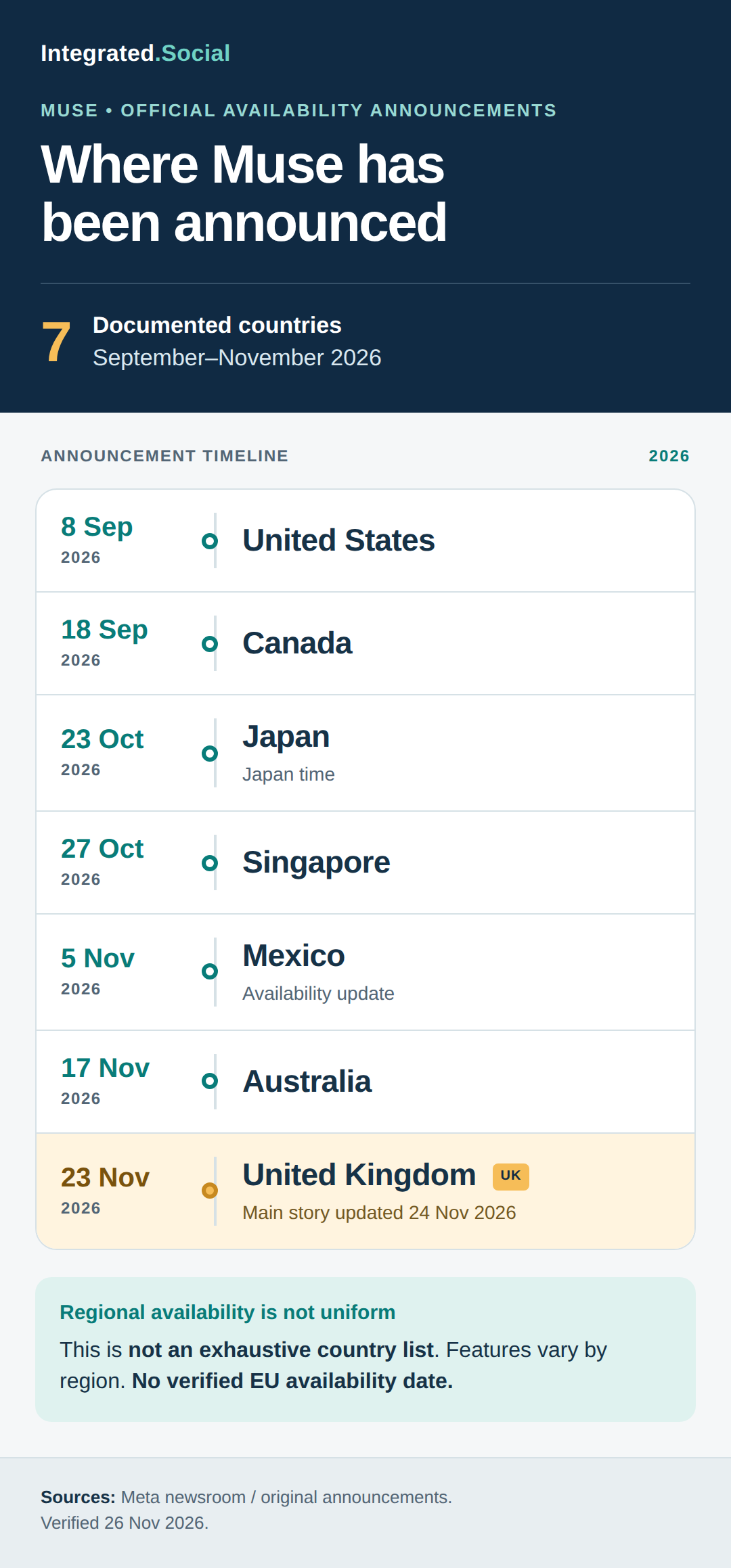
Meta's UK announcement establishes November 23, 2026 as the availability date; the main story also displays a November 24 update. UK access is for adults aged 18 and over, on iOS, Android, the web and WhatsApp. Meta describes glasses access as coming later, not a feature already available to every account. [1] [2]
| Country | Official availability announcement | Important context |
|---|---|---|
| United States | September 8, 2026 | Initial US rollout |
| Canada | September 18, 2026 | Zuckerberg's availability announcement |
| Japan | October 23, 2026 | Explicitly Japan time |
| Singapore | October 27, 2026 | Newsroom says available that day |
| Mexico | November 5, 2026 | Explicit update to the earlier launch story |
| Australia | November 17, 2026 | Some local experiences roll out progressively |
| United Kingdom | November 23, 2026 | Main story updated November 24 |
These are seven documented countries, not a verified exhaustive global list. Availability does not mean identical connectors, subscriptions or referral eligibility everywhere. No confirmed EU launch date was established; EU legal terms alone do not establish a launch. [3] [4] [5] [6] [7] [8] [9]
How do you get Muse in the UK and set up an account?
UK adults aged 18 and over can use Muse through its iOS or Android app, the web and WhatsApp. Meta's getting-started guide supports an existing Meta Account or a new one created using Facebook, Instagram, an email address or a phone number. Follow the verification shown to your account. [1] [21]
- Start at the disclosed Muse join link above or Meta's official download page, and check regional eligibility.
- Sign in with your Meta Account or create one through the options actually offered. Complete the account's verification and required details; this guide does not assume every signup uses the same six-digit-code screen.
- Begin with limited free usage. Choose a paid plan only after checking its current price and allowance.
- Open Settings immediately and redeem 6ADUUJ within 48 hours of joining. Confirm the reward, then review connections, permissions and Data controls before your first task.
If your Facebook, Instagram and Threads accounts share an Accounts Center, Meta says they can connect automatically. Inspect the actual account connections rather than assuming a new signup starts with no connected services. You can manage the accounts in Accounts Center. [2]
How do you get free Muse tokens with code 6ADUUJ?
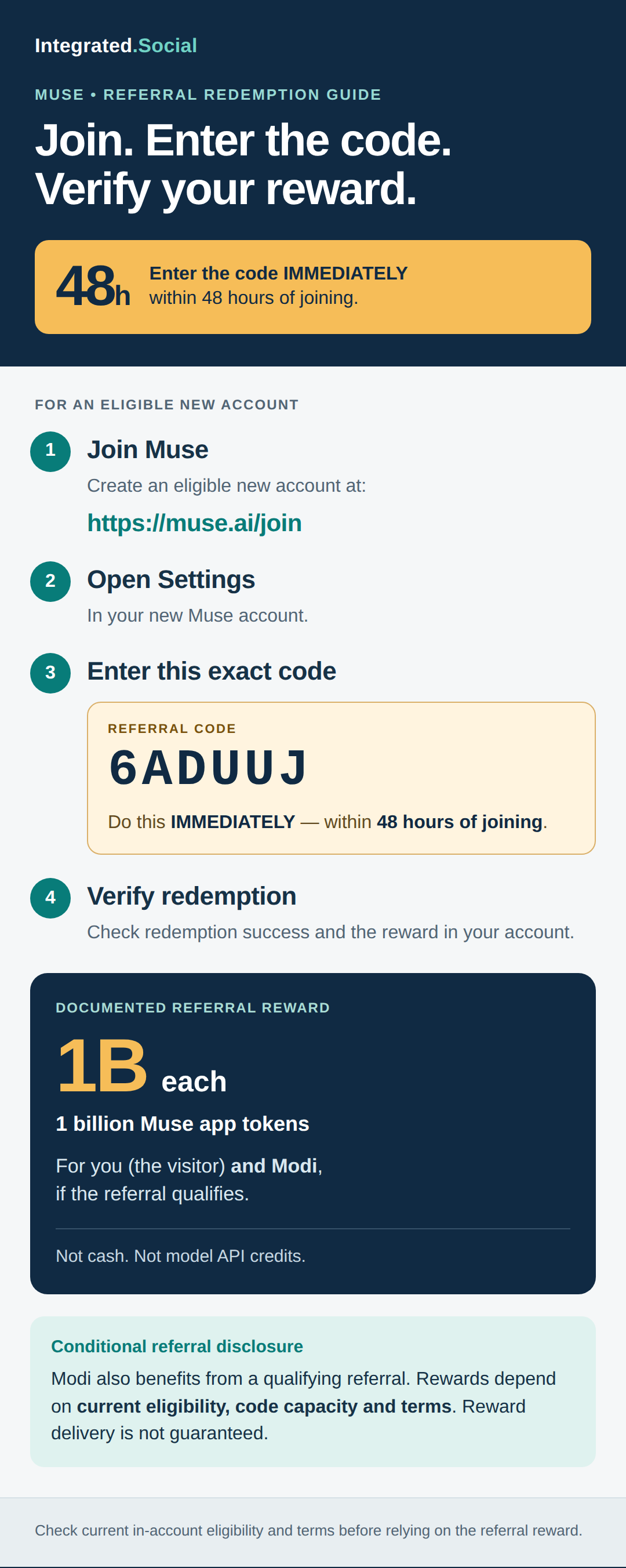
Do this immediately after joining. The documented deadline is at most 48 hours from joining, not 48 hours from reading this guide. Muse's September referral announcement says the new user and their friend each receive one billion Muse tokens when the friend onboards and redeems the code. Its follow-up specifies Settings and the 48-hour window. [14] [15]
What are the exact redemption instructions?
- Visit Muse's join page (referral instructions, opens in a new tab) and complete eligible account onboarding.
- Open Settings in your Muse account immediately. Find the referral-code redemption control offered to your account.
- Enter 6ADUUJ exactly, then submit it within 48 hours of joining. Do not wait until the final minutes.
- Check the account's redemption confirmation and token balance. If the control is missing or the code is rejected, check current offer terms and contact provider support; do not assume a reward was granted._
Referral disclosure: This is Modi Elnadi's supplied code. Under the documented eligible referral offer, you and Modi each receive one billion Muse app tokens. We have not tested this code's active status, remaining capacity or eligibility on your account. Signing up or following a link alone is not the documented redemption step.
What rules should you check before claiming the reward?
Use an eligible account in an available country and meet the applicable age requirement. Check the current referral screen for restrictions, reward confirmation and any expiry. The September program documented a 20-friend cap, but that is not proof of this code's current capacity. Do not assume unlimited referrals, stacking or automatic eligibility for every UK account. [14] [16]
Meta Help currently says promotional tokens do not expire; newer UK terms permit an expiry stated in your account or offer. Check both rather than relying on an unconditional lifetime promise. The general 12-month offer-validity rule is not an automatic expiry date for redeemed tokens. [3] [12] [16]
What does Muse do, and how is it different from a chatbot?
Muse is designed to perform multi-step work, not only compose answers. Meta describes a dedicated, persistent, isolated Linux Secure VM with a browser, connectors and task-specific tools. It can research options, use authorized apps and carry out permitted actions. These are documented capabilities, not a claim that we independently benchmarked its reliability. [1] [18] Meta identifies Muse Spark, from Meta Superintelligence Labs, as the model powering the UK launch. That provider description is not a claim that every task uses only one model or that model branding proves reliability. [1]
| Approach | What it normally contributes | Where the human remains responsible |
|---|---|---|
| Answer-only chatbot | Advice, drafts and explanations | Moving information between tools and executing decisions |
| Fixed automation | Repeated predefined steps and rules | Designing exceptions, permissions and recovery |
| Muse personal agent | Planning and acting through available tools and connections | Setting boundaries, approving actions and checking results |
| Business agent deployment | A controlled workflow with accountable owners and evaluation | Access policy, monitoring, evidence and organizational compliance |
This is an operating-model comparison, not a product leaderboard. A capable chatbot with tools can also act; an “agent” label alone does not prove autonomy or business suitability. Our agent-washing guide explains how to test the difference.
How can you use agentic AI on Muse without losing control?
Start with a narrow, reversible task and a clear success condition. Tell Muse which sources to consult, which accounts it may use and which actions are forbidden. Ask for evidence and a proposed result before granting execution permission. Good delegation reduces avoidable work; it does not remove your responsibility for decisions or communications.
Does Muse keep working after you close the app?
Meta says requested tasks can continue in the background, including monitoring and returning updates. It also lists document creation, image generation and reminders. Define the desired output and a stop condition; background execution is not a guarantee of successful browsing, accurate prices or a completed purchase. WhatsApp is an access channel, not blanket permission to read every chat. [19]
Which first workflows are worth trying?
| Workflow | Useful instruction | Review before execution |
|---|---|---|
| Travel research | Compare three options against dates, location and total-cost constraints | Live availability, cancellation rules and final purchase |
| Calendar preparation | Identify possible meeting windows using authorized calendar access | Time zones, guests, conflicts and invitation wording |
| Inbox triage | Summarize selected messages and draft replies without sending | Recipient, facts, attachments and commitments |
| Shopping comparison | Compare exact specifications and delivered costs from named sources | Seller, compatibility, returns and final checkout |
| Marketing research | Build a public-source competitor brief with dated citations | Source validity, missing evidence and commercial conclusions |
How should you write a permission-aware prompt?
Use a goal, evidence standard, access boundary and approval instruction in the same brief. Prefer “compare and draft” over “handle everything.” For example:
Compare three UK travel options for the dates I specify. Use public information first. Show source links, total quoted costs and cancellation conditions. Do not book, pay, message anyone or change my calendar. Ask before using a connected account. Flag missing or conflicting information.
What should you verify in the proposed result?
Check that every option matches your dates and requirements, prices are current and the proposed next action stays within your permission boundary. Correct the brief before approving. This verification step is why a good agent prompt includes a stop condition, not merely a desired output.
For an inbox task, explicitly request drafts only and exclude sensitive folders. For marketing work, start with public material rather than uploading client files. Keep a record of useful outputs, corrections and token consumption. Our agentic AI methodology provides a broader evaluation framework.
How can you reuse preferences and build a repeatable routine?
Give Muse a short operating brief: spending limits, dates, preferred or excluded airlines and retailers, seating or dietary needs, desired output, and the actions requiring approval. Meta says you can customize preferences by telling Muse what to change and review or edit remembered information. Inspect the saved result rather than assuming every rule is retained. [2] [21]
You can send natural follow-ups without waiting for a response or restating the whole context. Use side chats to organize tasks, but do not mistake a separate chat for a separate privacy boundary: Meta says Muse remains aware across its main and side chats. Keep instructions consistent and remove obsolete preferences. [21]
A universal Import memory option in Settings was not verified in the official pages reviewed. A safer manual alternative is to prepare a short, sanitized preferences brief from another assistant, remove passwords, client details and outdated instructions, then tell Muse what to remember. Check the memory controls afterward; importing all historical conversations is not necessary for a useful first workflow. [2] [21]
For a morning briefing, try this draft-only instruction:
Prepare a weekday morning briefing for 08:30 Europe/London using only the calendar and email sources I authorize. Summarize today's meetings, unresolved questions and preparation tasks with links to the original items. Do not send messages, accept invitations or modify events. Ask whether recurring scheduling is supported in my account; show the next run, permissions and how I can stop it before enabling anything.
Meta documents reminders, background work and ongoing goals, but that does not establish an identical recurring-task control for every account. Confirm any schedule and stopping condition in your account before relying on unattended delivery. Review the first briefing against the original sources. Our controlled agentic AI workflow service explains the broader business-governance requirements. [19] [21]
Which permissions and privacy settings matter most?
Meta says purchases require approval every time. Other actions can use scoped, time-limited pre-authorizations, so “it always asks first” is too broad. Review the permission and action history, and use browsing takeover where appropriate. Read-only email access is different from sending permission. [2]
Meta says training participation starts enabled, with opt-out under Settings → Data controls. Its claim that conversations and VM data are not shared with advertising systems does not mean Meta has no access or collects no data. Confidential VM is described as a future choice, not a verified current default. [2] [17]
Disconnecting an app stops future exchange but does not necessarily erase information already retained in memories or conversation history. Check deletion, memory and reset controls separately. Only connect accounts and third-party information you are authorized to use. Treat web content as potentially misleading, and review outputs even when the agent completes a task confidently. [3] [17]
Which UK brands and payment options does Muse support?
Meta lists UK launch partners across retail and travel, but the integration is not identical for every brand. Some support connecting your personal account; others are described as websites Muse can navigate. Check the connector and permissions actually offered before treating a partner announcement as a working account integration or completed booking. [1]
| Use case | Examples named by Meta | What to verify |
|---|---|---|
| Groceries and everyday shopping | Marks & Spencer, Sainsbury's, Ocado Retail, Argos | Exact item, delivery area, stock and whether account connection is supported |
| Fashion and electronics | ASOS, Debenhams Group, Currys | Size or specification, seller, returns and delivered cost |
| Travel | Trainline, easyJet, Jet2 | Route, dates, baggage, cancellation terms and final checkout |
These are provider-listed examples, not endorsements or tests of every retailer. Meta also names brands such as LOOKFANTASTIC, MyProtein, Cult Beauty, JustPark and JD Sports. Its launch announcement describes PayPal as coming soon, not an already available payment option for every account. [1]
Meta's UK announcement calls its Stripe-built checkout option Onelink; Stripe and Meta's UK payments guide call the wallet Link. Stripe's initial US announcement describes a single-use virtual card scoped to an approved purchase at other businesses, while the UK Help page says Link issues a one-time card number so your real card number remains private. Do not infer universal UK merchant coverage from the US launch figures. [1] [22] [23]
Meta says purchases require approval every time. Verify the merchant, items, transaction total and terms before approving; fulfillment remains with the merchant, and capability varies by location and checkout. Some supported stores also offer Shop Pay. These payment mechanisms reduce exposure of underlying credentials, not every shopping or AI risk. [1] [23]
Can Muse make mistakes or fail to finish a task?
Yes. In her UK review, BBC technology editor Zoe Kleinman reported unsuccessful shopping-page access and a train-booking task that required manual completion. Those are firsthand examples, not a measured failure rate. Treat stalled browsing as a reason to inspect and take over, not proof that more waiting will produce a reliable result. [20]
What do Muse tokens and subscriptions actually cost?
Consumer Muse tokens meter app usage, with consumption affected by models, tools, context and outputs. They are account-bound entitlements, not transferable money or raw developer API credits. No verified fixed task count or cash value per billion app tokens was established. Weekly subscription usage does not roll over. [12]
| Consumer access | Published monthly price | Published weekly allowance | Qualification |
|---|---|---|---|
| Free usage | No paid subscription required | Numeric allowance not verified | Limited usage; check your account |
| Power | USD 20 | 500 million Muse tokens | Region and account benefits vary |
| Maximum | USD 100 | 3 billion Muse tokens | UK Help uses the name Max |
These are official Help Center USD figures observed November 26, not verified GBP checkout totals or tax-inclusive UK prices. Additional-token pack prices were not established. Check the price, renewal terms and actual allowance in your account before subscribing. [10] [11]
Are Muse app tokens the same as API tokens?
No. The developer API separately prices model input, cached input and output per million tokens. Observed Standard rates for Spark 1.3 are USD 1.25 input, 0.15 cached input and 4.25 output; Wonder 1.0 is USD 4 input, 0.20 cached input and 20 output. These are developer tariffs, not consumer referral-token values. [13]
Do not multiply a billion referral tokens by API prices to claim a cash saving. Lower Contributor API rates involve training permissions, so cost comparisons need data-policy context. For developer budgeting, use the AI Token & Cost Calculator as a planning aid and verify current provider rates before spending.
What does Muse change for marketers and business owners?
My view is that the valuable shift is from generating persuasive text to helping a person complete a decision. For brands, accurate specifications, current terms and clear evidence become more useful when agents compare alternatives. That does not establish a new ranking factor or guarantee your business will be selected.
Our consumer-inertia analysis explores the commercial consequences. For an implementation project, review controlled agentic AI workflows and the SEO, AEO and GEO program, rather than assuming a personal consumer agent replaces business governance.
Read the separate Muse Glimmer model-release article for that different topic. You can also find Muse alongside our other disclosed recommended tools and referral benefits. If you decide to join, remember Settings → 6ADUUJ → redeem within 48 hours of joining, then confirm the reward in your account.