AI Answer Summary
BCG published its annual CMO Survey on 15 June 2026, covering 300 global chief marketing officers across B2B and B2C sectors. The headline finding is striking in its contradiction: 96% of CMOs report significant end-to-end AI transformation of their function, while 42% admit they still use.
The Transformation Illusion: What BCG's 2026 CMO Survey Actually Found
BCG published its annual CMO Survey on 15 June 2026, covering 300 global chief marketing officers across B2B and B2C sectors. The headline finding is striking in its contradiction: 96% of CMOs report significant end-to-end AI transformation of their function, while 42% admit they still use generative AI only to assist humans with discrete tasks in a handful of workflows.
Both statements can be true simultaneously, and that gap — between what CMOs claim and what they have actually built — is the defining commercial story of 2026. For B2B marketing leaders, the implications are direct and urgent.
Three Maturity Tiers: Where Does Your Marketing Organization Sit?
BCG segmented respondents into three tiers based on how they actually deploy AI, not on stated ambition or budget:
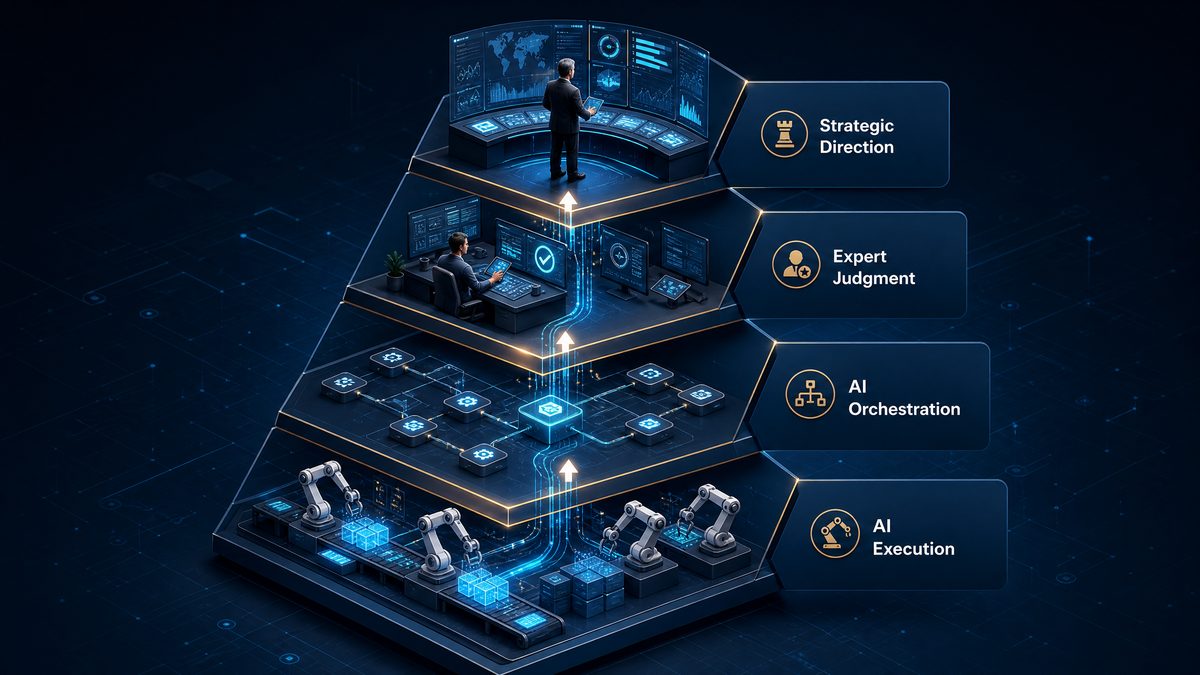
The Leaders (32%) deploy AI agents across strategy, insights, briefing, content creation, activation, and optimisation. They pair agents with human oversight to orchestrate multiple redesigned workflows. Approximately 8% of all CMOs surveyed — the leading edge of this group — are running certain campaign types with multiple agents operating autonomously. These organisations report 20–30% cost efficiency improvements, 3x marketing ROI, and 10x faster campaign cycle times.
The Followers (26%) are scaling beyond pilots in one or two domains, most commonly content development or media optimisation. They have some workflow redesign underway but their talent and technology stack lag their ambition.
The At-Risk (42%) use GenAI only to assist humans with specific tasks. Most have piloted use cases and seen productivity gains, but have not scaled across the business, transformed their operating model, or addressed critical talent gaps.
The ON24 State of AI in B2B Marketing 2026 report, published 24 June 2026 and based on a survey of more than 250 B2B marketers, reinforces this picture from a different angle: 56% of organisations reporting significant AI usage exceeded their top business goals by a significant margin, and top performers are more than twice as likely to be heavy AI users (56% vs 26%).
What the Leaders Are Actually Building
The BCG data is clear that the differentiator between leaders and the at-risk majority is not the AI tools they buy. It is the operating infrastructure they build. Leading CMOs are pulling ahead in three specific areas:
1. Discoverability infrastructure for the AI search era. 90% of CMOs in the BCG survey agreed that GenAI is already reshaping how buyers discover and evaluate brands. Leaders are investing in structured data, FAQPage schema, Speakable markup, and answer-dense content architectures designed to be cited in AI Mode, ChatGPT, Gemini, and Perplexity — not just to rank in traditional search.
2. Brand governance as a data layer, not a style guide. Salesforce Summer '26, which reached general availability on 15 June 2026, ships Brand Center as its headline marketing feature. The core insight is platform-agnostic: encode brand voice, positioning, and guidelines as structured data that every AI agent reads before generating any asset. When brand rules live as data, they are versionable, testable, and enforceable by the system rather than by a human reviewer catching drift after the fact.
3. Multi-agent orchestration, not single-tool adoption. The third wave of AI investment, now getting underway according to BCG, is about building the operating system that enables AI tools, agents, and workflows to function together. ZoomInfo's internal analysis of Fortune 500 customers using GTM Intelligence shows organisations with advanced AI-driven go-to-market strategies achieving 5x more revenue growth, 89% higher profits, and 2.5x greater valuation compared with peers.
The Investment Picture: Marketing Has Won the Mandate
43% of CMOs in the BCG survey report that their AI investments in marketing exceeded $15 million in 2026, up from 28% last year. Crucially, marketing is now leading those investment decisions internally: roughly half of CMOs say the marketing organisation owns AI investment decisions in the function, compared with only 14% led by the CEO or board.
This is a meaningful structural shift. Marketing is no longer waiting to be transformed by IT or strategy. The function has claimed the mandate and the budget. The question is whether it can deliver demonstrable, defensible enterprise impact before CFOs lose patience.
94% of CMOs in the BCG survey say that CEO expectations of marketing have increased significantly over the past two years. The pressure is not just to adopt AI, but to lead with it — and to show measurable revenue impact, not just productivity gains. For more on how to build the agentic marketing infrastructure that delivers that impact, see our guide to Agentic AI Marketing and our case study on building a 14-agent GTM engine.
The Salesforce Summer '26 Signal: Campaign Supply Chains Are Broken
Salesforce framed its Connections 2026 event around a concrete operational problem: the average B2B campaign supply chain spans more than 100 touchpoints and takes 12 to 14 weeks to execute. That is the gap between customer expectations moving in real time and campaigns moving on a quarter-long clock.
Salesforce's own State of Marketing research (n=4,450 marketing decision makers) quantifies the strain: 83% of marketers need more personalised content than they can produce; 78% do not get the data support they need; 73% struggle to respond promptly; and 64% struggle to keep up with changing buyer behaviours.
Rawlings, cited as a Salesforce Agentforce customer, reports 75% faster campaign creation — a vendor-stated figure, not independently verified, but directionally consistent with the BCG efficiency data. The portable lesson for any B2B marketing team, regardless of CRM: centralise brand voice and guidelines as structured data, then require every AI workflow to load it as context. The governance work is the moat; the vendor that hosts it is a detail. This connects directly to the AI Growth Marketing infrastructure we build for B2B clients.
What B2B Marketing Leaders Should Do Now
The BCG data suggests three immediate priorities for B2B marketing organisations that want to move from the at-risk tier to the followers or leaders tier before the window closes:
Audit your AI deployment depth, not breadth. Most at-risk organisations have piloted many use cases. The question is not how many tools you use, but how many end-to-end workflows have been redesigned around agents. If the answer is fewer than three, you are at risk of falling behind agent-native competitors.
Invest in data foundations before adding more agents. Salesforce's own research finds teams with unified customer data are 42% more likely to respond to customers regularly and 60% more likely to use AI agents to scale effectively. The ON24 data shows only 45% of B2B marketers use data related to specific named accounts. Fix the data layer before adding orchestration.
Build for AI discoverability, not just traditional search ranking. 90% of CMOs agree that GenAI is reshaping brand discovery. If your content architecture is not optimised for citation in Google AI Mode, ChatGPT, Gemini, and Perplexity, you are invisible to an increasingly large share of the B2B buying journey. Our AEO and GEO service and the complete AEO guide for 2026 cover the specific steps to build that citation infrastructure. See also our new Preferred Sources Strategy service for a structured approach to becoming a cited source in AI answers.
About the Author
Modi Elnadi is Founder and Director of Marketing & AI Growth at Integrated.Social, a London-based AI growth marketing agency. He works with B2B commercial and technology businesses to build agentic marketing systems, AEO and GEO content architectures, and AI-driven GTM engines that generate measurable pipeline and revenue. His work spans multi-agent orchestration, answer engine optimisation, B2B ABM, PPC, and demand generation — with a consistent focus on connecting AI investment to commercial outcomes rather than operational metrics alone.