Meta reported Q2 2026 revenue of $60.8 billion, a 28% year-over-year increase. The headline number is significant, but the commercially important detail is buried in the earnings call: Advantage+, Meta's end-to-end AI advertising automation suite, crossed a $75 billion annual revenue run rate in the quarter. That figure represents a material portion of Meta's total revenue and confirms that AI-automated advertising is not a future capability — it is the current revenue engine.
The same quarter produced a case study that deserves more attention than it has received. Movida, a Brazilian car-rental company, deployed Meta Business Agent on WhatsApp to handle selection, pricing and payment within a single conversation thread. The company reported a 44% year-over-year increase in daily WhatsApp bookings during the test period, with 85% of conversations resolved without human assistance. Those figures are company-reported and have not been independently audited, but they represent the clearest evidence yet of what agentic commerce on a messaging platform can produce at scale.
The Advantage+ Architecture: What It Actually Does
Advantage+ is not a single product. It is a suite of AI automation tools that progressively remove manual decision-making from the advertising workflow. Advantage+ Shopping Campaigns automate audience targeting, creative selection and bid optimisation across Meta's properties. Advantage+ Creative automatically adjusts image and video assets for different placements and audiences. Advantage+ Placements distributes budget across Facebook, Instagram, Messenger and the Audience Network based on real-time performance signals.
The commercial implication is that a business can now provide a product catalogue, a budget and a conversion objective, and Meta's AI will handle the rest. For direct-to-consumer brands with clear conversion signals, this architecture has demonstrably reduced cost per acquisition and increased return on ad spend. For B2B businesses with longer sales cycles and less direct conversion data, the automation is less straightforward — the system optimises for the signals it can measure, which may not align with the commercial outcomes that matter.
WhatsApp as a Commerce Channel: The Movida Evidence
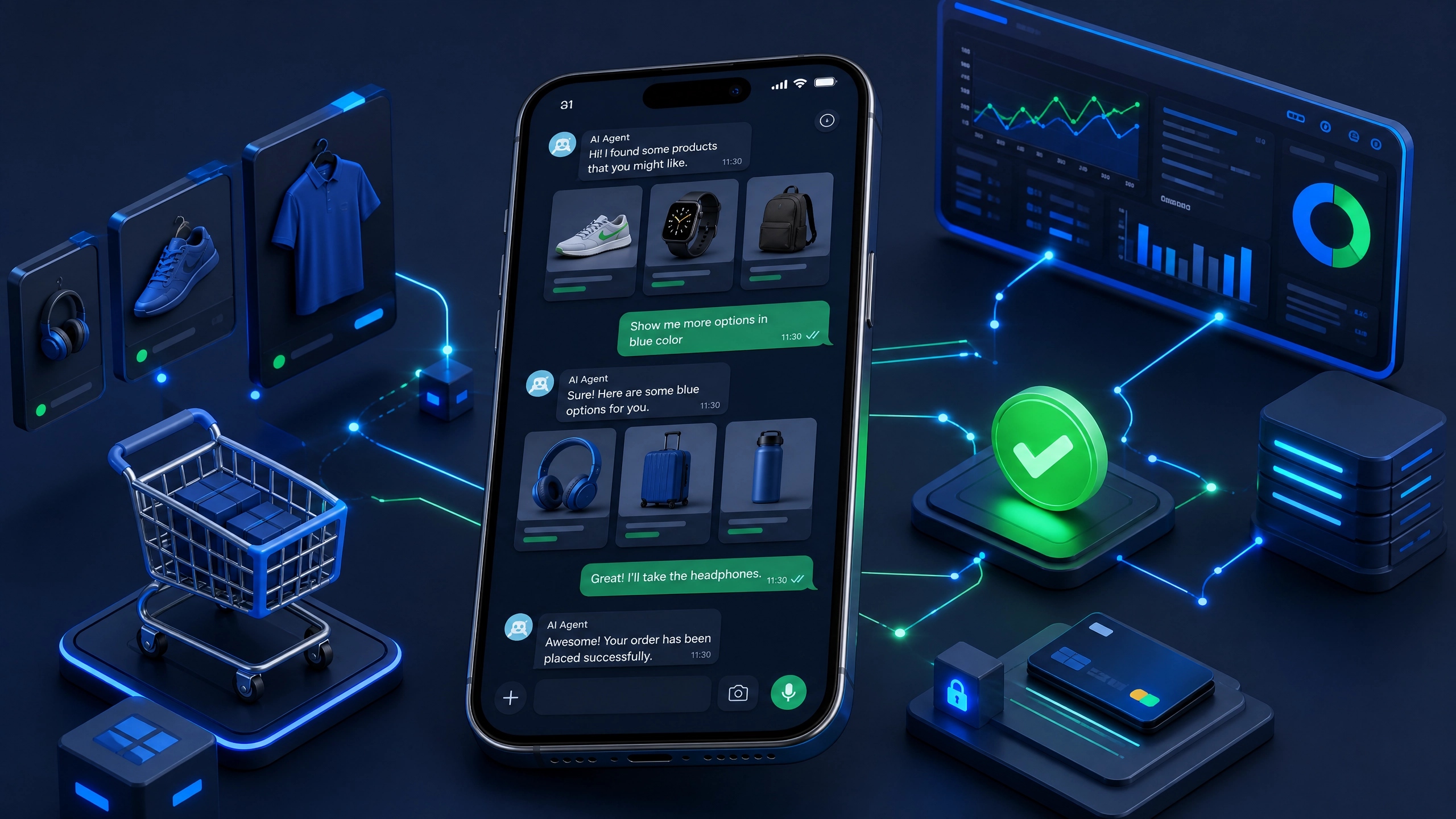
Meta Business Agent launched on 3 June 2026 at the Conversations 2026 event in London. The product allows businesses to deploy an AI agent within WhatsApp that can answer product questions, check availability, present options, handle objections and complete a transaction — all within the messaging thread. The agent can access inventory systems, pricing engines and payment processors through API integrations.
The Movida case study is the most concrete commercial evidence available. A customer initiates a WhatsApp conversation, the agent qualifies the rental requirements, presents available vehicles with pricing, handles date and location selection, and processes payment. The 44% increase in daily bookings is attributed to the combination of 24/7 availability, reduced friction in the booking flow and the ability to handle multiple simultaneous conversations without staffing costs.
The 85% resolution rate without human assistance is the figure that matters most for cost modelling. If that rate is sustainable at scale, the economics of WhatsApp as a commerce channel are compelling: the marginal cost of an additional conversation approaches zero once the agent is deployed and integrated. The risk is that the 15% of conversations requiring human escalation are disproportionately the high-value, high-complexity interactions where the agent's limitations are most commercially consequential.
The Attribution Problem That No One Is Solving
The commercially underexamined aspect of WhatsApp as a commerce channel is attribution. When a customer completes a purchase inside a WhatsApp conversation, the commercial outcome occurs within Meta's platform-controlled environment. Meta can report the conversion. The business can verify the transaction in its own systems. But the attribution chain — which prior touchpoints influenced the decision to initiate the WhatsApp conversation — is opaque.
This is not a new problem. Platform-controlled attribution has been a persistent challenge since Facebook introduced its own pixel and attribution window. What is new is the completeness of the conversion: when the entire journey from discovery to payment occurs within WhatsApp, the business has no independent data on what drove the customer to that conversation. The Movida 44% increase in daily bookings is a real outcome, but it cannot be disaggregated from channel migration (customers who would have booked by phone or web now booking via WhatsApp), seasonality, or the effect of the promotional campaign that launched the agent.
For B2B businesses evaluating WhatsApp as a lead generation or qualification channel, the attribution challenge is compounded by the longer sales cycle. An agent that qualifies a prospect and books a discovery call is producing a commercially valuable outcome, but the contribution of that touchpoint to eventual revenue may not be measurable within Meta's reporting framework.
What the $75 Billion Run Rate Means for B2B Marketing Budgets
The Advantage+ run rate is a signal about where advertising effectiveness is concentrating. Meta's AI is optimising across a dataset that includes billions of user interactions, purchase signals and behavioural patterns. The businesses that are generating the $75 billion run rate are predominantly direct-to-consumer brands with clear, measurable conversion signals. B2B businesses with longer cycles and less direct purchase data are competing for attention in an environment increasingly shaped by signals they cannot match.
The practical implication is that B2B advertisers on Meta need to be more deliberate about what they are optimising for. Optimising for lead form completions in a system designed to find purchase-intent signals will produce leads that are cheap to acquire but expensive to convert. The more effective approach is to use Meta's AI to find audiences with demonstrated interest in the problem category, drive them to content that builds the evidence base for your solution, and measure the downstream pipeline contribution rather than the cost per lead.
Key Takeaways
- Meta Q2 2026 revenue reached $60.8 billion (+28% YoY); Advantage+ crossed a $75 billion annual revenue run rate.
- Movida reported 44% more daily WhatsApp bookings and 85% conversation resolution without human assistance after deploying Meta Business Agent — figures that are company-reported, not independently audited.
- WhatsApp as a commerce channel creates a platform-controlled attribution environment where the full customer journey is opaque to the business.
- B2B advertisers should optimise for problem-category interest signals rather than direct conversion signals to get value from Meta's AI advertising infrastructure.
- The 15% of WhatsApp conversations requiring human escalation are likely disproportionately high-value — agent deployment should include clear escalation protocols and quality monitoring.
Meta reported Q2 2026 revenue of $60.8 billion, a 28% year-over-year increase. The headline number is significant, but the commercially important detail is buried in the earnings call: Advantage+, Meta's end-to-end AI advertising automation suite, crossed a $75 billion annual revenue run rate in the quarter. That figure represents a material portion of Meta's total revenue and confirms that AI-automated advertising is not a future capability — it is the current revenue engine.
The same quarter produced a case study that deserves more attention than it has received. Movida, a Brazilian car-rental company, deployed Meta Business Agent on WhatsApp to handle selection, pricing and payment within a single conversation thread. The company reported a 44% year-over-year increase in daily WhatsApp bookings during the test period, with 85% of conversations resolved without human assistance. Those figures are company-reported and have not been independently audited, but they represent the clearest evidence yet of what agentic commerce on a messaging platform can produce at scale.
The Advantage+ Architecture: What It Actually Does
Advantage+ is not a single product. It is a suite of AI automation tools that progressively remove manual decision-making from the advertising workflow. Advantage+ Shopping Campaigns automate audience targeting, creative selection and bid optimisation across Meta's properties. Advantage+ Creative automatically adjusts image and video assets for different placements and audiences. Advantage+ Placements distributes budget across Facebook, Instagram, Messenger and the Audience Network based on real-time performance signals.
The commercial implication is that a business can now provide a product catalogue, a budget and a conversion objective, and Meta's AI will handle the rest. For direct-to-consumer brands with clear conversion signals, this architecture has demonstrably reduced cost per acquisition and increased return on ad spend. For B2B businesses with longer sales cycles and less direct conversion data, the automation is less straightforward — the system optimises for the signals it can measure, which may not align with the commercial outcomes that matter.
WhatsApp as a Commerce Channel: The Movida Evidence
Meta Business Agent launched on 3 June 2026 at the Conversations 2026 event in London. The product allows businesses to deploy an AI agent within WhatsApp that can answer product questions, check availability, present options, handle objections and complete a transaction — all within the messaging thread. The agent can access inventory systems, pricing engines and payment processors through API integrations.
The Movida case study is the most concrete commercial evidence available. A customer initiates a WhatsApp conversation, the agent qualifies the rental requirements, presents available vehicles with pricing, handles date and location selection, and processes payment. The 44% increase in daily bookings is attributed to the combination of 24/7 availability, reduced friction in the booking flow and the ability to handle multiple simultaneous conversations without staffing costs.
The 85% resolution rate without human assistance is the figure that matters most for cost modelling. If that rate is sustainable at scale, the economics of WhatsApp as a commerce channel are compelling: the marginal cost of an additional conversation approaches zero once the agent is deployed and integrated. The risk is that the 15% of conversations requiring human escalation are disproportionately the high-value, high-complexity interactions where the agent's limitations are most commercially consequential.
The Attribution Problem That No One Is Solving
The commercially underexamined aspect of WhatsApp as a commerce channel is attribution. When a customer completes a purchase inside a WhatsApp conversation, the commercial outcome occurs within Meta's platform-controlled environment. Meta can report the conversion. The business can verify the transaction in its own systems. But the attribution chain — which prior touchpoints influenced the decision to initiate the WhatsApp conversation — is opaque.
This is not a new problem. Platform-controlled attribution has been a persistent challenge since Facebook introduced its own pixel and attribution window. What is new is the completeness of the conversion: when the entire journey from discovery to payment occurs within WhatsApp, the business has no independent data on what drove the customer to that conversation. The Movida 44% increase in daily bookings is a real outcome, but it cannot be disaggregated from channel migration (customers who would have booked by phone or web now booking via WhatsApp), seasonality, or the effect of the promotional campaign that launched the agent.
For B2B businesses evaluating WhatsApp as a lead generation or qualification channel, the attribution challenge is compounded by the longer sales cycle. An agent that qualifies a prospect and books a discovery call is producing a commercially valuable outcome, but the contribution of that touchpoint to eventual revenue may not be measurable within Meta's reporting framework.
What the $75 Billion Run Rate Means for B2B Marketing Budgets
The Advantage+ run rate is a signal about where advertising effectiveness is concentrating. Meta's AI is optimising across a dataset that includes billions of user interactions, purchase signals and behavioural patterns. The businesses that are generating the $75 billion run rate are predominantly direct-to-consumer brands with clear, measurable conversion signals. B2B businesses with longer cycles and less direct purchase data are competing for attention in an environment increasingly shaped by signals they cannot match.
The practical implication is that B2B advertisers on Meta need to be more deliberate about what they are optimising for. Optimising for lead form completions in a system designed to find purchase-intent signals will produce leads that are cheap to acquire but expensive to convert. The more effective approach is to use Meta's AI to find audiences with demonstrated interest in the problem category, drive them to content that builds the evidence base for your solution, and measure the downstream pipeline contribution rather than the cost per lead.
Key Takeaways
- Meta Q2 2026 revenue reached $60.8 billion (+28% YoY); Advantage+ crossed a $75 billion annual revenue run rate.
- Movida reported 44% more daily WhatsApp bookings and 85% conversation resolution without human assistance after deploying Meta Business Agent — figures that are company-reported, not independently audited.
- WhatsApp as a commerce channel creates a platform-controlled attribution environment where the full customer journey is opaque to the business.
- B2B advertisers should optimise for problem-category interest signals rather than direct conversion signals to get value from Meta's AI advertising infrastructure.
- The 15% of WhatsApp conversations requiring human escalation are likely disproportionately high-value — agent deployment should include clear escalation protocols and quality monitoring.