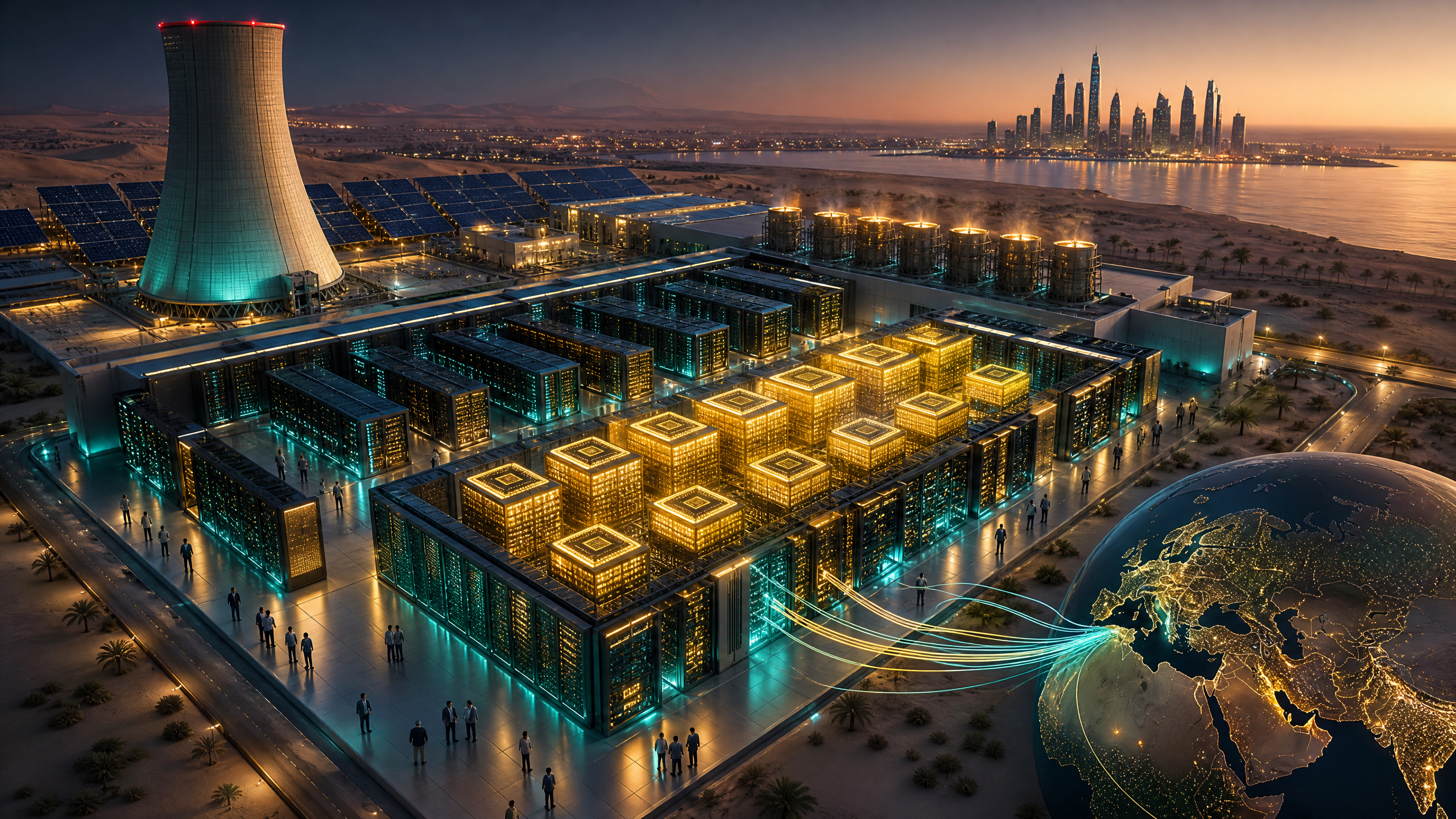
On 30 July 2026, the European Commission opened competitive procurement for up to seven AI Gigafactories across Europe. The programme combines up to €10 billion in EU and national public support with an expectation of at least €20 billion in private investment, bringing the total expected combined investment above €30 billion. Tender applications close in late 2026, with the goal of having facilities operational by 2028.
The announcement has been widely framed as Europe's answer to the US hyperscaler infrastructure build-out and the UAE's $15.2 billion AI campus programme. That framing is understandable but requires careful qualification. The €30 billion figure combines confirmed public support, expected private investment and aspirational programme targets. The seven facilities are planned sites, not operational data centres. And the competitive test for European AI infrastructure is not whether the compute exists — it is whether the compute can be converted into commercial AI capability at a speed and cost that allows European businesses to compete.
What the Programme Actually Commits
The European Commission's announcement confirms €10 billion in EU and national public support through EuroHPC, the joint undertaking that manages European high-performance computing infrastructure. The €20 billion in private investment is an expectation, not a commitment — the tender process will determine which private operators are selected and what capital they bring. The €30 billion total is therefore a programme ambition rather than a confirmed investment figure.
The seven facilities are intended to combine advanced processors, cloud technology, high-speed connectivity, software and energy-efficient data centre infrastructure. They are designed for AI model training, inference and fine-tuning at scale. The tender deadline of late 2026 and the 2028 operational target reflect a procurement and construction timeline that is ambitious given the complexity of the facilities and the current constraints on advanced processor supply chains.
For context, the original von der Leyen announcement in February 2025 committed €20 billion to mobilise several AI Gigafactories across the EU. The July 2026 tender represents the formal procurement launch of that programme, with the target expanded from four to seven sites and the total investment expectation increased accordingly.
The Comparison With UAE and US Infrastructure
The UAE's AI infrastructure programme, anchored by the OpenAI Stargate UAE campus and Core42's expanded global footprint, represents approximately $15.2 billion in committed investment with a target of 5 gigawatts of AI compute capacity by 2030. The US hyperscaler build-out — led by Microsoft, Google, Amazon and Meta — represents hundreds of billions of dollars in committed capital expenditure over the same period. Meta alone has guided to $115–135 billion in AI infrastructure spending in 2026.
The EU programme is smaller in absolute terms, but the comparison is complicated by structural differences. The UAE programme is primarily private capital with government facilitation. The US hyperscaler build-out is entirely private capital. The EU programme is primarily public capital designed to catalyse private investment in markets where the private sector has not yet committed at the required scale. The objective is different: not to build the world's largest AI compute cluster, but to ensure that European businesses have access to sovereign AI infrastructure that is not dependent on US or Chinese technology platforms.
The sovereignty argument is commercially significant. A European pharmaceutical company training models on patient data, a European financial institution running inference on transaction data, or a European government agency deploying AI in public services may have legal, regulatory or strategic reasons to require that their AI workloads run on European-controlled infrastructure. The Gigafactory programme addresses that requirement in a way that no amount of US hyperscaler capacity can.
The Commercialisation Challenge: Five Factors That Determine Competitive Outcomes
Building AI Gigafactories is a necessary but insufficient condition for European AI competitiveness. The historical pattern from previous European technology infrastructure programmes — including the original EuroHPC supercomputer investments — is that compute capacity is easier to build than commercial utilisation is to achieve. Five factors will determine whether the Gigafactory programme produces competitive commercial AI capability rather than underutilised public infrastructure.
Affordable enterprise access is the first factor. If Gigafactory compute is priced at rates that reflect the cost of public procurement and construction rather than the market rate for comparable commercial cloud capacity, European businesses will continue to use US hyperscaler infrastructure for cost reasons. The programme needs to produce compute that is competitively priced for the businesses it is intended to serve.
Talent and developer demand is the second factor. Compute without developers is idle infrastructure. Europe has strong AI research talent concentrated in academic institutions and a small number of technology companies, but the developer ecosystem for commercial AI application development is thinner than in the US. Gigafactory capacity needs to be accompanied by developer access programmes, startup support and commercial incentive structures that attract the builders who will create the applications that justify the infrastructure investment.
Energy availability and cost is the third factor. AI training and inference are energy-intensive workloads. The cost and availability of clean energy at the scale required for Gigafactory operations varies significantly across European markets. Sites selected for their political or geographic distribution rather than their energy infrastructure will face higher operating costs that flow through to compute pricing.
Procurement and deployment speed is the fourth factor. The 2028 operational target is two years away. The AI capability landscape in 2028 will be materially different from today. Infrastructure that is designed for 2026 model architectures and training requirements may be suboptimal for the workloads that will be commercially relevant when the facilities open. The programme needs mechanisms to update specifications and procurement terms as the technology evolves.
Commercial use case development is the fifth and most important factor. Gigafactory capacity will only produce competitive advantage if European businesses develop commercial AI applications that use it. That requires not just infrastructure but the full ecosystem: data, talent, capital, regulatory clarity and the organisational capability to deploy AI in production environments. The infrastructure investment is a necessary foundation, but the competitive outcome depends on what is built on top of it.
Key Takeaways
- The EU opened procurement for up to seven AI Gigafactories on 30 July 2026, combining €10B in public support with €20B in expected private investment — a programme ambition, not a confirmed commitment.
- The €30B total and seven-site target are aspirational figures; the tender closes late 2026 with a 2028 operational target.
- The sovereignty argument is commercially significant: European businesses with regulatory or strategic requirements for non-US infrastructure have a genuine need that the programme addresses.
- Competitive outcomes depend on five factors beyond compute capacity: affordable access, talent and developer demand, energy availability, procurement speed and commercial use case development.
- Europe does not only have a compute shortage — it has a commercialisation and execution challenge that infrastructure investment alone cannot resolve.
On 30 July 2026, the European Commission opened competitive procurement for up to seven AI Gigafactories across Europe. The programme combines up to €10 billion in EU and national public support with an expectation of at least €20 billion in private investment, bringing the total expected combined investment above €30 billion. Tender applications close in late 2026, with the goal of having facilities operational by 2028.
The announcement has been widely framed as Europe's answer to the US hyperscaler infrastructure build-out and the UAE's $15.2 billion AI campus programme. That framing is understandable but requires careful qualification. The €30 billion figure combines confirmed public support, expected private investment and aspirational programme targets. The seven facilities are planned sites, not operational data centres. And the competitive test for European AI infrastructure is not whether the compute exists — it is whether the compute can be converted into commercial AI capability at a speed and cost that allows European businesses to compete.
What the Programme Actually Commits
The European Commission's announcement confirms €10 billion in EU and national public support through EuroHPC, the joint undertaking that manages European high-performance computing infrastructure. The €20 billion in private investment is an expectation, not a commitment — the tender process will determine which private operators are selected and what capital they bring. The €30 billion total is therefore a programme ambition rather than a confirmed investment figure.
The seven facilities are intended to combine advanced processors, cloud technology, high-speed connectivity, software and energy-efficient data centre infrastructure. They are designed for AI model training, inference and fine-tuning at scale. The tender deadline of late 2026 and the 2028 operational target reflect a procurement and construction timeline that is ambitious given the complexity of the facilities and the current constraints on advanced processor supply chains.
For context, the original von der Leyen announcement in February 2025 committed €20 billion to mobilise several AI Gigafactories across the EU. The July 2026 tender represents the formal procurement launch of that programme, with the target expanded from four to seven sites and the total investment expectation increased accordingly.
The Comparison With UAE and US Infrastructure
The UAE's AI infrastructure programme, anchored by the OpenAI Stargate UAE campus and Core42's expanded global footprint, represents approximately $15.2 billion in committed investment with a target of 5 gigawatts of AI compute capacity by 2030. The US hyperscaler build-out — led by Microsoft, Google, Amazon and Meta — represents hundreds of billions of dollars in committed capital expenditure over the same period. Meta alone has guided to $115–135 billion in AI infrastructure spending in 2026.
The EU programme is smaller in absolute terms, but the comparison is complicated by structural differences. The UAE programme is primarily private capital with government facilitation. The US hyperscaler build-out is entirely private capital. The EU programme is primarily public capital designed to catalyse private investment in markets where the private sector has not yet committed at the required scale. The objective is different: not to build the world's largest AI compute cluster, but to ensure that European businesses have access to sovereign AI infrastructure that is not dependent on US or Chinese technology platforms.
The sovereignty argument is commercially significant. A European pharmaceutical company training models on patient data, a European financial institution running inference on transaction data, or a European government agency deploying AI in public services may have legal, regulatory or strategic reasons to require that their AI workloads run on European-controlled infrastructure. The Gigafactory programme addresses that requirement in a way that no amount of US hyperscaler capacity can.
The Commercialisation Challenge: Five Factors That Determine Competitive Outcomes
Building AI Gigafactories is a necessary but insufficient condition for European AI competitiveness. The historical pattern from previous European technology infrastructure programmes — including the original EuroHPC supercomputer investments — is that compute capacity is easier to build than commercial utilisation is to achieve. Five factors will determine whether the Gigafactory programme produces competitive commercial AI capability rather than underutilised public infrastructure.
Affordable enterprise access is the first factor. If Gigafactory compute is priced at rates that reflect the cost of public procurement and construction rather than the market rate for comparable commercial cloud capacity, European businesses will continue to use US hyperscaler infrastructure for cost reasons. The programme needs to produce compute that is competitively priced for the businesses it is intended to serve.
Talent and developer demand is the second factor. Compute without developers is idle infrastructure. Europe has strong AI research talent concentrated in academic institutions and a small number of technology companies, but the developer ecosystem for commercial AI application development is thinner than in the US. Gigafactory capacity needs to be accompanied by developer access programmes, startup support and commercial incentive structures that attract the builders who will create the applications that justify the infrastructure investment.
Energy availability and cost is the third factor. AI training and inference are energy-intensive workloads. The cost and availability of clean energy at the scale required for Gigafactory operations varies significantly across European markets. Sites selected for their political or geographic distribution rather than their energy infrastructure will face higher operating costs that flow through to compute pricing.
Procurement and deployment speed is the fourth factor. The 2028 operational target is two years away. The AI capability landscape in 2028 will be materially different from today. Infrastructure that is designed for 2026 model architectures and training requirements may be suboptimal for the workloads that will be commercially relevant when the facilities open. The programme needs mechanisms to update specifications and procurement terms as the technology evolves.
Commercial use case development is the fifth and most important factor. Gigafactory capacity will only produce competitive advantage if European businesses develop commercial AI applications that use it. That requires not just infrastructure but the full ecosystem: data, talent, capital, regulatory clarity and the organisational capability to deploy AI in production environments. The infrastructure investment is a necessary foundation, but the competitive outcome depends on what is built on top of it.
Key Takeaways
- The EU opened procurement for up to seven AI Gigafactories on 30 July 2026, combining €10B in public support with €20B in expected private investment — a programme ambition, not a confirmed commitment.
- The €30B total and seven-site target are aspirational figures; the tender closes late 2026 with a 2028 operational target.
- The sovereignty argument is commercially significant: European businesses with regulatory or strategic requirements for non-US infrastructure have a genuine need that the programme addresses.
- Competitive outcomes depend on five factors beyond compute capacity: affordable access, talent and developer demand, energy availability, procurement speed and commercial use case development.
- Europe does not only have a compute shortage — it has a commercialisation and execution challenge that infrastructure investment alone cannot resolve.