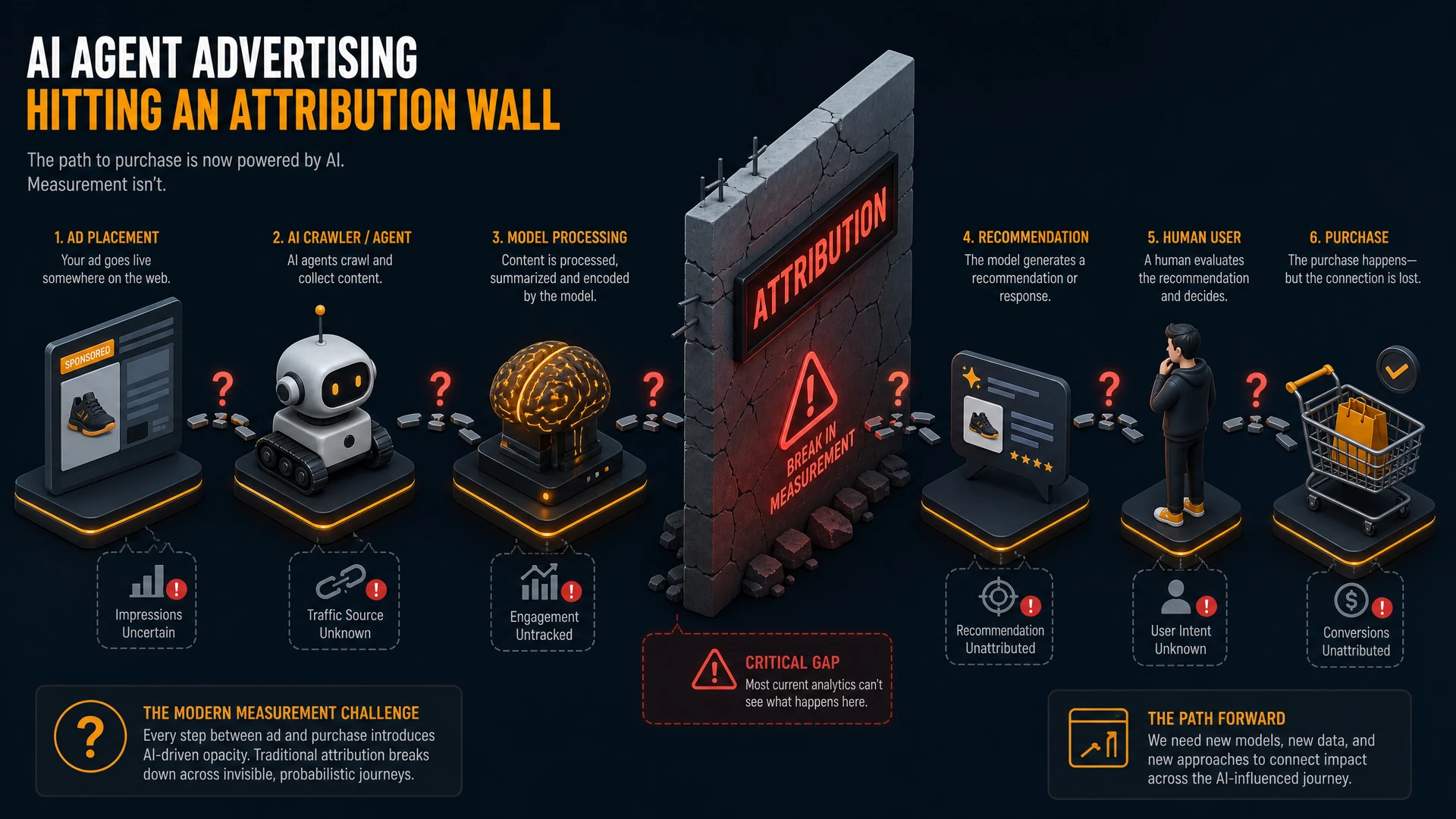
The short answer: most brands should retain some paid-search coverage for their own commercially valuable brand queries. Not because every brand click is incremental, and not because platform-reported ROAS proves it. The defensible argument is simpler: branded demand is earned, but the search-results page is contested. Whether coverage is worth the money is a counterfactual question that should be tested against competitor pressure, query intent, organic substitution and profit.
A brand search is intent, not a transaction you already own
There is a familiar sentence in performance marketing: “Why pay for branded search? You would have got those customers anyway.” It sounds financially disciplined. It is also usually an untested counterfactual.
Someone who searches for a company name has shown awareness and likely intent. They have not yet converted. Between search and transaction sits an auction, competitor messaging, comparison behavior, organic listings, marketplace results and the constraints of a small mobile screen.
The relevant question is not whether your business created the demand. It may have done so through product quality, brand investment, PR, organic search, referral programs, content, sponsorships or previous customer experience. The relevant question is whether a paid placement changes the probability, speed, value or quality of the eventual commercial outcome.
Google’s trademark policy is an important reality check. Google Ads does not restrict trademarks as keywords, although it may restrict trademark use in ad copy after a valid complaint, particularly where a direct competitor’s ad is confusing or misleading. In other words, a competitor can seek to enter the auction around your brand query even if it cannot freely use your brand in its ad text. Google’s trademark policy is the source of truth; legal advice is required for your category, jurisdictions and creative.
This does not mean every competitor bid is effective or that every brand term needs a bid. It means “we would have got the sale” is not an operating model. It is a hypothesis.
Brand demand is earned. The search-results page is rented.
Brands often create demand in one channel and expect to collect it in another. That is normal. A television spot can lead to a Google search. A LinkedIn post can lead to direct traffic. An AI answer can lead to a branded search. SEO can make the product understandable, while paid search gives the brand a controlled commercial message at the moment the buyer expresses intent.
No channel owns the customer. The brand that wins the customer journey does.
Paid brand coverage is therefore part acquisition and part defense. It can help the brand control the headline, proposition, offer, sitelinks, destination, geography and call to action. That control is particularly useful during a product launch, promotion, reputation event, competitor campaign or a major above-the-line investment that creates branded search volume.
The mistake is to call that control “free” or “always incremental.” It is neither. The mistake in the opposite direction is to abandon the top of a commercial results page simply because the query began with your name.
Organic position one is useful, but it is not the same slot
Strong organic visibility is an asset. It should be protected and improved. It does not make a paid position identical to the first organic result.
Google describes Ad Rank as the system that determines whether an ad is eligible to show and, if so, where it may appear relative to other ads. It is calculated at auction time using factors such as bid, competition, search context, quality of the ad and landing page, thresholds and the expected impact of assets. Google’s Ad Rank guidance says higher-quality ads can often lead to lower CPCs.
One technical nuance matters. The visible 1–10 Quality Score is a diagnostic summary; it is not a single auction input that mechanically lowers your cost. The relevant operational work is improving the query-to-ad-to-landing-page experience so the auction-time quality signals are strong. For an official brand landing page answering an exact branded query, that alignment can be an advantage. It is not a guarantee, and competitor pressure can still raise prices.
The practical question is therefore not, “Do we rank organically?” It is, “What does the buyer see, and what can they do, before they reach us?”
Do not treat every branded query as the same business case
“Brand” is not a homogeneous keyword bucket. A sensible program separates navigational, commercial and defensive intent.
| Query type | Typical example | Default action | Why |
|---|---|---|---|
| Navigational | Brand login, Brand support | Limit or exclude after testing | The user may already know the destination; an ad can be low incremental value. |
| Pure brand | Brand | Maintain measured coverage | Competitors, aggregators and SERP features can influence the next click. |
| Brand + commercial intent | Brand pricing, Brand demo, Brand product | Protect strongly, subject to efficiency | This is often close to a purchase or sales conversation. |
| Brand + comparison | Brand vs competitor, Brand alternatives, Brand reviews | Use tailored evidence pages and defensive coverage | The buyer is explicitly evaluating options. |
| Brand + promotion | Brand discount, Brand offer | Govern tightly with current terms | The ad can direct people to an accurate, controlled offer. |
These are starting categories, not universal rules. Query data, auction insights, landing-page behavior, customer lifecycle stage, geography and legal restrictions should shape the final structure.
The real question is incremental contribution
The useful debate is not “Are brand conversions incremental?” The question is: what proportion of the commercial outcome would still happen, at the same value, if paid brand coverage changed?
Platform attribution cannot answer that alone. Switching off a brand campaign will obviously remove recorded paid conversions. The decision depends on what happens next: do paid clicks migrate to organic with no loss in total outcomes, do competitors take some demand, does the mix of new versus returning buyers change, does revenue decline, or does profit improve?
Google describes incrementality testing as a controlled comparison that can quantify incremental revenue that would have been missed without a campaign. Its incrementality-testing guidance discusses user- and geography-based approaches and warns that actual outcomes vary by advertiser.
That is the standard to adopt. Do not turn off brand coverage because a dashboard looks efficient or inefficient. Design a test that answers the commercial question.
How to run a responsible brand-bidding incrementality test
1. Start with a written hypothesis
Define the claim in measurable language. For example: “Reducing coverage on pure-brand queries in matched regions will not reduce total new-customer profit after accounting for organic, direct and competitor effects.” Do not begin with a desired answer.
2. Segment the query set before testing
Keep brand + login separate from brand + pricing, comparison and generic brand terms. A broad switch-off may hide meaningful differences. The account should retain a query taxonomy, negative-keyword logic and documented exclusions.
3. Choose a defensible control design
Where practical, use comparable geographies, audiences or time windows. Avoid testing across a product launch, an unplanned competitor promotion, a site outage, a major retail event or a large offline-media burst unless those factors are deliberately modeled. Work with your analytics, finance and legal teams on the appropriate method.
4. Measure the full commercial system
Predefine the outcome set. At minimum, monitor total paid-plus-organic branded clicks, total branded conversions, new versus returning customers, qualified pipeline, revenue, gross margin, CAC, direct traffic, organic brand traffic, top and absolute-top impression metrics, competitor impression share where available, and important landing-page outcomes.
5. Separate substitution from loss
If paid clicks fall while organic clicks rise and total profit is steady, brand coverage may be low incremental for that segment. If organic only recovers part of the lost demand while new-customer revenue or pipeline declines, the campaign was likely protecting real commercial value. Do not call either result a victory or failure before accounting for profitability and confidence.
6. Add a competitor-pressure view
Auction conditions matter. Compare periods with different competitor visibility where possible. If a brand campaign is unnecessary in a quiet auction but valuable during competitive pressure, design a governed response rather than an ideological always-on or always-off rule.
7. Document the decision and retest
Record the hypothesis, date range, exclusions, data sources, confounders, approval owner and decision. Repeat when the SERP, product mix, competitor landscape or offline media strategy changes.
When reduced brand coverage can be the rational decision
The position here is not that every brand should bid on every variation forever. A reduction can be sensible when there is minimal competitor pressure, unusually expensive branded auctions, strong and stable organic substitution, overwhelmingly navigational demand, limited acquisition value, or a well-designed experiment finds no material incremental loss.
The key requirement is evidence. A brand campaign showing an 18x platform ROAS may simply be harvesting demand generated elsewhere. A campaign that looks expensive on last-click ROAS may be preventing valuable commercial leakage. Both outcomes are possible.
A practical operating model for paid brand
Treat brand search as a governed demand-capture program, not a vanity campaign. The following cadence works for many B2B and considered-purchase teams.
| Cadence | Decision | Evidence required |
|---|---|---|
| Weekly | Query classification, negatives, auction pressure, landing-page relevance | Search-term report, policy checks, auction metrics, page QA |
| Monthly | Budget and message changes by intent | Incremental-readout proxy, pipeline quality, new/returning mix, sales feedback |
| Quarterly | Coverage strategy and experiment plan | Controlled test design, finance review, competitor/market context |
| Event-led | Launches, promotions, reputation events and competitor attacks | Current offer terms, legal approval, message hierarchy, contingency owner |
The operating model should also connect to your wider search and AI-discovery strategy. Buyers may now encounter a brand in an AI answer, return to Google to verify it, search for a competitor comparison and then visit a pricing page. Evidence-led landing pages, structured internal links and clear commercial claims help all of those journeys.
For related reading, see our guides to AI business agents and paid-search lead forms [blocked], agentic advertising attribution [blocked] and AI search vendor research and budget shifts [blocked]. Teams reviewing a broader program can also explore our PPC and performance marketing services [blocked] and free AI Growth Audit [blocked].
The bottom line
You may have earned the search. You do not automatically own the next click.
The rational default is to defend commercially valuable brand queries where the buyer journey is contested, the advertisement is accurate and relevant, and the likely incremental contribution justifies the cost. The rational exception is to reduce or remove coverage when credible evidence shows the money can be better used elsewhere.
So when someone says, “You would have got those customers anyway,” do not answer with a belief of your own. Ask for the counterfactual test.
About the Author
Modi Elnadi is the founder of Integrated.Social and an AI performance marketing strategist. He helps B2B and enterprise teams connect paid media, SEO, AEO, AI discovery, evidence governance and measurement to commercially accountable growth programs. View Modi Elnadi’s profile [blocked] or contact Integrated.Social [blocked] to discuss an evidence-led search and AI visibility program.