Enterprise AI spending can rise while sustained value falls because buying models, licenses, and pilots is easier than redesigning the real work around them. In Accenture’s July 2026 Pulse of Change, figures also stated in Accenture’s September announcement, 82% of surveyed C-suite leaders said they were increasing AI investment, while only 23% said their organization had realized widespread, sustained business value from AI, down from 32% earlier in the year. That is not proof that AI investment is failing. It is a warning that investment momentum and operating results are different measures, and leaders should not treat one as evidence of the other.
That distinction is central to Accenture’s September 23 announcement of an investment in and partnership with Within. The stated proposition is to map how work actually happens, including handoffs, exceptions, and workarounds, so clients can identify automation opportunities and deploy agents with more operational context. It is a commercially logical response to the value gap. It is not, however, evidence that the partnership has already produced ROI for clients. Accenture did not disclose investment terms, and its release explicitly frames anticipated partnership benefits as forward-looking rather than guaranteed performance.
The commercial lesson for senior leaders is practical: do not ask only, “Which AI platform should we deploy?” Ask, “Which workflow will change, what evidence shows the starting condition, which exceptions are in scope, who owns the control points, and how will we know whether the new operating model is working?”
The gap is not interest in AI. It is durable operating value.
Accenture’s survey does not establish a universal enterprise ROI rate. It does show a useful tension in the views of a defined executive population: investment is moving faster than widespread, sustained results. The report says Accenture conducted two global surveys between April and June 2026: one of 3,000 C-suite leaders and one of 3,000 non-C-suite employees at organizations with annual revenues above $500 million, across 19 industries and 20 countries.[1]
That methodology matters. The 82%, 23%, and 32% figures are Accenture survey evidence, reported by respondents in that sample. They are not audited financial outcomes, a claim about every business, or a benchmark that a company should apply without considering its industry, baseline, use case, and measurement design. The “down from 32%” comparison also reflects Accenture’s own survey series and wording, not a controlled experiment of a single intervention.
Still, the directional signal is hard to dismiss. Adoption is nearly universal in many large organizations, but moving from local productivity to enterprise-wide value requires more than a capable model. Accenture’s report argues that organizations pulling ahead are redesigning infrastructure, roles, and workforce capabilities. That aligns with a straightforward operational reality: an agent cannot reliably execute a process that the organization itself cannot describe, govern, or measure.
Why a pilot can look productive without becoming a business capability
A pilot normally has advantages that production does not. It can run on a narrow data set, be watched by an expert team, avoid difficult edge cases, and use a motivated set of early adopters. A production workflow must survive shift changes, approvals, customer exceptions, supplier variation, permissions, system outages, regulatory checks, and an accountable owner’s absence.
This is where many investment cases become fragile. A team may record time saved in a demonstration, then assume the same gain will survive across functions. But time saved is not automatically capacity released; capacity released is not automatically cost removed; and neither is automatically incremental revenue. These are separate commercial questions that require a baseline, an attribution rule, and a credible counterfactual.
The better framing is not “AI has no value until every outcome is perfect.” It is “the business needs a traceable chain from workflow change to an agreed value measure.” That lets leaders stop weak initiatives early, protect promising ones from vague expectations, and compare use cases on more than novelty.
What Accenture and Within have actually announced
Confirmed: Accenture said that Accenture Ventures made an investment in Within and that the two companies are partnering to help clients gain deeper insight into work, identify performance-improvement opportunities, deploy AI agents, and pursue productivity and efficiency gains. The release describes Within as a platform that captures work across applications and offline interactions, then compiles the information into a continuously updated “Work Brain.”[2]
Confirmed: Within describes its own offer as mapping how a company works, structuring activities, handoffs, and approvals into a “Company Brain,” and using that context to inform process and agent decisions. It also says its design is intended to observe work rather than workers and references privacy and security badges on its site.[3]
Not confirmed by these sources: client-level ROI, adoption rates, implementation duration, cost savings, revenue impact, or the degree to which an Accenture-Within engagement will outperform another approach. The press release includes customer and company statements, which may be useful context, but they are not independently audited performance evidence. The partnership announcement also says investment terms were not disclosed.
That distinction should not make the announcement less interesting. It makes the right question clearer. Process intelligence and operational context may help address one of the hardest barriers to agentic AI: the gap between the documented process on a slide and the actual process people use to complete work. Whether it does so in a particular enterprise should be tested through a bounded, governed measurement plan.
The context problem is also a control problem
In many organizations, the official process is a policy, a process map, or an ERP configuration. The real process includes the judgment calls people make when a field is missing, an approval is delayed, a customer has an unusual request, or two systems disagree. Those exceptions are often where customer risk, margin leakage, compliance exposure, and manual effort sit.
An AI agent that only receives the official happy path may be confident in the wrong moment. An agent that receives a fuller process map may still be wrong, but its scope, escalation path, and evidence can be designed more deliberately. This is why workflow discovery should not be treated as a pre-sales diagram exercise. It is part of the operating design, risk design, and measurement design.
The inference here is modest: tools that reveal operational context could improve use-case selection and control design. The sources do not prove that every process-mining or work-mapping project will create sustained business value. Leaders should retain that uncertainty and make it explicit in the business case.
A practical checklist before scaling an AI workflow
Use this checklist before moving an AI assistant or agent from a promising use case to a material operating commitment.
1. Define one decision or workflow boundary
Name the workflow in business terms, not technology terms: for example, “resolve standard billing disputes under $5,000” rather than “deploy a finance agent.” State the entry trigger, expected output, systems touched, teams affected, and explicit exclusions. If the boundary cannot be drawn, the project is not ready for a value target.
2. Record the real baseline, including exceptions
Capture current volume, cycle time, touch time, error or rework rate, service level, escalation rate, and relevant control failures. Then sample the exceptions: the cases that require judgment, a workaround, or a human override. Do not let an average conceal the minority of cases that carry most of the risk.
3. Separate a product metric from a business metric
Model accuracy, task completion, and response speed are useful product measures. They do not by themselves establish business value. Agree the business measure separately, such as verified reduction in rework, avoided loss, improved fulfillment reliability, or released capacity that has a documented redeployment plan. Assign a finance or operations owner who can challenge the calculation.
4. Design human authority before autonomy
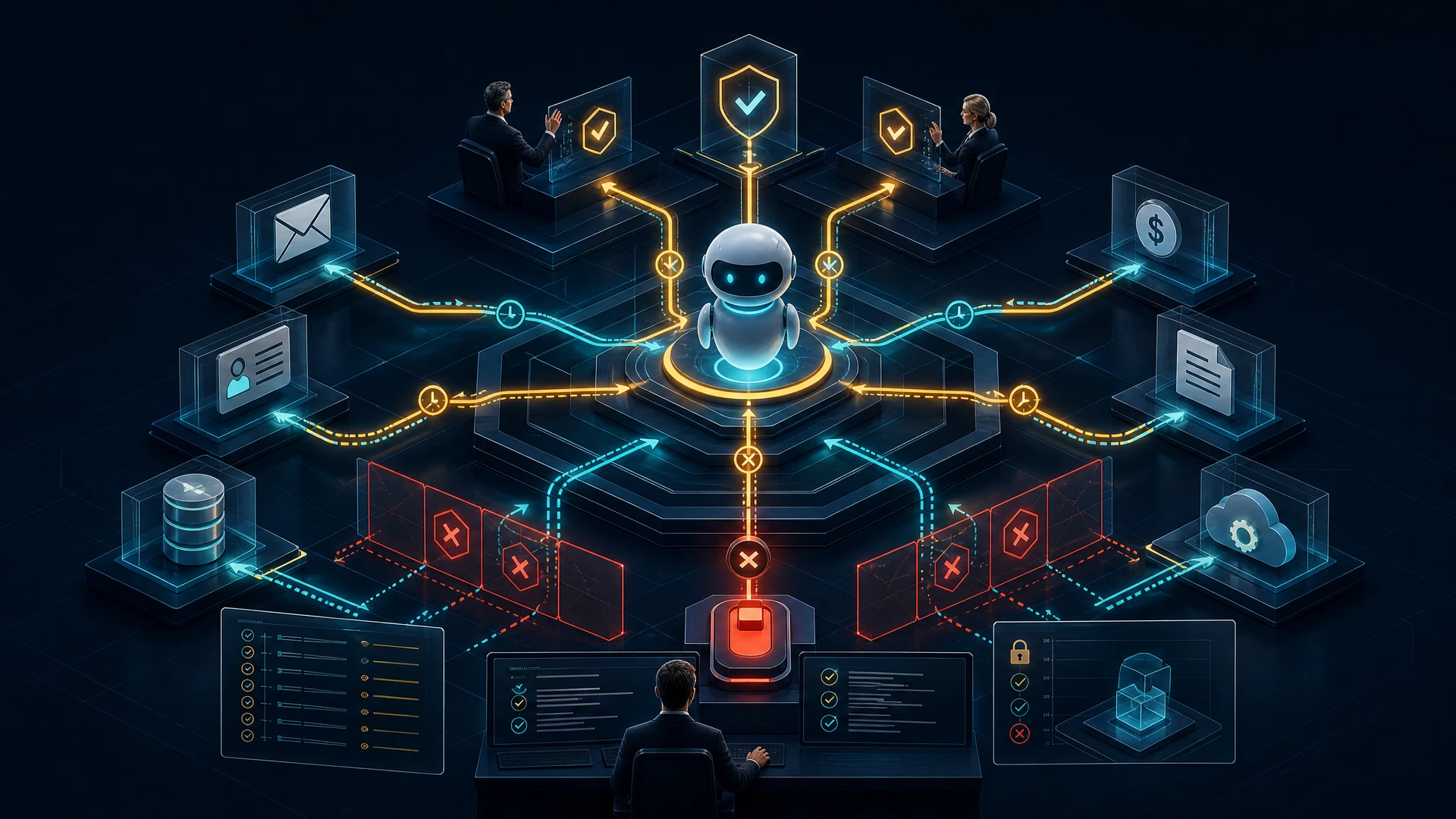
Specify what the system can recommend, draft, execute, or escalate. Identify the human role that can override it, the conditions that force review, the audit trail required, and the maximum impact of a wrong action. Governance is not a late compliance gate; it is the set of operating choices that defines safe scale.
5. Run a controlled comparison and a stop rule
Where feasible, compare a defined test group with the prior process or a matched control. Set the measurement window before launch. Set stop, rollback, and escalation criteria as well. If results do not meet the agreed threshold, pause and learn rather than expanding because the investment has already been announced.
6. Review change management as part of the economics
Ask who now does less work, who gains a new exception-review task, what skills are required, and whether incentives conflict with adoption. An agent that adds work to the people who must supervise it can simply move cost or risk. Sustainable value has to account for the whole workflow, not the most visible automated step.
From “AI deployment” to evidence-led workflow design
The Accenture-Within announcement is notable because it places operational knowledge close to the agent-deployment decision. That is a more mature conversation than selecting a model in isolation. But it should not lead executives to swap one simplification for another. A “Company Brain,” process map, or context layer is not the same thing as proven value. It is a potential input to a better implementation and measurement process.
For commercial leaders, the priority is to sequence the work. First, identify a workflow where the customer, margin, risk, or capacity consequence matters. Second, make the actual flow visible, including exceptions and handoffs. Third, decide the human-agent operating model and controls. Fourth, run the smallest measurement design that can credibly inform an expand-or-stop decision.
This approach is compatible with speed. It can reduce waste by preventing a broad rollout from becoming an expensive search for the real process after deployment. It also avoids the opposite mistake: holding every project to an impossible standard of certainty before any learning is allowed.
Integrated.Social can help scope a controlled evidence, measurement, or governance review for an AI-enabled workflow, with assumptions, controls, and outcome measures documented before implementation decisions are expanded.
For adjacent context, see our analysis of enterprise context as an AI value layer [blocked], a reliable task-closure scorecard for AI marketing agents [blocked], and agentic AI governance and security [blocked]. Organizations evaluating agent workflows can also review our Gemini & Agentic AI service [blocked] for the relevant delivery scope.
What to take to the next investment committee
Do not make the investment committee choose between “move fast” and “govern responsibly.” Give it a decision packet that makes both possible: the workflow boundary, baseline evidence, exception profile, proposed human authority, stated value hypothesis, measurement period, and stop rule.
Then label every statement correctly. The Accenture survey is external directional evidence from a large-enterprise respondent sample. The Accenture-Within partnership and investment are confirmed announcements with undisclosed terms. Within’s product descriptions are vendor positioning. The expected commercial impact in a specific organization remains a hypothesis until its workflow and measurement design produce evidence.
That discipline is not conservative theater. It is how an enterprise turns rising AI investment into a decision system capable of finding, sustaining, and verifying value.
FAQs
Does Accenture’s survey mean enterprise AI is failing?
No. The survey indicates that, among the C-suite respondents Accenture surveyed, investment is increasing faster than the share reporting widespread, sustained business value. It does not measure every company’s financial return or prove that AI programs broadly fail. It points to a scale and operating-model challenge worth testing inside each organization.
What did Accenture announce with Within?
Accenture announced an investment through Accenture Ventures and a new partnership with Within. The companies say they plan to help clients understand real work patterns, identify improvement opportunities, and support agent deployment. The announcement does not disclose the investment terms or establish client ROI from the partnership.
Why are workflow exceptions important for AI agents?
Exceptions expose the conditions where rules, data, approvals, and human judgment diverge from the ideal process. If an agent is deployed without a clear treatment for those conditions, it may make unsupported decisions or send too much work back to people. Mapping exceptions helps define escalation, authority, and evaluation requirements.
What should count as sustained AI value?
A sustained value claim should connect an AI-enabled workflow change to an agreed business measure over a defined period, with a documented baseline and accountable owner. Useful measures vary by use case, but the evidence should distinguish a system’s technical performance from outcomes such as durable service reliability, lower verified rework, or capacity that the business has actually redeployed.