The direct answer
The latest U.S.–China AI talks created a reported dialogue on national-security AI incidents, not a breakthrough agreement on artificial general intelligence (AGI) or superintelligence. Current systems are becoming more capable, but neither AGI nor superintelligence is an established deployed fact. For marketing, manufacturing and workforce leaders, the near-term signal is faster adoption plus greater supply-chain and governance uncertainty — not a science-fiction finish line.
Download the cited U.S.–China AI business briefing for the executive response plan, direct sources and QR codes to this analysis and the free audit.
What the U.S.–China AI talks actually established
The most useful reading of the summit is narrow. Public reporting indicates that the U.S. and China launched a dialogue and that a dedicated channel for national-security AI incidents was proposed. It does not establish a shared definition of AGI, a verified “superintelligence” milestone, a bilateral slowdown, or a comprehensive safety treaty.
At the UN Security Council meeting on September 23, POLITICO reported that U.S. and Chinese officials presented sharply different governance visions. White House science adviser Michael Kratsios opposed a global scheme to control “superintelligence,” while China’s UN representative Fu Cong called for international alignment on development strategies, standards and guardrails. Those are public positions, not evidence of a common operating rulebook.
The next day, PBS NewsHour reported that the U.S. and China were launching a U.S.–China AI Dialogue, with a dedicated communications line proposed for national-security incidents and a list of agreed dangers. Xi’s public remarks emphasized that AI should remain under human control. This is a potentially useful confidence-building step; it is not a reason for a business to treat model, chip, cloud or data dependencies as settled.
“Superintelligence” is rhetoric here, not a product category
Political language can make a frontier technology feel more settled than it is. AGI is generally used for a system with broad, transferable cognitive capability across domains. Superintelligence goes further: capability beyond the best human experts across most cognitive tasks, potentially including AI improvement. Neither label is a procurement specification, and neither should be used to describe a standard 2026 enterprise deployment without strong, task-specific evidence.
The Stanford AI Index 2026 makes the practical distinction clear. It describes powerful and uneven systems: agents improved to roughly 66% task success on OSWorld while still failing about one in three structured benchmark attempts; robots perform far better in controlled settings than in open-ended household tasks. Capability progress is real. General reliability is not a reasonable assumption.
Why this matters now for marketing, manufacturing and jobs
The talks matter because they sit above the business inputs that determine adoption: models, compute, chips, standards, data rules, safety testing and talent. A leader does not need to predict a winner in a geopolitical competition to recognize that those inputs can become more constrained, fragmented or politically sensitive.

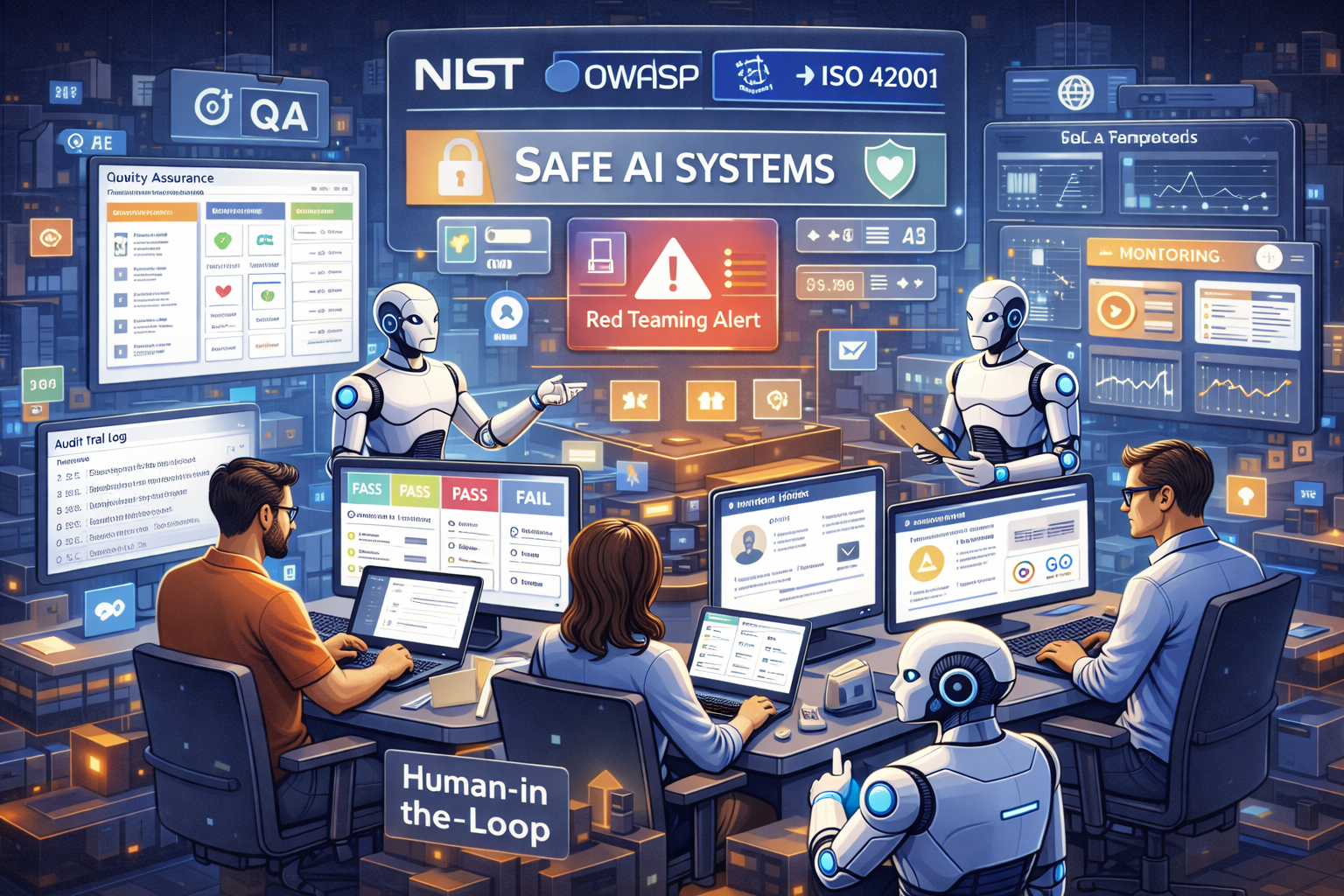
Illustrative conceptual visual. It represents operating choices, not a quantified forecast or a claim about either country’s AI capability.
Marketing: the new competitive surface is evidence, not model mythology
Marketing teams should care less about declarations of AGI and more about what current models already do: summarize research, draft variants, interpret structured information, operate selected tools and influence how buyers discover vendors. The Stanford AI Index says the U.S.–China model-performance gap had effectively closed by March 2026, with the top U.S. model leading by 2.7% in its cited comparison. That is not a universal quality verdict; it is a reminder to test a workflow against its task, cost, reliability and governance needs rather than its origin story.
For B2B teams, this increases the value of answer-engine optimization and entity clarity. A model-mediated buyer journey needs source-linked claims, clear ownership, current policies, structured product or service facts and an accurate path to a human. The operational standard is not “publish more AI content.” It is “can a reviewer trace every material claim and correct it quickly?”
A marketing control that survives model changes
Create a source register for high-stakes content and campaigns. Record the approved source, the editor, the model or tool used, the prompt or brief version, the approving owner and the correction path. This improves quality even when no system is autonomous, and it gives a team a usable audit trail when the model landscape shifts.
Manufacturing: focus on bounded tasks, resilience and the human fallback
The policy debate can sound like a race to a distant finish line. Factory leaders face a nearer decision: where can AI-enabled automation improve quality, maintenance, planning, safety or throughput without creating a brittle production dependency? China’s 2025 Global AI Governance Action Plan explicitly includes industrial manufacturing, intelligent infrastructure and safety evaluation as areas for AI deployment and cooperation. That is a stated policy direction, not proof that a particular factory is lights-out or that any deployment will deliver a specific return.
The International Federation of Robotics’ 2026 position paper offers a more useful operating frame: robots typically substitute tasks rather than entire occupations, and displacement, productivity and reinstatement effects interact. Begin with bounded use cases. Define quality thresholds, safe-stop behavior, manual fallback, cyber controls and supplier accountability before scaling a vision or optimization system.
Jobs: use forecasts to plan transitions, not to make headcount promises
The World Economic Forum’s Future of Jobs Report 2025 estimates 170 million jobs created and 92 million displaced by 2030 across macrotrends, for a net gain of 78 million. These are survey-based, global projections across technology, geoeconomic fragmentation, demographic change, the green transition and economic uncertainty — not a count of jobs that AI alone will eliminate.
The same report draws on more than 1,000 employers representing more than 14 million workers across 55 economies and 22 industry clusters. Its practical message for managers is to redesign work deliberately: map tasks, retain apprenticeship pathways, train people to evaluate and escalate, and do not mistake reduced task time for a reliable case for irreversible headcount decisions.
The U.S. and China are pursuing different policy paths — your operating model needs both speed and control
The U.S. AI Action Plan organizes policy around innovation, infrastructure, and international diplomacy and security, including the export of American AI stacks to allies and strengthened compute export-control enforcement. China’s Global AI Governance Action Plan calls for international cooperation, industry deployment, data governance, standards, safety assessment and emergency response. Both recognize AI as economic infrastructure; they differ in important strategic assumptions and governance language.
For a commercial team, the response is not to choose sides through a blog post. It is to make dependencies visible. Where does each critical workflow run? Which provider, cloud region, model, data set, connector, hardware layer and human approver does it depend on? What happens if one fails, changes terms, becomes unavailable or no longer meets the team’s risk requirements?
A 30-day response plan for leaders
1. Map three workflows before buying another platform
Choose one workflow each in marketing, operations and customer-facing support. Break it into inputs, decisions, actions, permissions, sources, quality criteria and fallback actions. A workflow map will reveal whether a problem is model capability, data quality, ownership, process design or measurement.
2. Define evidence and approval thresholds
Set a higher bar for material claims, regulated communications, customer commitments, pricing, product recommendations, production changes and data exports. AI governance services should translate into named decision rights, source requirements, review thresholds, logging and an escalation path — not a slide deck that no operator uses.
3. Stress-test vendor and infrastructure concentration
Record model, provider, cloud, region and data dependencies. For critical workflows, define a safe manual path or tested alternative. The goal is not to duplicate every system. It is to avoid discovering a single point of failure during a customer, safety or regulatory incident.
4. Train people for supervision, not only prompting
Good operators need to judge output, identify unsupported claims, escalate exceptions and recover a workflow. Give junior staff bounded work that develops judgment and customer context. Give managers a clear responsibility for outcomes, not a vague instruction to “use AI.”
5. Measure with commercial and human boundaries
Track quality, cycle time, error rate, rework, customer impact and employee experience. Do not convert a pilot’s hours saved into a revenue forecast or a job-loss forecast without a credible baseline and follow-up evidence. If your team needs an outside view of its discovery, technical and source foundation, request a free AI Visibility Audit.
What this means for AEO and SEO
AI policy rhetoric does not change the fundamentals of discoverability: clear entities, verified sources, human accountability and useful answers to real buyer questions. It does make the foundation more urgent. As models become a more common research and recommendation interface, ambiguous sites are easier to overlook and poorly sourced claims are easier to scale.
Start with the work you can validate: semantic, answer-first content and AI-search foundations; a governed agentic AI workflow; and a route from visibility to an accountable human conversation. The opportunity is not a guaranteed citation or conversion. It is a more resilient system for being understood, trusted and evaluated.
What leaders should not conclude
- Do not claim that the U.S. and China reached a comprehensive AI safety agreement.
- Do not treat “superintelligence” rhetoric as proof that AGI or superintelligence exists today.
- Do not turn a global workforce projection into an AI-only headcount prediction for one company.
- Do not call a visually automated factory fully autonomous without direct, site-specific evidence.
- Do not scale a model workflow because a benchmark moved; test it against your data, permissions, quality standards and rollback requirements.
About the Author
Modi Elnadi is the founder of Integrated.Social, a London AI growth marketing agency. He works with B2B teams on AI search visibility, evidence-led content, commercial measurement and governed adoption of agentic workflows. His approach connects SEO, AEO, GEO, paid media and operating controls so that new AI capability is matched to accountable decisions, source discipline and practical buyer journeys — not untestable performance claims.