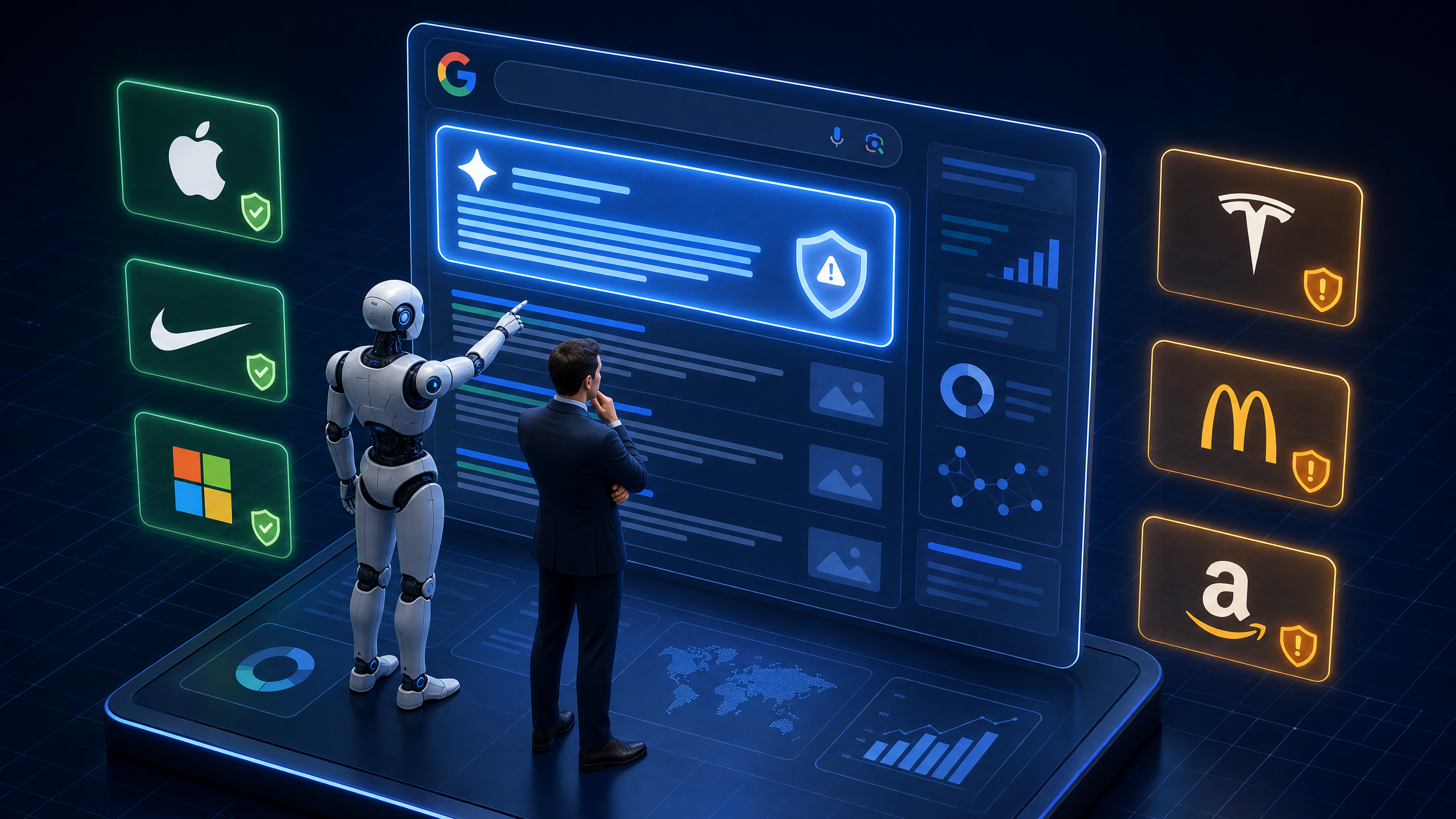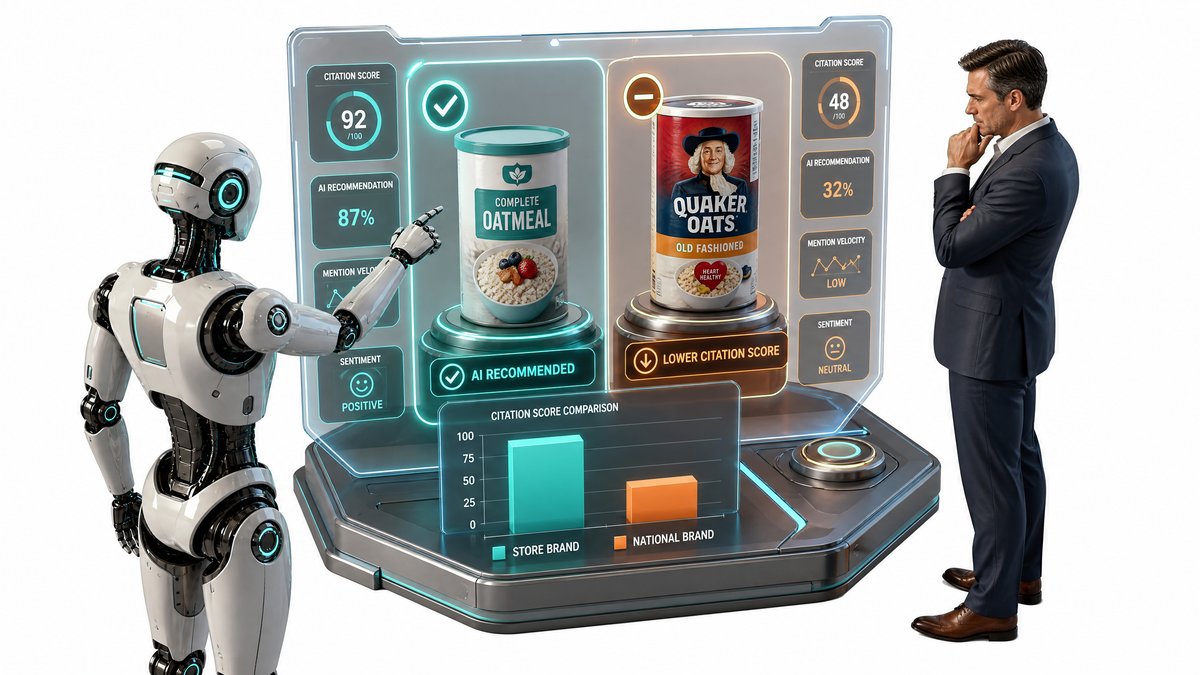
A quiet but commercially significant shift is underway in how AI shopping assistants recommend products. When a consumer asks ChatGPT, Gemini, Perplexity or Google AI Mode to suggest the best oatmeal, protein bar, cleaning spray or moisturiser, the answer is increasingly a store brand or a digitally-native challenger brand — not the household name that has spent decades and hundreds of millions building brand equity.
This is not a coincidence. It is the logical output of how large language models are trained, how they evaluate product authority, and what signals they treat as evidence of quality. For CPG marketing leaders, it represents one of the most disruptive commercial shifts since the rise of Amazon's private-label programme.
How AI Engines Decide What to Recommend
AI recommendation engines do not operate like search engines. They do not rank pages by backlinks or domain authority. They synthesise information from training data, structured product content, review corpora, editorial coverage, and increasingly from real-time retrieval. The signals they weight most heavily include:
- Ingredient and specification transparency — products with clear, structured, machine-readable ingredient lists and nutritional data are easier for AI to evaluate and cite confidently
- Third-party editorial coverage — independent reviews, consumer reports, and editorial roundups carry more weight than brand-owned content
- Review volume and sentiment quality — not just star ratings but the specificity and consistency of written reviews
- Price-to-specification ratio — AI assistants are trained on consumer guidance content that frequently highlights value, and store brands often win on this dimension
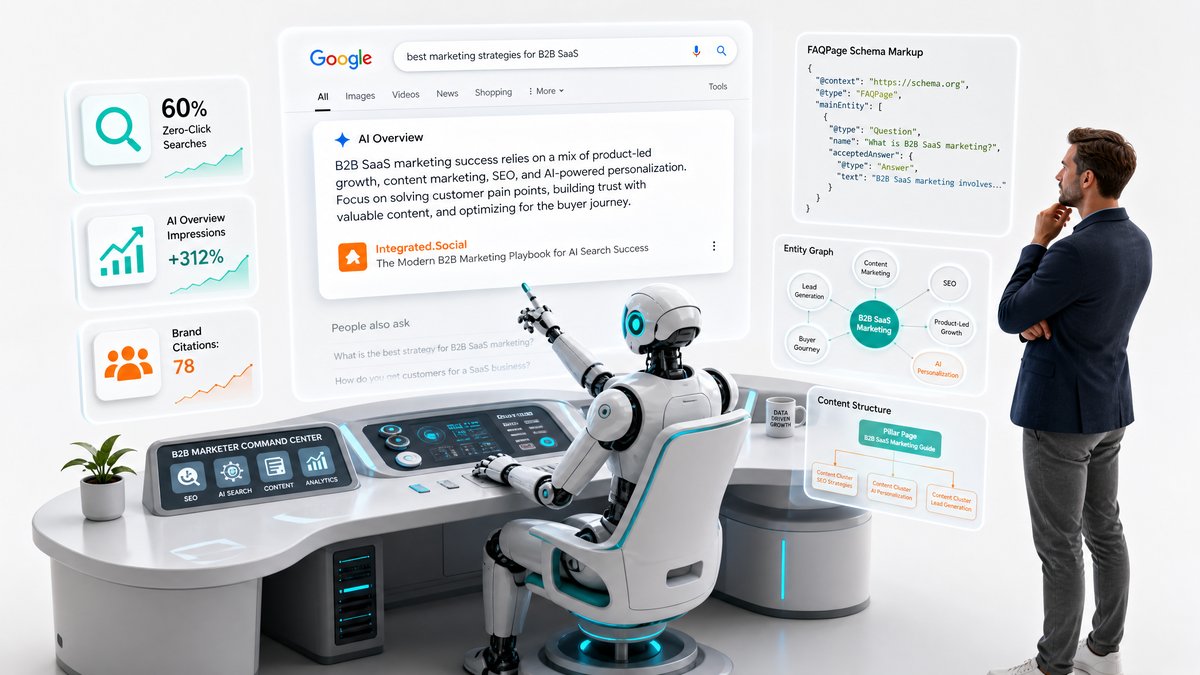
- Schema and structured data — brands with well-structured product schema, FAQPage markup, and clear entity definitions are more reliably cited
National brands have historically invested in mass-market advertising, retail placement, and brand awareness. These signals are largely invisible to AI recommendation systems. A brand that is universally recognised by humans may have surprisingly thin structured data, limited independent editorial coverage, and product descriptions optimised for packaging rather than machine comprehension.
The Store Brand Structural Advantage
Retailer-owned brands have spent the last decade investing in exactly the signals that AI systems reward. Aldi, Lidl, Costco's Kirkland Signature, Amazon Basics, and the private-label ranges of major UK supermarkets have all developed:
- Detailed product specification pages with structured data
- High-volume verified purchase reviews with specific language
- Strong editorial coverage in consumer-focused publications comparing them favourably to national equivalents
- Transparent ingredient and sourcing information that satisfies AI evaluation criteria
Kirkland Signature, for example, has accumulated decades of editorial coverage describing it as equivalent or superior to national brands across dozens of categories. That content is now training data. When an AI assistant is asked to recommend a product, Kirkland frequently appears because the evidence base supporting it is structured, consistent, and widely corroborated.
Stat to know: A 2024 PLMA survey found that US store brand dollar sales reached a record $271 billion, with unit share at 22.4% across all outlets. AI recommendation systems trained on this period of data will reflect the growing editorial and review volume that accompanied this growth.
What National Brands Are Getting Wrong
Most national brand digital marketing strategies were built for a world where Google's ten blue links were the primary discovery mechanism. That world is changing rapidly. The strategies that are failing in AI search include:
Brand-centric content that lacks specificity
Marketing content that emphasises brand heritage, emotional resonance, and lifestyle positioning does not give AI systems the factual anchors they need to recommend confidently. AI assistants need to know what is in the product, how it compares on measurable dimensions, and what independent sources say about it.
Unstructured product data
Many national brand websites have product pages optimised for visual merchandising rather than machine comprehension. Ingredients, nutritional data, allergen information, and comparative claims are often presented in formats that AI systems cannot reliably parse.
Over-reliance on paid media and retail placement
Paid search, display advertising, and in-store placement are invisible to AI recommendation systems. A brand that is number one in Google Shopping ads has no advantage when a consumer asks an AI assistant to recommend the best product in a category.
Thin independent editorial coverage
National brands have often relied on their own marketing channels rather than earning independent editorial coverage. Store brands, by contrast, have benefited from years of consumer journalism comparing them favourably to national equivalents.
The Citation Share Problem
AI citation share is becoming the new share of voice. When a consumer asks an AI assistant to recommend a product category, the brands that appear in the response are receiving a form of endorsement that is more trusted than advertising and more influential than organic search rankings. Research from Gartner suggests that by 2026, more than 30% of product discovery in certain categories will involve an AI intermediary.
For national brands, the risk is not just losing a single recommendation. It is being systematically absent from the consideration set of a growing segment of consumers who delegate initial product research to AI assistants. A brand that does not appear in AI recommendations is effectively invisible to those consumers at the moment of highest purchase intent.
The commercial implication: If 30% of category discovery moves through AI assistants and a national brand has near-zero citation share in that channel, the effective reach of its marketing investment is declining even if its traditional metrics appear stable.
How to Reclaim AI Citation Share
The good news is that AI citation share is not fixed. It is a function of the quality, structure, and authority of the information available about a brand and its products. National brands that invest in the right signals can improve their citation share significantly.
1. Audit your structured data
Every product page should have complete, machine-readable structured data including Product schema, nutritional or ingredient information in a parseable format, and clear entity definitions that connect the product to the brand, the category, and relevant certifications. This is the foundation of AI discoverability.
2. Build independent editorial authority
Commission or earn independent product reviews, ingredient analyses, and comparative assessments from credible third-party sources. AI systems weight corroborated claims from multiple independent sources far more heavily than brand-owned content.
3. Develop answer-first content
Create content that directly answers the questions AI assistants are likely to receive about your category. "What is the best [category] for [use case]?" should have a clear, structured answer that positions your product honestly against the criteria consumers care about.
4. Invest in FAQPage and Speakable schema
FAQ schema and Speakable markup signal to AI systems that your content is designed to answer questions directly. These are among the most effective structural signals for improving AI citation rates.
5. Monitor AI citation share as a KPI
Traditional brand tracking does not capture AI citation share. Brands need to develop monitoring workflows that test AI recommendations across the major platforms — ChatGPT, Gemini, Perplexity, Claude, and Google AI Mode — and track changes over time. This is a new capability that most CPG marketing functions do not yet have.
The Broader Strategic Shift
The store brand AI citation advantage is a symptom of a larger structural change in how digital authority is built and measured. The brands that will win in an AI-mediated discovery environment are not necessarily those with the largest advertising budgets or the strongest retail relationships. They are the brands with the most structured, corroborated, and machine-readable evidence base supporting their products.
This is a significant strategic opportunity for national brands that move quickly. The investment required to build AI-optimised product content, structured data, and independent editorial authority is substantial but manageable. The cost of not moving is potentially much higher: systematic absence from the consideration sets of a growing segment of AI-assisted consumers.
For marketing leaders navigating this shift, the starting point is an honest audit of current AI citation share across your key categories and competitors. The results are often surprising — and the gap between where brands currently stand and where they need to be is frequently larger than expected.
Integrated.Social works with B2B and CPG marketing teams to build AI citation strategies, structured data architectures, and AEO content programmes that improve visibility across ChatGPT, Gemini, Perplexity, and Google AI Mode. Learn more about our AEO and AI Search services, or explore how agentic AI can automate your AI visibility monitoring.
A quiet but commercially significant shift is underway in how AI shopping assistants recommend products. When a consumer asks ChatGPT, Gemini, Perplexity or Google AI Mode to suggest the best oatmeal, protein bar, cleaning spray or moisturiser, the answer is increasingly a store brand or a digitally-native challenger brand — not the household name that has spent decades and hundreds of millions building brand equity.
This is not a coincidence. It is the logical output of how large language models are trained, how they evaluate product authority, and what signals they treat as evidence of quality. For CPG marketing leaders, it represents one of the most disruptive commercial shifts since the rise of Amazon's private-label programme.
How AI Engines Decide What to Recommend
AI recommendation engines do not operate like search engines. They do not rank pages by backlinks or domain authority. They synthesise information from training data, structured product content, review corpora, editorial coverage, and increasingly from real-time retrieval. The signals they weight most heavily include:
- Ingredient and specification transparency — products with clear, structured, machine-readable ingredient lists and nutritional data are easier for AI to evaluate and cite confidently
- Third-party editorial coverage — independent reviews, consumer reports, and editorial roundups carry more weight than brand-owned content
- Review volume and sentiment quality — not just star ratings but the specificity and consistency of written reviews
- Price-to-specification ratio — AI assistants are trained on consumer guidance content that frequently highlights value, and store brands often win on this dimension
- Schema and structured data — brands with well-structured product schema, FAQPage markup, and clear entity definitions are more reliably cited
National brands have historically invested in mass-market advertising, retail placement, and brand awareness. These signals are largely invisible to AI recommendation systems. A brand that is universally recognised by humans may have surprisingly thin structured data, limited independent editorial coverage, and product descriptions optimised for packaging rather than machine comprehension.
The Store Brand Structural Advantage
Retailer-owned brands have spent the last decade investing in exactly the signals that AI systems reward. Aldi, Lidl, Costco's Kirkland Signature, Amazon Basics, and the private-label ranges of major UK supermarkets have all developed:
- Detailed product specification pages with structured data
- High-volume verified purchase reviews with specific language
- Strong editorial coverage in consumer-focused publications comparing them favourably to national equivalents
- Transparent ingredient and sourcing information that satisfies AI evaluation criteria
Kirkland Signature, for example, has accumulated decades of editorial coverage describing it as equivalent or superior to national brands across dozens of categories. That content is now training data. When an AI assistant is asked to recommend a product, Kirkland frequently appears because the evidence base supporting it is structured, consistent, and widely corroborated.
Stat to know: A 2024 PLMA survey found that US store brand dollar sales reached a record $271 billion, with unit share at 22.4% across all outlets. AI recommendation systems trained on this period of data will reflect the growing editorial and review volume that accompanied this growth.
What National Brands Are Getting Wrong
Most national brand digital marketing strategies were built for a world where Google's ten blue links were the primary discovery mechanism. That world is changing rapidly. The strategies that are failing in AI search include:
Brand-centric content that lacks specificity
Marketing content that emphasises brand heritage, emotional resonance, and lifestyle positioning does not give AI systems the factual anchors they need to recommend confidently. AI assistants need to know what is in the product, how it compares on measurable dimensions, and what independent sources say about it.
Unstructured product data
Many national brand websites have product pages optimised for visual merchandising rather than machine comprehension. Ingredients, nutritional data, allergen information, and comparative claims are often presented in formats that AI systems cannot reliably parse.
Over-reliance on paid media and retail placement
Paid search, display advertising, and in-store placement are invisible to AI recommendation systems. A brand that is number one in Google Shopping ads has no advantage when a consumer asks an AI assistant to recommend the best product in a category.
Thin independent editorial coverage
National brands have often relied on their own marketing channels rather than earning independent editorial coverage. Store brands, by contrast, have benefited from years of consumer journalism comparing them favourably to national equivalents.
The Citation Share Problem
AI citation share is becoming the new share of voice. When a consumer asks an AI assistant to recommend a product category, the brands that appear in the response are receiving a form of endorsement that is more trusted than advertising and more influential than organic search rankings. Research from Gartner suggests that by 2026, more than 30% of product discovery in certain categories will involve an AI intermediary.
For national brands, the risk is not just losing a single recommendation. It is being systematically absent from the consideration set of a growing segment of consumers who delegate initial product research to AI assistants. A brand that does not appear in AI recommendations is effectively invisible to those consumers at the moment of highest purchase intent.
The commercial implication: If 30% of category discovery moves through AI assistants and a national brand has near-zero citation share in that channel, the effective reach of its marketing investment is declining even if its traditional metrics appear stable.
How to Reclaim AI Citation Share
The good news is that AI citation share is not fixed. It is a function of the quality, structure, and authority of the information available about a brand and its products. National brands that invest in the right signals can improve their citation share significantly.
1. Audit your structured data
Every product page should have complete, machine-readable structured data including Product schema, nutritional or ingredient information in a parseable format, and clear entity definitions that connect the product to the brand, the category, and relevant certifications. This is the foundation of AI discoverability.
2. Build independent editorial authority
Commission or earn independent product reviews, ingredient analyses, and comparative assessments from credible third-party sources. AI systems weight corroborated claims from multiple independent sources far more heavily than brand-owned content.
3. Develop answer-first content
Create content that directly answers the questions AI assistants are likely to receive about your category. "What is the best [category] for [use case]?" should have a clear, structured answer that positions your product honestly against the criteria consumers care about.
4. Invest in FAQPage and Speakable schema
FAQ schema and Speakable markup signal to AI systems that your content is designed to answer questions directly. These are among the most effective structural signals for improving AI citation rates.
5. Monitor AI citation share as a KPI
Traditional brand tracking does not capture AI citation share. Brands need to develop monitoring workflows that test AI recommendations across the major platforms — ChatGPT, Gemini, Perplexity, Claude, and Google AI Mode — and track changes over time. This is a new capability that most CPG marketing functions do not yet have.
The Broader Strategic Shift
The store brand AI citation advantage is a symptom of a larger structural change in how digital authority is built and measured. The brands that will win in an AI-mediated discovery environment are not necessarily those with the largest advertising budgets or the strongest retail relationships. They are the brands with the most structured, corroborated, and machine-readable evidence base supporting their products.
This is a significant strategic opportunity for national brands that move quickly. The investment required to build AI-optimised product content, structured data, and independent editorial authority is substantial but manageable. The cost of not moving is potentially much higher: systematic absence from the consideration sets of a growing segment of AI-assisted consumers.
For marketing leaders navigating this shift, the starting point is an honest audit of current AI citation share across your key categories and competitors. The results are often surprising — and the gap between where brands currently stand and where they need to be is frequently larger than expected.
Integrated.Social works with B2B and CPG marketing teams to build AI citation strategies, structured data architectures, and AEO content programmes that improve visibility across ChatGPT, Gemini, Perplexity, and Google AI Mode. Learn more about our AEO and AI Search services, or explore how agentic AI can automate your AI visibility monitoring.