- Moonshot AI announced Kimi K3 on 16 July 2026 with 2.8 trillion total parameters and a 1,048,576-token context window.
- The API is live now at $3 input / $15 output per million tokens; full model weights are scheduled for release on 27 July 2026.
- Early benchmarks show Kimi K3 ranked No. 1 on LMArena Frontend Code Arena (1,679 Elo) and scored 76.24 on Artificial Analysis Coding.
- Moonshot itself states that overall performance still trails Claude Fable 5 and GPT-5.6 Sol.
- The strategic question is not whether K3 beats every Western model. It is whether frontier-class capability is becoming too abundant to command frontier pricing.
What Is Kimi K3?
Kimi K3 is Moonshot AI's new large language model, announced on 16 July 2026 and reported internationally by Reuters on 17 July 2026. Moonshot AI is a Beijing-based startup founded in 2023 that has grown rapidly through its Kimi consumer and enterprise AI products. Kimi K3 is the company's most ambitious model to date and its first entry into the three-trillion-parameter class.
The model carries 2.8 trillion total parameters and uses a Mixture-of-Experts (MoE) architecture that activates 16 of 896 experts during any given inference pass. This design means the compute cost per token is substantially lower than a dense model of equivalent total size. Moonshot reports that the architecture delivers approximately 2.5 times better scaling efficiency than its predecessor, Kimi K2. The model also features Kimi Delta Attention and Attention Residuals, architectural innovations that Moonshot says improve long-context coherence.
Kimi K3 supports native multimodality, including image and video understanding, and operates with a context window of 1,048,576 tokens, commonly described as one million tokens. At launch, the model operates in maximum reasoning effort mode only. A broader range of reasoning settings is expected to follow.
2.8 trillion parameters is a scale milestone, not a universal performance score.
Is Kimi K3 Really the World's Largest Open-Weight Model?
Moonshot describes Kimi K3 as the first open model in the three-trillion-parameter class, which would make it the largest announced open-weight model by parameter count. However, there is an important distinction to make at publication: the full model weights are not yet available for download. Moonshot has announced a weight release target of 27 July 2026. Until that checkpoint is actually downloadable and independently verified, the accurate description is "the largest announced open-weight model," not a fully available open-weight model. The API, Kimi.com, Kimi Work, and Kimi Code are already accessible.
Why Does Parameter Count Matter, and Why Can It Mislead?
Parameter count indicates the total number of learnable values inside a model and is a rough proxy for its potential capacity. Larger models trained on more data with more compute have historically demonstrated stronger general capability. However, parameter count alone is an incomplete performance signal for several reasons.
First, MoE models like Kimi K3 activate only a fraction of their total parameters per token. The 2.8 trillion figure represents total capacity, not active compute. Second, raw scale does not determine output quality in isolation. Training data quality, instruction tuning, reinforcement from human feedback, and inference-time reasoning all shape what a model actually produces. Third, Western frontier providers including OpenAI, Anthropic, and Google do not publicly disclose comparable parameter totals for their flagship models, making direct numerical comparisons impossible.
What Can Kimi K3 Do?
Moonshot positions Kimi K3 for long-horizon knowledge work. The documented capability set includes long-horizon coding across large repositories, terminal tool use, deep research and synthesis, slide and dashboard generation, native image and video understanding, interactive website creation, and complex scientific workflows. The one-million-token context window allows a single inference pass to process entire codebases, lengthy research documents, or extended multi-turn agent sessions without truncation.
What Do the Early Benchmarks Show?
Independent evaluation results published in the days following the announcement provide a mixed but broadly positive picture. The table below summarises the evidence available at publication.
| Evaluation | Reported Result | Evidence Type |
|---|---|---|
| LMArena Frontend Code Arena | No. 1, 1,679 Elo | Early third-party preference board |
| Artificial Analysis Intelligence Index | 57.11 | Independent composite |
| Artificial Analysis Coding | 76.24 | Independent composite |
| Artificial Analysis Agentic | 50.07 | Independent composite |
| Vals Index | 74.7 | Independent evaluation |
| BrowseComp (full 1M context) | 90.4% | Provider benchmark |
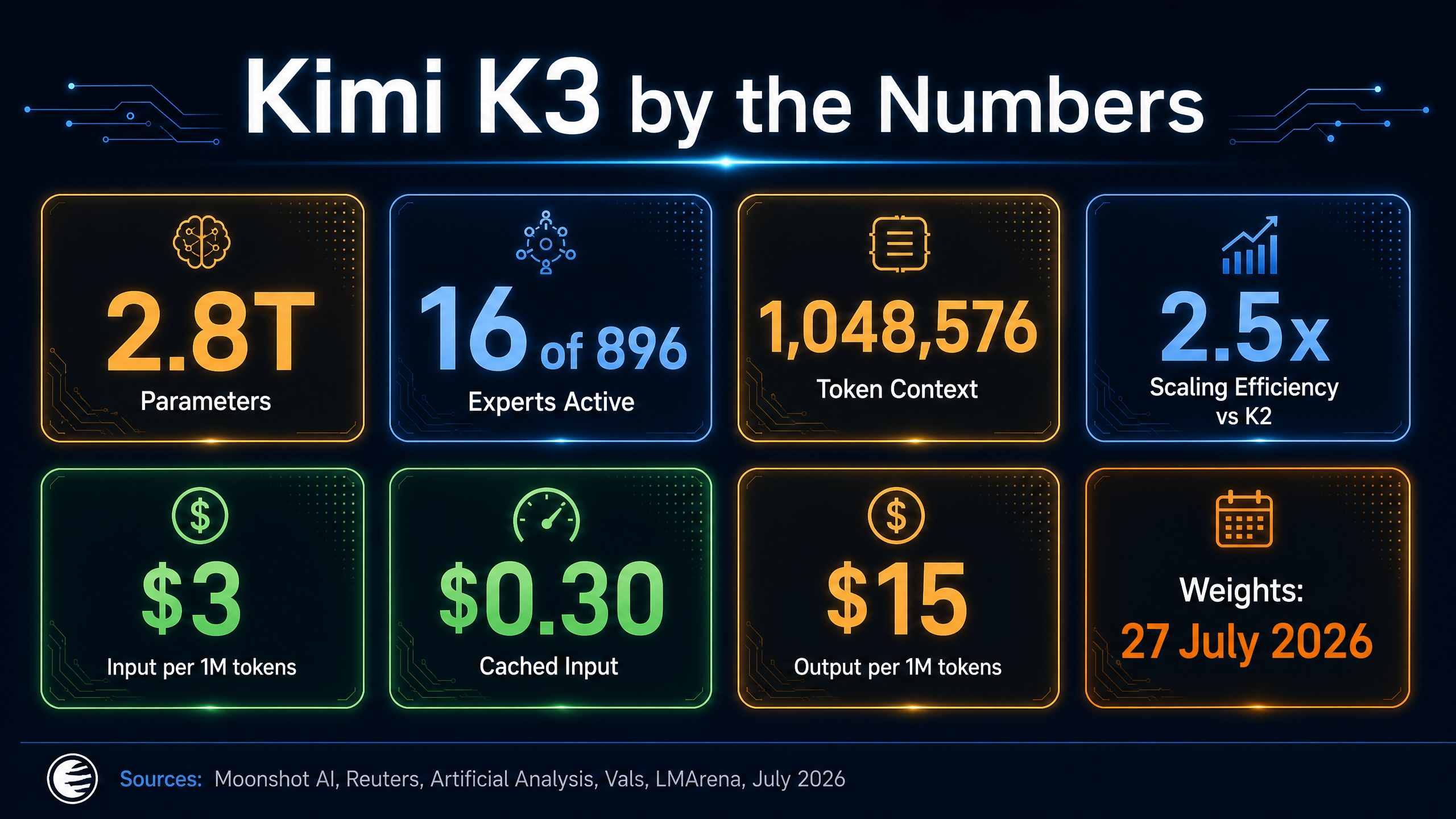
Sources: Moonshot AI, Reuters, Artificial Analysis, Vals, LMArena, July 2026
Does Kimi K3 Beat GPT-5.6 and Claude?
The honest answer is: on some evaluations, yes; overall, not yet. Kimi K3 ranked first on LMArena Frontend Code Arena and scored competitively on Artificial Analysis Coding. Reuters reported that Vals ranked it second behind Claude Fable 5 and ahead of GPT-5.6 Sol. However, Moonshot itself states in its official documentation that K3 overall performance still trails Claude Fable 5 and GPT-5.6 Sol. The defensible conclusion is that K3 has reached the frontier competitive set on specific tasks, particularly coding and agentic research, without having won every category.
Why Could This Be Another DeepSeek Moment?
In January 2025, DeepSeek R1 demonstrated that a Chinese lab could produce frontier-competitive reasoning performance at a fraction of the cost assumed by Western analysts. Kimi K3 raises a structurally similar question. An open-weight model in the three-trillion-parameter class, priced at $3 input and $15 output per million tokens, with early benchmark results that place it in the frontier competitive set, challenges the premium economics of proprietary models. If the weights release on 27 July as scheduled, third-party inference providers will be able to offer Kimi K3 at competitive rates, further compressing the price advantage of proprietary APIs.
However, "another DeepSeek moment" should be treated as a strategic question, not a settled conclusion. DeepSeek actual production adoption by Western enterprises has been limited by data sovereignty concerns, regulatory uncertainty, and trust. The same questions apply to Kimi K3.
What Remains Unknown?
Any honest assessment of Kimi K3 at this stage must acknowledge the significant unknowns. The full model weights have not been released and cannot be independently inspected. The complete technical report has not been published. Real-world reliability across diverse enterprise workloads has not been established. Enterprise data controls, telemetry, and deployment governance have not been publicly documented. International regulatory treatment, particularly in the UK, EU, and US, is unclear. Self-hosting a 2.8-trillion-parameter model requires supernode configurations with 64 or more accelerators, which very few organisations can operate.
What Are the Current Deployment Limitations?
Moonshot explicitly identifies three limitations in its official documentation. First, thinking-history sensitivity: output quality can become unstable if an agent harness fails to preserve the model previous reasoning history or switches models midway through a session. Second, excessive proactiveness: K3 may make unexpected decisions when instructions are ambiguous, requiring stronger behavioural boundaries in agentic deployments. Third, a user-experience gap: Moonshot acknowledges that K3 still trails Claude Fable 5 and GPT-5.6 Sol in overall user experience.
Modi's PoV: The Moat Is Moving
Kimi K3 matters not because it has definitively beaten every Western frontier model, but because it narrows the time during which frontier intelligence can command frontier pricing. The model market is moving from a small number of exclusive providers toward a broader ecosystem where frontier-class capability is increasingly available at lower cost and, eventually, as open weights.
For B2B organisations, this changes the strategic calculus. The competitive advantage from accessing a powerful model is diminishing. The advantage is moving toward what the organisation builds around that model: proprietary customer context, trusted content, agentic workflows designed for specific commercial outcomes, governance frameworks that enable safe deployment at scale, and distribution channels that reach buyers where AI is increasingly mediating discovery. The organisations that build those systems now, regardless of which model they use, will be better positioned than those waiting for a definitive winner to emerge.
Read next: Kimi K3 price comparison with GPT-5.6, Claude and Gemini
Kimi K3 Breaking-News Series
Kimi K3 Has Arrived: Is the World's Largest Open AI Model a New DeepSeek Moment? • 17 Jul 2026
Frequently Asked Questions
What is Kimi K3?
Kimi K3 is a large language model developed by Beijing-based Moonshot AI, announced on 16 July 2026. It has 2.8 trillion total parameters, uses a Mixture-of-Experts architecture that activates 16 of 896 experts per inference, and supports a one-million-token context window. It is available via API, Kimi.com, Kimi Work, and Kimi Code, with full model weights scheduled for release on 27 July 2026. The model supports multimodal inputs including text, images, and video.
When was Kimi K3 released?
Moonshot AI announced Kimi K3 on 16 July 2026. Reuters reported the international launch on 17 July 2026. The API and Kimi consumer products became available at announcement. Full open-weight model checkpoints are scheduled for release on 27 July 2026. Until that date, the model is accessible through Moonshot managed API and products but cannot be self-hosted or independently inspected.
How many parameters does Kimi K3 have?
Kimi K3 has 2.8 trillion total parameters, making it the largest announced open-weight model by parameter count as of July 2026. Its Mixture-of-Experts architecture means only 16 of 896 expert modules are activated during any single inference pass. Moonshot reports approximately 2.5 times better scaling efficiency than its predecessor Kimi K2, meaning the active compute cost per token is significantly lower than the total parameter count suggests.
Is Kimi K3 open source or open weight?
Kimi K3 is described by Moonshot as an open-weight model, not fully open source. Open weight means the model parameters will be publicly released for download and deployment, but the training data, training code, and full methodology may not be disclosed. This is the same model of openness used by Meta Llama series and Mistral models. Kimi K3 is not open source in the sense of a fully transparent development process with all artefacts publicly available.
Are the Kimi K3 weights available now?
No. At the time of publication, the full Kimi K3 model weights have not yet been released. Moonshot has announced a target release date of 27 July 2026. The API, Kimi.com, Kimi Work, and Kimi Code are all available now, allowing users to interact with the model through Moonshot managed infrastructure. Self-hosting and third-party deployment will only be possible once the weights are actually downloadable.
What is Kimi K3 context window?
Kimi K3 supports a context window of 1,048,576 tokens, commonly described as one million tokens. This is one of the largest context windows available in any model at this price point. In practical terms, it allows a single inference session to process entire software codebases, lengthy research documents, extended multi-turn agent conversations, or large data files without truncation. Moonshot reports a cache-hit rate above 90% in coding workloads, which significantly reduces the effective cost of repeated long-context queries.
Does Kimi K3 beat GPT-5.6?
On specific evaluations, particularly coding and agentic tasks, Kimi K3 performs competitively with GPT-5.6 Sol. It ranked first on LMArena Frontend Code Arena with 1,679 Elo and scored 76.24 on Artificial Analysis Coding. However, Moonshot itself states that K3 overall performance still trails GPT-5.6 Sol. The accurate conclusion is that K3 has reached the frontier competitive set, not that it has comprehensively surpassed GPT-5.6.
Can Kimi K3 run locally?
Not yet, and not easily. Full model weights are scheduled for release on 27 July 2026. Once available, self-hosting a 2.8-trillion-parameter model requires substantial infrastructure. Moonshot recommends supernode configurations with 64 or more accelerators. Reuters noted that very few organisations are likely to run the complete model locally because of the hardware requirement. Quantised or distilled versions may lower the barrier, but these have not been announced.
Who owns Moonshot AI?
Moonshot AI is a Beijing-based AI startup founded in 2023. The company has raised significant venture funding and operates as an independent commercial entity. Its investors include prominent Chinese technology venture firms. Moonshot AI is not a subsidiary of any of China large technology conglomerates, distinguishing it from AI efforts by Alibaba, Baidu, or Tencent. The company flagship consumer product is the Kimi assistant, which has accumulated a substantial user base in China.
Is Kimi K3 available outside China?
Yes. Moonshot AI launched Kimi K3 with international availability through its API and Kimi products. The Reuters report on 17 July 2026 covered the international launch specifically. However, enterprise deployment outside China will be subject to the same data sovereignty, regulatory, and trust considerations that apply to any AI model from a Chinese provider. Organisations in regulated industries or those handling sensitive data should conduct appropriate due diligence before production deployment.
Build a Model-Flexible Agentic AI Strategy
Integrated.Social helps organisations select, connect and govern the right models for each GTM, marketing and AI Search workflow, without locking the operating model to one provider.
Discuss an Agentic AI DeploymentRelated Reading
- Enterprise AI Model-Roadmap Dependency Risk 2026
- ChatGPT Work and GPT-5.6 for B2B Marketing
- Why Enterprise AI Agents Fail: Workflow Context
- AI Governance 2026: Quality Control
- Agentic AI Services
- AI Governance Services
Related Articles
The AI workforce and model strategy questions are connected. These posts explore the human side of the same shift.
AI Job Displacement Series • Part 1
AI Job Displacement Series • Part 2
AI Job Displacement Series • Part 3
About the Author
Modi Elnadi is the founder of Integrated.Social, a B2B AI marketing agency in London specialising in agentic AI strategy, AEO, and performance marketing. He designs multi-model AI architectures for enterprise and scale-up B2B brands, with a focus on building systems that are commercially effective, data-sovereign, and operationally resilient. Modi works at the intersection of hands-on execution and strategic thinking — building paid acquisition, ABM, and agentic marketing systems that tackle trust, positioning, and conversion barriers. Read Modi's full profile or connect on LinkedIn.
_- Moonshot AI announced Kimi K3 on 16 July 2026 with 2.8 trillion total parameters and a 1,048,576-token context window.
- The API is live now at $3 input / $15 output per million tokens; full model weights are scheduled for release on 27 July 2026.
- Early benchmarks show Kimi K3 ranked No. 1 on LMArena Frontend Code Arena (1,679 Elo) and scored 76.24 on Artificial Analysis Coding.
- Moonshot itself states that overall performance still trails Claude Fable 5 and GPT-5.6 Sol.
- The strategic question is not whether K3 beats every Western model. It is whether frontier-class capability is becoming too abundant to command frontier pricing.
What Is Kimi K3?
Kimi K3 is Moonshot AI's new large language model, announced on 16 July 2026 and reported internationally by Reuters on 17 July 2026. Moonshot AI is a Beijing-based startup founded in 2023 that has grown rapidly through its Kimi consumer and enterprise AI products. Kimi K3 is the company's most ambitious model to date and its first entry into the three-trillion-parameter class.
The model carries 2.8 trillion total parameters and uses a Mixture-of-Experts (MoE) architecture that activates 16 of 896 experts during any given inference pass. This design means the compute cost per token is substantially lower than a dense model of equivalent total size. Moonshot reports that the architecture delivers approximately 2.5 times better scaling efficiency than its predecessor, Kimi K2. The model also features Kimi Delta Attention and Attention Residuals, architectural innovations that Moonshot says improve long-context coherence.
Kimi K3 supports native multimodality, including image and video understanding, and operates with a context window of 1,048,576 tokens, commonly described as one million tokens. At launch, the model operates in maximum reasoning effort mode only. A broader range of reasoning settings is expected to follow.
2.8 trillion parameters is a scale milestone, not a universal performance score.
Is Kimi K3 Really the World's Largest Open-Weight Model?
Moonshot describes Kimi K3 as the first open model in the three-trillion-parameter class, which would make it the largest announced open-weight model by parameter count. However, there is an important distinction to make at publication: the full model weights are not yet available for download. Moonshot has announced a weight release target of 27 July 2026. Until that checkpoint is actually downloadable and independently verified, the accurate description is "the largest announced open-weight model," not a fully available open-weight model. The API, Kimi.com, Kimi Work, and Kimi Code are already accessible.
Why Does Parameter Count Matter, and Why Can It Mislead?
Parameter count indicates the total number of learnable values inside a model and is a rough proxy for its potential capacity. Larger models trained on more data with more compute have historically demonstrated stronger general capability. However, parameter count alone is an incomplete performance signal for several reasons.
First, MoE models like Kimi K3 activate only a fraction of their total parameters per token. The 2.8 trillion figure represents total capacity, not active compute. Second, raw scale does not determine output quality in isolation. Training data quality, instruction tuning, reinforcement from human feedback, and inference-time reasoning all shape what a model actually produces. Third, Western frontier providers including OpenAI, Anthropic, and Google do not publicly disclose comparable parameter totals for their flagship models, making direct numerical comparisons impossible.
What Can Kimi K3 Do?
Moonshot positions Kimi K3 for long-horizon knowledge work. The documented capability set includes long-horizon coding across large repositories, terminal tool use, deep research and synthesis, slide and dashboard generation, native image and video understanding, interactive website creation, and complex scientific workflows. The one-million-token context window allows a single inference pass to process entire codebases, lengthy research documents, or extended multi-turn agent sessions without truncation.
What Do the Early Benchmarks Show?
Independent evaluation results published in the days following the announcement provide a mixed but broadly positive picture. The table below summarises the evidence available at publication.
| Evaluation | Reported Result | Evidence Type |
|---|---|---|
| LMArena Frontend Code Arena | No. 1, 1,679 Elo | Early third-party preference board |
| Artificial Analysis Intelligence Index | 57.11 | Independent composite |
| Artificial Analysis Coding | 76.24 | Independent composite |
| Artificial Analysis Agentic | 50.07 | Independent composite |
| Vals Index | 74.7 | Independent evaluation |
| BrowseComp (full 1M context) | 90.4% | Provider benchmark |
Sources: Moonshot AI, Reuters, Artificial Analysis, Vals, LMArena, July 2026
Does Kimi K3 Beat GPT-5.6 and Claude?
The honest answer is: on some evaluations, yes; overall, not yet. Kimi K3 ranked first on LMArena Frontend Code Arena and scored competitively on Artificial Analysis Coding. Reuters reported that Vals ranked it second behind Claude Fable 5 and ahead of GPT-5.6 Sol. However, Moonshot itself states in its official documentation that K3 overall performance still trails Claude Fable 5 and GPT-5.6 Sol. The defensible conclusion is that K3 has reached the frontier competitive set on specific tasks, particularly coding and agentic research, without having won every category.
Why Could This Be Another DeepSeek Moment?
In January 2025, DeepSeek R1 demonstrated that a Chinese lab could produce frontier-competitive reasoning performance at a fraction of the cost assumed by Western analysts. Kimi K3 raises a structurally similar question. An open-weight model in the three-trillion-parameter class, priced at $3 input and $15 output per million tokens, with early benchmark results that place it in the frontier competitive set, challenges the premium economics of proprietary models. If the weights release on 27 July as scheduled, third-party inference providers will be able to offer Kimi K3 at competitive rates, further compressing the price advantage of proprietary APIs.
However, "another DeepSeek moment" should be treated as a strategic question, not a settled conclusion. DeepSeek actual production adoption by Western enterprises has been limited by data sovereignty concerns, regulatory uncertainty, and trust. The same questions apply to Kimi K3.
What Remains Unknown?
Any honest assessment of Kimi K3 at this stage must acknowledge the significant unknowns. The full model weights have not been released and cannot be independently inspected. The complete technical report has not been published. Real-world reliability across diverse enterprise workloads has not been established. Enterprise data controls, telemetry, and deployment governance have not been publicly documented. International regulatory treatment, particularly in the UK, EU, and US, is unclear. Self-hosting a 2.8-trillion-parameter model requires supernode configurations with 64 or more accelerators, which very few organisations can operate.
What Are the Current Deployment Limitations?
Moonshot explicitly identifies three limitations in its official documentation. First, thinking-history sensitivity: output quality can become unstable if an agent harness fails to preserve the model previous reasoning history or switches models midway through a session. Second, excessive proactiveness: K3 may make unexpected decisions when instructions are ambiguous, requiring stronger behavioural boundaries in agentic deployments. Third, a user-experience gap: Moonshot acknowledges that K3 still trails Claude Fable 5 and GPT-5.6 Sol in overall user experience.
Modi's PoV: The Moat Is Moving
Kimi K3 matters not because it has definitively beaten every Western frontier model, but because it narrows the time during which frontier intelligence can command frontier pricing. The model market is moving from a small number of exclusive providers toward a broader ecosystem where frontier-class capability is increasingly available at lower cost and, eventually, as open weights.
For B2B organisations, this changes the strategic calculus. The competitive advantage from accessing a powerful model is diminishing. The advantage is moving toward what the organisation builds around that model: proprietary customer context, trusted content, agentic workflows designed for specific commercial outcomes, governance frameworks that enable safe deployment at scale, and distribution channels that reach buyers where AI is increasingly mediating discovery. The organisations that build those systems now, regardless of which model they use, will be better positioned than those waiting for a definitive winner to emerge.
Read next: Kimi K3 price comparison with GPT-5.6, Claude and Gemini
Kimi K3 Breaking-News Series
Kimi K3 Has Arrived: Is the World's Largest Open AI Model a New DeepSeek Moment? • 17 Jul 2026
Frequently Asked Questions
What is Kimi K3?
Kimi K3 is a large language model developed by Beijing-based Moonshot AI, announced on 16 July 2026. It has 2.8 trillion total parameters, uses a Mixture-of-Experts architecture that activates 16 of 896 experts per inference, and supports a one-million-token context window. It is available via API, Kimi.com, Kimi Work, and Kimi Code, with full model weights scheduled for release on 27 July 2026. The model supports multimodal inputs including text, images, and video.
When was Kimi K3 released?
Moonshot AI announced Kimi K3 on 16 July 2026. Reuters reported the international launch on 17 July 2026. The API and Kimi consumer products became available at announcement. Full open-weight model checkpoints are scheduled for release on 27 July 2026. Until that date, the model is accessible through Moonshot managed API and products but cannot be self-hosted or independently inspected.
How many parameters does Kimi K3 have?
Kimi K3 has 2.8 trillion total parameters, making it the largest announced open-weight model by parameter count as of July 2026. Its Mixture-of-Experts architecture means only 16 of 896 expert modules are activated during any single inference pass. Moonshot reports approximately 2.5 times better scaling efficiency than its predecessor Kimi K2, meaning the active compute cost per token is significantly lower than the total parameter count suggests.
Is Kimi K3 open source or open weight?
Kimi K3 is described by Moonshot as an open-weight model, not fully open source. Open weight means the model parameters will be publicly released for download and deployment, but the training data, training code, and full methodology may not be disclosed. This is the same model of openness used by Meta Llama series and Mistral models. Kimi K3 is not open source in the sense of a fully transparent development process with all artefacts publicly available.
Are the Kimi K3 weights available now?
No. At the time of publication, the full Kimi K3 model weights have not yet been released. Moonshot has announced a target release date of 27 July 2026. The API, Kimi.com, Kimi Work, and Kimi Code are all available now, allowing users to interact with the model through Moonshot managed infrastructure. Self-hosting and third-party deployment will only be possible once the weights are actually downloadable.
What is Kimi K3 context window?
Kimi K3 supports a context window of 1,048,576 tokens, commonly described as one million tokens. This is one of the largest context windows available in any model at this price point. In practical terms, it allows a single inference session to process entire software codebases, lengthy research documents, extended multi-turn agent conversations, or large data files without truncation. Moonshot reports a cache-hit rate above 90% in coding workloads, which significantly reduces the effective cost of repeated long-context queries.
Does Kimi K3 beat GPT-5.6?
On specific evaluations, particularly coding and agentic tasks, Kimi K3 performs competitively with GPT-5.6 Sol. It ranked first on LMArena Frontend Code Arena with 1,679 Elo and scored 76.24 on Artificial Analysis Coding. However, Moonshot itself states that K3 overall performance still trails GPT-5.6 Sol. The accurate conclusion is that K3 has reached the frontier competitive set, not that it has comprehensively surpassed GPT-5.6.
Can Kimi K3 run locally?
Not yet, and not easily. Full model weights are scheduled for release on 27 July 2026. Once available, self-hosting a 2.8-trillion-parameter model requires substantial infrastructure. Moonshot recommends supernode configurations with 64 or more accelerators. Reuters noted that very few organisations are likely to run the complete model locally because of the hardware requirement. Quantised or distilled versions may lower the barrier, but these have not been announced.
Who owns Moonshot AI?
Moonshot AI is a Beijing-based AI startup founded in 2023. The company has raised significant venture funding and operates as an independent commercial entity. Its investors include prominent Chinese technology venture firms. Moonshot AI is not a subsidiary of any of China large technology conglomerates, distinguishing it from AI efforts by Alibaba, Baidu, or Tencent. The company flagship consumer product is the Kimi assistant, which has accumulated a substantial user base in China.
Is Kimi K3 available outside China?
Yes. Moonshot AI launched Kimi K3 with international availability through its API and Kimi products. The Reuters report on 17 July 2026 covered the international launch specifically. However, enterprise deployment outside China will be subject to the same data sovereignty, regulatory, and trust considerations that apply to any AI model from a Chinese provider. Organisations in regulated industries or those handling sensitive data should conduct appropriate due diligence before production deployment.
Build a Model-Flexible Agentic AI Strategy
Integrated.Social helps organisations select, connect and govern the right models for each GTM, marketing and AI Search workflow, without locking the operating model to one provider.
Discuss an Agentic AI DeploymentRelated Reading
- Enterprise AI Model-Roadmap Dependency Risk 2026
- ChatGPT Work and GPT-5.6 for B2B Marketing
- Why Enterprise AI Agents Fail: Workflow Context
- AI Governance 2026: Quality Control
- Agentic AI Services
- AI Governance Services
Related Articles
The AI workforce and model strategy questions are connected. These posts explore the human side of the same shift.
AI Job Displacement Series • Part 1
AI Job Displacement Series • Part 2
AI Job Displacement Series • Part 3
About the Author
Modi Elnadi is the founder of Integrated.Social, a B2B AI marketing agency in London specialising in agentic AI strategy, AEO, and performance marketing. He designs multi-model AI architectures for enterprise and scale-up B2B brands, with a focus on building systems that are commercially effective, data-sovereign, and operationally resilient. Modi works at the intersection of hands-on execution and strategic thinking — building paid acquisition, ABM, and agentic marketing systems that tackle trust, positioning, and conversion barriers. Read Modi's full profile or connect on LinkedIn.
_