AI Search Has Entered the Agency-Selection Process
AI search is no longer only a traffic question. It is becoming part of how marketers select the people they trust with traffic, content and growth.
A Fractl survey reported by Search Engine Land asked 343 US marketing decision-makers how they describe AI-search work, how they allocate budget and how they evaluate vendors. The most commercially important result was not which acronym won. It was that 66% had already used an AI tool to research a marketing vendor.
That changes the agency pitch before the pitch begins.
When a prospective client asks ChatGPT, Gemini or Perplexity which agencies understand AEO and AI search [blocked], the answer engine becomes an unofficial procurement analyst. It reads your website, third-party references, case studies, people, methodology and inconsistencies. It can form a shortlist before anyone books a call.
The Terminology Debate Is Less Important Than Buyer Intent
The survey found that 81% still call their internal strategy SEO. Yet when looking for help, 46% would search for AI search optimization, compared with 24% who would search for SEO.
That is not a contradiction. It is a transition.
Buyers use the old category to organize responsibility and the new phrase to describe the emerging problem. A commercially sensible agency does not force the market to choose between SEO, AEO and GEO. It explains the relationship:
| Discipline | Primary job | Commercial contribution |
|---|---|---|
| SEO | Earn discoverability in traditional search | Demand capture and compounding organic traffic |
| AEO | Make answers clear, structured and retrievable | Featured answers and citation readiness |
| GEO / AI search | Make the brand verifiable inside generated responses | Shortlist inclusion, recommendation and narrative accuracy |
Our AEO agency buyers' guide [blocked] goes deeper on what these capabilities should look like in practice.
The Budget Shift Is Already Material
Respondents allocated an average 24% of search and content budget to AI-search visibility. Eighty-two percent allocated something; 43% allocated more than one-fifth.
This does not mean every company should immediately move 24% of its budget. The sample is US-only, contains 343 respondents and was produced by Fractl, whose co-founder wrote the coverage. The correct reading is directional: AI visibility has moved from an experimental line item into mainstream planning.
The more useful budget question is not, "What percentage should we copy?" It is:
Which existing search, content, digital PR, product-marketing and analytics work must change because AI systems now mediate buyer research?
Often the answer is not a new silo. It is a new standard for evidence across the existing stack.
Case Studies Beat Acronyms
Thirty-four percent chose measurable case studies as the strongest credibility signal. Clear methodology followed at 22%, then expertise and track record at 15%. Terminology fluency ranked at 9%.
That is a useful correction for an industry that keeps inventing labels faster than buyers can absorb them.
A credible AI-search programme should show:
- The prompt set and buyer questions being monitored.
- The baseline for citations, mentions, recommendation and narrative accuracy.
- The entity, content and evidence gaps that explain weak representation.
- The interventions made across owned and earned sources.
- The commercial metrics used alongside visibility indicators.
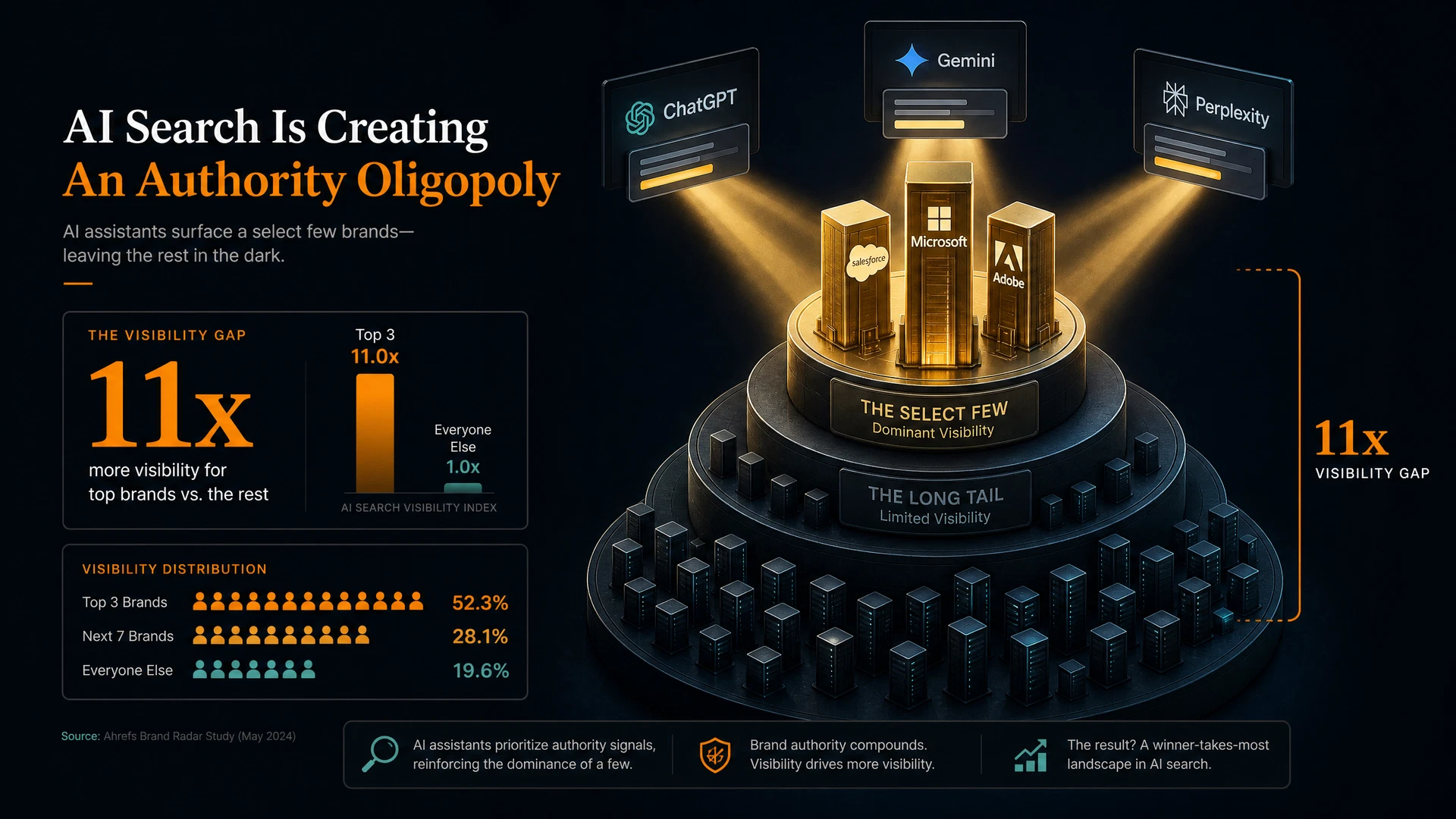
Our AI-search authority analysis [blocked] shows why evidence can compound into a winner-takes-most market. That makes transparent methodology more important, not less.
Modi's PoV: The Agency Website Is Becoming a Machine-Readable Pitch Deck
The traditional agency pitch deck is controlled theatre. The agency chooses the story, the proof and the sequence.
AI-mediated research is different. The buyer can ask the same question five ways, compare your claims with external evidence, examine named experts and find contradictory pages in seconds.
The agency website therefore needs to do more than convert a human visitor. It must operate as a machine-readable due-diligence environment.
That means publishing named methodologies, specific service boundaries, measurable case studies, author expertise, pricing logic where possible, and content that answers objections directly. It also means connecting services, people, proof and analysis through clear internal links and consistent structured data.
This is why the B2B credibility stack [blocked] is a whole-company discipline. AI systems do not separate your marketing page from your leadership footprint, customer evidence or technical documentation. They synthesize all of it.
What Marketing Leaders Should Do Next
Start by testing the decision journey, not only branded visibility. Ask the major answer engines which providers they would shortlist for your category, what evidence they use, what concerns they raise and which competitors appear more credible.
Then run a focused evidence sprint:
- Replace generic superiority claims with dated, attributable proof.
- Turn internal methodology into clear public explanations.
- Link authors, credentials, services, case studies and supporting articles.
- Measure recommendation, narrative accuracy and citation quality alongside traffic.
- Use the free AI Growth Audit [blocked] to identify obvious structural gaps before paying for a larger programme.
The opportunity is not to sound fluent in the latest acronym. It is to become the vendor that buyers and machines can verify with the least friction.
AI search has made credibility queryable. Agencies that cannot prove their method will lose before the first sales call.