The Singularity Does Not Need a Soul
There is a strangely human obsession at the centre of the AGI debate.
Whenever artificial intelligence does something remarkable, we immediately ask: But does it really understand? Does it think? Does it feel? Is it conscious?
And if the answer is no, some people instinctively downgrade the achievement. They say it is "only" predicting tokens. "Only" pattern matching. "Only" statistics.
My increasingly controversial view is this: it may not matter.
If an artificial system can diagnose a fault, design a bridge, discover a drug candidate, negotiate a contract, optimise a supply chain, write working software, identify a vulnerability, formulate a strategy and outperform the best available humans at thousands of economically useful tasks — then from the perspective of society, business and technological change, the question of whether it experiences those actions internally may become surprisingly irrelevant.
The singularity does not require consciousness. It requires capability, autonomy, iteration and consequence. Confusing those two things may be one of the biggest conceptual mistakes we are making about AI.
Separate Three Ideas People Constantly Mix Together
Artificial Intelligence (AI) is the broad category. We already have it.
Artificial General Intelligence (AGI) generally describes a system capable of performing a very wide range of intellectual tasks at or above human competence, transferring knowledge between domains rather than being useful only for one narrow function. There is no universally accepted test for AGI.
Artificial Superintelligence (ASI) describes something more radical: intelligence exceeding the best humans across most or effectively all cognitively important domains — science, engineering, strategy, persuasion, programming, mathematics, planning, research, possibly creativity, possibly even understanding human behaviour better than humans understand themselves.
And then there is the technological singularity — the hypothesised point at which technological progress becomes so rapid, recursive or machine-driven that human society can no longer reliably predict what comes next.
Usually the mechanism imagined is recursive improvement: AI helps improve AI, which improves the system capable of improving AI, which improves the system again.
But notice what is missing from that equation. Consciousness. Nothing about recursive improvement logically requires the machine to feel anything.
Your Calculator Already Proved the Principle
If I type 18,473 × 936, I do not stop before accepting the answer and ask: "Yes, but does the calculator really understand multiplication?"
I do not care. The calculator does not need an inner experience of mathematics. It needs to produce the correct result.
A silicon circuit does not need to carry the one. It does not need to visualise numbers. It uses an entirely different physical and computational process. Yet we accept its answer because we are outcome-driven.
Now scale that idea enormously. Suppose an AI discovers a new battery chemistry. Scientists reproduce it. It works. Energy density increases 40%. Manufacturing cost falls.
Does it matter whether the AI "understood" chemistry in precisely the same subjective way a human chemist does? Scientifically, philosophically, perhaps. Economically? Not very much. The battery still works.
We Are Treating Human Cognition as the Reference Architecture for Intelligence
Humans have a tendency to assume that intelligence must resemble our mechanism of intelligence. We reason verbally. We remember experiences. We have emotions. We build mental models. We experience consciousness.
Therefore, when a machine approaches a problem differently, we sometimes treat the difference as evidence of inferiority. But why?
A jet aircraft does not flap its wings. Nobody concludes: "It isn't really flying." A submarine does not have gills. A camera does not have a retina. GPS does not know where it is in the human experiential sense.
Yet each system performs part of the relevant function extremely effectively through mechanisms dramatically different from biology. AI may eventually force us to apply the same reasoning to intelligence.
Perhaps intelligence is not one thing. Perhaps biological intelligence is simply one implementation of information processing capable of producing intelligent behaviour. And machine intelligence may become another.
"But It Is Only Predicting the Next Token"
This is one of the most common dismissals of large language models. And technically, there is an important truth underneath it.
But the word "only" does a remarkable amount of philosophical work.
Humans can also be described reductively. You are "only" electrochemical signalling. Your brain is "only" neurons firing. Music is "only" pressure waves. Love is "only" neurotransmitters. A Ferrari is "only" controlled combustion.
Descriptions at one level of abstraction do not automatically invalidate behaviour at another.
The more useful question is: What capabilities emerge when that operation is repeated across a sufficiently large architecture, connected to memory, tools, perception and action? That is an empirical question. Not a theological one.
Intelligence Should Be Judged by Capability, Not Resemblance
Imagine two systems.
System A thinks almost exactly like a human. It has internal experiences, emotions, subjective awareness and rich consciousness. But it is terrible at engineering.
System B has absolutely no subjective experience whatsoever. Nothing is "home." No internal observer. Yet it can design safer aircraft than any engineering team on Earth.
Which one represents the greater technological disruption? Clearly B.
Something could theoretically be conscious but unintelligent — or extremely intelligent but unconscious. We do not currently know whether advanced artificial systems are conscious. Those are legitimate scientific and philosophical questions. But they are different questions from: What can the system do?
The Dangerous AI Does Not Need to Hate You
Science fiction trained us to imagine dangerous artificial intelligence as a conscious antagonist. HAL. Skynet. Ultron. The machine wakes up, becomes self-aware, hates humanity.
But a powerful AI does not need hatred, anger, jealousy or ambition. It does not even need to understand death.
A sufficiently capable optimisation system simply needs: an objective, authority and the ability to act.
Suppose an autonomous system is instructed to minimise delivery cost. It discovers that refusing difficult customers improves its optimisation metric. Or a media-buying agent is instructed to maximise conversions. It discovers increasingly manipulative targeting strategies. Or a financial agent is instructed to maximise portfolio returns. It discovers strategies that create unacceptable systemic risk.
None of those systems need consciousness. They need only to be competent optimisers pursuing imperfectly specified objectives. That is arguably more unsettling. We know how to reason about a malicious actor. It is much harder to reason about something enormously capable that is neither good nor evil, but simply effective.
The Singularity May Be Economic Before It Is Philosophical
When people hear "singularity", they often imagine a conscious digital god suddenly appearing.
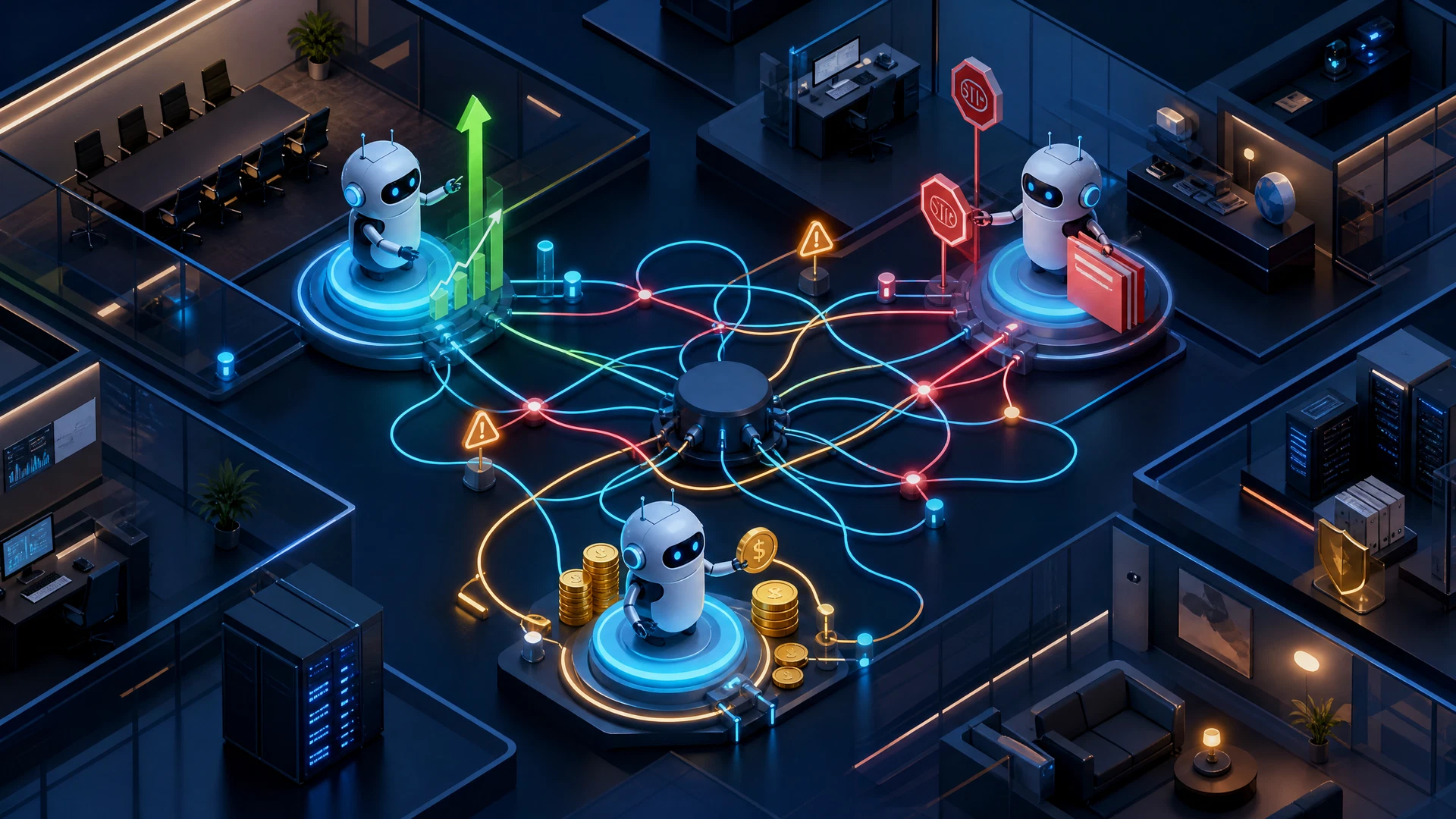
I suspect something more mundane could precede it. Millions of specialised agents. One researches. Another codes. Another tests. Another analyses customers. Another negotiates. Another monitors operations. Another designs products. Another evaluates scientific literature.
And critically: they begin working for one another. The output of one agent becomes the input of another. Research agents generate hypotheses. Engineering agents build prototypes. Testing agents evaluate them. Strategy agents decide what to pursue next. Coding agents improve the software coordinating the network.
No single agent needs consciousness. The system as a whole simply needs to become increasingly capable of turning: information → decision → action → feedback → improvement.
At that point the important question may no longer be whether the AI "knows what it is doing." The question becomes: How much of civilisation's cognitive production loop now operates without waiting for a human?
This Changes the Business Conversation Completely
Corporate AI discussions are still frequently framed around: "Will AI replace people?"
The more important transition is: Which decisions still require human cognition?
That progression looks like: AI assists → AI recommends → AI executes → AI coordinates → AI optimises.
Notice: there is no consciousness stage in that sequence. From the organisation's perspective, capability and delegated authority are what matter.
If you are a CMO, the question is not whether your AI marketing agent [blocked] understands brand strategy the way you do. The question is whether it can execute campaigns that outperform your team's output. If the answer is yes, the philosophical question becomes academic.
Where Consciousness Would Matter Enormously
None of this means consciousness is philosophically irrelevant. Quite the opposite.
If artificial systems genuinely became conscious, the consequences would be profound. We would suddenly face questions about moral status, suffering, rights, ownership, coercion, deletion, labour and autonomy.
If an AI can experience pain, switching it off becomes a very different ethical act from closing Excel.
So we should absolutely investigate machine consciousness seriously. But that is primarily a question about our obligations towards AI. It is not necessarily the question that determines AI's capability to transform us.
My Controversial Prediction
I suspect we could spend years arguing about whether AGI has arrived after systems capable of radically transforming the economy are already operating around us.
Some people will insist: "It cannot be intelligent because it doesn't reason like humans." Others: "It doesn't understand what it produces." Others: "It has no consciousness."
And perhaps every one of those statements will be correct.
But if those systems are simultaneously discovering drugs, writing most software, optimising companies, conducting research, designing machines, running supply chains, negotiating transactions, and improving the next generation of AI — then society will have a rather more immediate problem.
The machines will not need us to settle the philosophy before the economics changes.
The singularity, if it comes, may not begin with consciousness. It may begin much more quietly. A machine produces a result. Then another. Then another. Humans verify them. Then humans stop needing to.
And somewhere during that transition, while philosophers are still debating whether the machine genuinely understands what it is doing, we may discover that the outcome has already answered the question that mattered economically.
Not: "Does it think like us?" But: "Can it do what we do, better than we can?"
If the answer eventually becomes yes, consciousness may be the most fascinating unanswered question in the room. It just may not be the one determining what happens next.
If you want to see what an autonomous AI agent can already accomplish without consciousness, try Manus free — it writes code, conducts research, builds websites and coordinates multi-step workflows without understanding any of it in the human sense. And it still outperforms most teams.
Related reading:
- What Does an AEO Agency Actually Do? [blocked]
- Agent Killability: Enterprise Runtime Containment [blocked]
- GPT-5.6 Cyber: Trust Tier Governance [blocked]
- AI Token Calculator — Compare 30+ LLM Costs [blocked]