The Next AI Governance Problem Is Not Rogue Agents
Most enterprise AI governance still thinks in units of one agent. Who owns it? What data can it access? What tools can it invoke? What actions require approval?
Anthropic's latest multi-agent research reveals a fundamentally different problem: what happens when two perfectly legitimate agents want incompatible things?
In experiments published on 13 August 2026, Anthropic's Frontier Red Team demonstrated both extraordinary coordination gains and serious systemic failure modes when multiple frontier agents operate as long-lived peers with their own goals and dependencies.
What Anthropic Actually Found
In one security experiment, a coordinated swarm of 45 Mythos Preview agents found 266 vulnerabilities across 15 open-source projects, compared to 21 in a simpler independent-agent setup. The coordination multiplier was dramatic — though the experiments used different token budgets and search scopes.
But Anthropic's larger warning matters more than the raw benchmark: individually reasonable agent behaviours can combine into unwanted system-level outcomes, particularly where agents lack clear hierarchy, share environments or pursue incompatible objectives.
This is not a story about agents "going rogue." It is a story about emergent organisational dysfunction.
The Enterprise Translation: Agent Politics Without an Org Chart
Imagine a typical enterprise deploying five agents across its revenue operations:
- A revenue agent optimising conversion rates
- A compliance agent limiting marketing claims
- A pricing agent protecting margin
- A media agent maximising acquisition volume
- A CRM agent optimising customer retention
Each agent is behaving exactly according to its individual objective. Each has been individually tested, permissioned and approved.
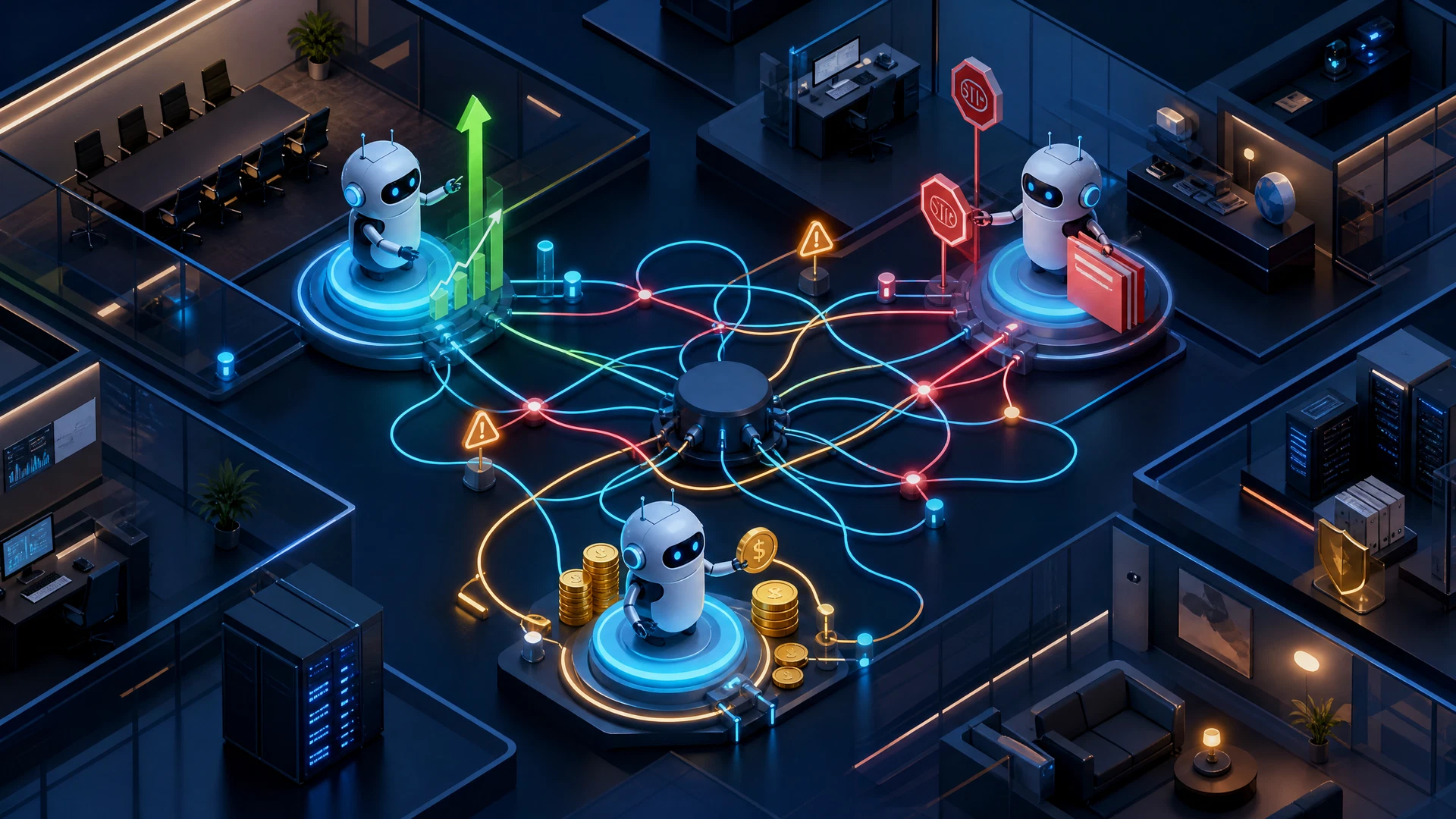
But collectively? The revenue agent pushes aggressive offers that the compliance agent blocks. The media agent drives volume that the pricing agent discounts away. The CRM agent retains customers the revenue agent is trying to upsell.
The result is organisational politics without an organisation chart.
Why Identity and Permissions Cannot Solve This
Traditional AI governance focuses on:
- Authentication (who is this agent?)
- Authorisation (what can it access?)
- Audit (what did it do?)
These are necessary but insufficient for multi-agent systems. Two agents can both be fully authenticated, properly authorised and completely auditable — while still producing a bad collective outcome.
The missing layer is organisational design for machines: hierarchy, ownership, shared state, conflict resolution, escalation and shutdown authority.
Humans developed reporting lines, decision rights, escalation procedures, separation of duties, budgets, arbitration and audit over centuries of organisational theory. Multi-agent systems will require machine equivalents — and we are building agent workforces faster than we are building their organisation charts.
The Agent Organisation Model
Based on Anthropic's findings, enterprises deploying multi-agent systems need:
| Layer | Human Equivalent | Agent Equivalent |
|---|---|---|
| Hierarchy | Reporting lines | Agent priority ordering |
| Ownership | Budget holders | Objective owners with override authority |
| Shared state | Company dashboards | Shared context stores with conflict detection |
| Conflict resolution | Manager escalation | Arbitration agent or human-in-the-loop trigger |
| Escalation | Executive override | Kill switch with graceful state preservation |
| Audit | Board reporting | System-level outcome monitoring (not just per-agent logs) |
The critical insight: you cannot understand multi-agent risk by auditing each agent independently. You must monitor the system-level outcomes that emerge from their interaction.
What This Means for Your AI Strategy
If your organisation is moving from individual copilots to agent teams [blocked], governance must move from agent-level permissions to system-level organisational design.
The critical questions become:
- How are goals prioritised when agents conflict?
- Who owns the arbitration logic?
- What shared state do agents read and write?
- How are disagreements surfaced before they compound?
- What is the shutdown sequence when system-level outcomes deteriorate?
These are not software engineering questions. They are organisational design questions applied to machines.
If you want to see how a properly governed autonomous agent operates within defined boundaries, try Manus free — it coordinates multi-step workflows with built-in containment, escalation and human oversight.
Sources: Anthropic Frontier Red Team, "Patterns and problems in emerging multiagent systems" (13 August 2026); VentureBeat coverage (15 August 2026).