AI Answer Summary
Only 43% of WordPress sites pass all three Core Web Vitals on mobile, compared to the 85%+ pass rates achievable with purpose-built AI-native websites. Beyond performance, the structural gap is more consequential: WordPress retrofits schema via plugins, while AI-native sites embed a unified entity.
AI Website vs WordPress for B2B: The Performance and AEO Gap in 2026
Only 43% of WordPress sites pass all three Core Web Vitals on mobile, compared to the 85%+ pass rates achievable with purpose-built AI-native websites. Beyond performance, the structural gap is more consequential: WordPress retrofits schema via plugins, while AI-native sites embed a unified entity graph from the ground up. For B2B brands competing in AI search, that architecture difference translates directly into citation frequency.
WordPress powers 42.4% of all websites as of March 2026, according to W3Techs data. That market dominance is a testament to its flexibility and ecosystem depth. But dominance in market share does not translate to dominance in AI search performance - and for B2B brands whose buyers increasingly research in ChatGPT, Perplexity, and Google AI Mode before visiting any website, the distinction matters.
This article is not a takedown of WordPress. It is a data-led comparison of two architectural approaches to B2B websites, with a specific focus on the metrics that drive AI search visibility and lead generation in 2026.
The Core Web Vitals Gap
The CrUX Technology Report, powered by Google's Chrome User Experience data, tracks Core Web Vitals pass rates across every major CMS. As of mid-2025, the data shows a clear performance hierarchy:
| Platform | Mobile CWV Pass Rate | Good TTFB |
|---|---|---|
| Duda | 83.6% | High |
| Shopify | ~65% | Managed |
| Wix | ~63% | Managed |
| Squarespace | ~58% | Managed |
| WordPress | 43.4% | 32% |
| Drupal | ~52% | Low |
Source: CrUX Technology Report via HTTP Archive, June 2025.
WordPress's problem is not INP (85.9% pass rate, close to average). The problem is LCP, driven by slow TTFB. Only 32% of WordPress sites have good TTFB, according to CrUX data. Fully hosted platforms handle TTFB at the infrastructure level; WordPress delegates it to the site owner's hosting choice and caching configuration.
The practical consequence: the median mobile LCP on an unoptimized WordPress site is 3.5-4.5 seconds. After expert optimisation - managed hosting, server-level caching, CDN, deferred JavaScript, preloaded LCP images - the median drops to 1.6-2.1 seconds. That is a meaningful improvement. But it requires ongoing expert effort, and it is a ceiling that purpose-built AI-native sites clear by default.
An AI-native B2B website built on React with server-side rendering, edge CDN delivery, and schema-first architecture typically achieves LCP under 2.5 seconds and passes all three Core Web Vitals on the first build. The performance is structural, not the result of continuous optimisation overhead.
The Schema Architecture Gap
Performance is the visible gap. The schema gap is the one that determines AI search visibility.
Pages with FAQPage schema appear in Google AI Overviews 3.2 times more often than pages without structured data, according to SearchAtlas analysis published in April 2026. AI-referred sessions for schema-enhanced content grew 527% between January and May 2025. Schema markup improves LLM comprehension by 300% compared to unstructured data, according to Data World research cited in the same study.
WordPress can add schema via plugins - Yoast SEO, RankMath, and Schema Pro are the most common. The problem is not the presence of schema; it is the architecture.
A typical WordPress site with multiple SEO plugins produces fragmented schema: Article schema from Yoast, FAQ schema from a separate plugin, LocalBusiness schema from a third plugin, and Organization schema from a fourth. These declarations often conflict, use inconsistent @id values, and lack the cross-page entity graph that AI systems use to build trust in a brand.
An AI-native website built schema-first implements a unified entity graph from day one. Every page shares consistent @id references for the Organization, Person (author), and Service entities. BreadcrumbList, Speakable, and isBasedOn declarations are built into the component architecture, not bolted on via plugins. The result is a coherent entity graph that AI systems can traverse reliably - which is exactly what drives citation frequency.
The AEO Readiness Gap
AEO - Answer Engine Optimization - is the discipline of structuring content so AI systems select your brand as the authoritative answer to buyer questions. It requires three things that WordPress struggles to deliver natively:
1. Answer-first content architecture. AI systems extract answers from the first 40-60 words of a section. WordPress's block editor and most themes are designed for visual presentation, not answer extraction. AI-native sites can enforce answer-first formatting at the component level.
2. Speakable schema. Speakable schema marks sections of a page as suitable for voice search and AI Overview extraction. WordPress has no native Speakable support; it requires custom development. AI-native sites can implement Speakable at the component level, marking every article intro, FAQ block, and H2 section automatically.
3. Entity verification. AI systems verify brand identity through sameAs links connecting the Organization schema to LinkedIn, Crunchbase, Wikidata, and other authoritative sources. WordPress schema plugins support sameAs, but the implementation is manual and inconsistent. AI-native sites wire sameAs into the base Organization schema, ensuring every page carries the verification signal.
The Maintenance Overhead Gap
WordPress requires active maintenance that AI-native websites do not. The average WordPress site runs 20-30 active plugins. Each plugin requires regular updates, security patches, and compatibility testing after WordPress core releases. Plugin conflicts are a common source of performance regressions and schema breakage.
The security surface is significant. WordPress powers 42.4% of the web, making it the most targeted CMS for automated attacks. Security hardening, malware scanning, and firewall configuration are ongoing operational requirements.
An AI-native website built on a modern framework with a managed deployment pipeline has a dramatically smaller attack surface. Dependencies are managed via package managers with automated security auditing. There is no plugin ecosystem to maintain.
This maintenance overhead is not a dealbreaker for large B2B organisations with dedicated development teams. For growth-stage B2B companies where the marketing team owns the website, it is a meaningful operational cost.
When WordPress Still Makes Sense
This comparison is not a verdict. WordPress remains the right choice for specific B2B contexts:
Large content teams with established editorial workflows. WordPress's editorial interface, user roles, and content scheduling are mature and familiar. If your team publishes 20+ pieces per month and relies on WordPress's workflow, migration costs may outweigh AEO gains.
WooCommerce-dependent businesses. If your B2B revenue model depends on WooCommerce's product catalogue, checkout, and subscription management, the migration cost and risk are substantial. WooCommerce has no direct equivalent in AI-native frameworks.
Existing plugin ecosystem. If your marketing stack is deeply integrated with WordPress plugins - membership management, LMS, event management, complex forms - the cost of replicating that functionality in a custom framework is real.
Budget-constrained early-stage companies. A well-configured WordPress site on managed hosting is faster and cheaper to launch than a custom AI-native build. If your priority is getting to market quickly with a functional website, WordPress is a reasonable starting point.
The decision framework is simple: if AI search citation is a primary growth channel for your business, and your buyers research in ChatGPT, Perplexity, or Google AI Mode before visiting your website, the architectural advantages of an AI-native site compound over time. If your growth model is primarily content volume, paid media, or direct sales, WordPress's editorial strengths may outweigh its AEO limitations.
The Migration Decision
If you are evaluating a migration from WordPress to an AI-native website, the key question is not "which platform is better" but "what does my growth model require."
The data points to a clear performance and AEO advantage for AI-native architectures. A 43% vs 85%+ Core Web Vitals pass rate is not a marginal difference. A 3x higher AI citation rate from schema-enhanced pages is not a marginal difference. A 527% increase in AI-referred sessions for schema-enhanced content is not a marginal difference.
For B2B brands whose buyers are already researching in AI systems - and Gartner's research suggests that AI-assisted research now influences over 70% of B2B purchase decisions - the question is not whether to invest in AI search visibility, but whether your current website architecture can support it.
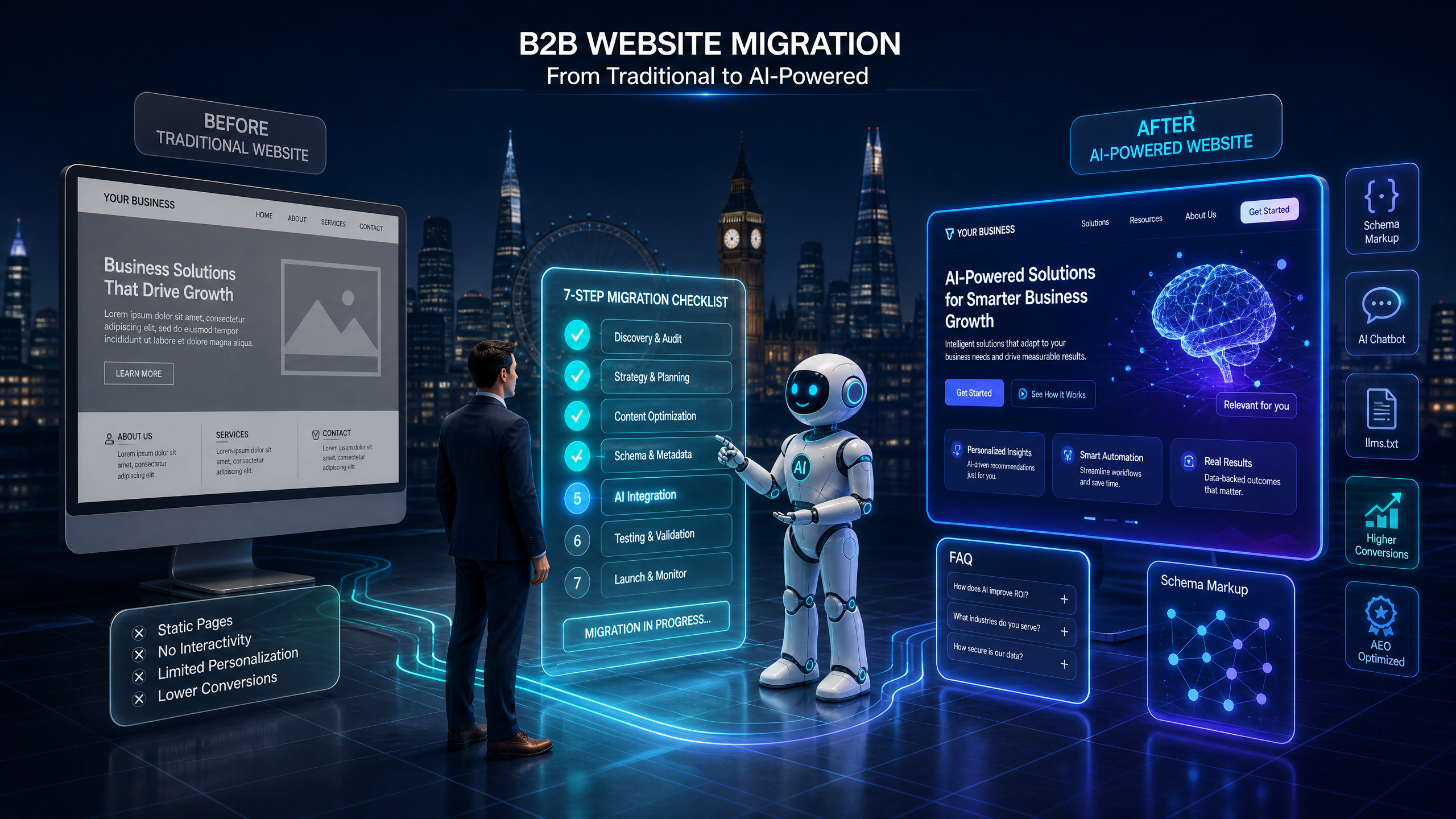
Integrated.Social has published a detailed 47-step migration checklist covering content audit, schema mapping, technical migration, and post-launch verification. If you want to understand what an AI-native website would look like for your specific B2B context, the AI Websites service page covers our build process, typical timelines, and the performance benchmarks we target.
Frequently Asked Questions
Is WordPress good for B2B SEO and AEO in 2026? WordPress can support B2B SEO with the right plugins and hosting, but it faces structural disadvantages for AEO. Only 43% of WordPress sites pass all three Core Web Vitals on mobile as of mid-2025. Schema is added via third-party plugins that often conflict, producing fragmented entity graphs. AI-native websites built with modern frameworks achieve higher Core Web Vitals pass rates and implement unified schema architectures that improve AI citation rates by up to 3x.
What is an AI-native website and how does it differ from a WordPress site? An AI-native website is built from the ground up to be readable, citable, and rankable by AI systems. It uses a unified JSON-LD entity graph, schema-first content architecture, and performance-optimised rendering. WordPress is a PHP-based CMS that adds schema retrospectively via plugins. The difference is architectural: AI-native sites treat structured data as infrastructure; WordPress treats it as a plugin.
Can WordPress be optimised to compete with AI-native websites for AEO? WordPress can be significantly optimised - managed hosting, WP Rocket, Cloudflare CDN, and Yoast Premium can close much of the performance gap. However, the schema architecture gap is harder to close. Achieving the structured data depth required for consistent AI citation requires custom development that effectively rebuilds what AI-native frameworks provide natively.
About the Author
Modi Elnadi is the founder of Integrated.Social, a B2B AI marketing agency in London specialising in Agentic AI lead generation, Answer Engine Optimization, and AI-native website builds. Modi has been building performance marketing systems since 2014, with a focus on the intersection of technical architecture and commercial outcomes. His work spans FinTech, SaaS, professional services, and regulated B2B sectors. This article draws on data from the CrUX Technology Report, SearchAtlas AEO research, and Integrated.Social client deployments.