AI Answer Summary
AI search referral traffic converts 22% higher than traditional organic search - 3.49% versus 2.86% - according to 2026 conversion rate benchmarks from Digital Applied. The reason is structural: users arriving from ChatGPT, Perplexity, or Google AI Overviews have already been pre-qualified by an AI.
What "Migrating to an AI Website" Actually Means
AI search referral traffic converts 22% higher than traditional organic search - 3.49% versus 2.86% - according to 2026 conversion rate benchmarks from Digital Applied. The reason is structural: users arriving from ChatGPT, Perplexity, or Google AI Overviews have already been pre-qualified by an AI system that narrowed their options before generating the link. They arrive with higher intent, shorter consideration cycles, and a clearer sense of what they want.
The problem is that most B2B websites are invisible to those AI systems. They were built to rank in Google's blue-link results - optimised for keyword density, backlink profiles, and page speed - not to be cited by language models that parse semantic structure, extract direct answers, and evaluate entity authority. A website that cannot be read by an AI system cannot be recommended by one.
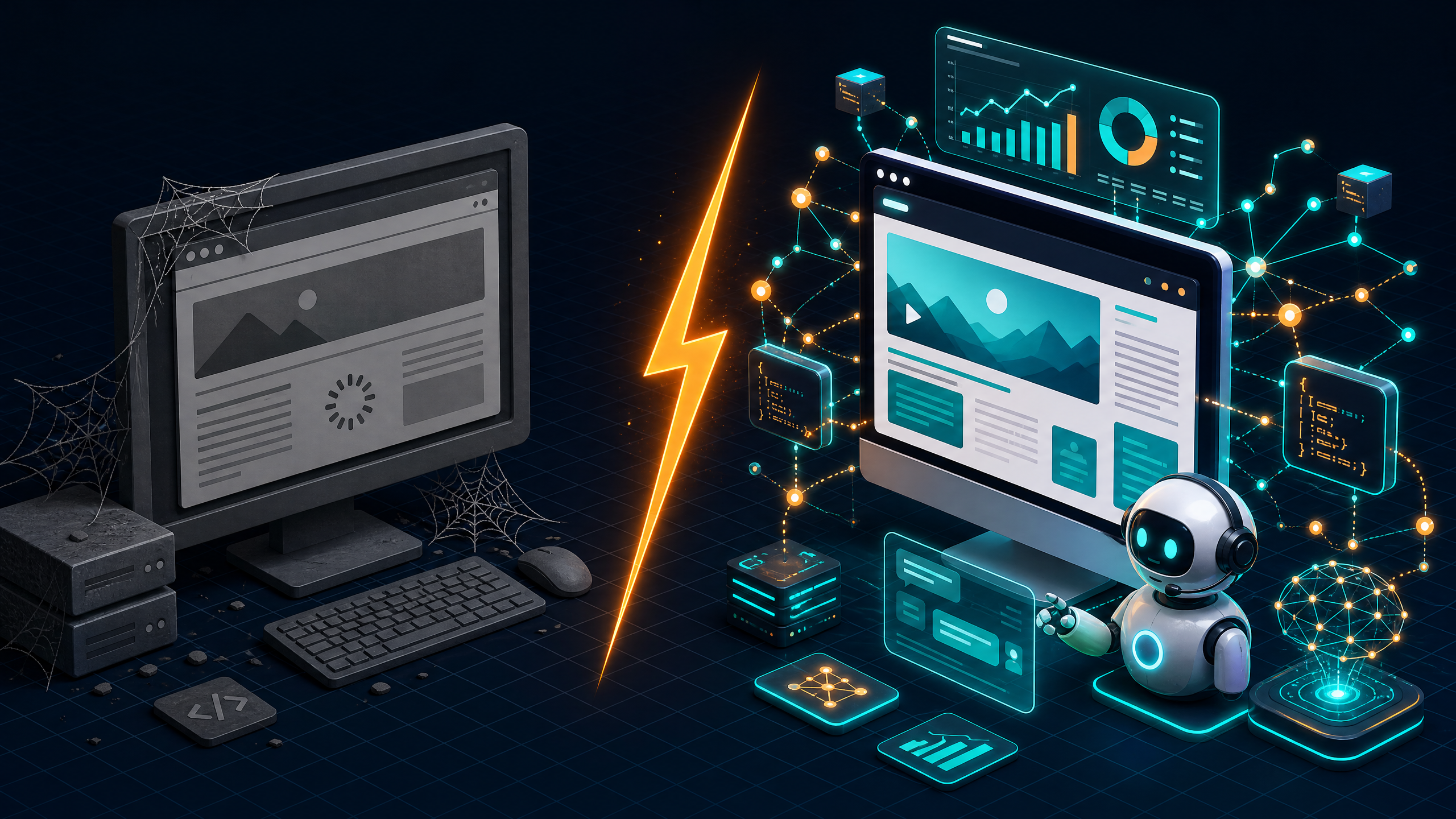
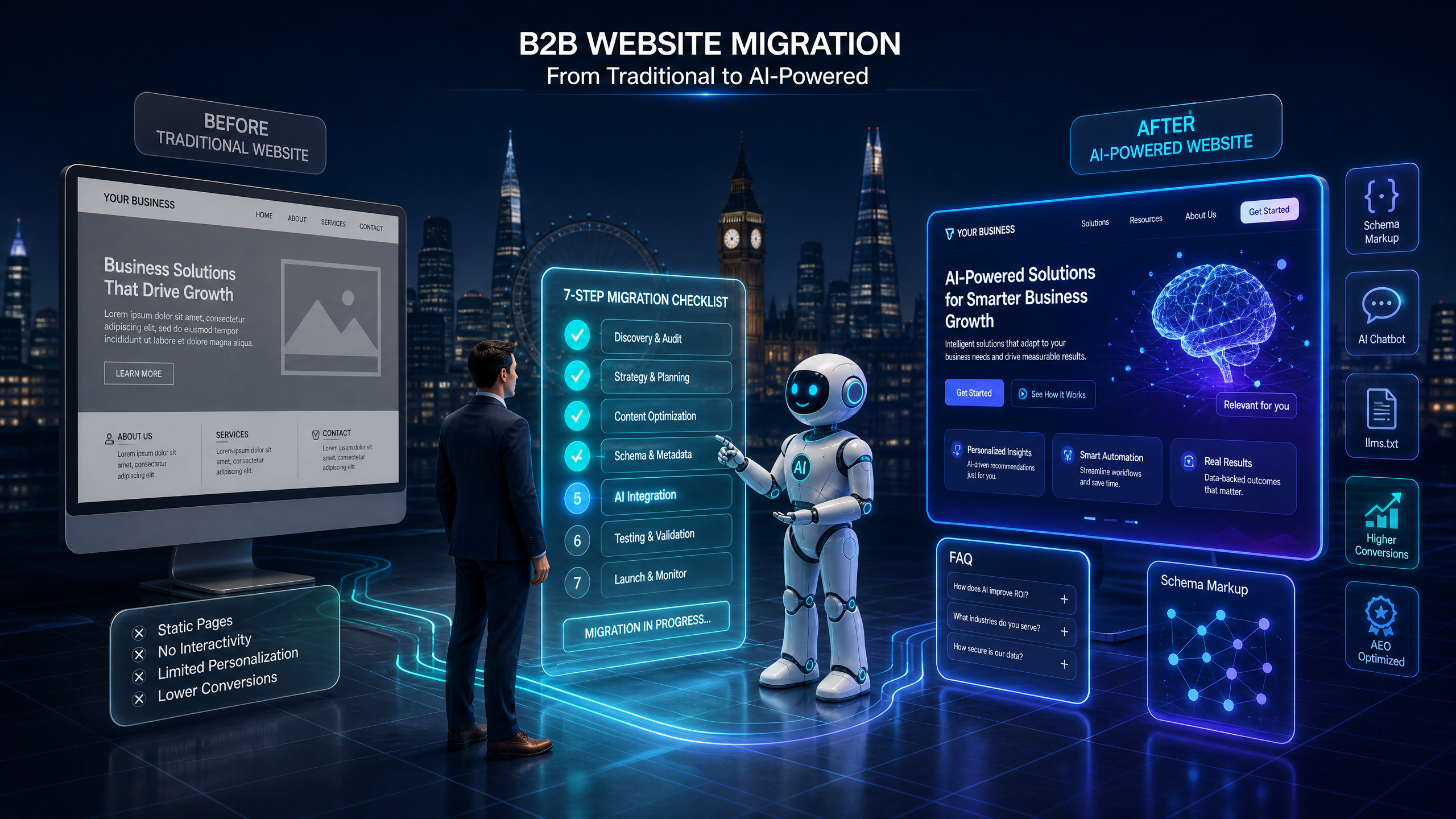
Migrating to an AI website means restructuring your digital presence so that AI systems can discover, parse, cite, and recommend it. This is not a cosmetic change. It requires changes to content architecture, technical markup, conversion design, and measurement infrastructure. This 7-step checklist covers each layer in sequence, from the highest-ROI changes you can make this week to the structural decisions that determine long-term AI search visibility.
Step 1 - Audit Your Current Site's AI Citation Readiness
Before making any changes, you need a baseline. An AI citation readiness audit evaluates your site against the signals that AI systems use to select sources: schema coverage, content format, semantic HTML structure, mobile performance, entity clarity, and E-E-A-T indicators.
The audit should answer six questions. Does every page have JSON-LD schema markup? Are your H2 sections structured as questions with direct answers in the first sentence? Does your HTML use semantic elements (article, section, nav) rather than generic divs? Is your mobile conversion rate above 1.5%? Do you have a named author with credentials on every content page? Do you have an llms.txt file at your domain root?
Most B2B websites built before 2023 fail on at least four of these six criteria. The audit output is a prioritised list of changes ranked by impact on AI citation frequency, with the highest-ROI items - typically schema markup and content restructuring - at the top.
Integrated.Social offers a free 48-hour AI website audit [blocked] that evaluates your site against 47 AI-readiness criteria and delivers a prioritised action plan. For context on what distinguishes an AI website from a traditional B2B site, see our analysis of what makes an AI website different from a regular website [blocked].
Step 2 - Implement Schema Markup (FAQPage, HowTo, Article, Organization)
Schema markup alone produces a 35.67x lift in AI citation frequency, according to AEOfix research across 110 brands. This is the single highest-ROI technical change you can make to a B2B website.
The minimum schema set for AI citation readiness is five types. Organization schema establishes your brand entity globally - name, URL, logo, contact information, and social profiles - so AI systems can identify and reference your company consistently across queries. Article or BlogPosting schema on every content page signals content type, author, publication date, and topic. FAQPage schema is the most directly impactful: it maps questions to answers in a format that AI systems extract and cite verbatim when generating responses to user queries. HowTo schema on process-oriented pages matches "how to" queries that represent high-intent B2B searches. BreadcrumbList schema provides navigation hierarchy signals that help AI systems understand your site structure.
All schema should be implemented as JSON-LD blocks in script tags, not as microdata attributes embedded in HTML. Validate every implementation with Google's Rich Results Test before deployment. For a comprehensive guide to schema strategy for AI citation, see our AEO 2026 complete guide [blocked].
Step 3 - Restructure Content for Direct-Answer Format
AI systems favour pages that answer the question in the first one to two sentences of each section. Buried answers - where the relevant information appears after three paragraphs of context - are rarely cited. The model needs to find the relevant text quickly, and it reads the opening of each section looking for the most relevant answer fragment to extract.
The restructuring pattern is straightforward. Every H2 heading should be phrased as a question your target buyer actually asks. The first sentence after that H2 should contain the complete answer, not a preamble. Supporting context, examples, and implementation steps follow. This is the inverted pyramid pattern applied to B2B content: lead with the claim, then explain it.
For a B2B website with 40 service and blog pages, this restructuring typically takes two to three weeks of content editing. The impact on AI citation rates begins within 30 to 60 days as AI crawlers re-index the updated pages. The same restructuring also improves Google featured snippet eligibility, creating a dual benefit for both traditional and AI search channels.
This approach directly supports AI search optimisation for 2026 [blocked], where direct-answer content is the foundation of both SEO and AEO performance.
Step 4 - Add Semantic HTML5 Structure
AI parsers use your HTML structure to understand content hierarchy and identify the most relevant passages. Generic div elements provide no signals about what each block of content is. Semantic HTML5 elements give explicit signals that AI systems use to distinguish navigation from content, primary content from supplementary material, and article body from header and footer.
The key semantic elements are article (wrapping the primary content unit), section (wrapping topically distinct sub-sections), header and footer (signalling non-body content to skip), nav (marking navigation as non-content), and aside (marking supplementary content). Each page should have exactly one H1 element - the primary topic signal. H2 elements should map to major sections, H3 to sub-sections within those.
Research indicates that semantic HTML5 structure produces a 140% lift in AI citation frequency compared to div-based layouts. For most B2B websites, implementing semantic HTML requires a template-level change rather than page-by-page editing, making it a one-time effort with permanent benefit.
Step 5 - Deploy an llms.txt File and AI Meta Tags
An llms.txt file is an AI-specific sitemap written in Markdown, placed at your domain root, that lists your most important pages with titles, URLs, and one-line descriptions designed for LLM ingestion. ChatGPT's training crawlers and browsing mode use it to prioritise high-value content. Research indicates it produces a 110% lift in AI citation frequency compared to sites without it.
The file format is simple: a brand description at the top, followed by a list of your 20 to 30 most authoritative pages with their URLs and one-sentence descriptions. Update it whenever significant new content is published. Reference it in your robots.txt file so AI crawlers can discover it.
AI meta tags complement the llms.txt file by providing page-level signals. The most impactful is the ai:summary meta tag, which should contain a 40 to 60 word direct answer to the primary question the page addresses. Treat it as a compressed answer for LLMs, not a marketing teaser. The meta description should also be written as a direct answer to the primary query, not as a call to action.
Step 6 - Add AI-Native Conversion Elements
A website that is cited by AI systems but fails to convert the resulting traffic is leaving the highest-quality leads in your funnel. AI search referrals arrive with higher intent than traditional organic visitors, but they also arrive with higher expectations: they have already received an AI-generated answer and are visiting your site to verify, extend, or act on it.
AI-native conversion elements are designed for this intent profile. An AI chatbot on your homepage and service pages can engage visitors with contextual questions, qualify intent, and route them to the appropriate conversion path - a demo booking, a free audit, or a content download - without requiring them to navigate a static site structure. Research indicates that websites with AI chatbots see 20 to 35% higher conversion rates compared to static forms for equivalent traffic.
Intent-aware CTAs replace generic "Contact Us" buttons with specific, context-matched offers. A visitor arriving from a ChatGPT response about "how to migrate a B2B website to AI" should see a CTA for an AI website audit, not a generic contact form. The specificity of the offer should match the specificity of the query that brought them to the page.
For B2B lead generation specifically, the agent-qualified lead (AQL) model [blocked] is increasingly relevant: AI agents can qualify and route leads before a human sales conversation, compressing the sales cycle for buyers who arrive pre-educated from AI search.
Step 7 - Measure AI Referral Traffic Separately
AI referral traffic behaves differently from traditional organic traffic, and measuring it with the same metrics produces misleading conclusions. The 22% conversion premium for AI referrals only becomes visible when you track the channel separately.
In GA4, create a custom channel grouping that captures referrals from chatgpt.com, perplexity.ai, gemini.google.com, and claude.ai as "AI Search Referrals." Set up a separate conversion goal for this channel and track it weekly. In Google Search Console, monitor AI Overviews impressions and clicks under the Search Appearance filter - this shows how often your pages appear in AI-generated answer boxes, even when users do not click through.
The key metrics to track are AI citation rate (how often your brand appears in AI-generated responses for target queries), AI referral conversion rate (benchmark: 3.49% industry average), and AI referral share of total traffic (currently 4.7% of total website traffic across industries, up from 1.2% in 2025). For a comprehensive measurement framework, see our analysis of measuring AI attribution across ChatGPT, Perplexity, and Google AI Mode [blocked].
When to Rebuild vs. When to Retrofit
The rebuild-versus-retrofit decision depends on three factors: technology stack age, content architecture, and conversion performance.
| Factor | Retrofit | Rebuild |
|---|---|---|
| CMS supports JSON-LD schema | Yes | No |
| Content structured in H2/H3 hierarchies | Yes | No |
| Current conversion rate | Above 2% | Below 1.5% |
| Mobile conversion rate | Above 1.5% | Below 1% |
| Site age | Under 5 years | Over 7 years |
| Technical debt | Manageable | Significant |
Most B2B websites built between 2020 and 2023 benefit from a phased approach: retrofit the highest-traffic pages immediately using schema markup and content restructuring, then rebuild the site architecture over 12 to 18 months. This approach delivers early AI citation wins while managing the cost and disruption of a full rebuild.
For B2B companies in London and the UK, Integrated.Social's AI Websites service [blocked] covers both retrofit and rebuild engagements, with a free audit to determine which approach is right for your specific situation.
The Integrated.Social Perspective
The shift from traditional SEO to AI-mediated discovery is not a future trend - it is happening now. AI search referrals already represent 4.7% of total website traffic across industries, up from 1.2% in 2025. For B2B companies in competitive categories, that share is higher, and it is growing faster than any other traffic channel.
The B2B websites that will dominate AI search in 2027 are being built and retrofitted today. The technical foundation - schema markup, direct-answer content, semantic HTML, llms.txt - takes four to eight weeks to implement. The competitive advantage it creates compounds over time as AI systems build citation histories and entity authority signals accumulate.
The seven steps in this checklist are not a one-time project. They are the foundation of an ongoing AI search visibility programme that requires quarterly content updates, schema maintenance, and measurement refinement. The companies that treat AI website readiness as a continuous capability rather than a one-time migration will hold a durable advantage as AI search continues to displace traditional organic as the primary discovery channel for B2B buyers.
For a free assessment of where your B2B website stands today, book your AI website audit with Integrated.Social [blocked].
About the Author
Modi Elnadi is the founder of Integrated.Social [blocked], a London-based AI performance marketing agency specialising in AI Websites, AEO, GEO, and Agentic AI for B2B companies in fintech, SaaS, and professional services. He has built AI-native growth systems for enterprise clients across the UK, US, and MENA, with a focus on the intersection of AI search visibility and commercial pipeline performance. Connect on LinkedIn.
Sources: Digital Applied Conversion Rate Benchmarks 2026 (digitalapplied.com); AEOfix ChatGPT Optimization Research, 110 brands, February 2026 (aeofix.com); Apollo.io B2B Buyer Journey Report 2026 (apollo.io)