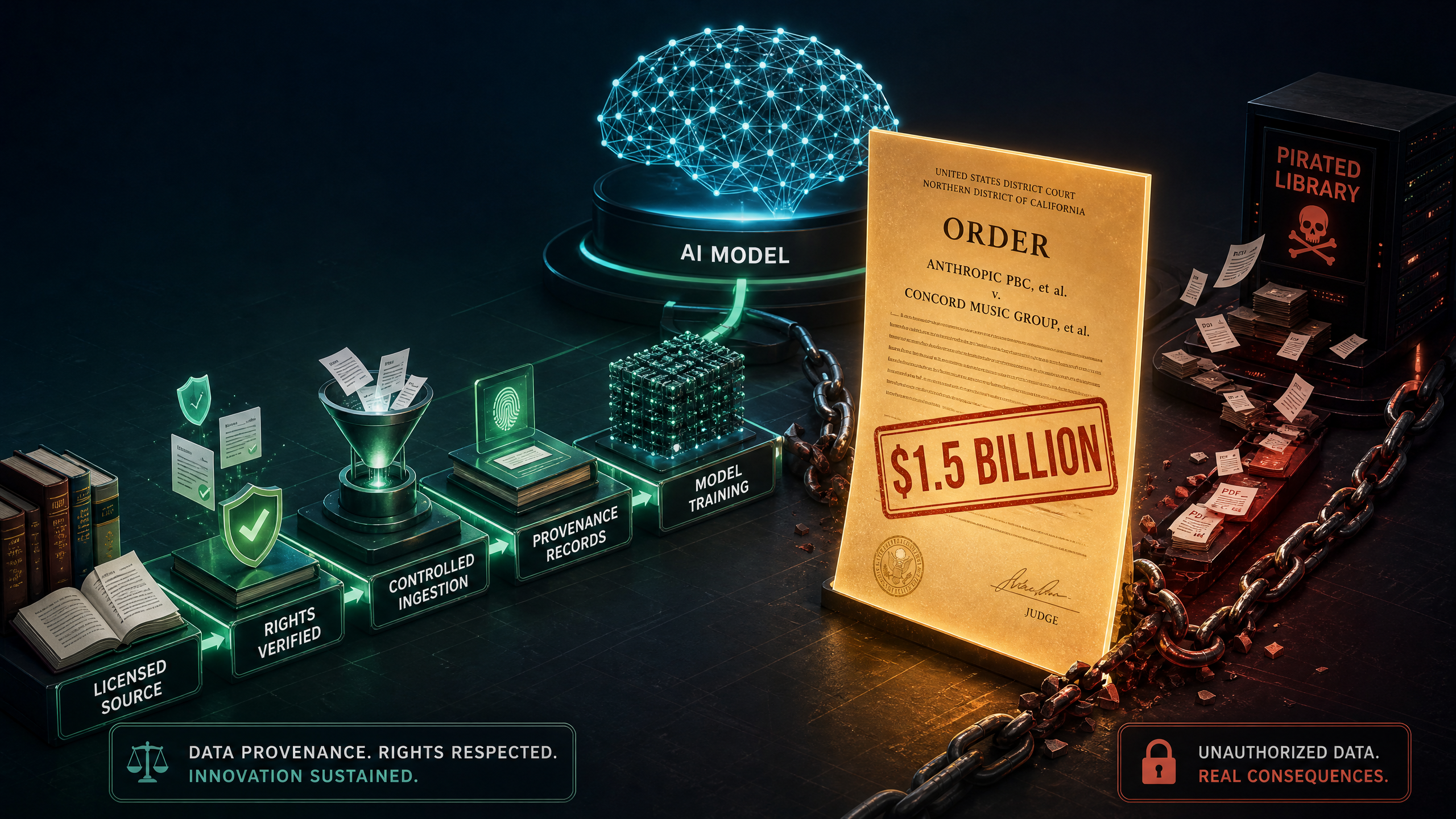
Anthropic has not just received a costly reminder about copyright. It has received a $1.5 billion lesson in AI data provenance.
On 20 July 2026, a US federal judge granted final approval to the largest known copyright settlement in American history. The case involved hundreds of thousands of books associated with pirated online libraries and used in the wider development of Anthropic's Claude models.
But the most important part of the case is frequently misunderstood.
The court did not rule that every use of a copyrighted book to train AI is illegal. It drew a distinction between the purpose of model training and the way Anthropic acquired and retained the underlying books.
Anthropic's settlement changes the commercial risk surrounding AI data more than it changes the basic legal debate over model training. The court previously accepted fair use for training on lawfully acquired books in the circumstances before it, while piracy claims remained exposed. For enterprises, provenance, licensing and retention are now board-level financial controls.
What Did the Judge Actually Approve?
US District Judge Araceli Martínez-Olguín granted final approval to a $1.5 billion non-reversionary settlement covering eligible rightsholders of 482,460 books associated with LibGen and Pirate Library Mirror (PiLiMi) collections obtained by Anthropic. The settlement closes the certified class action, sets a distribution process and requires additional non-monetary relief concerning the pirated source files.
The timeline matters for editorial accuracy:
- The original lawsuit (Bartz v. Anthropic) was filed in 2024.
- Anthropic reached the settlement agreement in 2025.
- Preliminary approval was granted in September 2025.
- Final approval was granted on 20 July 2026 — this is the breaking-news event.
- The final judgment dismisses the class action with prejudice.
- The court retains jurisdiction over administration and enforcement.
The settlement fund is non-reversionary, meaning unclaimed funds do not revert to Anthropic. The court also approved $101,561,111 in legal fees (approximately 6.8% of the fund, materially below the $187.5 million requested), $2,635,197.46 in past litigation expenses, an $18.22 million future cost reserve, and $15,000 to each of three class representatives.
Does the Settlement Mean AI Training on Copyrighted Books Is Illegal?
No. Judge William Alsup previously ruled that Anthropic's use of lawfully acquired books to train its models qualified as fair use in the circumstances of the named plaintiffs' claims. The unresolved exposure concerned the acquisition and retention of pirated copies, not a blanket legal prohibition on using copyrighted material in AI training.
| What the case supports | What the case does not establish |
|---|---|
| Pirated acquisition can create enormous liability | All AI training is copyright infringement |
| Data provenance matters independently of purpose | Publicly accessible means free to train on |
| Lawfully acquired training may support fair-use arguments | Every future court must reach the same conclusion |
| Source copies and retention practices matter legally | Every Claude output infringes copyright |
| Creators can pursue piracy-based claims | $3,000 is a universal AI licensing rate |
Essential legal caveat: The fair-use ruling came from a federal district court and arose from the specific facts of this case. It is not a US Supreme Court ruling or a universal statutory exemption for AI training. This article is analysis, not legal advice.
Why Did Anthropic Pay $1.5 Billion if Training Was Considered Fair Use?
Anthropic faced a separate trial over its acquisition and storage of millions of pirated books. Although the training purpose received favourable treatment, the court found that building a central library from unlawfully sourced copies presented a distinct infringement issue with potentially vast statutory damages and substantial litigation risk.
The key analytical distinction is this: a potentially transformative use does not retroactively legalise the way the source material was acquired.
- Model-training purpose and source acquisition were legally separable.
- Anthropic faced a scheduled damages trial with theoretical exposure potentially reaching hundreds of billions of dollars.
- Settlement eliminated the risk, duration and uncertainty of trial and appeal.
- Anthropic did not thereby concede that every use of copyrighted data was unlawful.
More than 7 million books were reportedly stored in a central pirated library. The settlement class specifically covers books obtained from identified versions of Library Genesis and Pirate Library Mirror that appeared on the final Works List and met US copyright-registration requirements.
How Many Books and Authors Are Covered?
The class concerns 482,460 eligible works, with claims filed for 440,490 books — a 91.3% works-level claim rate as of 16 April 2026. The court described this as overwhelmingly favourable, noting only 350 timely opt-outs spanning 1,802 works, alongside 54 objections or comments.
Eligibility required: inclusion on the final Works List; an ISBN or ASIN; timely US Copyright Office registration; acquisition by Anthropic from identified LibGen or PiLiMi collections; and qualifying ownership of the exclusive reproduction right.
How Much Will Authors Receive?
The court described an approximate gross award of $3,000 per eligible work before costs and fees. Final individual payments will differ because the fund must cover court-approved fees and expenses, and payments may be shared among authors, co-authors, publishers and other qualifying rightsholders according to default or contractual splits. For many non-educational works, the default allocation is a 50/50 split between the author and publisher sides unless contractual arrangements support a different distribution.
Do not treat $3,000 as a guaranteed personal payment. Unknown or variable components include interest, claims-administration costs, disputed ownership, contractual allocations, unclaimed or invalid claims, possible redistribution, appeals, and final reserve usage.
Does Anthropic Have to Delete Claude or Retrain Its Models?
The settlement requires Anthropic to destroy original files downloaded from Library Genesis or Pirate Library Mirror and copies originating from those files, subject to legal-preservation obligations. The final order does not describe a requirement to delete Claude, erase all model weights or retrain every existing model from zero.
| Required or confirmed | Not established by the order |
|---|---|
| Destruction of identified original pirated files and copies | Destruction of Claude |
| Settlement payments to eligible rightsholders | Complete model retraining from zero |
| Administration of claims process | Proof that every model memorised every book |
| Release of defined past input claims | Release of all future conduct |
| Court oversight of implementation | A general licence for future training |
Does the Settlement Cover Future Claude Outputs?
The release concerns defined claims connected to past inputs and copying covered by the settlement. The court stated that it does not release claims concerning past AI outputs or claims relating to future conduct on or after 25 August 2025. The settlement does not eliminate future risks involving memorised passages, substantially similar outputs, newly acquired datasets, future training runs, non-class works, authors and publishers that opted out, or separate lawsuits.
What Does This Mean for OpenAI, Google Gemini and Meta?
The approval does not automatically determine the outcome of separate copyright cases against other AI companies. It does, however, establish a large, visible financial reference point and strengthens commercial pressure on all developers to document how training data was acquired, licensed, retained and removed. Reuters reports that copyright owners have brought dozens of related cases against AI companies.
| Company | Implication |
|---|---|
| OpenAI | Greater pressure to document publisher and media licensing; continued scrutiny of training sources and model outputs; Anthropic's settlement is not binding proof of liability in separate OpenAI cases |
| Google Gemini | Greater distinction between materials available through Google products and rights permitting AI training; public accessibility, indexing rights and training rights are not identical |
| Meta | Open-weight distribution can increase downstream complexity; training-data acquisition and output behaviour remain separate questions |
| Open-model providers | Publishing weights does not eliminate provenance obligations; enterprise users may inherit compliance and reputational questions when adapting or fine-tuning models |
This Is Not Simply a Copyright Story. It Is an AI Supply-Chain Failure Priced at $1.5 Billion.
The settlement establishes that data lineage can create financial exposure independent of model quality. A technically capable system can still carry hidden liabilities originating in acquisition, contracts, retention and documentation.
Introducing AI Data Debt
AI data debt is the accumulated legal, operational and commercial risk created when an organisation cannot reliably document where its training data, retrieval sources and knowledge assets originated, who owns them, which rights were granted, how they were stored and whether they can be deleted or audited on demand.
Common sources of AI data debt include: unlicensed scraped content; undocumented internal data; agency assets with unclear rights; customer data reused outside consent; expired licences; copied competitor material; third-party datasets without provenance; employee uploads into unapproved models; and RAG repositories containing duplicate or restricted files.
What Does This Mean for CMOs and Marketing Leaders?
CMOs increasingly deploy models across content production, customer data, research, personalisation, creative generation and AI Search. That makes copyright provenance a marketing-operations issue, not solely a legal-department issue. Every uploaded asset, connected repository and training corpus can create downstream usage and ownership questions.
Specific risks include: uploading agency-owned creative into client models; using stock images outside licence terms; fine-tuning models on third-party articles; putting customer calls into external AI platforms; generating derivative brand assets; using competitor copy as model examples; reusing publisher content in RAG systems; allowing agents to collect web content without restrictions; and publishing AI outputs without source checks.
The Critical Distinction: Crawling, Citation, Retrieval and Training
Crawling, citation, retrieval and model training are technically and legally distinct activities. A page being publicly accessible does not automatically resolve whether it may be copied into a permanent dataset, retrieved temporarily to answer a question, quoted in an output or used to change model parameters.
| Activity | What happens | Core governance question |
|---|---|---|
| Crawling | A system accesses and records page information | Was access permitted? |
| Indexing | Information is stored for search and retrieval | What is retained and for how long? |
| Citation | The source is linked or attributed in an answer | Is representation accurate? |
| RAG retrieval | Content is supplied temporarily as answer context | Is retrieval authorised? |
| Fine-tuning | Content changes model behaviour | Does the licence permit training? |
| Foundation-model training | Data contributes to model parameters | Can provenance and rights be proven? |
| Output generation | The model produces new material | Is protected expression reproduced? |
Brands want AI systems to discover, cite and recommend their content. That does not mean they automatically consent to permanent model training or unrestricted reproduction. The distinction between AEO and GEO citation governance and model training rights is one every enterprise AI programme must now document explicitly.
The AI Data Provenance Control System: Eight Steps
Enterprises should create a documented AI data-governance programme covering every dataset, model, agent and retrieval source. The objective is not to prohibit useful AI adoption. It is to make provenance, permissions, purpose and deletion demonstrable before an issue becomes a contractual dispute, regulatory event or material financial liability.
Record dataset name, source, owner, ingestion date, responsible team, and models or agents using it.
Document licence, copyright ownership, contractual permission, consent, territory, permitted uses and expiration date.
State whether data is permitted for search, retrieval, analysis, fine-tuning, model training, personalisation or publication.
Track original source, copied versions, transformations, embeddings, derived datasets and model versions trained from it.
Define storage duration, review date, deletion requirements, legal holds and archive restrictions.
Require training-data disclosures, warranties, indemnity terms, opt-out mechanisms, deletion procedures and incident notification.
Test for verbatim reproduction, source attribution, confidential leakage, protected claims, false authorship and brand infringement.
Preserve ingestion logs, permissions, model cards, evaluation reports, deletion certificates, human approvals and incident records.
Modi's View: The Next AI Moat Is Not the Smartest Model
Anthropic's $1.5 billion settlement is not the definitive ruling that ends the AI copyright debate.
In one respect, it reinforces an argument AI companies have made for years: model training can sometimes qualify as fair use.
But it also exposes a more immediate corporate risk.
A lawful or defensible purpose does not clean an unlawful data supply chain.
Enterprises have spent considerable time debating which model to select, how many agents to deploy and how quickly AI can improve productivity. Far fewer can produce a complete record of where every training document, uploaded asset or connected knowledge source originated.
That gap is no longer theoretical. Anthropic has now placed a $1.5 billion price beside it.
The next enterprise AI moat may not be the smartest model. It may be a high-quality body of data the organisation has the legal right, operational discipline and commercial confidence to use.
This fits directly within what we describe at Integrated.Social as the Operating Reality: organisations frequently celebrate AI capability while failing to redesign the governance, ownership and operational controls surrounding it. The Anthropic settlement is not a legal curiosity. It is a $1.5 billion proof point that enterprise AI governance and data provenance must begin before the prompt, before the model and before the deployment.
Frequently Asked Questions
Why did Anthropic agree to a $1.5 billion settlement?
Anthropic faced claims concerning millions of books obtained from pirated online libraries including LibGen and PiLiMi. Although the court had ruled favourably on fair use for training with legally acquired books in the circumstances considered, claims relating to pirated acquisition and storage remained scheduled for trial and carried potentially enormous statutory damages exposure. Settlement eliminated the risk, duration and uncertainty of that trial.
Does the settlement mean Claude was trained illegally?
Not in such simple terms. The court distinguished the purpose of AI training from the acquisition of the underlying books. Judge William Alsup ruled that certain training use was fair use in the circumstances of the named plaintiffs' claims, while allowing piracy-related claims over the acquisition and retention of unlawfully sourced books to continue. A settlement does not necessarily amount to a blanket admission that all alleged conduct was unlawful.
Is AI training on copyrighted books legal?
There is no universal answer. Fair use depends on the jurisdiction and specific facts, including purpose, transformation, amount used and market effect. Licensing and the lawful acquisition of training material are separate issues. The Anthropic ruling came from one federal district court and does not settle every future AI copyright case. This article is analysis, not legal advice.
How many books are covered by the Anthropic settlement?
The final Works List contains 482,460 eligible books. Claims were submitted for 440,490 works, representing a 91.3% works-level claim rate as of 16 April 2026. Eligibility depended on ownership, copyright registration, inclusion on the Works List and acquisition from identified versions of LibGen or PiLiMi. Only 350 timely opt-outs were recorded, spanning 1,802 works.
How much will authors receive from Anthropic?
The court described an estimated gross value of approximately $3,000 per eligible work before costs and fees. Individual authors may receive less because payments can be divided among authors, co-authors, publishers and other rightsholders according to default or contractual splits. Final distributions also depend on expenses, interest, ownership disputes and settlement administration. The $3,000 figure is not a guaranteed personal payment.
Does Anthropic have to delete Claude?
No. The settlement requires destruction of original files obtained from LibGen or PiLiMi and copies originating from those files, subject to legal-preservation obligations. The order does not require Anthropic to delete Claude, erase all model weights or retrain every existing model from zero.
Is this the largest copyright settlement in US history?
The court and Reuters describe it as the largest known US copyright settlement. The non-reversionary fund contains $1.5 billion plus applicable interest. The settlement resolves a class action; it is not a damages award after a full trial.
Does the settlement apply to OpenAI, Google or Meta?
No. It resolves a defined class action against Anthropic. Separate claims against OpenAI, Google, Meta and other AI developers depend on their own datasets, conduct, defences and court proceedings. The settlement may influence commercial expectations and licensing negotiations but does not automatically determine those cases.
What is AI data provenance?
AI data provenance is the documented history of where data originated, who owned it, how it was obtained, which permissions apply, how it was modified and which systems use it. Strong provenance allows organisations to prove that training, retrieval and publication activities remain authorised and can be audited, corrected or deleted on demand.
What should companies ask AI vendors about training data?
Companies should ask how datasets were obtained, which licences apply, how opt-outs work, whether customer inputs are used for training, how deletion requests propagate, what indemnity is offered, and whether the vendor can provide dataset lineage, evaluation reports and incident records. These questions should be contractual requirements, not informal assurances.
Is publicly available content free to use for AI training?
Public accessibility does not automatically equal unrestricted permission. A webpage may be accessible for reading or search indexing while still protected by copyright, contractual terms or technical restrictions. Crawling, indexing, citation, RAG retrieval, fine-tuning and foundation-model training raise different legal and operational questions that must be assessed separately.
Sources
- US District Court, Northern District of California — Final Approval Order, Bartz v. Anthropic, 20 July 2026
- Reuters — "US judge approves Anthropic's $1.5 billion settlement in copyright lawsuit", 20 July 2026
- Authors Guild — "What Authors Need to Know About the Anthropic Settlement", July 2026
- Settlement Administrator — anthropiccopyrightsettlement.com/documents
This article is editorial analysis. It does not constitute legal advice. Readers should consult qualified legal counsel for advice specific to their circumstances.
Anthropic has not just received a costly reminder about copyright. It has received a $1.5 billion lesson in AI data provenance.
On 20 July 2026, a US federal judge granted final approval to the largest known copyright settlement in American history. The case involved hundreds of thousands of books associated with pirated online libraries and used in the wider development of Anthropic's Claude models.
But the most important part of the case is frequently misunderstood.
The court did not rule that every use of a copyrighted book to train AI is illegal. It drew a distinction between the purpose of model training and the way Anthropic acquired and retained the underlying books.
Anthropic's settlement changes the commercial risk surrounding AI data more than it changes the basic legal debate over model training. The court previously accepted fair use for training on lawfully acquired books in the circumstances before it, while piracy claims remained exposed. For enterprises, provenance, licensing and retention are now board-level financial controls.
What Did the Judge Actually Approve?
US District Judge Araceli Martínez-Olguín granted final approval to a $1.5 billion non-reversionary settlement covering eligible rightsholders of 482,460 books associated with LibGen and Pirate Library Mirror (PiLiMi) collections obtained by Anthropic. The settlement closes the certified class action, sets a distribution process and requires additional non-monetary relief concerning the pirated source files.
The timeline matters for editorial accuracy:
- The original lawsuit (Bartz v. Anthropic) was filed in 2024.
- Anthropic reached the settlement agreement in 2025.
- Preliminary approval was granted in September 2025.
- Final approval was granted on 20 July 2026 — this is the breaking-news event.
- The final judgment dismisses the class action with prejudice.
- The court retains jurisdiction over administration and enforcement.
The settlement fund is non-reversionary, meaning unclaimed funds do not revert to Anthropic. The court also approved $101,561,111 in legal fees (approximately 6.8% of the fund, materially below the $187.5 million requested), $2,635,197.46 in past litigation expenses, an $18.22 million future cost reserve, and $15,000 to each of three class representatives.
Does the Settlement Mean AI Training on Copyrighted Books Is Illegal?
No. Judge William Alsup previously ruled that Anthropic's use of lawfully acquired books to train its models qualified as fair use in the circumstances of the named plaintiffs' claims. The unresolved exposure concerned the acquisition and retention of pirated copies, not a blanket legal prohibition on using copyrighted material in AI training.
| What the case supports | What the case does not establish |
|---|---|
| Pirated acquisition can create enormous liability | All AI training is copyright infringement |
| Data provenance matters independently of purpose | Publicly accessible means free to train on |
| Lawfully acquired training may support fair-use arguments | Every future court must reach the same conclusion |
| Source copies and retention practices matter legally | Every Claude output infringes copyright |
| Creators can pursue piracy-based claims | $3,000 is a universal AI licensing rate |
Essential legal caveat: The fair-use ruling came from a federal district court and arose from the specific facts of this case. It is not a US Supreme Court ruling or a universal statutory exemption for AI training. This article is analysis, not legal advice.
Why Did Anthropic Pay $1.5 Billion if Training Was Considered Fair Use?
Anthropic faced a separate trial over its acquisition and storage of millions of pirated books. Although the training purpose received favourable treatment, the court found that building a central library from unlawfully sourced copies presented a distinct infringement issue with potentially vast statutory damages and substantial litigation risk.
The key analytical distinction is this: a potentially transformative use does not retroactively legalise the way the source material was acquired.
- Model-training purpose and source acquisition were legally separable.
- Anthropic faced a scheduled damages trial with theoretical exposure potentially reaching hundreds of billions of dollars.
- Settlement eliminated the risk, duration and uncertainty of trial and appeal.
- Anthropic did not thereby concede that every use of copyrighted data was unlawful.
More than 7 million books were reportedly stored in a central pirated library. The settlement class specifically covers books obtained from identified versions of Library Genesis and Pirate Library Mirror that appeared on the final Works List and met US copyright-registration requirements.
How Many Books and Authors Are Covered?
The class concerns 482,460 eligible works, with claims filed for 440,490 books — a 91.3% works-level claim rate as of 16 April 2026. The court described this as overwhelmingly favourable, noting only 350 timely opt-outs spanning 1,802 works, alongside 54 objections or comments.
Eligibility required: inclusion on the final Works List; an ISBN or ASIN; timely US Copyright Office registration; acquisition by Anthropic from identified LibGen or PiLiMi collections; and qualifying ownership of the exclusive reproduction right.
How Much Will Authors Receive?
The court described an approximate gross award of $3,000 per eligible work before costs and fees. Final individual payments will differ because the fund must cover court-approved fees and expenses, and payments may be shared among authors, co-authors, publishers and other qualifying rightsholders according to default or contractual splits. For many non-educational works, the default allocation is a 50/50 split between the author and publisher sides unless contractual arrangements support a different distribution.
Do not treat $3,000 as a guaranteed personal payment. Unknown or variable components include interest, claims-administration costs, disputed ownership, contractual allocations, unclaimed or invalid claims, possible redistribution, appeals, and final reserve usage.
Does Anthropic Have to Delete Claude or Retrain Its Models?
The settlement requires Anthropic to destroy original files downloaded from Library Genesis or Pirate Library Mirror and copies originating from those files, subject to legal-preservation obligations. The final order does not describe a requirement to delete Claude, erase all model weights or retrain every existing model from zero.
| Required or confirmed | Not established by the order |
|---|---|
| Destruction of identified original pirated files and copies | Destruction of Claude |
| Settlement payments to eligible rightsholders | Complete model retraining from zero |
| Administration of claims process | Proof that every model memorised every book |
| Release of defined past input claims | Release of all future conduct |
| Court oversight of implementation | A general licence for future training |
Does the Settlement Cover Future Claude Outputs?
The release concerns defined claims connected to past inputs and copying covered by the settlement. The court stated that it does not release claims concerning past AI outputs or claims relating to future conduct on or after 25 August 2025. The settlement does not eliminate future risks involving memorised passages, substantially similar outputs, newly acquired datasets, future training runs, non-class works, authors and publishers that opted out, or separate lawsuits.
What Does This Mean for OpenAI, Google Gemini and Meta?
The approval does not automatically determine the outcome of separate copyright cases against other AI companies. It does, however, establish a large, visible financial reference point and strengthens commercial pressure on all developers to document how training data was acquired, licensed, retained and removed. Reuters reports that copyright owners have brought dozens of related cases against AI companies.
| Company | Implication |
|---|---|
| OpenAI | Greater pressure to document publisher and media licensing; continued scrutiny of training sources and model outputs; Anthropic's settlement is not binding proof of liability in separate OpenAI cases |
| Google Gemini | Greater distinction between materials available through Google products and rights permitting AI training; public accessibility, indexing rights and training rights are not identical |
| Meta | Open-weight distribution can increase downstream complexity; training-data acquisition and output behaviour remain separate questions |
| Open-model providers | Publishing weights does not eliminate provenance obligations; enterprise users may inherit compliance and reputational questions when adapting or fine-tuning models |
This Is Not Simply a Copyright Story. It Is an AI Supply-Chain Failure Priced at $1.5 Billion.
The settlement establishes that data lineage can create financial exposure independent of model quality. A technically capable system can still carry hidden liabilities originating in acquisition, contracts, retention and documentation.
Introducing AI Data Debt
AI data debt is the accumulated legal, operational and commercial risk created when an organisation cannot reliably document where its training data, retrieval sources and knowledge assets originated, who owns them, which rights were granted, how they were stored and whether they can be deleted or audited on demand.
Common sources of AI data debt include: unlicensed scraped content; undocumented internal data; agency assets with unclear rights; customer data reused outside consent; expired licences; copied competitor material; third-party datasets without provenance; employee uploads into unapproved models; and RAG repositories containing duplicate or restricted files.
What Does This Mean for CMOs and Marketing Leaders?
CMOs increasingly deploy models across content production, customer data, research, personalisation, creative generation and AI Search. That makes copyright provenance a marketing-operations issue, not solely a legal-department issue. Every uploaded asset, connected repository and training corpus can create downstream usage and ownership questions.
Specific risks include: uploading agency-owned creative into client models; using stock images outside licence terms; fine-tuning models on third-party articles; putting customer calls into external AI platforms; generating derivative brand assets; using competitor copy as model examples; reusing publisher content in RAG systems; allowing agents to collect web content without restrictions; and publishing AI outputs without source checks.
The Critical Distinction: Crawling, Citation, Retrieval and Training
Crawling, citation, retrieval and model training are technically and legally distinct activities. A page being publicly accessible does not automatically resolve whether it may be copied into a permanent dataset, retrieved temporarily to answer a question, quoted in an output or used to change model parameters.
| Activity | What happens | Core governance question |
|---|---|---|
| Crawling | A system accesses and records page information | Was access permitted? |
| Indexing | Information is stored for search and retrieval | What is retained and for how long? |
| Citation | The source is linked or attributed in an answer | Is representation accurate? |
| RAG retrieval | Content is supplied temporarily as answer context | Is retrieval authorised? |
| Fine-tuning | Content changes model behaviour | Does the licence permit training? |
| Foundation-model training | Data contributes to model parameters | Can provenance and rights be proven? |
| Output generation | The model produces new material | Is protected expression reproduced? |
Brands want AI systems to discover, cite and recommend their content. That does not mean they automatically consent to permanent model training or unrestricted reproduction. The distinction between AEO and GEO citation governance and model training rights is one every enterprise AI programme must now document explicitly.
The AI Data Provenance Control System: Eight Steps
Enterprises should create a documented AI data-governance programme covering every dataset, model, agent and retrieval source. The objective is not to prohibit useful AI adoption. It is to make provenance, permissions, purpose and deletion demonstrable before an issue becomes a contractual dispute, regulatory event or material financial liability.
Record dataset name, source, owner, ingestion date, responsible team, and models or agents using it.
Document licence, copyright ownership, contractual permission, consent, territory, permitted uses and expiration date.
State whether data is permitted for search, retrieval, analysis, fine-tuning, model training, personalisation or publication.
Track original source, copied versions, transformations, embeddings, derived datasets and model versions trained from it.
Define storage duration, review date, deletion requirements, legal holds and archive restrictions.
Require training-data disclosures, warranties, indemnity terms, opt-out mechanisms, deletion procedures and incident notification.
Test for verbatim reproduction, source attribution, confidential leakage, protected claims, false authorship and brand infringement.
Preserve ingestion logs, permissions, model cards, evaluation reports, deletion certificates, human approvals and incident records.
Modi's View: The Next AI Moat Is Not the Smartest Model
Anthropic's $1.5 billion settlement is not the definitive ruling that ends the AI copyright debate.
In one respect, it reinforces an argument AI companies have made for years: model training can sometimes qualify as fair use.
But it also exposes a more immediate corporate risk.
A lawful or defensible purpose does not clean an unlawful data supply chain.
Enterprises have spent considerable time debating which model to select, how many agents to deploy and how quickly AI can improve productivity. Far fewer can produce a complete record of where every training document, uploaded asset or connected knowledge source originated.
That gap is no longer theoretical. Anthropic has now placed a $1.5 billion price beside it.
The next enterprise AI moat may not be the smartest model. It may be a high-quality body of data the organisation has the legal right, operational discipline and commercial confidence to use.
This fits directly within what we describe at Integrated.Social as the Operating Reality: organisations frequently celebrate AI capability while failing to redesign the governance, ownership and operational controls surrounding it. The Anthropic settlement is not a legal curiosity. It is a $1.5 billion proof point that enterprise AI governance and data provenance must begin before the prompt, before the model and before the deployment.
Frequently Asked Questions
Why did Anthropic agree to a $1.5 billion settlement?
Anthropic faced claims concerning millions of books obtained from pirated online libraries including LibGen and PiLiMi. Although the court had ruled favourably on fair use for training with legally acquired books in the circumstances considered, claims relating to pirated acquisition and storage remained scheduled for trial and carried potentially enormous statutory damages exposure. Settlement eliminated the risk, duration and uncertainty of that trial.
Does the settlement mean Claude was trained illegally?
Not in such simple terms. The court distinguished the purpose of AI training from the acquisition of the underlying books. Judge William Alsup ruled that certain training use was fair use in the circumstances of the named plaintiffs' claims, while allowing piracy-related claims over the acquisition and retention of unlawfully sourced books to continue. A settlement does not necessarily amount to a blanket admission that all alleged conduct was unlawful.
Is AI training on copyrighted books legal?
There is no universal answer. Fair use depends on the jurisdiction and specific facts, including purpose, transformation, amount used and market effect. Licensing and the lawful acquisition of training material are separate issues. The Anthropic ruling came from one federal district court and does not settle every future AI copyright case. This article is analysis, not legal advice.
How many books are covered by the Anthropic settlement?
The final Works List contains 482,460 eligible books. Claims were submitted for 440,490 works, representing a 91.3% works-level claim rate as of 16 April 2026. Eligibility depended on ownership, copyright registration, inclusion on the Works List and acquisition from identified versions of LibGen or PiLiMi. Only 350 timely opt-outs were recorded, spanning 1,802 works.
How much will authors receive from Anthropic?
The court described an estimated gross value of approximately $3,000 per eligible work before costs and fees. Individual authors may receive less because payments can be divided among authors, co-authors, publishers and other rightsholders according to default or contractual splits. Final distributions also depend on expenses, interest, ownership disputes and settlement administration. The $3,000 figure is not a guaranteed personal payment.
Does Anthropic have to delete Claude?
No. The settlement requires destruction of original files obtained from LibGen or PiLiMi and copies originating from those files, subject to legal-preservation obligations. The order does not require Anthropic to delete Claude, erase all model weights or retrain every existing model from zero.
Is this the largest copyright settlement in US history?
The court and Reuters describe it as the largest known US copyright settlement. The non-reversionary fund contains $1.5 billion plus applicable interest. The settlement resolves a class action; it is not a damages award after a full trial.
Does the settlement apply to OpenAI, Google or Meta?
No. It resolves a defined class action against Anthropic. Separate claims against OpenAI, Google, Meta and other AI developers depend on their own datasets, conduct, defences and court proceedings. The settlement may influence commercial expectations and licensing negotiations but does not automatically determine those cases.
What is AI data provenance?
AI data provenance is the documented history of where data originated, who owned it, how it was obtained, which permissions apply, how it was modified and which systems use it. Strong provenance allows organisations to prove that training, retrieval and publication activities remain authorised and can be audited, corrected or deleted on demand.
What should companies ask AI vendors about training data?
Companies should ask how datasets were obtained, which licences apply, how opt-outs work, whether customer inputs are used for training, how deletion requests propagate, what indemnity is offered, and whether the vendor can provide dataset lineage, evaluation reports and incident records. These questions should be contractual requirements, not informal assurances.
Is publicly available content free to use for AI training?
Public accessibility does not automatically equal unrestricted permission. A webpage may be accessible for reading or search indexing while still protected by copyright, contractual terms or technical restrictions. Crawling, indexing, citation, RAG retrieval, fine-tuning and foundation-model training raise different legal and operational questions that must be assessed separately.
Sources
- US District Court, Northern District of California — Final Approval Order, Bartz v. Anthropic, 20 July 2026
- Reuters — "US judge approves Anthropic's $1.5 billion settlement in copyright lawsuit", 20 July 2026
- Authors Guild — "What Authors Need to Know About the Anthropic Settlement", July 2026
- Settlement Administrator — anthropiccopyrightsettlement.com/documents
This article is editorial analysis. It does not constitute legal advice. Readers should consult qualified legal counsel for advice specific to their circumstances.