AI Summary
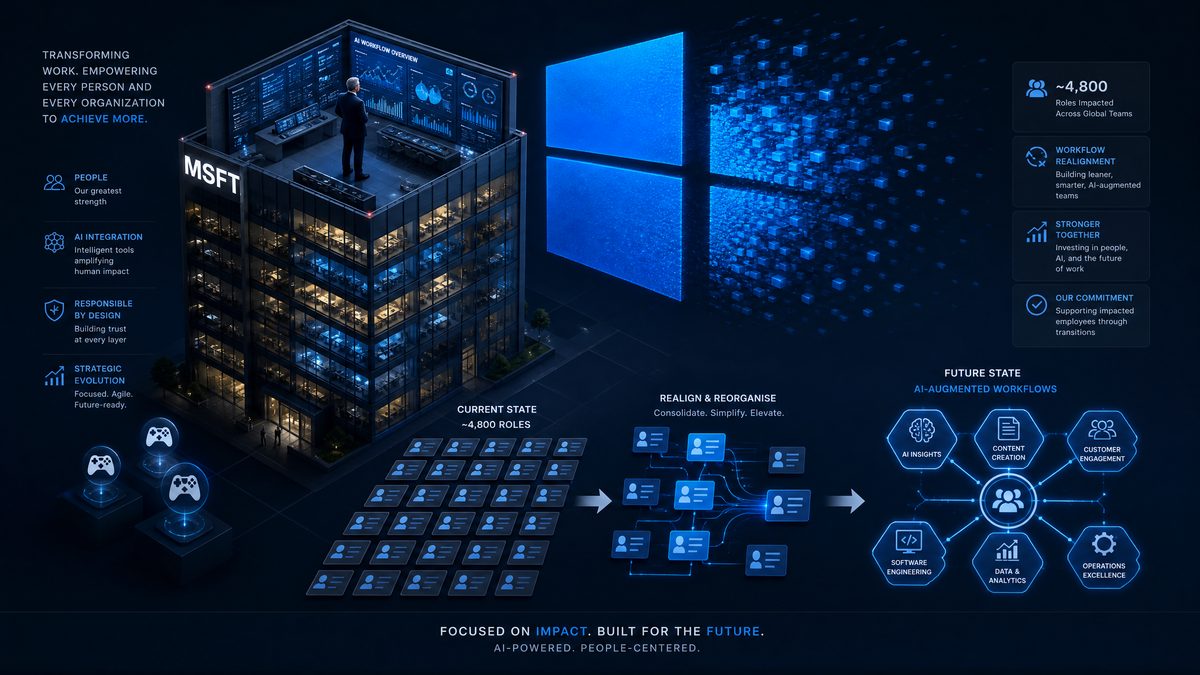
- Microsoft announced approximately 4,800 job cuts on 6 July 2026 — about 2.1% of its global workforce.
- 3,200 of those roles are connected to Xbox, including 1,600 immediate cuts and an expected further 1,600 during the fiscal year.
- Chief People Officer Amy Coleman stated explicitly: "The roles eliminated today are not being replaced by AI."
- Reuters and analysts linked the financial context to Xbox portfolio performance, competitive pressure from Sony and Nintendo, and the cost of $190 billion in projected AI investment for 2026.
- Microsoft's shares fell 1.4% on the announcement day, following a 23% decline in H1 2026 — their worst first-half performance since 2022.
- The restructuring is better understood as a mixture of Xbox portfolio change, financial discipline, work redesign and capital allocation toward AI.
- A layoff does not prove that the affected employees were weak performers or that their roles were obsolete.
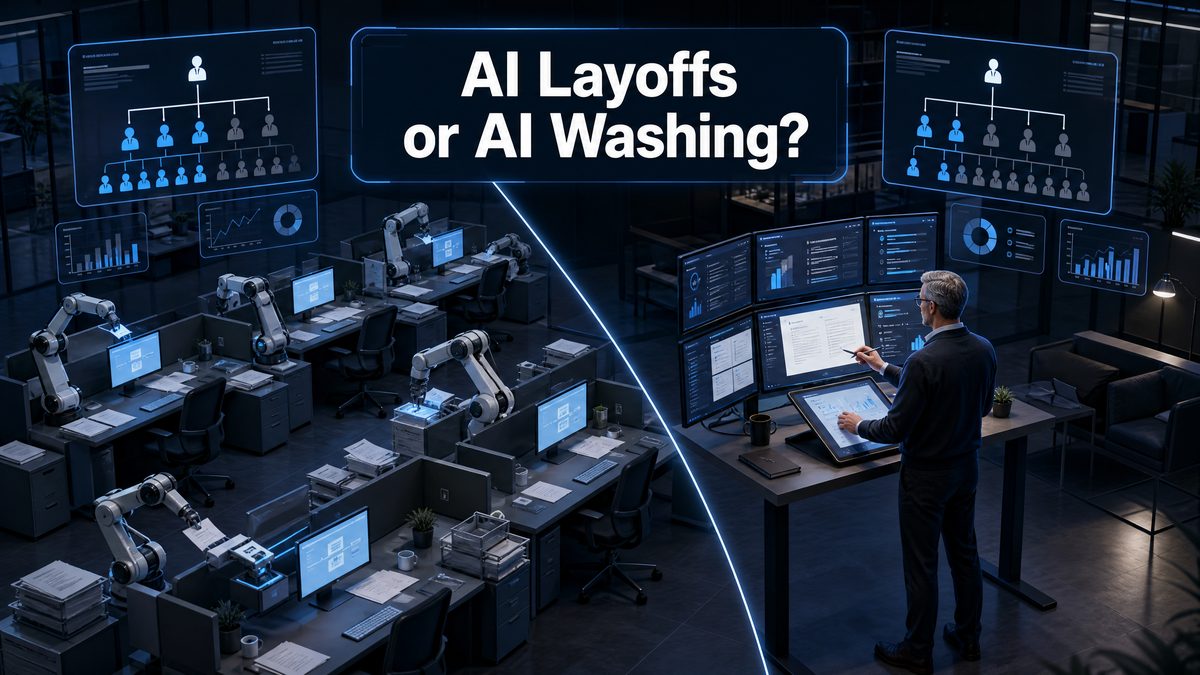
A layoff tells us what happened to a company at a particular moment. It does not establish the value or performance of the individual who lost their role. Microsoft's July 2026 announcement is a useful test case for applying that discipline. The headline — 4,800 jobs cut — is accurate. The implication that AI directly replaced those people is not supported by the evidence. Understanding the difference matters, both for the people affected and for the organisations drawing lessons from the decision.
This article is part of the AI, Work and the Operating Reality series, which examines the evidence behind AI-related workforce decisions and the distinction between genuine automation, AI-enabled restructuring, capital reallocation and AI-washing.
What Did Microsoft Announce on 6 July 2026?
Microsoft announced on 6 July 2026 that it would cut approximately 4,800 roles, representing about 2.1% of its global workforce. The announcement came through a combination of a company blog post and a Reuters report, which provided additional financial and strategic context. The cuts were described by the company as part of a broader transformation effort, with Chief People Officer Amy Coleman stating in a memo to employees: "The roles eliminated today are not being replaced by AI. At the same time, what is true is that AI is changing how work gets done."
Where Are the Microsoft Cuts Taking Place?
The majority of the cuts — approximately 3,200 roles — are concentrated in the Xbox gaming division. Of those, 1,600 employees were laid off on the announcement date, with a further 1,600 expected to follow during the fiscal year. The remaining approximately 1,600 cuts are distributed across other parts of the business. Microsoft has not provided a detailed country-by-country breakdown of the non-Xbox cuts.
Why Is Xbox Carrying Most of the Reduction?
Xbox's restructuring reflects a strategic pivot that has been building for several years. Despite spending tens of billions of dollars to expand the gaming division — including the $68.7 billion acquisition of Activision Blizzard — Microsoft has struggled to narrow the gap with Sony's PlayStation and Nintendo. The company has increasingly shifted its strategy toward distributing games across more platforms rather than relying on console-exclusive titles to drive Xbox hardware sales.
The restructuring includes the divestment of four studios. Compulsion Games (producer of 'South of Midnight') and Double Fine Productions (maker of 'Psychonauts') will become independent studios. Ninja Theory and Undead Labs will be spun off to continue developing 'Senua' and 'State of Decay 3' respectively. Arkane Studios, currently working on a Marvel Comics-based game, has begun consultations with its workers union in France to review options.
A surge in memory chip prices driven by data centre demand has also forced Microsoft to raise Xbox console prices at a time when demand for the console was already soft. The combination of competitive pressure, strategic repositioning and cost headwinds created the conditions for a significant restructuring of the gaming business, independent of any AI-driven automation rationale.
Did Microsoft Say AI Replaced the Affected Workers?
No. Microsoft's Chief People Officer Amy Coleman was explicit: "The roles eliminated today are not being replaced by AI." This is a significant statement, and it should be taken at face value as the company's official position. However, Coleman also acknowledged that "AI is changing how work gets done" — a statement that is consistent with AI influencing the size and composition of teams over time, without those teams being directly replaced by a specific AI system on a specific date.
The distinction matters. AI changing how work gets done is a gradual, ongoing process that affects productivity, skill requirements and team structures. AI directly replacing workers implies a specific system performing a specific role at a specific quality standard. Microsoft confirmed the former and denied the latter.
How Do AI Infrastructure Costs Affect Workforce Decisions?
Microsoft issued a $190 billion AI spending projection for 2026, massively surpassing analyst expectations. Building and running AI infrastructure at that scale — data centres, compute, energy, talent — requires capital that must come from somewhere. When revenue growth is constrained and margin expectations are fixed, reducing headcount is one of the few levers available to fund that investment without diluting returns.
Gil Luria, managing director of D.A. Davidson, described the dynamic directly: "Microsoft has been managing down its workforce in order to pay for its AI investments. By keeping its headcount down they have been able to accelerate revenue growth while maintaining the same margins." This is capital reallocation, not direct AI replacement. The distinction is important because it implies a different set of lessons for other organisations.
Parth Talsania, CEO of Equisights Research, noted that the announcement "reads more like portfolio reallocation and operating discipline than a fresh catalyst for the stock," adding that "the market is likely to reward Microsoft less for headcount reductions and more for evidence that AI monetization is scaling faster than AI-related costs."
What Is the Difference Between AI Replacement and AI Capital Reallocation?
| Question | Confirmed fact | Reasonable inference | Unsupported claim |
|---|---|---|---|
| Number of cuts | 4,800 roles, 2.1% of workforce | Company is simplifying costs and portfolio | AI directly replaced every affected worker |
| Xbox concentration | 3,200 of 4,800 cuts in Xbox division | Portfolio returns and competitive position influenced the decision | All affected roles were technologically obsolete |
| AI involvement | CPO: "AI is changing how work gets done" | AI investment influences capital priorities and team sizing | One AI system performs all the work of the eliminated roles |
| Hiring | Microsoft continues hiring in strategic areas | Workforce skill mix is changing toward AI-native capabilities | Microsoft no longer needs people to build or run its products |
What Skills Is Microsoft Still Hiring?
Microsoft continues to hire actively in AI engineering, Azure cloud infrastructure, security, and AI-native product development. The company's voluntary buyout programme earlier in 2026 — offered to approximately 7% of its US workforce, around 9,000 employees — was designed to reduce headcount in areas of lower strategic priority while preserving capacity in areas of growth. The workforce is being recomposed, not simply reduced.
What Does the Restructuring Tell CMOs?
Microsoft's restructuring offers three practical lessons for marketing and commercial leaders. First, AI investment at scale requires capital reallocation, and that reallocation will affect teams across the organisation — not just the teams directly deploying AI. Second, the skills that remain valuable are those that AI cannot yet reliably perform: strategic judgment, customer relationships, creative direction, governance and exception handling. Third, the announcement of AI-related cuts does not mean the AI systems are ready to perform the work. The gap between announcement and operational reality can be substantial.
For CMOs building AI-enabled marketing operations, the relevant question is not whether to reduce headcount, but whether the AI systems are genuinely ready to perform the work at the quality and reliability standard required. See AI Marketing Strategy for how Integrated.Social approaches this assessment.
Why Does a Layoff Not Prove Weak Performance?
Microsoft's affected employees include experienced engineers, game developers, producers and studio leaders who built some of the most commercially successful games and platforms in the industry. Their roles were eliminated because of portfolio strategy, competitive positioning and capital allocation decisions made at the executive level — not because of any assessment of their individual performance or capability.
This distinction matters beyond compassion. Organisations that treat layoffs as performance signals will misread the talent market, underestimate the expertise they have lost, and be surprised when the AI systems they deployed require precisely the knowledge that left with the people they removed. The expert-in-the-loop problem — examined in detail in Why Human-in-the-Loop AI Fails After Companies Remove Their Experts — begins here.
What Evidence Would Prove Genuine AI Substitution?
Genuine AI substitution would require evidence that a specific, tested, production-deployed system is performing the work of the eliminated roles at an acceptable quality, risk and customer-outcome level. That evidence would include: the name and deployment status of the system; measurable output quality metrics before and after; customer satisfaction or business outcome data; exception handling coverage; and governance arrangements for failures. Microsoft has not provided this evidence, because the CPO explicitly stated the roles are not being replaced by AI. The restructuring is real. The AI-replacement narrative is not the explanation.
Evidence and Limitations
Confirmed: 4,800 cuts announced 6 July 2026 (Reuters, Microsoft blog); 3,200 Xbox roles (1,600 immediate + 1,600 during FY); CPO Amy Coleman's statement that roles are not being replaced by AI; $190B AI spending projection; shares -1.4% on announcement, -23% H1 2026.
Reported, not fully confirmed: Analyst commentary from Luria and Talsania reflects independent market analysis, not Microsoft's official position.
Modi's inference: The classification of Microsoft's restructuring as primarily capital reallocation and portfolio change, rather than direct AI replacement, reflects analysis of available public evidence and the CPO's explicit statement.
What would change the conclusion: Evidence that specific AI systems are performing the work of the eliminated roles at production quality would shift the classification toward genuine automation.
AI Summary
- Microsoft announced approximately 4,800 job cuts on 6 July 2026 — about 2.1% of its global workforce.
- 3,200 of those roles are connected to Xbox, including 1,600 immediate cuts and an expected further 1,600 during the fiscal year.
- Chief People Officer Amy Coleman stated explicitly: "The roles eliminated today are not being replaced by AI."
- Reuters and analysts linked the financial context to Xbox portfolio performance, competitive pressure from Sony and Nintendo, and the cost of $190 billion in projected AI investment for 2026.
- Microsoft's shares fell 1.4% on the announcement day, following a 23% decline in H1 2026 — their worst first-half performance since 2022.
- The restructuring is better understood as a mixture of Xbox portfolio change, financial discipline, work redesign and capital allocation toward AI.
- A layoff does not prove that the affected employees were weak performers or that their roles were obsolete.
A layoff tells us what happened to a company at a particular moment. It does not establish the value or performance of the individual who lost their role. Microsoft's July 2026 announcement is a useful test case for applying that discipline. The headline — 4,800 jobs cut — is accurate. The implication that AI directly replaced those people is not supported by the evidence. Understanding the difference matters, both for the people affected and for the organisations drawing lessons from the decision.
This article is part of the AI, Work and the Operating Reality series, which examines the evidence behind AI-related workforce decisions and the distinction between genuine automation, AI-enabled restructuring, capital reallocation and AI-washing.
What Did Microsoft Announce on 6 July 2026?
Microsoft announced on 6 July 2026 that it would cut approximately 4,800 roles, representing about 2.1% of its global workforce. The announcement came through a combination of a company blog post and a Reuters report, which provided additional financial and strategic context. The cuts were described by the company as part of a broader transformation effort, with Chief People Officer Amy Coleman stating in a memo to employees: "The roles eliminated today are not being replaced by AI. At the same time, what is true is that AI is changing how work gets done."
Where Are the Microsoft Cuts Taking Place?
The majority of the cuts — approximately 3,200 roles — are concentrated in the Xbox gaming division. Of those, 1,600 employees were laid off on the announcement date, with a further 1,600 expected to follow during the fiscal year. The remaining approximately 1,600 cuts are distributed across other parts of the business. Microsoft has not provided a detailed country-by-country breakdown of the non-Xbox cuts.
Why Is Xbox Carrying Most of the Reduction?
Xbox's restructuring reflects a strategic pivot that has been building for several years. Despite spending tens of billions of dollars to expand the gaming division — including the $68.7 billion acquisition of Activision Blizzard — Microsoft has struggled to narrow the gap with Sony's PlayStation and Nintendo. The company has increasingly shifted its strategy toward distributing games across more platforms rather than relying on console-exclusive titles to drive Xbox hardware sales.
The restructuring includes the divestment of four studios. Compulsion Games (producer of 'South of Midnight') and Double Fine Productions (maker of 'Psychonauts') will become independent studios. Ninja Theory and Undead Labs will be spun off to continue developing 'Senua' and 'State of Decay 3' respectively. Arkane Studios, currently working on a Marvel Comics-based game, has begun consultations with its workers union in France to review options.
A surge in memory chip prices driven by data centre demand has also forced Microsoft to raise Xbox console prices at a time when demand for the console was already soft. The combination of competitive pressure, strategic repositioning and cost headwinds created the conditions for a significant restructuring of the gaming business, independent of any AI-driven automation rationale.
Did Microsoft Say AI Replaced the Affected Workers?
No. Microsoft's Chief People Officer Amy Coleman was explicit: "The roles eliminated today are not being replaced by AI." This is a significant statement, and it should be taken at face value as the company's official position. However, Coleman also acknowledged that "AI is changing how work gets done" — a statement that is consistent with AI influencing the size and composition of teams over time, without those teams being directly replaced by a specific AI system on a specific date.
The distinction matters. AI changing how work gets done is a gradual, ongoing process that affects productivity, skill requirements and team structures. AI directly replacing workers implies a specific system performing a specific role at a specific quality standard. Microsoft confirmed the former and denied the latter.
How Do AI Infrastructure Costs Affect Workforce Decisions?
Microsoft issued a $190 billion AI spending projection for 2026, massively surpassing analyst expectations. Building and running AI infrastructure at that scale — data centres, compute, energy, talent — requires capital that must come from somewhere. When revenue growth is constrained and margin expectations are fixed, reducing headcount is one of the few levers available to fund that investment without diluting returns.
Gil Luria, managing director of D.A. Davidson, described the dynamic directly: "Microsoft has been managing down its workforce in order to pay for its AI investments. By keeping its headcount down they have been able to accelerate revenue growth while maintaining the same margins." This is capital reallocation, not direct AI replacement. The distinction is important because it implies a different set of lessons for other organisations.
Parth Talsania, CEO of Equisights Research, noted that the announcement "reads more like portfolio reallocation and operating discipline than a fresh catalyst for the stock," adding that "the market is likely to reward Microsoft less for headcount reductions and more for evidence that AI monetization is scaling faster than AI-related costs."
What Is the Difference Between AI Replacement and AI Capital Reallocation?
| Question | Confirmed fact | Reasonable inference | Unsupported claim |
|---|---|---|---|
| Number of cuts | 4,800 roles, 2.1% of workforce | Company is simplifying costs and portfolio | AI directly replaced every affected worker |
| Xbox concentration | 3,200 of 4,800 cuts in Xbox division | Portfolio returns and competitive position influenced the decision | All affected roles were technologically obsolete |
| AI involvement | CPO: "AI is changing how work gets done" | AI investment influences capital priorities and team sizing | One AI system performs all the work of the eliminated roles |
| Hiring | Microsoft continues hiring in strategic areas | Workforce skill mix is changing toward AI-native capabilities | Microsoft no longer needs people to build or run its products |
What Skills Is Microsoft Still Hiring?
Microsoft continues to hire actively in AI engineering, Azure cloud infrastructure, security, and AI-native product development. The company's voluntary buyout programme earlier in 2026 — offered to approximately 7% of its US workforce, around 9,000 employees — was designed to reduce headcount in areas of lower strategic priority while preserving capacity in areas of growth. The workforce is being recomposed, not simply reduced.
What Does the Restructuring Tell CMOs?
Microsoft's restructuring offers three practical lessons for marketing and commercial leaders. First, AI investment at scale requires capital reallocation, and that reallocation will affect teams across the organisation — not just the teams directly deploying AI. Second, the skills that remain valuable are those that AI cannot yet reliably perform: strategic judgment, customer relationships, creative direction, governance and exception handling. Third, the announcement of AI-related cuts does not mean the AI systems are ready to perform the work. The gap between announcement and operational reality can be substantial.
For CMOs building AI-enabled marketing operations, the relevant question is not whether to reduce headcount, but whether the AI systems are genuinely ready to perform the work at the quality and reliability standard required. See AI Marketing Strategy for how Integrated.Social approaches this assessment.
Why Does a Layoff Not Prove Weak Performance?
Microsoft's affected employees include experienced engineers, game developers, producers and studio leaders who built some of the most commercially successful games and platforms in the industry. Their roles were eliminated because of portfolio strategy, competitive positioning and capital allocation decisions made at the executive level — not because of any assessment of their individual performance or capability.
This distinction matters beyond compassion. Organisations that treat layoffs as performance signals will misread the talent market, underestimate the expertise they have lost, and be surprised when the AI systems they deployed require precisely the knowledge that left with the people they removed. The expert-in-the-loop problem — examined in detail in Why Human-in-the-Loop AI Fails After Companies Remove Their Experts — begins here.
What Evidence Would Prove Genuine AI Substitution?
Genuine AI substitution would require evidence that a specific, tested, production-deployed system is performing the work of the eliminated roles at an acceptable quality, risk and customer-outcome level. That evidence would include: the name and deployment status of the system; measurable output quality metrics before and after; customer satisfaction or business outcome data; exception handling coverage; and governance arrangements for failures. Microsoft has not provided this evidence, because the CPO explicitly stated the roles are not being replaced by AI. The restructuring is real. The AI-replacement narrative is not the explanation.
Evidence and Limitations
Confirmed: 4,800 cuts announced 6 July 2026 (Reuters, Microsoft blog); 3,200 Xbox roles (1,600 immediate + 1,600 during FY); CPO Amy Coleman's statement that roles are not being replaced by AI; $190B AI spending projection; shares -1.4% on announcement, -23% H1 2026.
Reported, not fully confirmed: Analyst commentary from Luria and Talsania reflects independent market analysis, not Microsoft's official position.
Modi's inference: The classification of Microsoft's restructuring as primarily capital reallocation and portfolio change, rather than direct AI replacement, reflects analysis of available public evidence and the CPO's explicit statement.
What would change the conclusion: Evidence that specific AI systems are performing the work of the eliminated roles at production quality would shift the classification toward genuine automation.