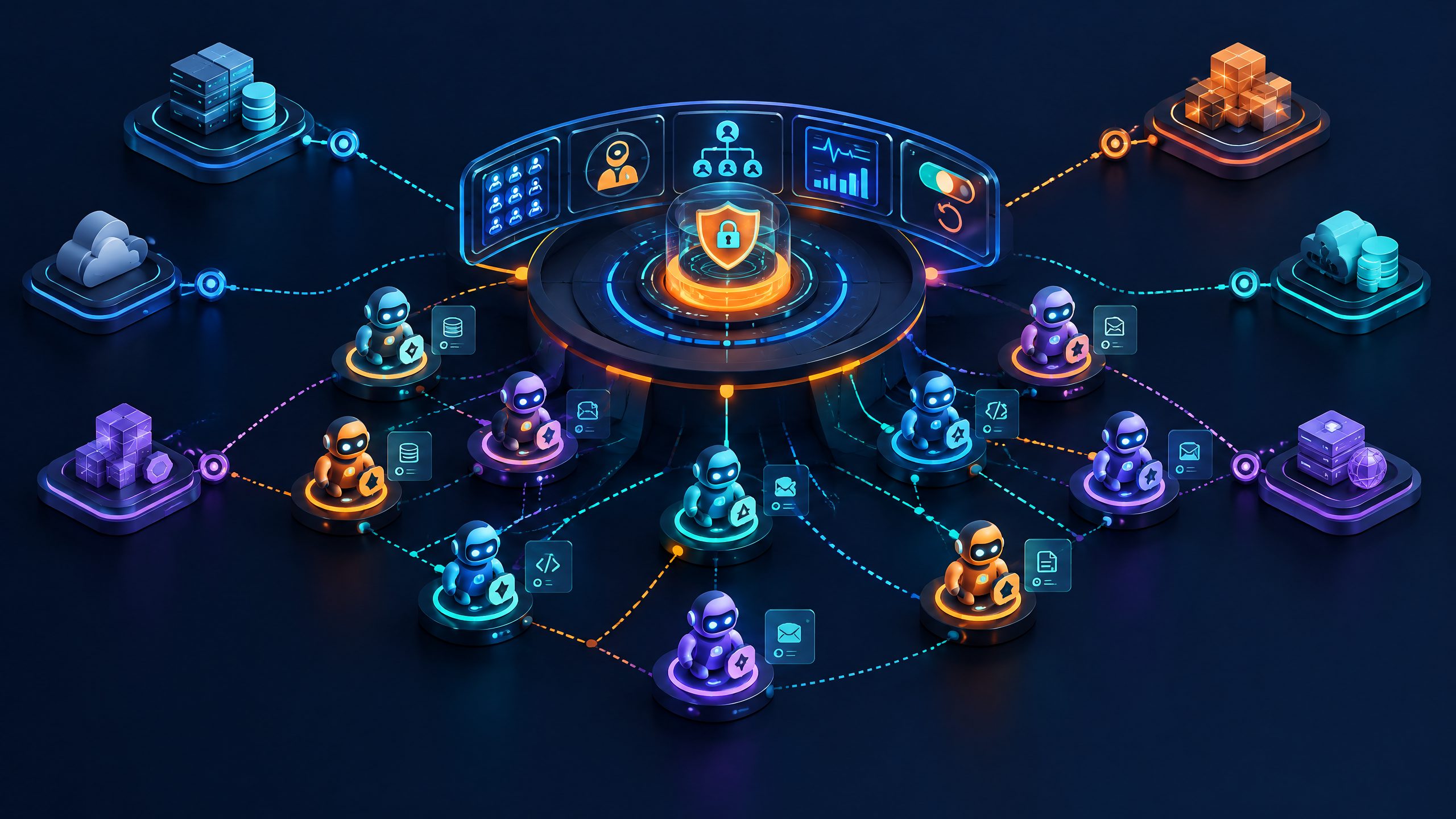
The short answer is not one vendor, dashboard, or policy document. It is an operating model that identifies every agent, limits what each may do, observes behavior while work happens, and intervenes when risk crosses a defined threshold. The Blueprint Alliance is a useful attempt to describe that model across vendors. It is not yet a formal standard, a certified interoperability program, or proof that multi-vendor controls work together in production.
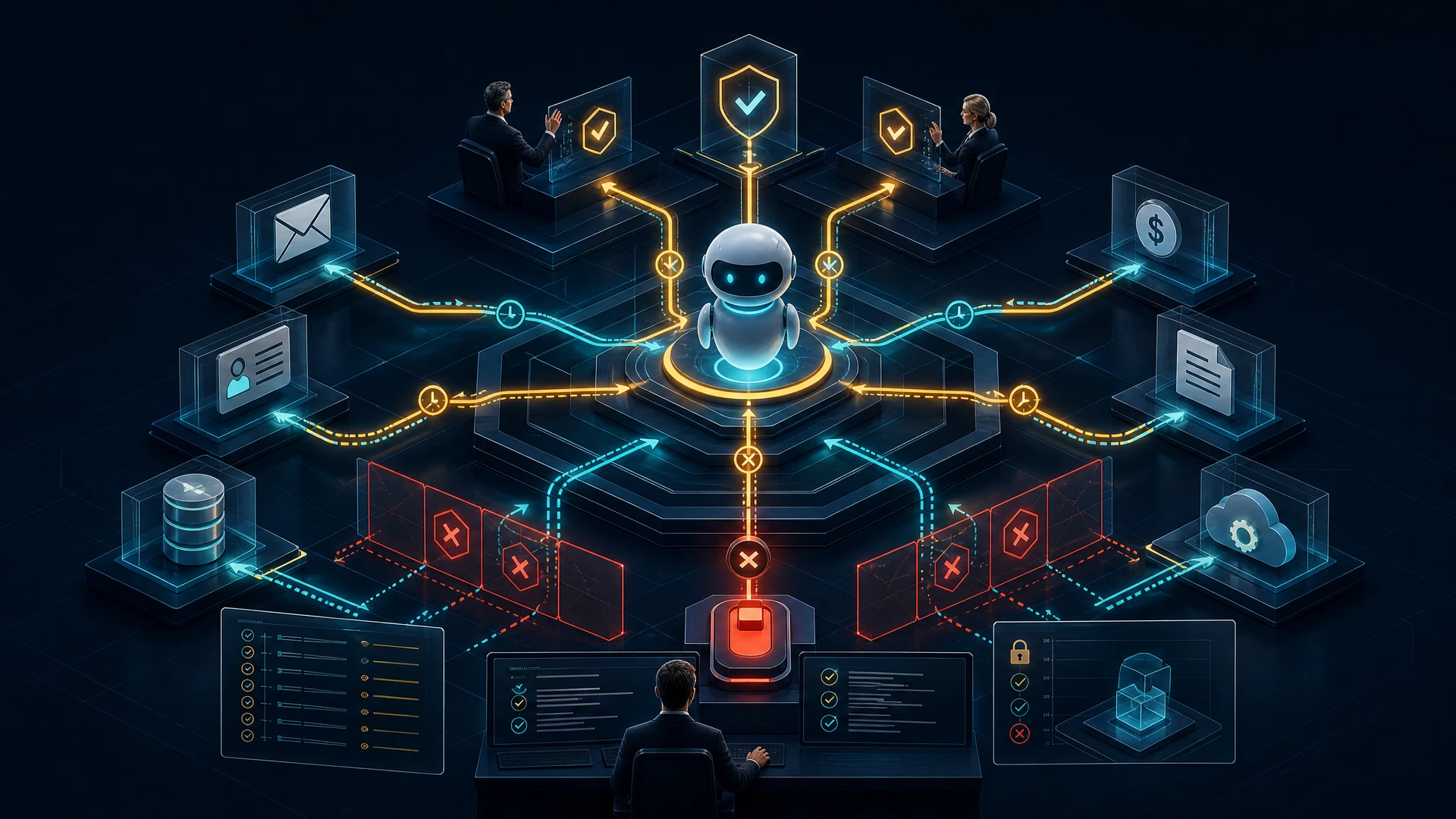
On September 22, 2026, Okta, AWS, CrowdStrike, Databricks, Docker, Google Cloud, Lovable, Proofpoint, Salesforce, ServiceNow, Wiz, and Zscaler announced the Blueprint Alliance, a cross-industry coalition for a shared architecture to secure AI agents.[Okta announcement] [Blueprint Alliance overview] The group’s reference architecture organizes the problem around four questions: Where are my agents? What can they do? What are they doing? How do I respond? Those are the right executive questions because an autonomous system with access to customer data, a cloud environment, a campaign account, or a code repository is not simply another software seat.
The launch deserves attention, but also precision. Confirmed: the coalition has published principles, a reference architecture, and a stated plan to test interoperability across MCP, OCSF, SSF, and CAEP. Not confirmed: that those protocols already produce reliable cross-vendor controls in a live enterprise, that the members’ products interoperate end to end, or that an adopter will receive a unified control plane by joining the ecosystem. The Alliance is a coalition reference architecture and vendor roadmap. Enterprises should evaluate it as such.
Why an agent needs management, not just access
A traditional user account has an owner, role, sign-in history, and lifecycle. An agent can be created inside a SaaS tool, built with an internal framework, invoked through an API, handed a temporary credential, and delegated work by another agent. That changes the question from “who has access?” to “what authority was delegated, in what context, for how long, and what happened?”
The scale argument is a forecast, not a current census. Gartner predicts that by 2028 the average global Fortune 500 enterprise will have more than 150,000 agents in use, up from fewer than 15 in 2025; Gartner also says only 13% of organizations believe they have the right agent governance in place.[Gartner] That prediction is Gartner’s, not the Alliance’s, and it should be read as a planning signal rather than a measured count of every company’s agents.
The Alliance’s website separately says that 92% of organizations use autonomous agents and that 34% secure them with the same rigor as human users. Those are vendor-published figures on the Alliance site; the page does not identify a methodology or original study in the material reviewed for this article. They should not be treated as independent market evidence. The operational point remains valid without them: an enterprise cannot govern what it cannot discover, attribute, constrain, and reconstruct.
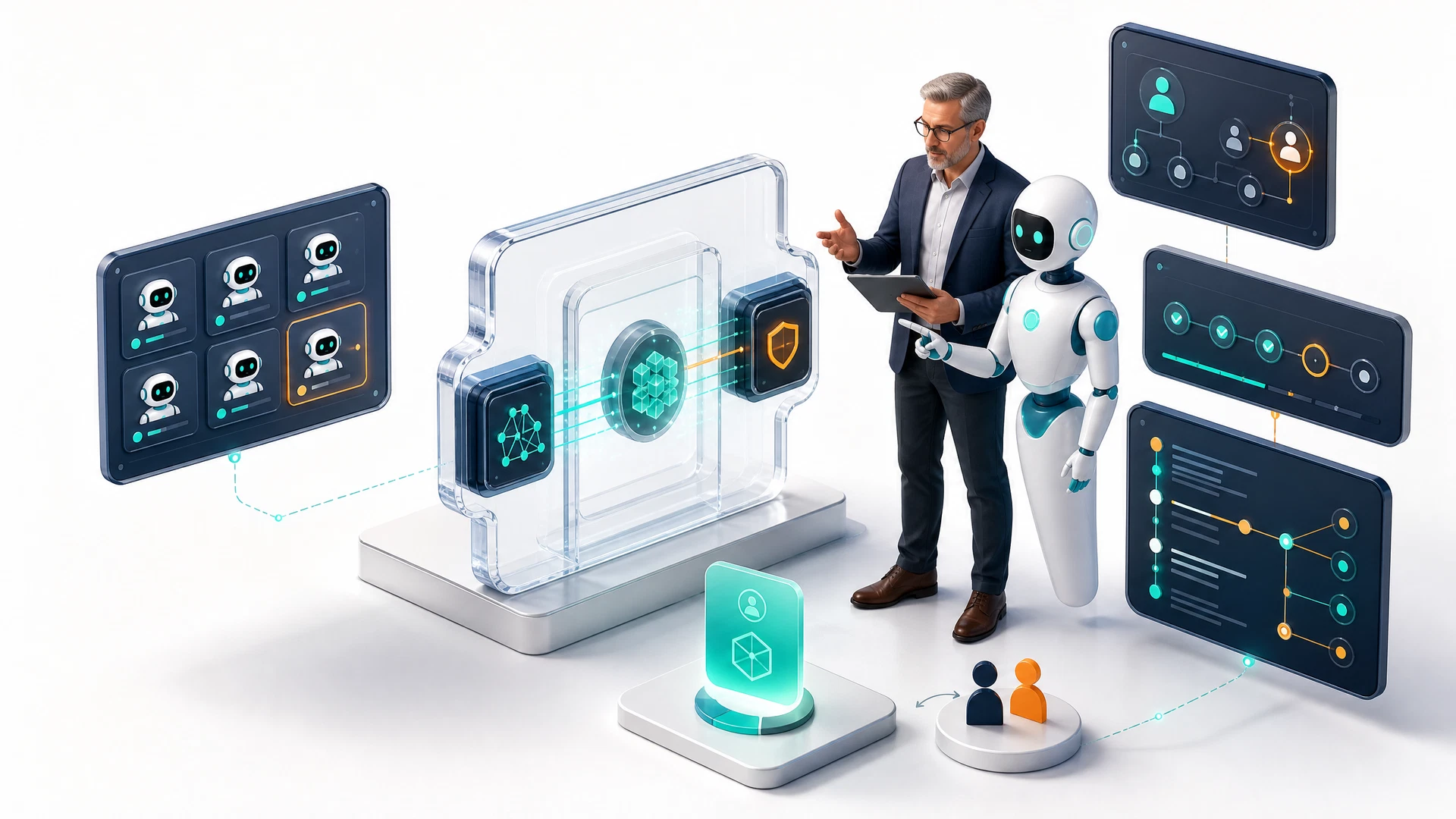
This is why the word manager is useful. It is not a person approving every action; it is the accountable combination of business owner, security control, platform rule, and escalation process. The owner defines purpose and acceptable outcomes; authorization controls limit resources; runtime telemetry tests behavior; and an incident workflow can suspend, narrow, or revoke authority.
What the Blueprint Alliance has actually put on the table
The coalition describes six principles: treat every agent as a distinct security identity; scope access to the task rather than grant standing access; make delegation traceable; monitor runtime behavior; make containment instant and reversible; and adapt governance as agent capabilities evolve. Its architecture places four operational capabilities around those principles.
1. Discovery and governed identity: “Where are my agents?”
The first capability is inventory. A credible inventory needs a unique identity, accountable owner, creation source, environment, enabled tools and connectors, data classes touched, authorization method, and lifecycle state. Shadow agents can be approved tool features enabled without a defined owner or review path, not only unauthorized bots.
The Alliance’s “first-class identity” idea is therefore practical. It means an agent should be provisioned, authenticated, reviewed, and retired with discipline comparable to a workforce or workload identity. It does not mean a single identity vendor must own the entire stack. That distinction matters for buyers seeking a multi-vendor approach.
2. Task-scoped authority: “What can they do?”
The second capability separates broad platform access from task-specific authority. An agent preparing a market summary may need an approved research repository, not standing rights to export a CRM, change a pricing table, or create a public campaign. In a multi-agent chain, each delegated step also needs an origin and authority record.
This is aligned with the related question explored in our analysis of contextual authority for AI agents [blocked]: permissions are not enough if the system cannot show why a permission was valid for a particular action. The policy must be tied to the task, data sensitivity, tool, environment, amount of authority delegated, and time window.
3. Runtime observation: “What are they doing?”
Provisioning-time checks cannot see a later tool call, unexpected retrieval query, changed prompt chain, or downstream request for more scope. The Alliance calls for runtime monitoring, execution context, and risk signals. Controls need to see events while work is underway, not only audit them after a result has been published, sent, deleted, or spent.
That is an important design direction, but it is not an interoperability result. The Stack’s independent coverage noted that the group says it is building and testing interoperability across MCP, OCSF, SSF, and CAEP, with the goal of coordinated action across connected control planes.[The Stack] The verb tense matters. “Building and testing” is a commitment to future work, not evidence that a customer can already connect any member product and expect shared runtime enforcement.
4. Containment and recovery: “How do I respond?”
A response control is not merely an alert ticket. It can pause a session, revoke a token, block a sensitive tool, require review, narrow a configuration, or disable an agent while preserving investigative evidence. “Instant and reversible” is the Alliance’s target state. Buyers should ask who can invoke a stop action, what it affects, how quickly it works, what remains recoverable, and how it is recorded.
That question is related to our review of automated shutdown and the agent control plane [blocked]. A kill switch is necessary, but it is not a complete control model if the enterprise cannot identify the agent, understand its active delegations, and distinguish a safe pause from an incomplete transaction.
Founding members: broad coverage, not one integrated product
The founding members cover cloud and AI infrastructure (AWS and Google Cloud); data and analytics (Databricks); runtime and developer environments (Docker); identity (Okta); applications (Salesforce and ServiceNow); and security controls (CrowdStrike, Proofpoint, Wiz, and Zscaler). Lovable is also a founding member. GE Appliances and World Central Kitchen are strategic advisors, not founding technology members.[Okta announcement]
That breadth is the Alliance’s proposition. Agents use cloud compute, call tools, retrieve data, interact with applications, and may trigger endpoint, network, or data-security concerns. A single-vendor product view can leave gaps between those layers.
But breadth also creates the hard problem. Each member has its own products, data models, deployments, and roadmaps. A reference architecture can establish a vocabulary; it cannot resolve event semantics, control precedence, support obligations, latency, data retention, licensing, or incident ownership. An inference from the member mix is that the Alliance can help frame cross-domain design conversations. It has not eliminated integration work or vendor risk.
Forkast makes a similarly useful distinction: the effort is not shipping one product, and future joint interoperability results will be a meaningful test of whether this becomes more than coalition alignment.[Forkast] Senior leaders should ask for those results before treating the architecture as a deployment assurance.
Practical checklist: evaluate an agent-governance stack before expanding access
Use this checklist for a design review, pilot gate, or vendor evaluation; it is more specific than “do we have an AI policy?”
- Inventory the estate. List internal and SaaS agents, automations, agent service accounts, tools, environments, and owners; record what remains unknown.
- Classify authority by task. For each high-impact workflow, document the minimum data, tools, actions, spending limits, and time window required. Remove unrelated standing access.
- Make delegation reconstructable. Preserve the initiator, downstream delegations, policy decision, credentials, and outcome. Test whether an investigator can follow the chain.
- Define signals and intervention points. Monitor unusual retrieval, new connectors, escalation, external publishing, financial action, and repeated failure. Specify the recipient and available control.
- Test containment safely. In a tabletop and nonproduction exercise, confirm teams can pause an agent, revoke authority, retain logs, and restore approved work.
- Demand vendor evidence. Ask for supported standards, versions, event mappings, tested integrations, limitations, deployment responsibility, and roadmap status. Treat future features as roadmap statements until demonstrated locally.
- Assign owners. Identify the workflow owner, platform owner, security approver, data steward, and escalation authority for each material use case.
The goal is controlled learning, not a universal freeze. Gartner likewise warns that simply blocking agents may create shadow use. Give lower-risk work a governed path while reserving sensitive systems and irreversible actions for stronger review.[Gartner]
What this means for commercial and marketing teams
Agent governance is not only an IT issue once agents can access campaign platforms, customer data, content systems, product information, or purchasing workflows. A marketing agent that changes bids, sends a segment, publishes a claim, or transfers a customer record can create commercial, legal, and trust consequences. The control design should match the action, not the department.
For commercial teams, the sensible first move is an evidence-based pilot: bounded inputs, reversible outputs, an owner, success and exception criteria, action logs, and pre-defined approval triggers. As our examination of enterprise agent security standards [blocked] explains, access, authority, and accountability should be proportionate to possible impact.
Integrated.Social’s AI governance service [blocked] can help a B2B team scope a controlled evidence, measurement, or governance review for a specific agent-enabled workflow. That work should clarify decision rights, observable controls, data boundaries, and test criteria; it should not be presented as a guarantee of compliance, security, revenue, leads, rankings, or AI citations.
The decision to make now
The Blueprint Alliance has turned vague concern about “agent sprawl” into four testable operating questions. Its principles are directionally sound, and its members make the effort relevant across identity, security, cloud, data, application, and runtime layers.
The disciplined response is neither dismissal nor premature adoption. Treat the Blueprint as a decision framework and vendor roadmap. Challenge your inventory, authority model, runtime evidence, and response design. Then ask which integration works today, what proves it, where the gaps are, and who owns failure when the control chain breaks. Until joint reference integrations and repeatable results are published and validated in context, it remains a coordination effort, not a proven interoperability outcome.
Frequently asked questions
Is the Blueprint Alliance a formal AI agent security standard?
No. The materials reviewed describe an industry coalition and an open, multi-vendor reference architecture. It is not presented as a formal standard issued by an accredited standards body, nor as a certification that products or deployments are interoperable. Enterprises should verify the status of individual integrations and protocols directly with vendors.
Which companies founded the Blueprint Alliance?
The founding members named in Okta’s September 22, 2026 announcement are AWS, CrowdStrike, Databricks, Docker, Google Cloud, Lovable, Okta, Proofpoint, Salesforce, ServiceNow, Wiz, and Zscaler. GE Appliances and World Central Kitchen are described as strategic advisors, which is a different role from founding technology membership.
What evidence should a buyer request before relying on cross-vendor agent controls?
Request a tested integration description for the exact product versions and deployment model under consideration. It should state which signals are exchanged, how identities and authorizations are correlated, what action can be taken, expected latency, failure behavior, log retention, control ownership, and any feature still on the roadmap. A diagram alone is not sufficient evidence.
How should an enterprise start governing agents without stopping useful experimentation?
Start with one bounded workflow whose inputs, tools, data, and possible actions can be defined clearly. Give it a named owner, task-scoped permissions, action logging, explicit escalation rules, and a tested suspension process. Expand only after the organization can explain what happened during the pilot and where its controls did not work as intended.
Sources
- https://blueprintalliance.ai/
- https://www.okta.com/newsroom/press-releases/industry-leaders-form-the-blueprint-alliance/
- https://www.thestack.technology/the-blueprint-what-the-hell-are-my-agents-doing/
- https://forkast.news/the-blueprint-alliance-building-an-agent-governance-stack-by-consensus/
- https://www.gartner.com/en/newsroom/press-releases/2026-04-28-gartner-identifies-six-steps-to-manage-artificial-intelligence-agent-sprawl