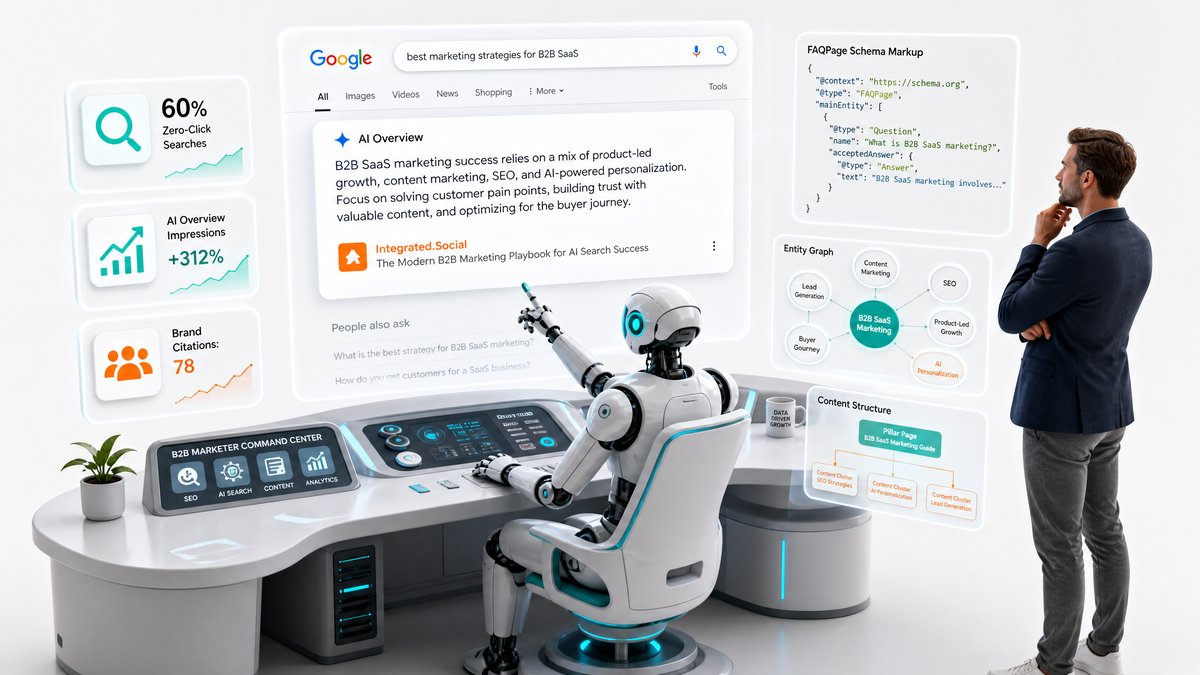
AI Answer Summary
When ChatGPT, Gemini, or Google AI Overviews generate an answer, they are not randomly selecting sources from the web. They are following a set of structural and authority signals to identify which content is most suitable to cite. Most content fails these signals. Not because it is low quality,.
Why Most Content Never Gets Cited by AI
When ChatGPT, Gemini, or Google AI Overviews generate an answer, they are not randomly selecting sources from the web. They are following a set of structural and authority signals to identify which content is most suitable to cite. Most content fails these signals. Not because it is low quality, but because it is not structured for AI extraction.
The good news: the patterns AI systems prefer are learnable, consistent, and implementable without rewriting your entire content library. This guide covers the seven structural patterns that make content citation-ready for AI answer engines.
The Citation Selection Model: How AI Chooses Sources
Before the seven patterns, it helps to understand how AI systems evaluate content for citation. The process is not identical across systems, but the underlying signals are consistent:
1. Relevance matching, Does the content directly answer the query? AI systems prefer content that addresses the exact question, not content that mentions the topic in passing.
2. Structural clarity, Is the answer extractable? AI systems prefer content where the answer is clearly delineated, in a paragraph, list, or table, rather than buried in flowing prose.
3. Authority signals, Is the source credible? AI systems weight content from domains with established topical authority, named authors with verifiable credentials, and content that cites primary sources.
4. Freshness, Is the content current? AI systems, particularly for time-sensitive queries, prefer recently published or updated content over older material.
5. Claim density, Does the content make specific, verifiable claims? AI systems prefer content with concrete numbers, named frameworks, and specific recommendations over vague generalisations.
The seven patterns below address each of these signals directly.
Pattern 1: Answer-First Architecture
The single most impactful structural change you can make is moving the direct answer to the first paragraph.
AI systems extract the first substantive paragraph that answers the query. If your content opens with context, history, or a table of contents, the AI will skip to the first paragraph that actually answers the question, which may be paragraph four or five. By then, a competitor's content that opens with the direct answer has already been selected as the citation source.
The structure:
- Direct answer (2-3 sentences), this is what AI extracts
- Why it matters, context and stakes
- How it works, mechanism and depth
- What to do, actionable next steps
AI systems extract the first substantive paragraph that directly answers the query. If your first paragraph is "In this article, we will explore..." you are training AI to skip your content.
Pattern 2: Explicit Question-Answer Pairs
AI systems are trained on Q&A data. Content that explicitly mirrors the question-answer format is structurally aligned with how AI processes and retrieves information.
This means:
- Use the exact query as a heading ("What is AEO?" not "Understanding AEO")
- Follow the heading immediately with a direct answer paragraph
- Add FAQPage schema to make the Q&A pairs machine-readable
The heading "What is Answer Engine Optimization?" followed by a direct definition is far more citation-ready than "The Evolution of Search" followed by three paragraphs of context before the definition appears.
Pattern 3: Claim Density and Specificity
Vague content does not get cited. AI systems prefer content with specific, verifiable claims, numbers, named frameworks, concrete recommendations, and primary source references.
Low claim density (not citation-ready):
"AI Overviews appear on many searches and can reduce click-through rates significantly for websites that rank well."
High claim density (citation-ready):
"Google AI Overviews appear on approximately 68% of searches in 2026. When an AI Overview is present, position-1 organic CTR drops by 25-40% compared to a SERP without an AI Overview."
The second version gives AI a specific, citable claim. The first gives it nothing to extract.
For every assertion in your content, ask: "Can I make this more specific?" Replace "many" with a percentage. Replace "significantly" with a measured range. Replace "some companies" with a named example or study.
Pattern 4: Named Frameworks and Proprietary Terminology
AI systems cite sources that introduce named concepts. When you name a framework, methodology, or model, you create a citable entity that AI systems can attribute to your brand.
Examples:
- "The (Re)Target Framework" (Integrated.Social)
- "E-E-A-T" (Google)
- "The Flywheel" (HubSpot)
- "Jobs to Be Done" (Clayton Christensen)
When you introduce a named framework, define it clearly in the first mention, use it consistently throughout the content, and implement DefinedTerm schema to make it machine-readable. AI systems that encounter the framework name in a query will trace it back to your content as the origin source.
Pattern 5: Structured Data as a Citation Signal
Schema markup is the machine-readable layer that tells AI systems exactly what your content means. For citation eligibility, the highest-impact schema types are:
| Schema Type | Citation Signal | Implementation |
|---|---|---|
| FAQPage | Direct Q&A extraction | Every informational page |
| HowTo | Process and tutorial citation | Step-by-step guides |
| Article + Author | Author authority and credentials | All blog posts and guides |
| DefinedTerm | Concept and framework citation | Glossary pages, named frameworks |
| SpeakableSpecification | Voice and conversational AI | Key definition paragraphs |
FAQPage schema is the single most impactful implementation. It provides structured Q&A pairs that AI systems can extract verbatim, bypassing the need for AI to interpret your prose structure.
Pattern 6: Author Authority and Entity Signals
AI systems do not just evaluate content, they evaluate the entity that produced it. Author authority is a significant citation signal, particularly for YMYL (Your Money, Your Life) topics including finance, health, and legal content.
Author authority signals:
- Named byline on every piece of content
- Person schema with name, jobTitle, credentials, and sameAs links to LinkedIn and other authoritative profiles
- Author bio that explicitly states relevant expertise and experience
- Consistent authorship, the same named author publishing consistently on a topic builds topical authority over time
- External citations, being cited by authoritative publications creates entity authority that AI systems recognise
Anonymous or "Editorial Team" bylines are a significant citation disadvantage. AI systems prefer content from identifiable human experts with verifiable credentials.
Pattern 7: Primary Source Citation and Evidence Chains
AI systems are trained to prefer content that cites primary sources, original research, official documentation, peer-reviewed studies, and government data. Content that builds an evidence chain from primary sources is significantly more citation-worthy than content that makes unsupported assertions or cites secondary sources.
Evidence chain structure:
- Make a specific claim
- Cite the primary source (with a link)
- Explain the implication for your audience
- Connect to your named framework or recommendation
Example:
"Google AI Overviews now appear on 68% of searches (Google Search Central, 2026). When an AI Overview is present, position-1 organic CTR drops by 25-40% (SparkToro zero-click study, 2026). This means traditional click-based SEO metrics are measuring a shrinking minority of search behaviour, which is why the (Re)Target framework treats AI Overview impressions as a primary KPI, not a secondary one."
This structure gives AI a claim, a source, an implication, and a named framework, four citation signals in four sentences.
The Citation-Readiness Checklist
Before publishing any piece of content intended for AI citation, run it through this checklist:
Structure:
- Direct answer in the first paragraph (2-3 sentences)
- Exact query phrase used as a heading
- FAQ section with explicit Q&A pairs
- FAQPage schema implemented
Claims:
- Every assertion includes a specific number or named example
- Primary sources cited with links for key statistics
- Named framework or proprietary terminology introduced and defined
Authority:
- Named author with Person schema
- Author bio with explicit credentials
- datePublished and dateModified in Article schema
- Organization schema on the domain with complete knowsAbout fields
Freshness:
- dateModified updated to current date
- Statistics checked and updated if older than 12 months
- "Last updated" label visible on the page
Applying the Seven Patterns: A Before and After
Here is a single paragraph transformed from citation-invisible to citation-ready using all seven patterns:
Before:
"AI is changing how people search online. Many users are getting answers directly from AI tools without clicking on websites. This is something marketers need to think about when creating content."
After:
"AI Overviews now appear on 68% of Google searches in 2026, and 60% of all searches end without a click, up from 34% in 2022 (SparkToro, 2026). For B2B marketers, this means the primary value of informational content has shifted from driving clicks to winning AI citations. The (Re)Target framework addresses this by treating AI Overview impressions as a top-of-funnel brand channel, measured separately from organic traffic and optimised through answer-first content structure, FAQPage schema, and entity authority building."
The second version contains: a specific claim with a source, a trend comparison, a named audience, a named framework, a strategic implication, and three named tactics. It is extractable, attributable, and citation-ready.
The brands that master these seven patterns in 2026 will compound their AI citation advantage over the next 12-18 months as AI search becomes the dominant interface for information discovery.
Ready to improve your AI search visibility? Request a free AI growth audit from the Integrated.Social team and discover how your brand appears across ChatGPT, Perplexity, and Google AI Overviews.