Integrated.SocialIntegrated.Social

Will Every Executive and Brand Soon Need an AI Digital Representative?

ProWebChat launched AI YOU and AI YOU OS in July 2026, positioning AI-generated digital identities as a new category of brand and executive representation. The question is not whether AI digital representatives will become mainstream. It is whether the organisations that adopt them will govern them well enough to build trust rather than erode it.

Modi Elnadi6 min read
Will Every Executive and Brand Soon Need an AI Digital Representative?
AI SummaryKey takeaways for AI answer engines
  • ProWebChat launched AI YOU and AI YOU OS in July 2026, creating a new category of AI digital representatives for individuals and brands.
  • 75% of executives expect AI agents will be part of the C-suite within 5 years; 95% say roles are already changing because of AI (Writer/Workplace Intelligence, 2026).
  • The AI agents market reached $10.91B in 2026, projected to reach $50.31B by 2030 (Grand View Research).
  • Salesforce Agentforce resolved 84% of 380,000+ support interactions autonomously, demonstrating the scale at which AI representatives can operate.
  • Governance, not technology, is the primary differentiator between AI representatives that build trust and those that erode it.
  • AEO-optimised content is the knowledge foundation that makes AI digital representatives accurate, on-brand, and citation-ready.
Key Numbers
75%

of executives expect AI agents in the C-suite within 5 years

Writer/Workplace Intelligence, 2026

$10.91B

global AI agents market in 2026

Grand View Research

84%

of Salesforce Agentforce support cases resolved autonomously

Salesforce, 2026

30%

of customer service cases now handled by AI agents

Salesforce State of Service, 2026

A New Category of Brand Presence

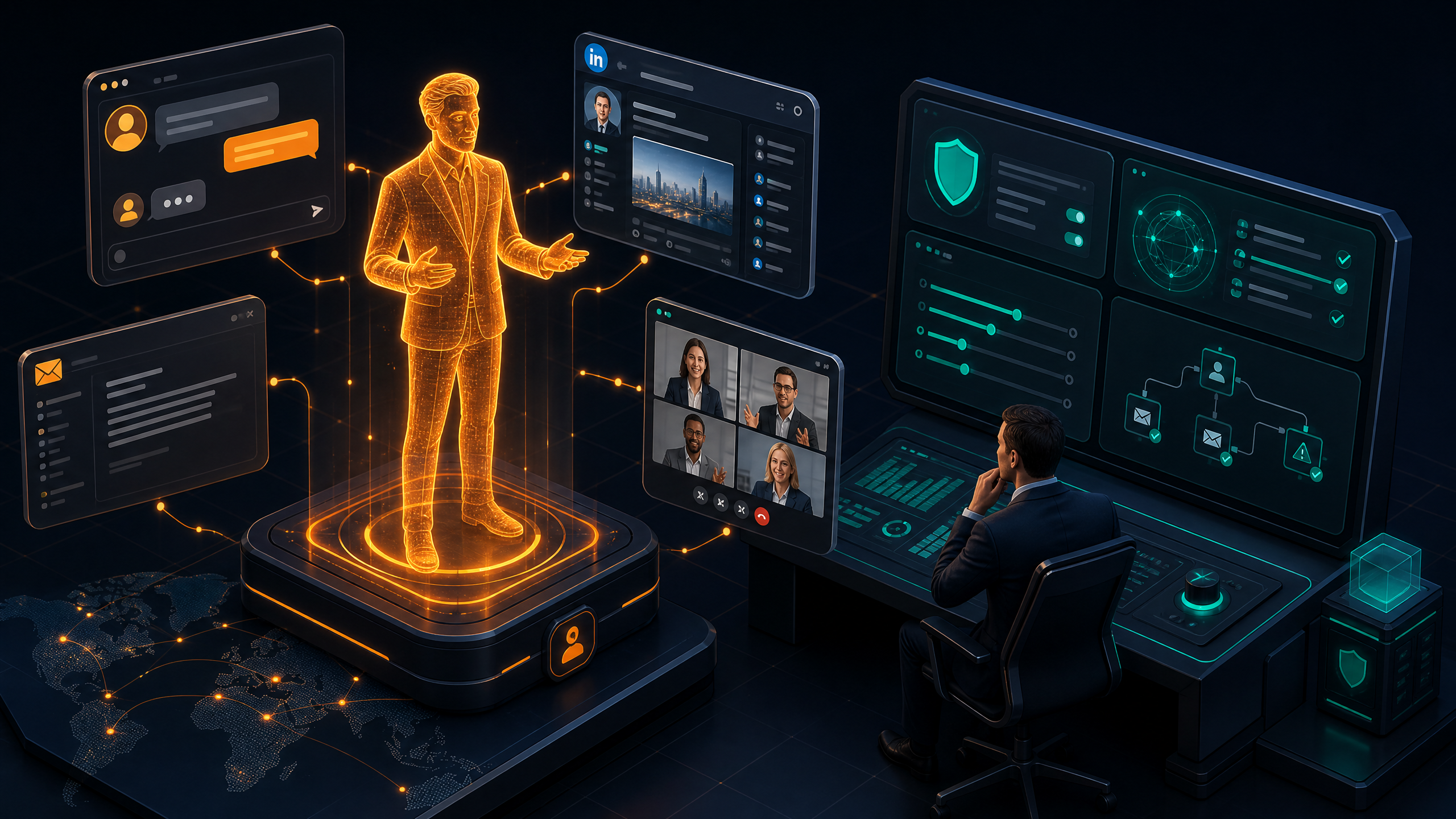
ProWebChat launched AI YOU and AI YOU OS in July 2026 with a positioning that deserves careful attention from every B2B marketing leader: AI-generated digital identities that expand static AI responses into personalised digital representatives. The platform allows individuals and brands to define the knowledge base, communication style, and engagement boundaries that govern how their AI representative interacts with audiences.

This is not a chatbot. A chatbot answers predefined questions from a script. An AI digital representative is designed to reflect the personality, expertise, and positioning of a specific individual or brand, drawing on approved knowledge to engage with novel queries in a way that is consistent with how the human or brand would respond.

The category is new. The underlying pressure that is creating it is not.

The Scale Problem That AI Representatives Solve

Every executive and brand faces the same fundamental constraint: the demand for their attention, expertise, and engagement exceeds the supply. A CEO with a strong LinkedIn presence cannot personally respond to every comment, every question, and every inbound message. A brand with a complex product cannot have a human expert available at every moment a prospect has a question.

AI digital representatives address this constraint by operating at scale across channels and time zones without degrading the quality or consistency of the engagement. According to a 2026 survey by Writer and Workplace Intelligence, 75 percent of executives expect AI agents will be part of their company's C-suite within five years, and 95 percent say roles and team structures are already changing because of AI. The AI agents market reached $10.91 billion in 2026, up 43 percent from 2025, and is projected to reach $50.31 billion by 2030.

Salesforce's Agentforce provides a concrete benchmark for what governed AI representation looks like at scale: the system handled over 380,000 support interactions and resolved 84 percent of cases autonomously. That is not a pilot. It is a production deployment at a scale that demonstrates what AI representatives can do when they are properly governed.

The Governance Question Is the Only Question That Matters

The technology for AI digital representation is available. The question that separates organisations that will benefit from it from those that will be damaged by it is governance.

An AI representative that makes inaccurate claims, contradicts official brand positions, or engages in ways that conflict with the executive's actual views can damage credibility faster than it builds it. The failure mode is not that the AI is obviously wrong. It is that the AI is subtly inconsistent, producing responses that are plausible but not quite right, eroding trust gradually rather than catastrophically.

Effective governance for AI digital representatives requires four components. The first is a defined knowledge boundary: what the AI representative knows, what it does not know, and how it handles questions outside its approved scope. The second is a claim approval process: who verifies that the AI's responses are accurate and on-brand before they go live. The third is an escalation framework: the triggers that route a query to a human rather than allowing the AI to respond autonomously. The fourth is a monitoring system that detects drift between the AI representative's behaviour and the brand's actual position over time.

None of these components are provided by the platform. They are the advertiser's responsibility, which is the same pattern we see in Google's AI labelling policy: the platform provides the mechanism, the brand provides the governance.

The AEO Connection

AI digital representatives and Answer Engine Optimisation are not separate strategies. They are complementary components of a coherent AI presence architecture.

AEO ensures that when AI systems retrieve and cite information about a brand or executive, the content they surface is accurate, structured, and aligned with the brand's positioning. An AI digital representative that operates from an AEO-optimised knowledge base will produce more accurate and on-brand responses than one drawing from unstructured or inconsistent content.

The practical implication is that brands which have invested in AEO, building structured, citation-ready content with clear entity relationships and FAQ schema, have a significant advantage when deploying AI digital representatives. Their knowledge base is already organised in the format that AI systems retrieve and cite most reliably. Brands that have not made that investment will find that their AI representative draws on whatever content is available, which may not reflect their current positioning, their most recent thinking, or their approved claims.

For a detailed view of how AEO structures content for AI retrieval, see our post on how answer engines now surface content differently [blocked] and the practical steps for building citation-ready content.

The Integrated.Social Perspective

The question is not whether AI digital representatives will become mainstream. The trajectory is clear. The question is whether the organisations that adopt them will govern them well enough to build trust rather than erode it.

The brands that will benefit most are those that approach AI digital representation as a trust infrastructure project, not a technology deployment. The starting point is the knowledge boundary. The second step is the governance framework. The third step is connecting the representative's knowledge base to the brand's AEO-optimised content so that what the AI says is consistent with what AI search engines surface about the brand.

Our AEO and AI Search service [blocked] is designed to build exactly this kind of foundation. If you want to understand how your current content and AI visibility position you for the AI representation layer, our free AI growth audit [blocked] is the right starting point. For context on how AI discoverability is already affecting B2B revenue, see our analysis of AI discoverability as a pipeline problem [blocked].

About the Author

Modi Elnadi is the founder of Integrated.Social, a B2B AI marketing agency in London specialising in Agentic AI lead generation, Answer Engine Optimisation, and AI-native website builds. Modi has been building performance marketing systems since 2014, with a focus on the intersection of AI capability and commercial outcomes for FinTech, SaaS, and B2B brands across the UK and USA. He has audited dozens of client websites for AI visibility and built AEO programmes that have generated measurable pipeline from ChatGPT, Perplexity, and Google AI Mode citations. Connect with Modi on LinkedIn or explore Integrated.Social's AEO and AI Search services [blocked].

Part of: Gemini Enterprise Agentic AI for Marketing & Sales & AI Breaking News, Trends & Market Intelligence

This article is part of our Gemini Enterprise Agentic AI marketing topic cluster. Explore related guides:

View all Gemini Enterprise Agentic AI for Marketing & Sales content →

Frequently Asked Questions

What is an AI digital representative?

An AI digital representative is an AI-powered system that engages with audiences on behalf of a person or brand, drawing on approved knowledge, communication style, and defined boundaries to respond to queries, participate in conversations, and represent the entity's perspective across digital channels. Unlike a static chatbot, an AI digital representative is designed to reflect the personality, expertise, and positioning of a specific individual or brand rather than providing generic responses.

What is ProWebChat's AI YOU platform?

ProWebChat launched AI YOU and AI YOU OS in July 2026, positioning them as a platform for creating personalised AI digital identities that expand static AI responses into dynamic, personalised digital representatives. AI YOU OS is described as an operating system for AI identity management, allowing individuals and brands to define the knowledge base, communication style, and boundaries that govern how their AI representative engages with audiences.

Will executives need AI digital representatives in the near future?

According to a 2026 survey by Writer and Workplace Intelligence, 75 percent of executives expect AI agents will be part of their company's C-suite within five years, and 95 percent say roles and team structures are already changing because of AI. As AI-mediated communication becomes the norm for initial audience engagement, executives and brands that do not have a governed AI representative risk ceding that engagement layer to competitors who do.

What are the governance risks of AI digital representatives for brands?

The primary governance risks are claim accuracy, brand consistency, and trust erosion. An AI representative that makes inaccurate claims, contradicts official brand positions, or engages in ways that conflict with the executive's actual views can damage credibility faster than it builds it. Effective governance requires defining the knowledge boundary, the claim approval process, the escalation triggers for human handoff, and the monitoring framework that detects drift between the AI representative's behaviour and the brand's actual position.

How does AI digital representation connect to Answer Engine Optimisation?

AI digital representatives and Answer Engine Optimisation are complementary strategies. AEO ensures that when AI systems retrieve and cite information about a brand or executive, the content they surface is accurate, structured, and aligned with the brand's positioning. An AI digital representative that operates from an AEO-optimised knowledge base will produce more accurate and on-brand responses than one drawing from unstructured or inconsistent content. Together, they form a coherent AI presence strategy.

What is the AI agents market size in 2026?

The global AI agents market reached $10.91 billion in 2026, up from $7.63 billion in 2025, a 43 percent increase in one year. The market is projected to reach $50.31 billion by 2030 at a 45.8 percent CAGR, according to Grand View Research. Enterprise agentic AI specifically is projected to grow from $2.58 billion in 2024 to $24.50 billion by 2030, reflecting the rapid expansion of autonomous, multi-step business agents across industries.

How should B2B brands approach AI digital representation strategically?

B2B brands should approach AI digital representation as a trust infrastructure project, not a technology deployment. The starting point is defining the knowledge boundary: what the AI representative knows, what it does not know, and how it handles questions outside its approved scope. The second step is establishing the governance framework: who approves new knowledge, how claims are verified, and what triggers a human handoff. The third step is connecting the AI representative's knowledge base to the brand's AEO-optimised content so that the representative's responses are consistent with what AI search engines surface about the brand.

Further Reading & References

Free AI Visibility Audit

Is your website being cited by ChatGPT, Gemini, and Google AI Mode?

Enter your website URL below and we will run a free AI visibility audit. You will receive a scored report showing exactly where your content is winning citations and where it is being bypassed.

FREE AI VISIBILITY AUDIT

Get your AI Answer Readiness Score

Scored across 7 dimensions. PDF report emailed in under 60 seconds.

No credit card. No spam. Results in under 60 seconds.

WHAT YOU RECEIVE

AI Answer Readiness Score (0–100)
📊7-dimension scorecard with ratings
🔍Top 3 gaps costing you AI citations
📄Branded PDF report by email
About the Author

Modi Elnadi

Founder & Director of Marketing and AI Growth · Integrated.Social

MBA, University of Surrey (Honors) · London, UK · Founded 2014

Modi Elnadi is the founder of Integrated.Social, a boutique B2B growth marketing agency established in London in 2014. With 16+ years deploying revenue-generating marketing systems across B2B SaaS, FinTech, Ecommerce, Sports Media, FMCG, Telecoms, and Travel & Tourism, Modi specializes in Agentic AI lead generation, AI Search Optimization (SEO/AEO/GEO/LLMO), and PPC & Performance Max. He has managed $25M+ in paid media, delivered 5x–35x ROAS, and built multi-agent AI systems that generate pipeline daily at scale. Every engagement is consultative, data-driven, and ROI-accountable.

Sectors

B2B SaaSFinTechEcommerceSports MediaFMCGTelecomsTravel & TourismCybersecurityEnterprise AI

Expertise

Agentic AI SystemsGTM StrategyAI Search (SEO/AEO/GEO/LLMO)PPC & Performance MaxDemand GenerationAccount-Based MarketingCRM & RevOpsBrand PositioningPersona-Driven CampaignsA/B Testing & CRO

Ready to deploy a lead generation system?

We deploy agentic AI systems for B2B marketing and sales teams, live infrastructure that generates leads daily, not strategy decks. Get a free AI growth audit.

Share this article

Found this useful? Share it with your network.

Help a colleague stay ahead of the AI marketing curve.

95 people shared this
Will Every Executive and Brand Soon Need an AI Digital Representative?
integrated.social

Will Every Executive and Brand Soon Need an AI Digital Representative?

ProWebChat launched AI YOU and AI YOU OS in July 2026, positioning AI-generated digital identities as a new category ...

Continue Reading

3 related articles selected for you

All articles

Explore 100+ AI marketing insights from the Integrated.Social editorial team

Browse all articles