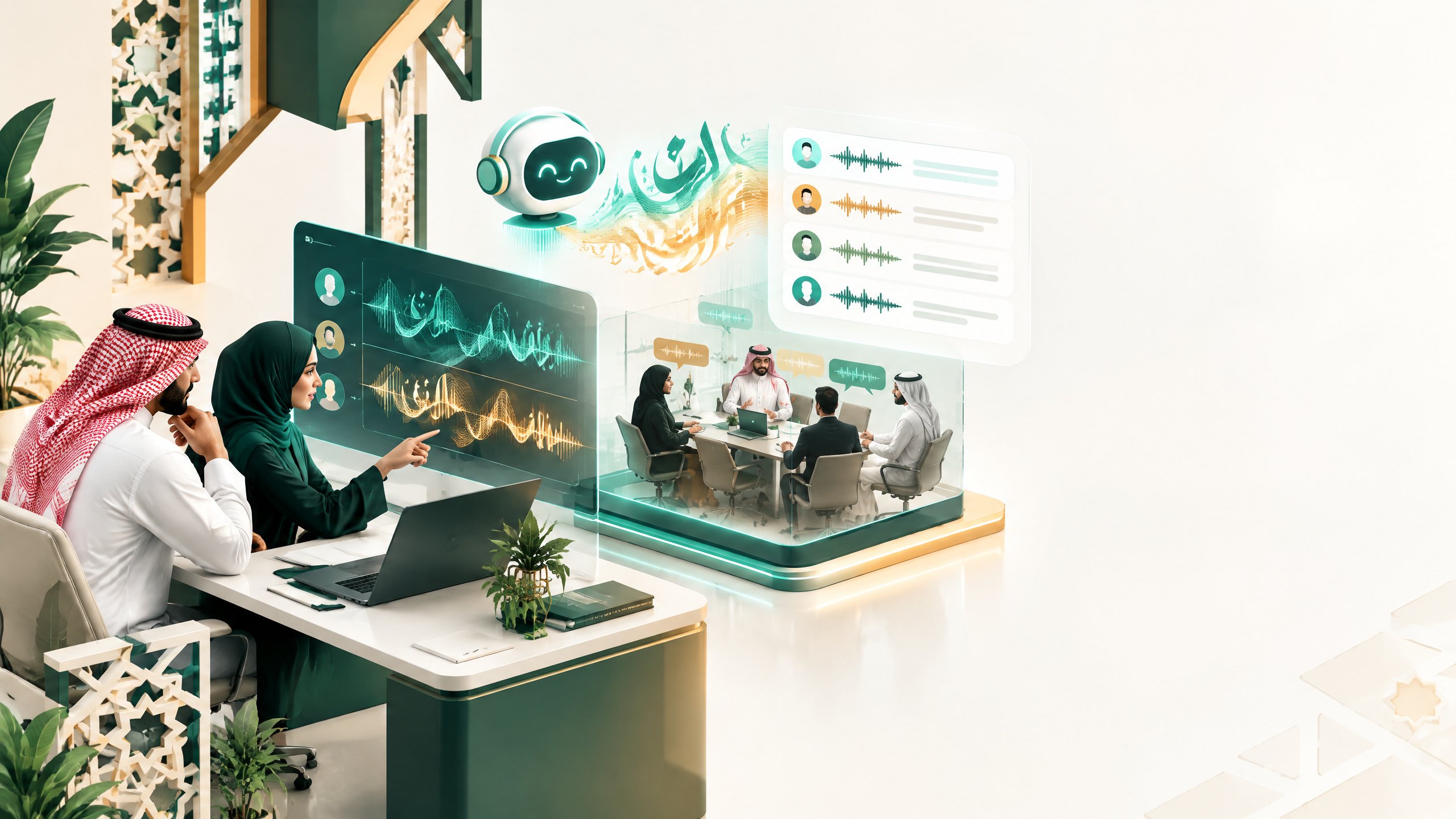
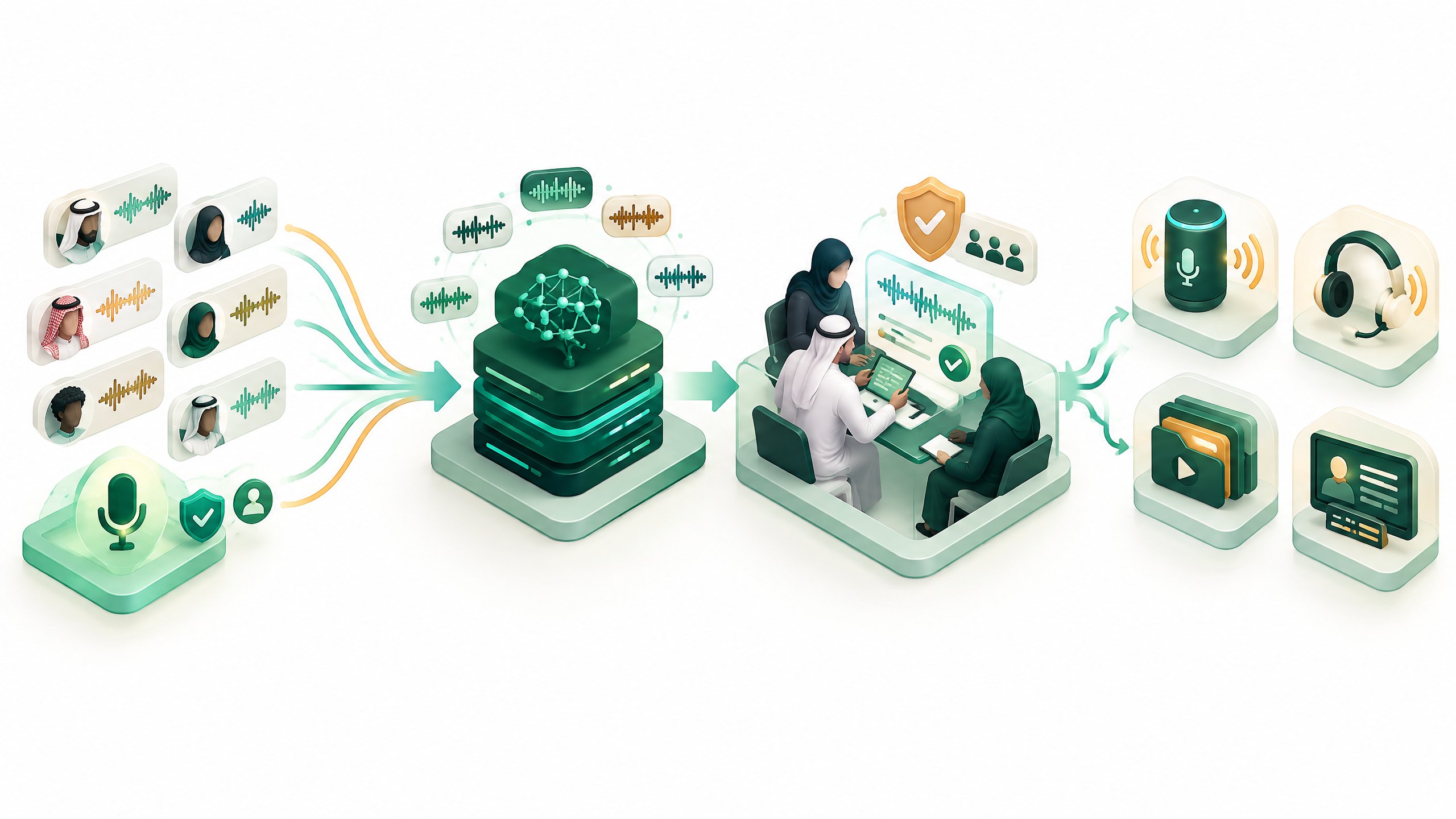
NVIDIA reported that fine-tuning Nemotron 3.5 ASR on 133.7 hours of Najdi and Hijazi audio from Saudi Arabia’s SADA corpus reduced word-error rate on its target split from 55.05% to 29.96%. The result is a material proof point for local language data, not a guarantee of production performance. For B2B leaders, dialect data, rights, evaluation and human release ownership belong in the product operating model, not a cosmetic localisation layer.
NVIDIA’s Saudi Arabic ASR result: what was actually tested
In a September 30 technical post, NVIDIA described an experiment that fine-tuned its Nemotron 3.5 automatic speech recognition model using Saudi Audio Dataset for Arabic, or SADA, material. The team focused on Najdi and Hijazi rather than treating “Arabic,” or even “Saudi Arabic,” as a single uniform language target. It curated the source data down to 103,559 utterances, 133.7 hours, after removing clips with transcription or alignment issues that would distort the learning task.
The reported outcome is substantial on the stated test split: word-error rate, or WER, fell from 55.05% to 29.96%. NVIDIA also reported an improvement across the full SADA test set from 58.84% to 35.61% WER, while retention checks on FLEURS English and Arabic improved in that experiment. The work ran for 12,000 steps and roughly four and a half hours on two GPUs, according to the company’s technical account.
The training recipe matters as much as the headline number. NVIDIA used limited curation intended to remove structurally unlearnable labels rather than difficult accents, replay mixing of Saudi material with small English and Arabic FLEURS streams to help preserve earlier capabilities, and duration-based batch bucketing. It also examined how much of the encoder to update and reported that, for this data volume and target, a full fine-tune outperformed partial encoder adaptation.
WER is a useful experimental metric, but it is not a universal measure of customer comprehension, safety, commercial value or cultural fit. It counts recognition errors against a reference transcript. A contact center, public voice assistant, media workflow or regulated service must still test the utterances, acoustic environments, escalation paths, privacy requirements and consequences specific to its use.
Fact versus implication
| Reported fact | Practical implication, not a promise |
|---|---|
| NVIDIA fine-tuned on 133.7 hours of curated Najdi and Hijazi SADA speech. | Data selected for a defined locale can be a stronger starting point than a broad Arabic label. Each organization still needs to define its own audiences and use cases. |
| Target-split WER moved from 55.05% to 29.96%. | Local evaluation can reveal meaningful headroom, but the result cannot be assumed for every Saudi dialect, channel, vendor configuration or production workflow. |
| The wider SADA corpus spans about 667 hours and more than 10 Saudi dialects. | “Saudi Arabic” contains material variation. Coverage, sampling and release decisions need to be made deliberately. |
| NVIDIA used replay mixing to protect retained language capability. | Adaptation can affect existing performance, so multilingual regression tests should be part of the release gate. |
Why the announcement matters to B2B AI marketing teams
The most important lesson is not that every business should fine-tune a speech model. It is that local language data is product infrastructure. A model can be technically multilingual yet still mishandle the dialect, terminology, code-switching, names, pace, sound quality and conversational conventions that determine whether an experience feels credible to a local customer.
For marketing and customer-experience leaders, the decision therefore sits across teams. Brand leaders define which voice interactions may represent the company. Operations leaders decide when transcription is sufficient and when a human must review it. Data and legal owners establish whether recordings, annotations, retention, reuse and model-adaptation rights are appropriate. Engineering teams select evaluation sets, latency settings, monitoring and rollback procedures.
That is especially relevant in Saudi Arabia and the Gulf, where national AI capacity, language resources and enterprise deployment are developing together. Our coverage of HUMAIN’s Saudi AI infrastructure position gives wider context: regional AI strategy is not only about model access. It is also about data, infrastructure, governance and institutional accountability surrounding the model.
Possible use cases, subject to validation
Voice assistants and conversational agents. Better recognition of intended dialectal speech could reduce friction before a customer reaches a workflow, but teams should test failure handling, accent variation, Arabic-English code-switching, named entities, background noise and whether the agent is allowed to act on the transcript. For higher-consequence decisions, a transcript should not become an automatic instruction merely because it looks plausible.
Call centers. Transcription may assist search, call summarisation, coaching, quality assurance or routing. It should not automatically become the record of a customer’s meaning or consent. Measure errors by queue, channel, geography, speaker type and business-critical vocabulary; review samples where a recognition mistake could change a commitment, complaint, payment or eligibility outcome.
Media archives and captions. A domain-adapted model may make old programming easier to search or create a better draft captioning workflow. Yet captions are public-facing content. Editorial review remains necessary for names, quotes, sensitive language, timing, readable line breaks and corrections that affect meaning.
Dialect data is not a language checkbox
A common localisation error begins with a binary question: “Does the product support Arabic?” The more useful questions are: which Arabic, for whom, in which channel, under which stakes and with what evidence?
SADA’s reported scope illustrates why. Saudi Press Agency said the corpus contains roughly 667 hours of transcribed audio, including more than 600 hours supplied by the Saudi Broadcasting Authority from 57 television programmes and series, and covers more than 10 Saudi dialects. That is an important local resource. It is not evidence that any one system has equal competence across every dialect, speaker group, acoustic setting or business context.
The NVIDIA experiment itself is appropriately narrower: it identified Najdi and Hijazi as its initial target, then evaluated results against that target. That discipline is worth adopting. A business should not claim comprehensive dialect support when it has only tested a subset. Nor should it remove “hard” speech during curation merely because the baseline model struggles; doing so may create flattering benchmark results that hide the conditions customers actually encounter.
For organizations exploring agentic customer workflows, this language layer must join the broader design. The Gemini agentic AI service is relevant here not as a substitute for evaluation, but as a reminder that useful AI agents need bounded tools, observable handoffs and human accountability, not only fluent input and output.
From benchmark to operating model
The gap between a technical result and a deployable experience is where strategy earns its value. Begin by defining the job: searchable archive, internal agent-assist, live captions, customer self-service or another bounded service. The desired latency, error tolerance, consent model, retention period, brand risk and human-review standard will differ sharply among those choices.
Next, build a representative evaluation set before choosing a solution. Include real approved examples of the dialects, demographics, speech rates, audio devices, noise conditions, campaign terminology, product names and code-switching patterns that matter. Keep a held-out test set. Report not just an aggregate WER but the error types that change an outcome: negations, numbers, account identifiers, names, addresses, intent and terms with legal or commercial significance.
Finally, treat model adaptation as a controlled release, not a content update. Test the pre-existing languages and flows that must keep working. Document threshold changes, decoder settings, latency effects, prompts, vendor versions, data lineage and rollback procedures. NVIDIA’s post, for example, shows an accuracy-versus-latency trade-off when a larger context window is used. There is no universally “best” setting outside the workflow it serves.
Experimental results are not deployment guarantees. The reported figures are an encouraging technical finding on defined data and test conditions, not a warranty for another organization’s dialect mix, production audio, customer journeys or regulatory context.
Practical localisation-and-governance checklist
Use this checklist before launching or materially expanding a locale-sensitive speech, captioning or agent flow:
- Name the locale precisely. Record target dialects, audiences, geography, Arabic-English code-switching expectations and excluded use cases. Do not market a broader capability than the evidence supports.
- Confirm rights and provenance. Inventory recordings, transcripts, annotations, contributors, licenses, consent basis, retention requirements, onward-use restrictions and whether the data may be used for training, tuning, testing or only service delivery.
- Use representative evaluation sets. Separate train, validation and held-out release samples. Include noise, mobile calls, named entities, industry vocabulary and edge cases that reflect real use, not merely the cleanest available audio.
- Measure material errors. Track WER or character error rate alongside task-specific failures: incorrect amounts, names, intent, denials, opt-outs, safety instructions or terms that could create a misleading public claim.
- Set boundaries by consequence. Decide which tasks may be drafted, suggested, routed or executed. Require confirmation or human review where a transcription can create financial, legal, reputational or customer-rights consequences.
- Assign a named human approver. A named human must approve locale-sensitive public flows, data rights and release quality. Define the approver’s authority, evidence required, reapproval triggers and escalation route.
- Test multilingual regression. If a model is adapted for Saudi dialects, test the languages, locales and business journeys that must remain reliable. Replay data is a technique, not proof that regression cannot occur.
- Make the user experience recoverable. Provide easy correction, repeat, handoff and human-support paths. Preserve enough traceability to investigate disputes without retaining data beyond the approved need.
- Monitor after release. Sample outputs, review drift by channel and cohort, watch changing terminology, log incidents and maintain a rollback plan. Reassess after model, prompt, decoder, dataset or policy changes.
- Align marketing claims with evidence. Have marketing, product, legal and operations agree on what can be said publicly. A free AI growth audit can help surface where AI positioning, customer proof and governance evidence are disconnected.
For a wider framework on deciding which decisions can be automated and which must remain controlled, see Maximum Autonomous Consequence.
Modi's POV
The headline is not “AI finally speaks Saudi Arabic.” That would overstate both the experiment and the nature of language. The more useful reading is that an established multilingual model responded strongly when researchers supplied focused local dialect data and made deliberate engineering choices around curation, replay, adaptation and evaluation.
For B2B marketers, the implication is uncomfortable but productive: localisation cannot be delegated to a final translation pass. If speech, agents, captions or call analytics will shape customer trust, then language evidence belongs at the beginning of product planning. It affects the data a company can lawfully use, the personas it includes, the assertions it makes in market, the reviewer it assigns and the situations where the system must defer.
I would resist both extremes: treating this as a reason to delay every voice initiative, or using a single benchmark as permission to automate public interactions broadly. Start with a narrow, measurable workflow; establish the human approval and escalation design; then expand only when local evidence supports expansion. Our AI marketing strategy service can connect product, audience, governance and measurement decisions before a brand turns a language model into a public promise.
Limitations and what to watch next
NVIDIA’s reported result is based on an experimental configuration, a chosen subset of SADA and specific evaluation scripts and conditions. The largest result, 55.05% to 29.96% WER, concerns the Najdi and Hijazi target split, not every Arabic dialect or every form of Saudi speech. The broader SADA figures are useful, but still do not substitute for independent evaluation on a particular company’s audio, vocabulary, hardware, deployment architecture and service design.
The available reporting also does not establish business outcomes such as lower call handling time, higher conversion, greater customer satisfaction, accessibility impact, cost savings or legal compliance for any individual deployment. Those outcomes require their own baselines, controlled evaluation and governance review. Claims about real-time suitability likewise need to be tested against the end-to-end system, not inferred solely from model characteristics or a lab setting.
For Arabic-language readers, read the Arabic translation of this NVIDIA and SADA analysis, which keeps the same evidence boundary and adds links to the Arabic AI and Saudi infrastructure coverage.
The next evidence to watch is not simply another benchmark. It is transparent, locale-specific reporting on coverage, rights, model changes, regression tests, user correction, human-review performance and how organizations manage failures in public-facing use.
Sources
- NVIDIA Developer: Fine-Tuning NVIDIA Nemotron for Saudi Arabic Dialects, with a Path to Other Languages — Technical methods, curation details, reported evaluation results, replay mixing, adaptation and decoding trade-offs.
- Saudi Press Agency: NVIDIA Leverages SDAIA's SADA Dataset to Enhance Nemotron 3.5 ASR Model — SADA launch context, reported corpus size, broadcasting contribution and stated dialect coverage.
About the Author
Modi Elnadi is the founder of Integrated.Social and writes about AI visibility, responsible agent design and practical B2B growth strategy. His work focuses on connecting AI opportunity to trustworthy customer experiences, measurable marketing decisions and accountable operating models.