A TestFlight invitation branded as “OpenAI OpenAds Optimizer” should be treated as suspicious until OpenAI confirms it through an official channel. Integrated.Social reviewed an invitation supplied on 7 October 2026 and found no matching product name in OpenAI’s public advertiser materials. OpenAI’s official advertiser site uses ChatGPT Ads and Ads Manager. That mismatch does not prove the TestFlight build contains malware or has compromised a device. It does mean advertisers should not accept, install, sign in to, or authorise the app on the strength of the invitation alone.
What is the OpenAI OpenAds Optimizer TestFlight invitation?
The supplied invitation described an app called “OpenAI OpenAds Optimizer”. It used familiar paid-media language: spend, impressions, clicks, conversions, CTR, CPC, CPM, CPA and ROAS. It also used scarcity and incentive claims such as “Limited Beta Access”, “1,000 Users Only” and potential advertising credits. That language can look plausible because OpenAI has a real ChatGPT advertising product and publicly describes an Ads Manager workflow for campaigns, creative, measurement and optimisation.
The conclusion should remain precise. The invitation is unverified and suspicious. We are not publishing the email address visible in the supplied material or identifying any person or business as responsible. We have not analysed the app package. We cannot state that it contains malware, steals credentials or has compromised an account. The decision that follows from the available evidence is simpler: do not grant it trust or access until the claimed relationship with OpenAI is confirmed through OpenAI’s official website or support channels.
What OpenAI’s official materials call the advertiser product
OpenAI’s advertiser site calls the product ChatGPT Ads and points advertisers to Ads Manager resources. It describes a campaign workflow: create a campaign, add details, launch, measure and optimise. This explains why a claimed advertising-optimisation beta could look credible to a performance marketer.
But a convincing category story is not identity verification. Familiar AI advertising language and a recognisable Apple workflow are not proof of an OpenAI relationship. Use a claimed company’s public site, authenticated portal or known support channel to verify an unexpected beta programme.
Why a real TestFlight invitation can still be risky
TestFlight is Apple’s genuine beta-distribution and feedback service. Apple says developers can invite external testers and an external build may undergo App Review before testing begins. Two opposite claims are therefore wrong: TestFlight is not an unreviewed download channel, and its presence does not prove that every identity or commercial claim in a beta invitation is endorsed by Apple or the brand being invoked.
That distinction is central. A recipient can see Apple branding, a TestFlight workflow and professional campaign terminology, then infer a relationship that has not been independently verified. This is a social-engineering risk: the legitimacy of the transport can reduce scrutiny of the identity claim.
How the trust-abuse pattern works
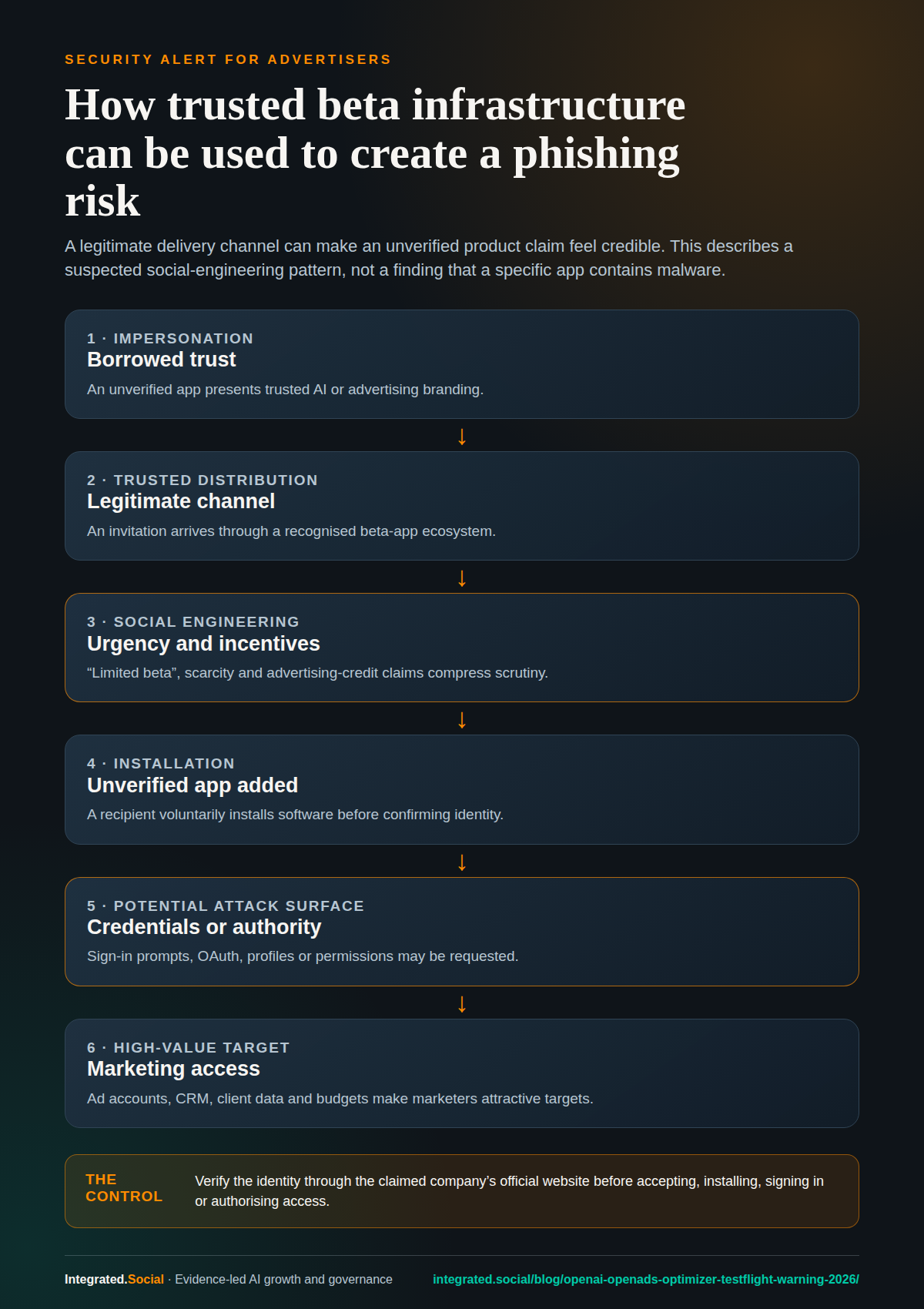
The invitation illustrates a pattern worth watching across AI, advertising and SaaS beta programmes:
- A familiar brand or product category supplies initial credibility.
- A recognised distribution mechanism supplies another credibility signal.
- Scarcity, exclusivity or credits create urgency.
- The recipient installs an app before confirming who owns it.
- A later password, OAuth, profile or broad-permission request becomes a separate, more consequential decision.
This is a potential attack pattern, not a technical finding about the specific build. The responsible posture is to identify each decision point and stop before an unverified claim becomes access.
Why advertisers are attractive phishing targets
Advertisers often carry concentrated permissions: advertising accounts, platform partners, pixels, budgets, analytics, CRM integrations, audiences, product feeds and client reporting. A compromised or over-authorised account can create campaign, data, reputation and client-trust problems even when no single login can transfer money directly.
That makes an optimisation invitation an effective lure. It speaks directly to a marketer’s task: improving performance, comparing creative, finding budget waste and accessing a new AI channel early. The answer is not to avoid every beta. It is to treat access as a commercial-authority decision, not merely a product-discovery decision.
Four questions before accepting an AI beta
Verify the programme independently
Do not rely on the invitation’s links, email address, screenshots or product description. Start with the claimed company’s public website, authenticated customer portal or a known support channel. Look for a matching programme name, developer name and invitation process. If the relationship cannot be confirmed, pause.
Check the scope before you sign in
Read access, analytics export, OAuth consent, administrative control, configuration profiles and device-management permissions are not interchangeable. Identify the accounts, data and consequences involved. An app that drafts a report has a different risk profile from one that manages campaigns, accesses a CRM or reads a device profile.
Separate urgency from evidence
A limited tester count, credits, unexpected timing, or a product name unavailable through official channels should prompt verification. Scarcity alone is not proof of fraud. Scarcity combined with an unverified identity or access request is a reason to stop.
Keep legitimate tests reversible
Where a beta is confirmed, use the smallest possible scope: a non-production account, least-privilege access, no client data, no reusable credentials, and no ability to publish, spend or change account ownership. Name an approver and an exit route first.
What should you do if you received, accepted or installed the invite?
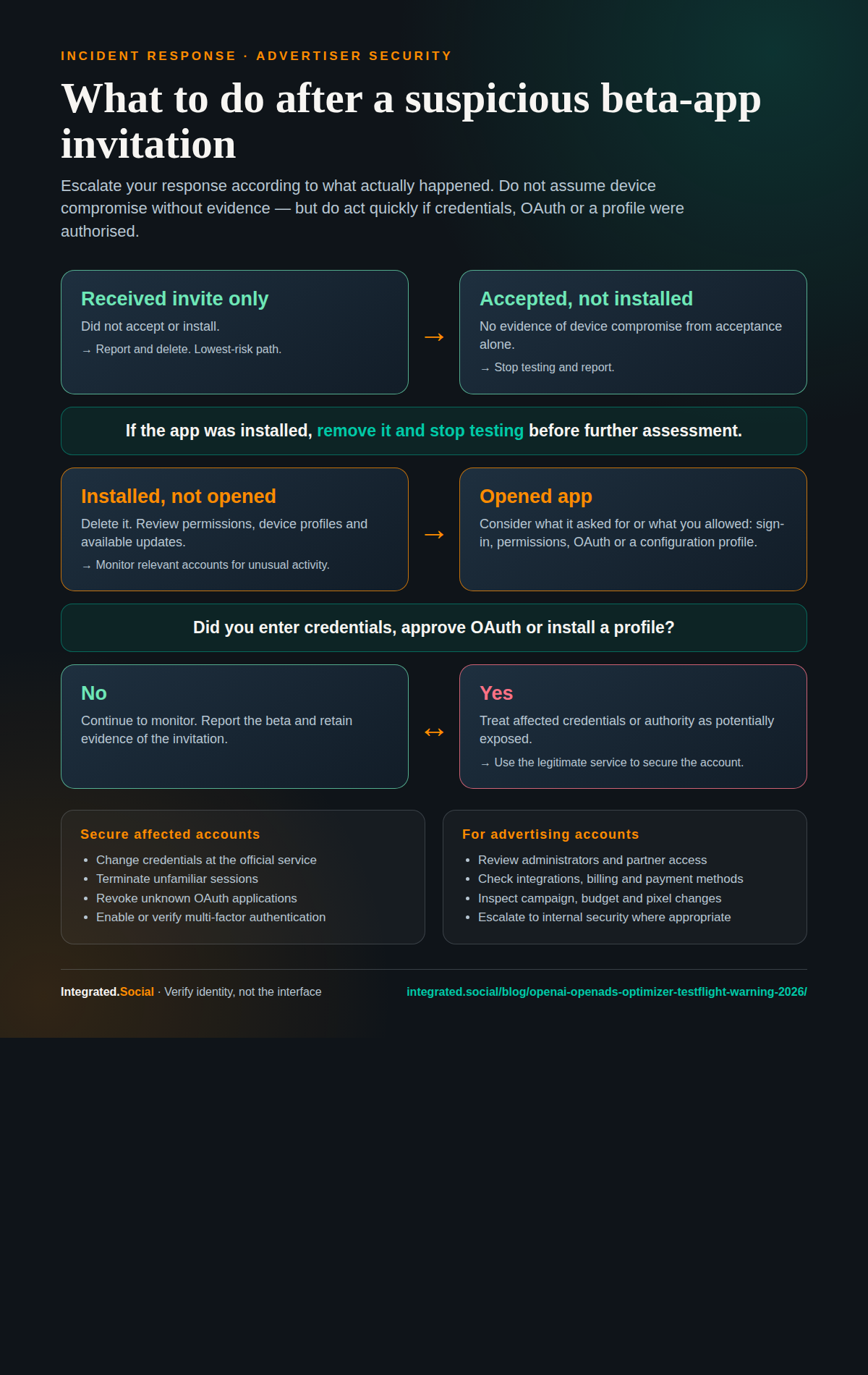
Match the response to what happened. A recipient who only saw an invitation should not assume device compromise. A recipient who entered credentials, approved OAuth or installed a configuration profile has a materially different response path.
Invitation received but not accepted
Do not accept the invite or install the application. Preserve enough information for an internal security team or platform report, then delete the invitation. Apple advises recipients to be suspicious of unexpected messages and to contact the claimed company directly rather than relying on the message.
Apple asks recipients to forward suspicious Apple-looking email to reportphishing@apple.com. In the UK, suspicious messages can also be forwarded to the NCSC at report@phishing.gov.uk; the NCSC advises not clicking links and says it may analyse reports and work with hosting providers on malicious infrastructure.
Accepted, but did not install
Acceptance alone is not evidence of device or Apple Account compromise. Leave the beta or stop testing through TestFlight where the relevant option is available, report the invite, and retain details for your security team. Do not convert a low-evidence event into certainty: it is not established that acceptance alone exposes credentials or creates account takeover.
Installed but did not open
Remove the beta app and stop testing. Check for unfamiliar device-management profiles, VPN configurations and permissions. Update the device through Apple’s normal update route, then review relevant account activity. The aim is to remove an untrusted app and check for observable signs; installation alone does not establish that every connected account is compromised.
Credentials, OAuth or a profile approved
Treat the affected authority as potentially exposed. Go directly to the legitimate service to change the password, terminate unknown sessions, revoke unfamiliar OAuth grants and verify multi-factor authentication. For advertising and CRM platforms, review administrators, connected apps, billing settings, payment methods and recent account changes. Tell the internal security owner and preserve facts rather than guessing at technical impact.
A simple incident-response decision tree for advertisers
Use this as an operational guide, not proof that a particular beta is malicious:
- Invitation only: report and delete; do not install.
- Accepted but not installed: leave the beta or stop testing, then report it. Acceptance alone is not evidence of device compromise.
- Installed: remove the app, stop testing, review profiles and permissions, update the device and monitor relevant accounts.
- Credentials, OAuth or a profile approved: change credentials through the official service, revoke sessions and OAuth, verify multi-factor authentication, audit affected accounts and escalate internally.
The governance lesson: marketing access is security access
AI marketing tools increasingly ask to connect to campaign accounts, analytics, CRM, creative platforms and customer data. The fastest way to assess a tool is often to grant broad OAuth permissions. That is also how a narrow beta can become a wider business-control problem.
A better operating model uses least privilege, a named owner, a time-limited purpose, inspectable logs, a revocation route and human approval before spend, publishing, deletion, account changes or data exports. For related design, see our work on AI agents and employee-style access revocation, agent containment for enterprise governance and ChatGPT advertising measurement and agentic demand.
Modi’s POV: AI advertising excitement is a social-engineering surface
The danger is not just that an unverified app can look polished. The surrounding narrative is believable: OpenAI has a real advertising platform, marketers want early access, campaign terminology is familiar, and TestFlight is genuine. A convincing phishing attempt borrows those truths and inserts one unverified identity claim between them.
For marketing leaders, account access is not an IT detail delegated after procurement. The ability to read campaign data, alter budgets, activate pixels, access audiences or connect a CRM is commercial authority. Verify identity before granting it. A familiar interface, AI model name or trusted delivery channel cannot substitute for that step.
References
- OpenAI Ads: Advertise in ChatGPT — official advertiser naming, campaign workflow and support links.
- Apple: TestFlight Overview — TestFlight purpose, external testers and review context.
- Apple: Recognize and avoid social engineering schemes — verification, account-protection and Apple reporting guidance.
- NCSC: Report a scam email — UK reporting route and response guidance.
- Apple TestFlight Terms and Conditions — beta-participation and removal language.
About the Author
Modi Elnadi is the founder of Integrated.Social. He helps marketing leaders connect AI opportunity to accountable operating practice: clear evidence, scoped authority, human review and customer-safe delivery. His work spans AI search, paid-media measurement, agentic workflows and the governance controls that make new technology useful without treating access as an afterthought.