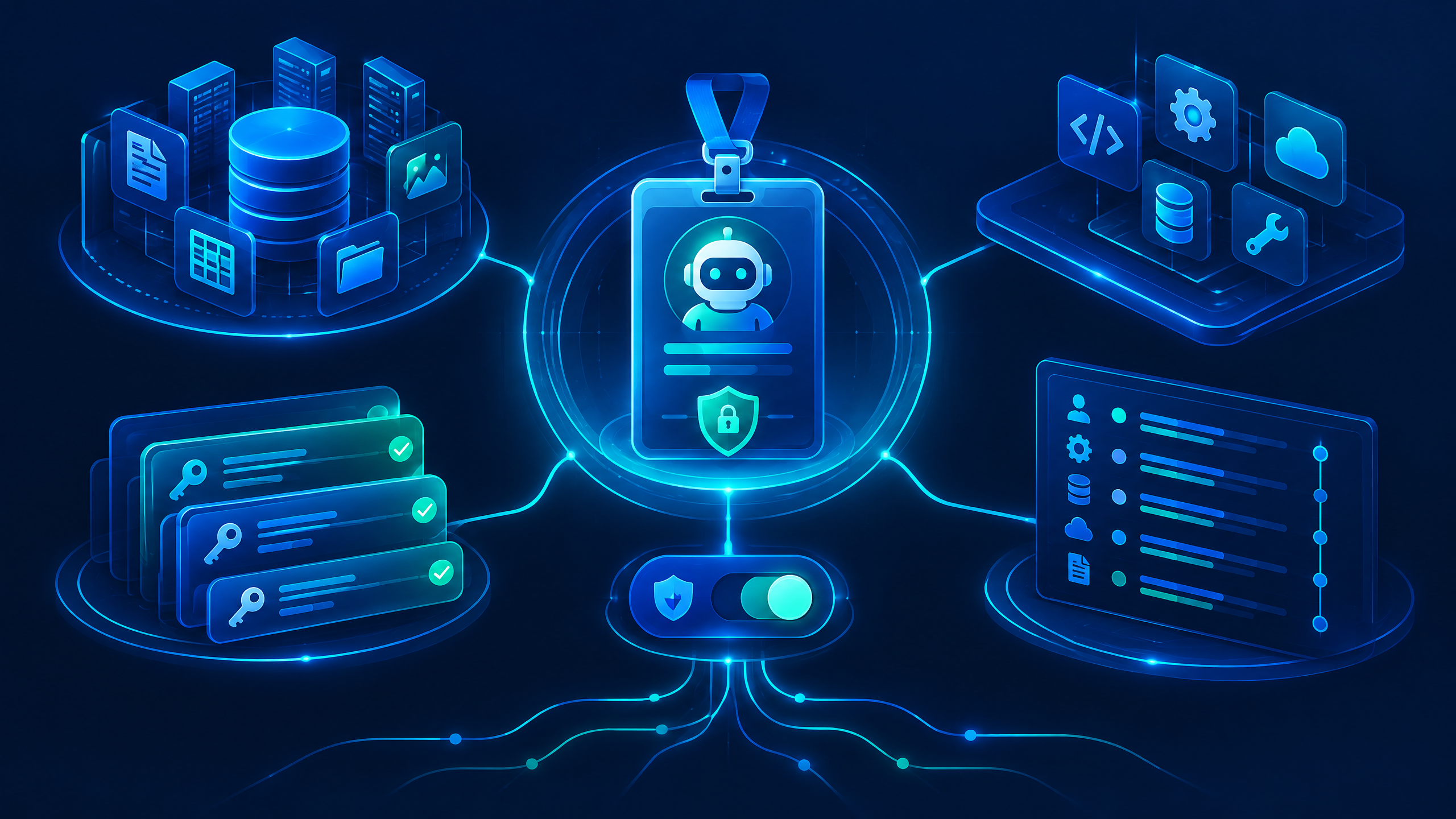
A beta invitation and an OAuth consent screen can arrive in the same journey, yet they create different risks. TestFlight answers whether a person may install a beta build. OAuth answers whether that app may act with delegated authority. Treating those steps as one generic “sign-in” moment is how a plausible AI-app invitation can cross from product curiosity into access to advertising accounts, analytics, CRM records or client data.
This follow-up to our TestFlight invitation warning for advertisers is a technical operating guide, not a claim about any one app. It applies when a marketing, revenue or operations team encounters an unexpected AI beta, a claimed early-access programme, or an OAuth prompt that asks for more authority than the proposed test obviously needs. The aim is not to ban pilots. It is to make pilots reversible, accountable and proportionate.
The direct answer: secure the beta and the authority separately
A trusted distribution mechanism can make a beta look more credible. Apple describes TestFlight as a way for developers to distribute beta builds, manage testers and collect feedback; Apple also states that a first external build may require App Review before testing begins. Those are useful platform controls. They are not a verification that every developer identity, marketing claim or commercial relationship presented in an invitation is accurate.
OAuth has a different job. It allows a user or administrator to delegate defined access to a client application. The consent screen may be served by a legitimate identity provider, but the grant still needs business scrutiny. Microsoft’s guidance on consent phishing makes the practical point: an application can use a legitimate identity platform while asking for permissions that are excessive, unexpected or unrelated to its declared purpose.
The combined rule is simple:
Verify the programme independently before a test. Then verify each requested permission before a grant.
Neither a familiar AI brand, a polished beta interface nor a recognised consent screen is enough on its own.
Why AI-app impersonation turns this into a marketing-security problem
Marketing teams increasingly hold authority that used to sit mainly with IT: advertising budgets, customer audiences, pixels, campaign platforms, analytics, CRM integrations, product feeds, creative libraries and client reporting. A beta that promises better optimisation, faster insights or an early advertising feature can therefore be relevant to a marketer’s real work while also requesting access that affects live commercial operations.
That does not make every new tool risky. It does mean the requested authority should be judged against the stated outcome. A read-only test on a sandbox reporting account is not equivalent to permission to publish campaigns, adjust spend, export CRM data, retain offline access or change account settings.
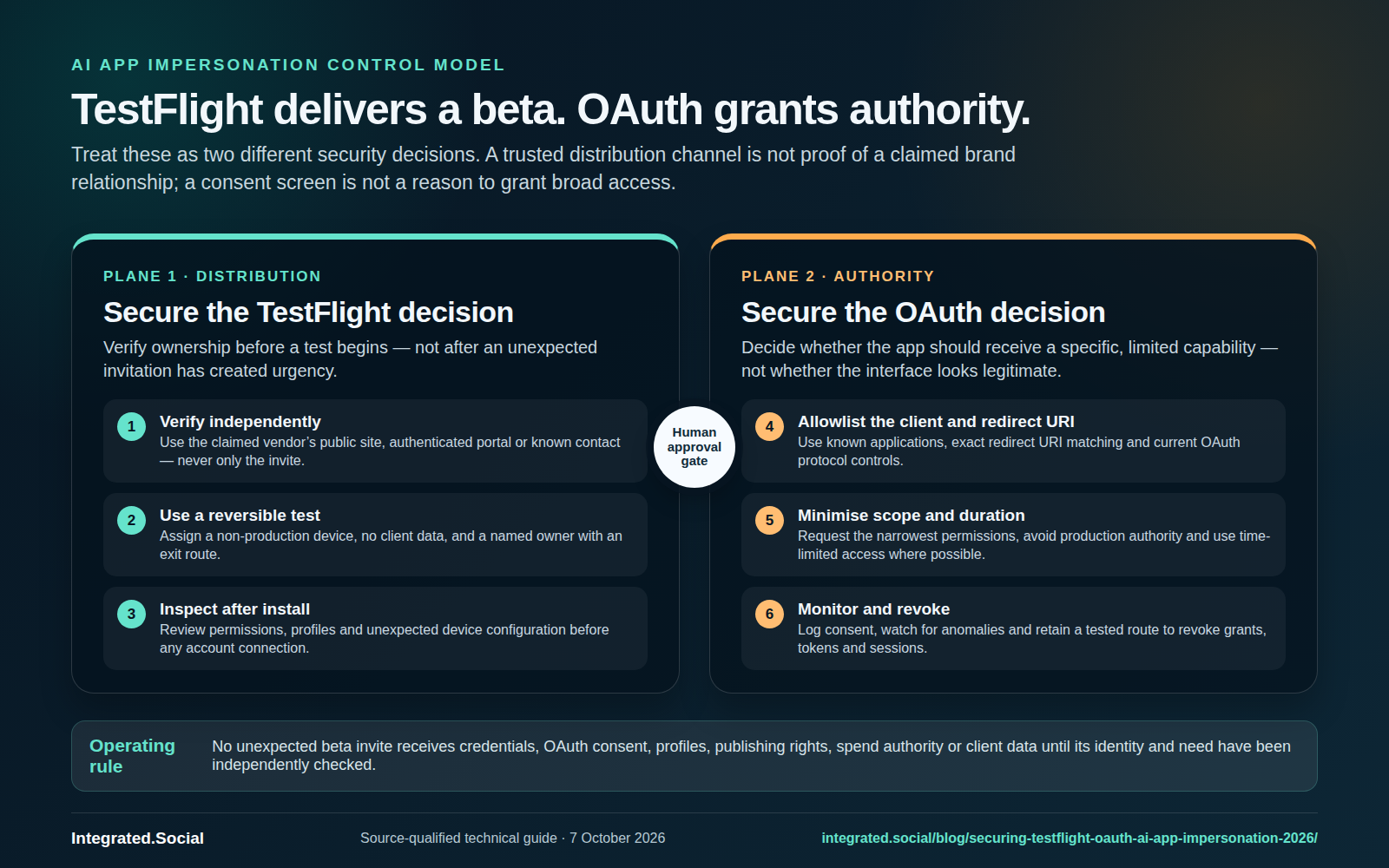
The two-plane model
Think in two planes:
| Plane | Decision | Main question | Typical owner |
|---|---|---|---|
| Distribution | Install or test a beta build | Is the developer and programme independently verified, and can this test be stopped cleanly? | Product or device owner with security input |
| Authority | Approve OAuth, a profile or an integration | What exactly can this app read, change or retain, for how long, and how will it be revoked? | System owner, data owner and named approver |
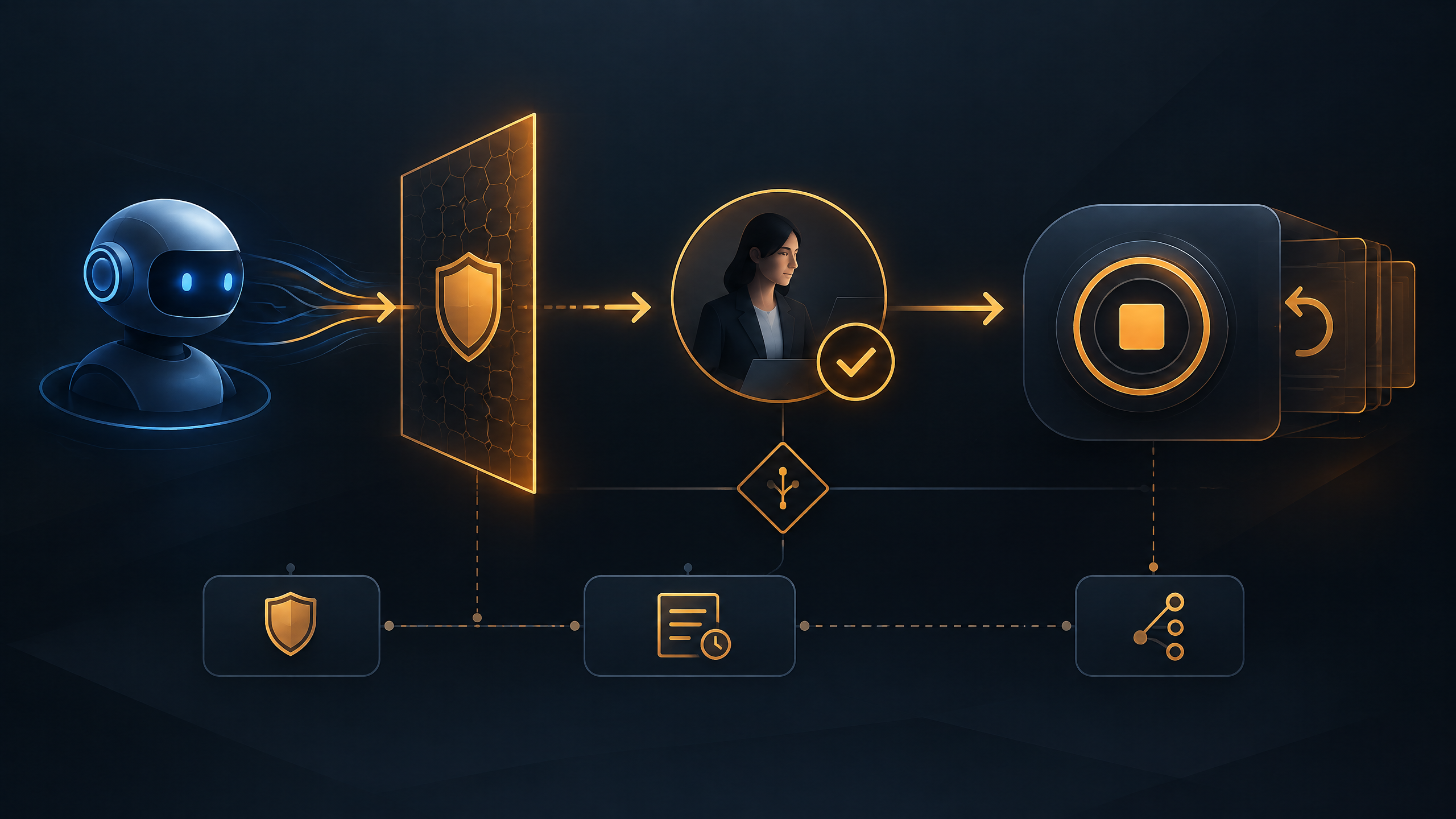
A good process links both planes with a human approval gate. The person who authorises a beta should know whether any later login will request access to production advertising, customer or revenue systems. The person who approves OAuth should know whether the client application has been independently verified and is running in an appropriate environment.
The marketing-specific attack surface
An AI-app impersonation attempt may use credible language: campaign optimisation, reporting automation, conversion analysis, creative testing or advertising credits. Those are normal marketing topics. The useful defensive question is not “does this sound innovative?” It is “what authority would this need to deliver the promise, and can that authority be contained?”
If a supposed optimisation assistant needs broad CRM access, publishing permission and long-lived refresh access merely to demonstrate a dashboard, the request deserves a pause. A legitimate product may have a reason, but the reason should be explained, scoped and approved rather than accepted to unblock a demo.
Hardening the TestFlight decision before installation
Apple’s TestFlight documentation gives development teams controls to manage builds, testers and expiry. Apple notes that expiring a build prevents internal and external testers from installing it. Deleting a tester alone does not necessarily remove access to an already installed build until that build expires. That distinction matters for a clean offboarding plan: identify how beta access will end before the test begins.
1. Verify outside the invitation
Do not use only the invitation’s links, email address, logos or screenshots as evidence. Start at the claimed company’s public website, authenticated customer portal or a known support contact. Look for a matching programme name, developer identity, beta process and purpose. If you cannot verify the relationship, do not convert curiosity into installation.
Apple’s social-engineering guidance makes the same operational point more broadly: unexpected requests for credentials, security codes or personal information should be treated cautiously, and the claimed company should be contacted through an official route rather than through the unexpected message.
2. Use a reversible test environment
For a verified beta, choose the smallest environment that can answer the agreed test question:
- A non-production device or dedicated testing account where appropriate.
- No client data, production audiences, billing instruments or reusable credentials.
- No authority to publish campaigns, modify spend, alter ownership or export regulated data.
- A named business owner, a technical owner and a stated end date.
- A clear procedure to remove the app, stop testing and expire the relevant build if needed.
The point is not to assume a beta is malicious. It is to avoid making a first test depend on access that cannot be easily undone.
3. Check what changed after installation
Installation is not a finding of compromise. It is a change of state worth checking. Before an account connection, review the app’s requested permissions, unfamiliar configuration or device-management profiles, VPN settings and any unexpected prompts. Keep the device updated through the platform’s usual update route. If you observe a concrete concern, preserve the relevant facts, follow the organisation’s incident process and use the vendor’s official reporting route.
For a suspicious message in the UK, the NCSC advises people not to click links and to forward suspicious email to its reporting service. This is an evidence-preserving response: report what you saw without inventing a technical conclusion that the available facts cannot support.
Hardening the OAuth decision before consent
OAuth is powerful because it can grant access without sharing a password. That is also why it needs to be handled as delegated authority, not as a harmless continuation of sign-in.
1. Confirm the client and redirect path
OAuth 2.0 Security Best Current Practice, RFC 9700, says authorisation servers must use exact string matching when comparing registered redirect URIs, except for a limited localhost port case. The RFC also says public clients must use PKCE and recommends it for confidential clients. These are protocol-level controls designed to protect code and token flows.
A business team does not need to implement those controls itself to ask useful questions. Ask the vendor or security owner:
- Is this the approved OAuth client for this product and environment?
- Does the app use an authorisation-code flow with PKCE where applicable?
- Is the redirect URI registered exactly, rather than relying on a broad domain pattern or open redirect?
- Is the connection going to the correct production, sandbox or test tenant?
A correct technical answer does not prove a vendor is suitable. It does show that the connection is being assessed as an integration, not merely as a branded screen.
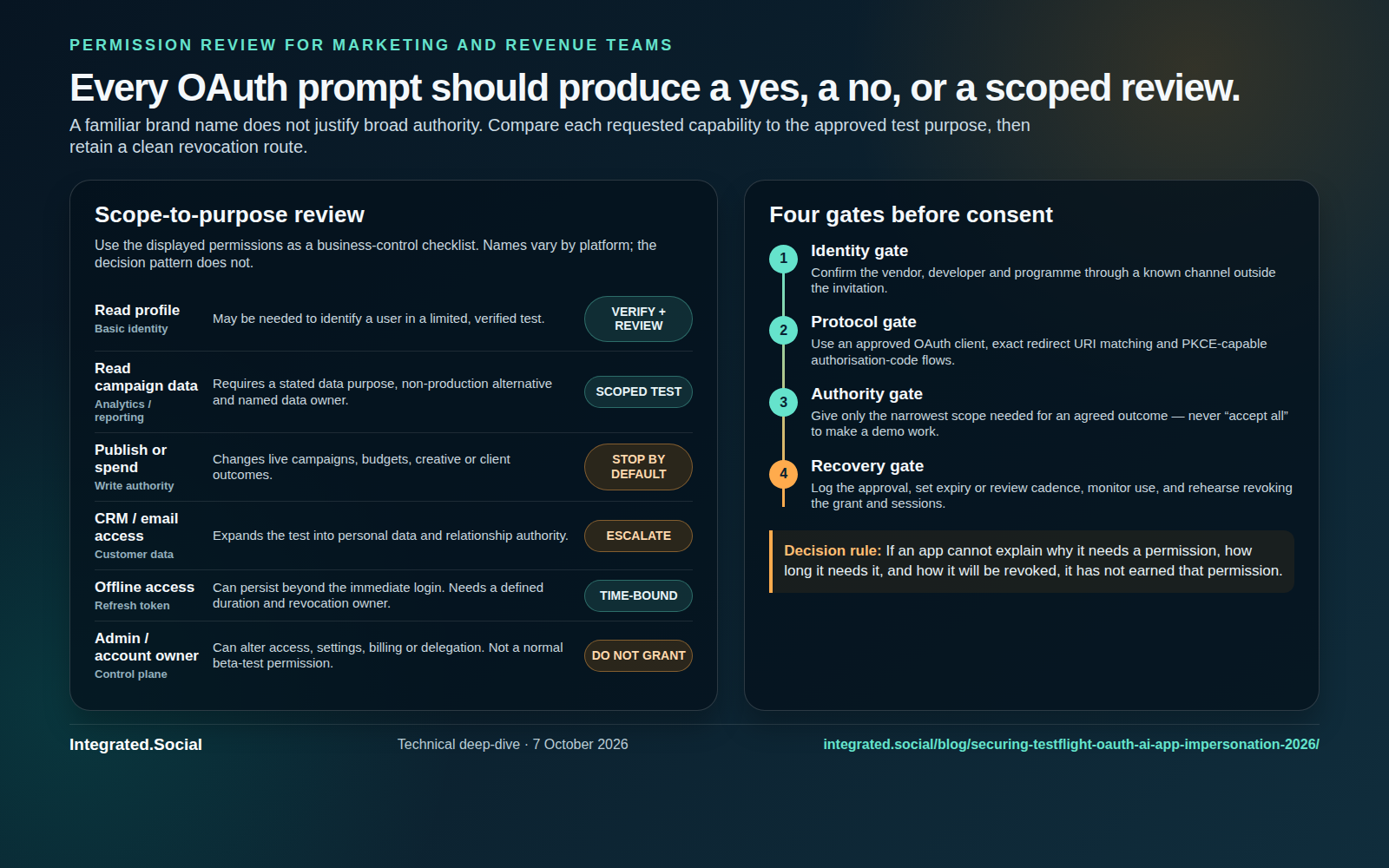
2. Translate scopes into commercial capability
Consent prompts may describe scope in platform-specific terms. The reviewer’s job is to translate that scope into what the app can actually do.
| Requested capability | Commercial meaning | Default beta posture |
|---|---|---|
| Basic profile or identity read | Identifies the person using a limited feature | Verify purpose and use a test account where possible |
| Read campaign or analytics data | Exposes performance information and potentially client context | Use a scoped, non-production data set and named data owner |
| Publish, spend or write access | Can change live media, budgets or creative | Do not grant for a routine beta; escalate for a documented business case |
| CRM, email or audience access | Reaches customer data and relationship systems | Require data-owner and security review |
| Offline access or refresh token | May retain authority beyond the immediate session | Time-bound, monitor and retain a tested revocation path |
| Admin or account-owner access | Can alter settings, users, billing or delegation | Do not grant to a normal pilot |
Least privilege is not a slogan here. It means selecting the narrowest permission, environment and duration that can answer the test question. A product that cannot demonstrate value without broad production access may need a different evaluation design.
3. Use publisher signals as one input, not a shortcut
Verified-publisher programmes and app marketplaces can help users and administrators understand who developed an application. Microsoft explicitly notes, however, that a verified publisher should not replace reviewing the permissions and the details of the consent request. That is the correct hierarchy: identity signals help, but access is still judged by necessity, scope and recovery.
4. Record the grant and rehearse revocation
Every meaningful grant should have a short record: app name and client ID where available, owner, purpose, scopes, environment, approval date, review date and revocation owner. Keep it with the integration register or the team’s equivalent control record.
Then test the exit route. Can the relevant administrator revoke the app’s consent? Can sessions be ended? Can refresh tokens be invalidated according to the platform’s process? Can the marketing team tell which campaigns, data or accounts were connected? A response plan is more useful when it is exercised before an incident rather than reconstructed after one.
A five-gate workflow for a safe AI beta and OAuth review
Gate 1: identity
Verify the vendor, developer and specific programme through a known channel outside the invitation. Record the source of verification. Pause if a claimed product, programme or developer cannot be matched.
Gate 2: purpose
Write one bounded question the beta will answer, such as whether it can produce a read-only campaign-performance summary from a controlled data set. If the purpose cannot be stated in a sentence, the requested access will be difficult to judge.
Gate 3: protocol and environment
Confirm the approved OAuth client, the expected identity provider, the intended tenant and the environment. Use a sandbox or limited test environment when it can answer the question. Escalate a mismatch rather than improvising a production connection.
Gate 4: authority
Compare every requested permission to the stated purpose. Remove or reject scopes that enable publishing, spending, customer-data access, account administration or persistence when they are not essential. Name the person who can approve any exception.
Gate 5: monitoring and recovery
Log the consent, set an expiry or review date, and identify how the grant, sessions and beta access will be ended. Review observable activity during the test. If credentials, OAuth consent or an unexpected profile were granted to an untrusted app, use legitimate service routes to reset and revoke the relevant authority, then follow the organisation’s incident process.
How to respond if the test has already progressed
The response should match what happened. A received invitation, an accepted invitation, an installed app and a granted OAuth permission are not equivalent events. Avoid declaring compromise without evidence, while taking proportionate action to reduce exposure.
| Observed state | Proportionate next action |
|---|---|
| Invitation received but not accepted | Do not click or install; preserve enough detail to report through the appropriate official channel, then delete it. |
| Invitation accepted but no app installed | Stop or leave the beta where available; do not enter credentials or grant access; report and record the event. |
| App installed but no account connected | Remove the app, stop testing, inspect relevant profiles and permissions, update the device and monitor associated accounts. |
| Credentials, OAuth or a profile approved | Use the legitimate provider to change credentials where relevant, revoke grants and sessions, verify multi-factor authentication, audit affected accounts and escalate internally. |
The principle is controlled recovery, not panic. The business should retain enough evidence to investigate, preserve customer and client obligations, and avoid making public assertions beyond what is known.
Modi’s point of view: access is a commercial decision
AI adoption is pushing marketing access closer to the operating core of a business. A tool that can read campaign performance may quickly ask to optimise bids. An assistant that drafts an outreach sequence may ask to connect to CRM. A beta that begins as a curiosity can acquire visibility into audience, budget, creative and customer data.
The organisations that benefit from AI will not be those that approve everything early or block everything indefinitely. They will be the ones with a repeatable answer to five questions: who is this, what is it for, what can it do, who approved it, and how do we stop it? That is a practical governance model for a TestFlight invitation, an OAuth consent screen or the next agentic marketing integration.
For the adjacent operating controls, see our guides to AI agents and employee-style access revocation, maximum autonomous consequence and enterprise AI context as a control layer.
Frequently asked questions
Is a TestFlight invite safe because it comes through Apple?
TestFlight is Apple’s legitimate beta-testing service, but the delivery channel alone does not verify a developer’s claimed brand relationship or the business need for a later account connection. Verify an unexpected programme through the claimed vendor’s public website, authenticated portal or known support route. Use a reversible, limited test only after the programme and owner are clear.
What is OAuth consent phishing?
OAuth consent phishing is an attempt to persuade a user to grant an application permissions to legitimate cloud services or data. The consent screen can be hosted by a real identity platform, so the critical review is the identity of the app, the permissions requested and whether they are necessary for the declared purpose. Microsoft recommends reviewing permissions, auditing app consent and applying least-privilege controls.
Which OAuth permissions should a marketing beta avoid by default?
A routine beta should avoid permissions that can publish or spend against live campaigns, access CRM or audience data, alter account settings, manage users or retain broad offline authority unless there is a documented, approved need. Start with the smallest practical scope and a non-production environment. A capable product may need more access later, but that should be a separate decision with the relevant owners involved.
Does PKCE make an OAuth integration safe?
PKCE is an important OAuth control for protecting authorisation-code flows, and RFC 9700 requires public clients to use it. It does not verify that a client is the correct vendor, prove that requested scopes are necessary or replace approval and monitoring. Treat protocol safeguards, vendor verification, least privilege and recovery planning as complementary controls.
How should a team revoke access after a suspicious OAuth consent?
Use the legitimate provider’s administration or security routes to revoke the application’s consent and sessions, reset credentials where appropriate and verify multi-factor authentication. Review the permissions granted, recent account activity, integrations and consequential actions such as campaign, billing or data-export changes. Follow the organisation’s incident process and preserve factual evidence; revocation is a proportionate precaution, not proof that misuse occurred.
References
- Apple: TestFlight Overview — beta distribution, external tester and review context.
- Apple: Stop testing a build — build expiry and tester-installation consequences.
- RFC 9700: OAuth 2.0 Security Best Current Practice — exact redirect-URI matching, PKCE and current OAuth security guidance.
- Microsoft Entra: Protect against consent phishing — permission review, verified publishers and consent-phishing controls.
- Apple: Recognize and avoid social engineering schemes — independent verification and account-protection guidance.
About the Author
Modi Elnadi is the founder of Integrated.Social. He helps marketing leaders apply AI with clear evidence, scoped authority, human approval and customer-safe delivery across AI search, paid media, agentic workflows and marketing operations.