
The short answer: this is an execution race, not a satellite-count race
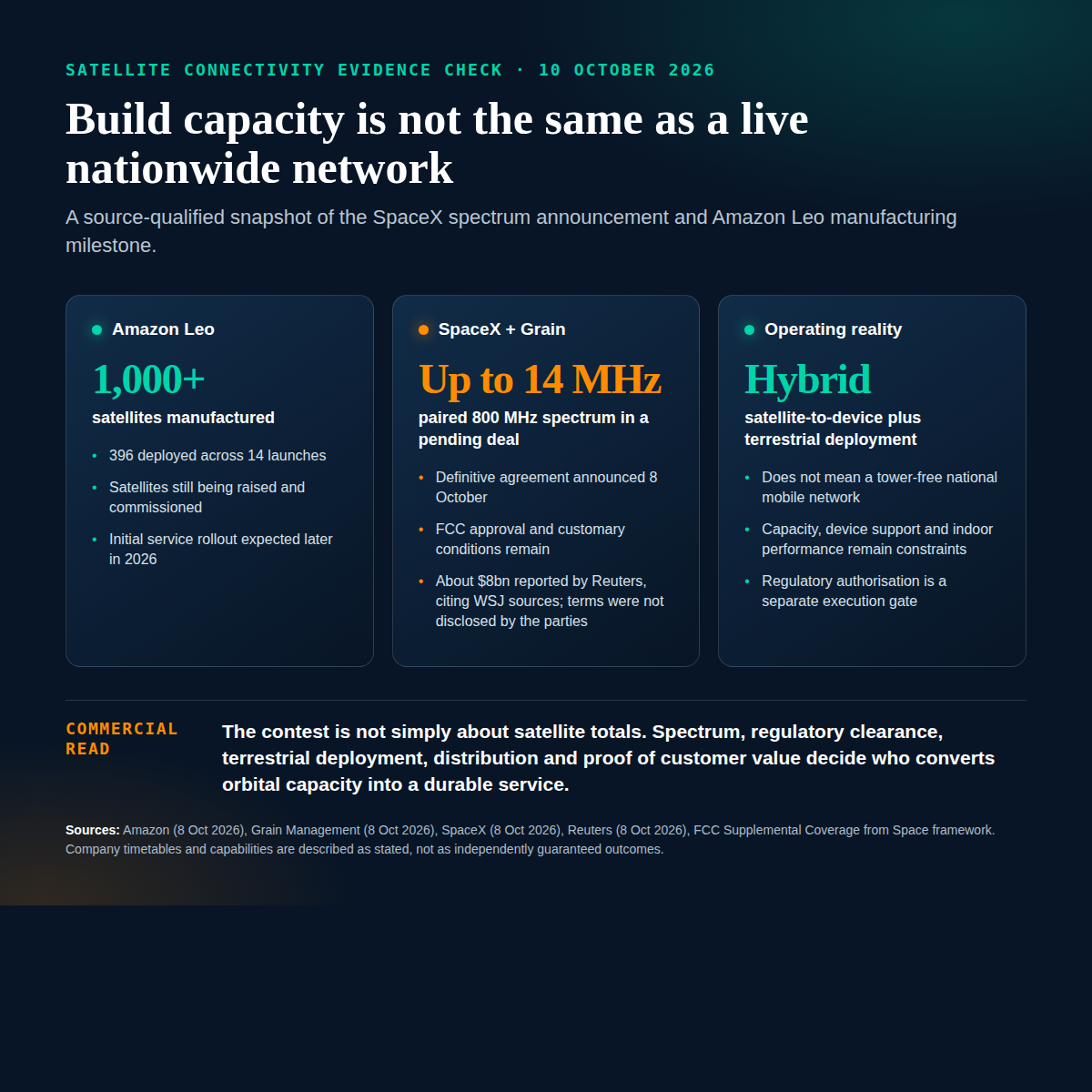
The 8 October announcements from SpaceX and Amazon sit at different points in the satellite-connectivity value chain. SpaceX and Grain Management announced a definitive agreement, subject to FCC approval and customary closing conditions, for SpaceX to acquire Grain’s nationwide 800 MHz spectrum portfolio. Amazon announced that it had manufactured more than 1,000 Amazon Leo satellites at its Kirkland facility, while reporting 396 satellites deployed across 14 launches.
Both developments matter. Neither proves a finished nationwide mobile network, a universal indoor-coverage solution or a commercial outcome that can be extrapolated from a press release.
The more useful commercial reading is that low-Earth-orbit connectivity is moving into a harder phase. Launches and factory throughput remain important, but so do spectrum rights, regulatory permissions, terrestrial integration, handset support, carrier distribution, enterprise procurement, capacity management and customer proof. A system with satellites but no route to market has a different problem from a system with spectrum but no approved, tested service architecture.
For readers tracking $SPCX, the reported agreement is best understood as an execution test rather than a stock-price thesis. SEC and Nasdaq records identify Space Exploration Technologies Corp. Class A common stock as SPCX, but this article does not use a current price, target, return or valuation claim. The question is whether the company can turn a pending spectrum transaction and its existing satellite-to-device position into an approved, dependable hybrid service.
Why $SPCX needs a separate evidence ledger
The SpaceX market context is real, but it should not be used to flatten every operating milestone into one financial conclusion. The SEC issuer record and Nasdaq security page are the appropriate places to verify the listing and market data at the time a reader makes a decision. A current share price, intraday move or market capitalisation is time-sensitive information, so it is deliberately outside this article.
For this story, keep three evidence ledgers separate. Market evidence answers what the security is and what public filings say. Transaction evidence answers whether the Grain agreement has closed and whether the FCC has approved the transfer. Operating evidence answers where a customer can actually use a service, with which device, at what capacity and under which support commitments. A credible commercial thesis needs all three; a press release normally establishes only part of one.
What SpaceX and Grain actually announced
Grain Management’s 8 October announcement says SpaceX agreed to acquire 100% of Grain’s nationwide 800 MHz portfolio. SpaceX’s associated FCC narrative describes the asset as up to approximately 14 MHz of paired spectrum in the 800 MHz band. The agreement had not closed at the time of publication: both parties say FCC approval and customary closing conditions remain outstanding.
That distinction is not legalistic wording. It changes what a buyer, competitor or investor can safely infer:
| What is supported | What is not yet supported |
|---|---|
| A definitive agreement was announced on 8 October 2026 | A completed transfer or a paid-and-closed acquisition |
| Reuters reported an approximately $8bn cash value, citing the Wall Street Journal and people familiar with the matter | A party-disclosed exact purchase price or final deal economics |
| SpaceX describes a proposed hybrid architecture: satellite-to-device connectivity plus terrestrial deployment | A finished, tower-free national mobile network |
| Low-band 800 MHz characteristics can be useful in a hybrid mobile design | Guaranteed indoor coverage, capacity or device compatibility everywhere |
Reuters reported that the value was about $8 billion in cash, while also reporting that the companies did not disclose terms. That makes the figure useful context, not a confirmed line item that should be turned into a valuation model.
The company’s stated network concept is also hybrid. The FCC’s Supplemental Coverage from Space framework requires a relevant satellite authorisation, an approved terrestrial-spectrum lease or agreement, equipment certification and interference protections. A spectrum portfolio alone is not the same thing as operating authority, an installed terrestrial layer or a customer-ready service.
Amazon Leo’s milestone is manufacturing capacity, not live-service proof
Amazon’s 8 October manufacturing update is significant because it documents an industrial capability: more than 1,000 Amazon Leo satellites produced at a facility designed for a stated capacity of five satellites per day. The same update says 396 satellites had been deployed across 14 launches and notes that spacecraft are being raised to their assigned operating altitude and commissioned.
Those verbs matter:
- Manufactured means built at a factory.
- Launched or deployed means placed into orbit through a mission, not necessarily fully commissioned for customer service.
- Operational means a service-ready state that should be demonstrated with a stated geography, customer offer, device, capacity and support model.
- Commercially proven means the service can be judged against availability, price, performance, reliability, support and customer adoption measures.
Amazon says it expects an initial Leo service rollout later in 2026. That is a company timetable, not evidence that a global, nationwide or full-scale enterprise network is already live. The current first-generation constellation authorisation targets 3,232 satellites, while Amazon has separately discussed a proposed future direct-to-device system. A broadband constellation, a proposed direct-to-device system and a customer-ready mobile service should not be folded into one headline number.
The lesson for marketing and procurement leaders is familiar: a capacity headline can be a leading indicator, but it is not the complete buyer story. The same discipline applies to AI infrastructure, agent platforms and new media channels. Ask what is announced, what has been approved, what is deployed, what is usable, and what has been measured in the operating environment that matters to you.
Starlink is further along in distribution, but satellite remains supplementary
Starlink has a materially more documented carrier-distribution path in the United States through T-Mobile. T-Mobile’s satellite service page describes compatible-device support for messaging and selected satellite-ready applications outside tower coverage, while also warning about lower speeds, limited capacity, location dependence and the importance of a clear view of the sky.
That is the right commercial frame. Direct-to-device satellite service can reduce dead-zone risk, improve resilience and create a useful back-up or extension layer. It does not erase the economics of dense terrestrial networks. Large satellite beams, finite spectrum, device power, congested demand, indoor attenuation, national authorisation and application design still matter.
The SpaceX Starlink Mobile page says 650 satellite-to-mobile satellites have been launched. That is a company-reported launch count, not a universal performance benchmark or a reason to assume all 650 are active in every market. Treat the count as an indication of programme scale, then investigate the service, partner and regulatory status in each geography.
The carrier map is also not one simple alliance. T-Mobile has a SpaceX-linked supplemental service. AT&T has a commercial agreement with AST SpaceMobile. Verizon has documented relationships with AST SpaceMobile and Skylo. Amazon Leo is building its own set of broadband and enterprise routes. These are competitive networks with distinct spectrum positions, operating models, regulatory milestones and customer propositions.
The five gates that turn orbital capacity into a commercial network
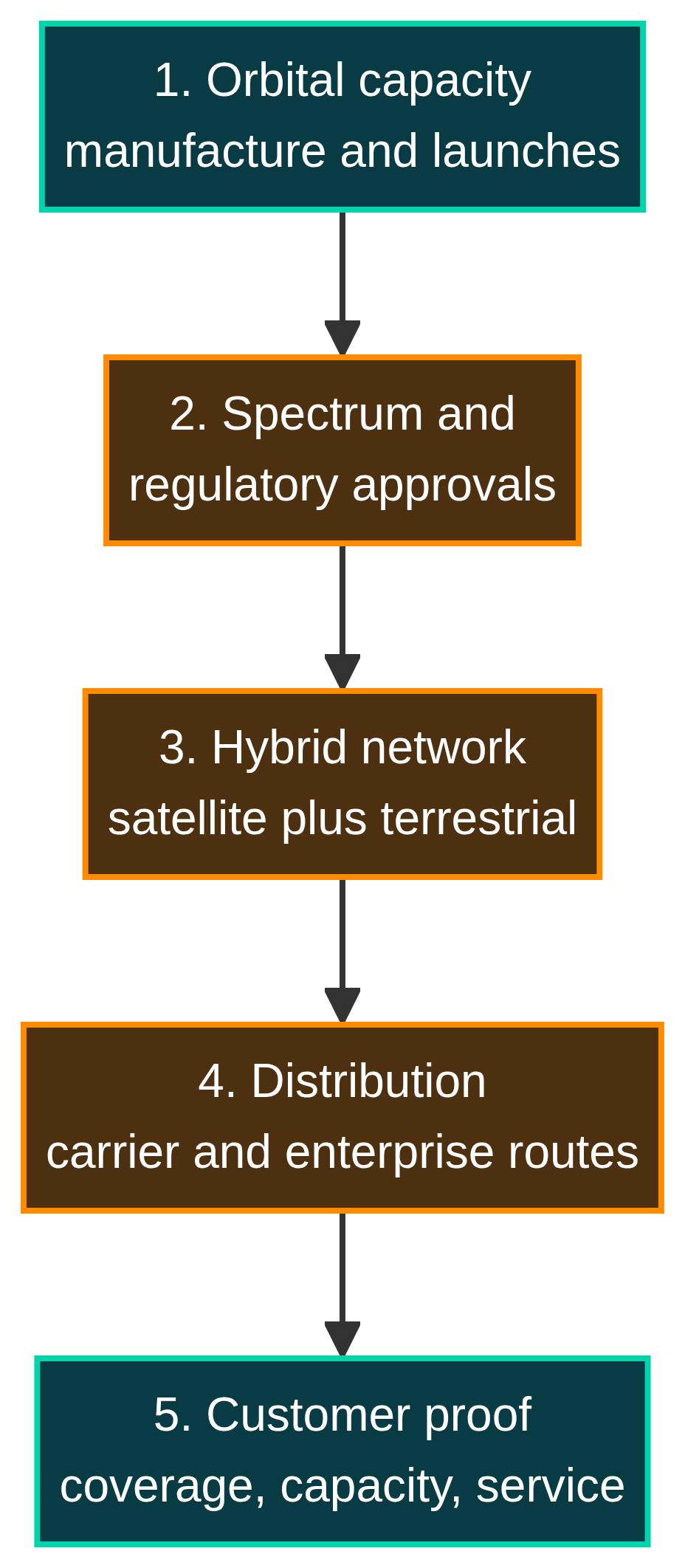
The technical story can be read as a five-gate operating sequence. It is deliberately useful beyond telecom: a capability is only commercially meaningful after the dependencies around it work together.
1. Orbital capacity
Can the company manufacture, launch, deploy, maintain and replace enough satellites for the service it is describing? Amazon’s 1,000-plus manufacturing milestone is strong evidence of factory capacity. It is not proof that its entire constellation is in service.
2. Spectrum and regulatory approvals
Does the proposed service have the right spectrum, satellite authority, licence transfer, leasing arrangement, equipment certification and interference protections? SpaceX’s announced Grain transaction can be strategically material here, but it remains pending. The FCC’s 6 October 2026 direct-to-device order is a separate action from approving the later 800 MHz transfer.
3. Hybrid network integration
Can satellite links, terrestrial radios, backhaul, handset hardware, core network software and customer support operate as one coherent service? The answer determines whether a headline about spectrum becomes a real operating capability.
4. Distribution and service design
Who sells the service, activates customers, supports devices, prices capacity, handles outages and owns the commercial relationship? Carrier partnerships and enterprise channels are not a footnote. They are how technical coverage becomes a product a customer can buy and rely on.
5. Customer proof
What is measured in the field: coverage, service availability, capacity at peak, indoor performance, application compatibility, latency, support and economics? This is where a network moves from an announcement to a decision-ready offering.
Why this matters to enterprise, government and media leaders
Satellite connectivity is becoming more relevant for organisations with remote assets, mobile workforces, maritime operations, aviation, public-sector resilience requirements or hard-to-serve locations. It can be a valuable layer for business continuity, field coordination, temporary backhaul and selected industrial use cases.
But it should be bought as a layered architecture, not a magical replacement for fibre, mobile networks or safety-critical communications. A responsible evaluation separates:
| Buyer question | Evidence to request |
|---|---|
| Where will people or assets actually be? | Coverage map, country permissions, line-of-sight conditions and terminal requirements |
| What must work during a disruption? | Service-level scope, back-up power, failover path, support model and escalation ownership |
| Which applications are suitable? | Tested device and application list, capacity assumptions and latency limits |
| Can a regulated or sensitive workflow use it? | Security design, data handling, audit trail, operator controls and regulatory review |
| What commercial value is plausible? | Named use case, baseline cost or risk, measured pilot criteria and a reversible exit plan |
For brand and growth leaders, the wider lesson is about AI-mediated discovery. As infrastructure, agents and new distribution surfaces reshape how a buyer gets online and asks a question, reliable content, fast pages, complete service information and a defensible entity graph become more important. A company cannot assume that a new network, assistant or search surface will accurately infer its offer from fragmented claims.
That is why our work on AI Search Optimisation, AI Governance and AI Marketing Strategy begins with a more basic question: can a human, system or agent find the approved evidence, understand the offer and complete the next decision without an unsupported leap?
A practical 30-day telecom and AI-discovery response
Days 1–7: map the exposure
List locations, mobile teams, remote operations, service interruptions and customer journeys where connectivity affects safety, revenue, service or reputation. Separate a genuine resilience need from a novelty use case.
Days 8–14: separate the announced from the usable
For each provider, create a simple evidence register: launch or manufacturing claims, regulatory status, geography, device support, carrier relationship, service limitations, customer references and source date. Do not use an announcement as a substitute for a service test.
Days 15–21: run a bounded technical and commercial pilot
Choose one non-safety-critical scenario. Define terminal placement, device compatibility, peak-demand conditions, response time, data requirements, support owner, failure path and success criteria before testing. Compare it with the terrestrial or multi-network alternative, not with an idealised “no connectivity” baseline.
Days 22–30: make public information decision-ready
Update the service, policy, location, support and contact information that a buyer, carrier partner or AI answer engine needs to validate your organisation. The network may be new; the need for accurate, accessible and source-backed customer information is not.
The strategic takeaway
SpaceX’s pending 800 MHz agreement and Amazon Leo’s factory milestone make satellite connectivity more commercially consequential. They do not remove the execution burden. The winning provider will not necessarily be the one with the loudest constellation statistic. It will be the one that connects orbital capacity, spectrum, approvals, terrestrial integration, distribution and proof into a service customers can understand, access and trust.
For $SPCX observers, that is a better decision framework than a single transaction value. For Amazon, the manufacturing milestone is a real operational signal, but commissioning, service rollout and channel proof remain the next tests. For every enterprise buyer, the practical response is to evaluate the entire operating chain and retain a terrestrial, multi-network and human-owned fall-back plan.
About the Author
Modi Elnadi is the Founder and Director of Marketing and AI Growth at Integrated.Social. He writes evidence-led analysis on AI infrastructure, agentic systems, AI search and commercial governance: distinguish a reported transaction from a completed outcome, name the operating constraints, and keep a human owner accountable for the next decision.